It Is Common For Critics To Assert That The Bible Is Not True. Can This Assertion Be Proven By Evidence?
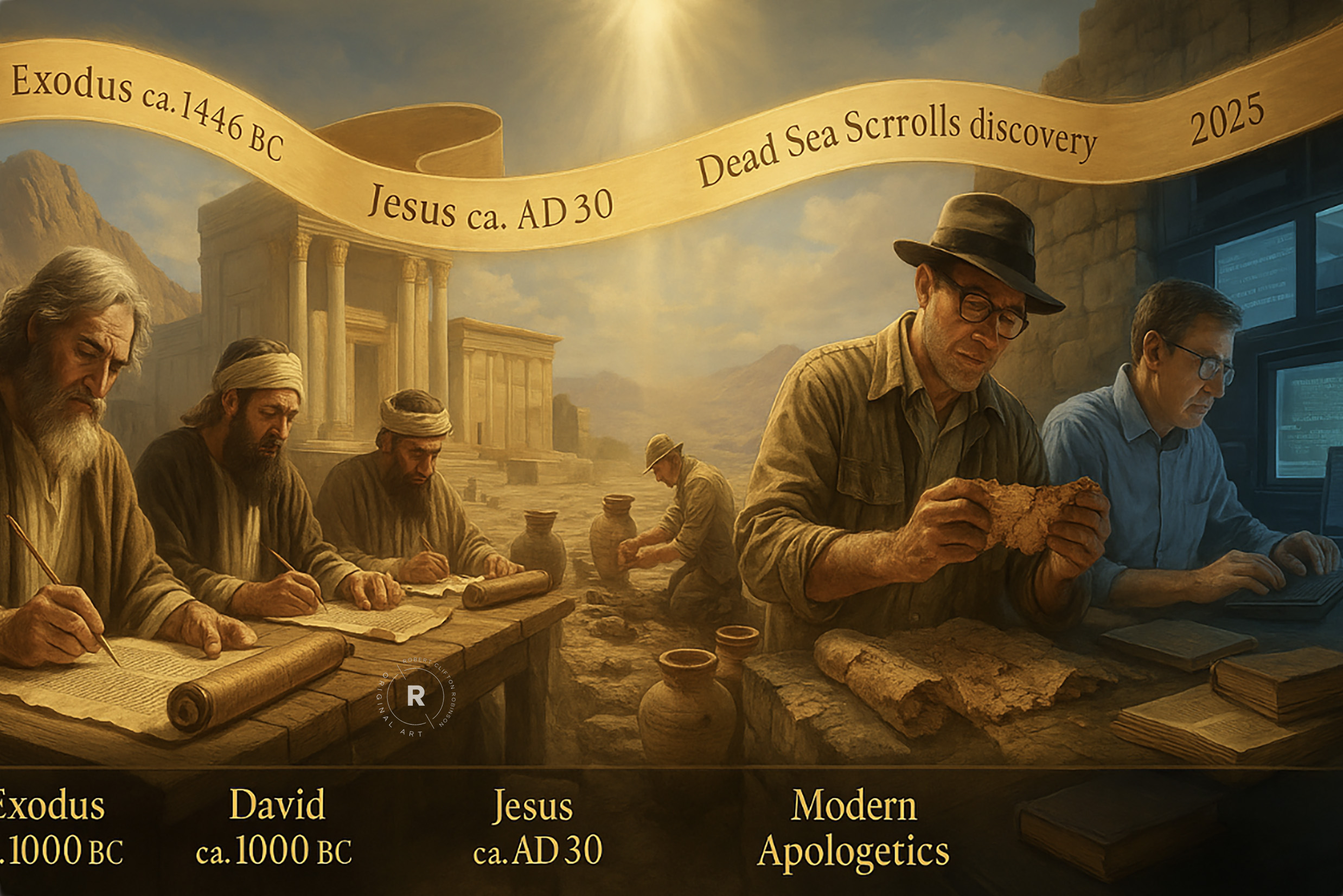
In my own scholarship that expands over 50 years of careful study, writing, teaching and publishing 45 books and over 3,400 essay on the Bible, I have never found anything in the Bible that has been proven untrue, erroneous, or contradictory. This fact has been foundational for me, coming from atheism and becoming a believer in the Bible because of the evidence that proves it is true.
If I Had Found Anything That Was Not True In The Past 50 Years, I Would Still Be An Atheist
But what of other scholars, critics, skeptics, and students of the Bible? Has anyone every found anything in the Bible that has been proven untrue, by evidence?
Has Anything Been Proven False in the Bible?
Short answer: No.
Despite thousands of challenges over centuries—from skeptics, atheists, and liberal theologians—no specific claim of the Bible has been universally proven false by verifiable, empirical evidence. Alleged errors often fall into one of three categories:
- Not understanding ancient context
- Alleged contradictions due to incomplete information
- Philosophical objections, not factual refutations
There Are Hundreds of Examples of Alleged Errors, Discrepancies and Contradictions That Critics Allege
Critics often point to Luke 2:2, which says that “this was the first registration taken when Quirinius was governor of Syria.” Pundits claim a contradiction exists in this text because, they say, Quirinius’ known governorship was around AD 6, while Jesus’ birth was before 4 BC.
More recent scholarship (and archaeological discoveries like the Lapis Tiburtinus) indicates that Quirinius had an earlier administrative role or dual appointment—resolving the alleged contradiction. This is an example of an apparent error being refuted by historical facts.
- Impeaching A Primary Atheist Argument: Contradictions In The Bible
- Is The Bible Filled With Contradictions?
The Assertion That There Are Contradictions in the Bible
No contradiction in the Bible has been conclusively proven when context, genre, authorship, manuscript variants, and idiomatic expression are properly considered. I have answered hundreds of these alleged contradictions in thousands of debates over the past 50 years. In a majority of these cases the critic simply did not understand the text, or failed to understand that in the presence of multiple eyewitnesses, each witness remembers different details.
A Common Example:
Matthew 27:5 says Judas hanged himself.
Acts 1:18 says he fell headlong and his body burst open.
Critical Claim: There is a contradiction in the cause of death.
Resolution: Both are true. Judas hanged himself, and his body later fell and burst open. Both are complementary, not contradictory, details of the same event.
This is one of the easiest complaints to answer in that in all examples where contradictions are alleged, the critic fails to understand that multiple things can all be true at the same time. A genuine contradiction only occurs when the statements made cannot all happen at the same time.
Legal Scholar, Simon Greenleaf, Harvard law professor and expert in legal evidentiary standards, stated that apparent contradictions in eyewitness accounts are a mark of authenticity, not fraud. Genuine independent testimonies differ in detail but not in substance.
Proving There Are No Discrepancies In The New Testament
Proven Scientific or Historical Errors?
Critics claim the Bible is unscientific or mythological. What we find in the text is that the Bible recorded cosmological tenets before modern science knew they existed,
Published in 1450 BC: Time, Space, and Matter: Genesis 1: 1: “In the beginning, God created the heavens and the earth.” This is the first sentence of the first book in the Bible describing how the universe came into existence from nothing. The Hebrew word used for “created” is Bara, to make from non preexistent materials—to create from nothing. Notice that time, space, and matter are listed in the correct order that they first existed: “In the beginning (time), God created the heavens (space) and the earth (matter).
Published in 1000BC: The Universe Is Stretched Out: Psalms 104:2: “You, Lord, who cover yourself with light as with a garment, who stretch out the heavens like a curtain:” Also, Isaiah 40:22 says that God “stretches out the heavens like a curtain.” This reference to the universe expanding like a curtain is found 11 times in the Bible. How could man—three thousand years ago—know the specific process of our universe at its inception in expanding from one side to another, like a curtain?
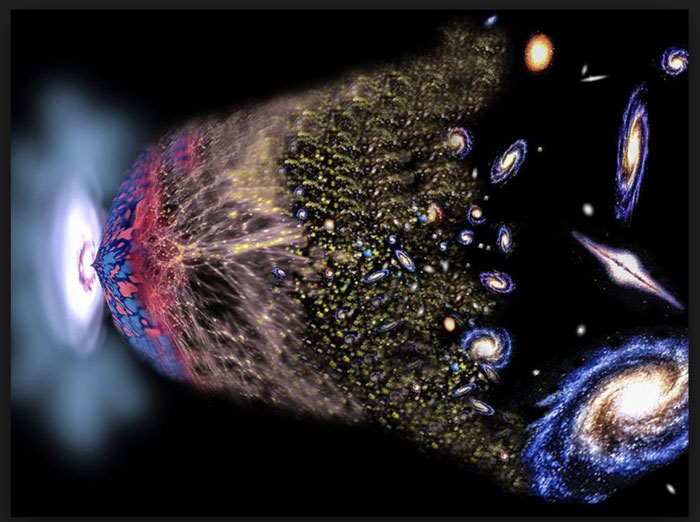
NASA Image of the Universe Expanding Like a Curtain (used by permission)
Published in 700 BC: The Earth Is Round: Isaiah 40:22 describes the “circle of the earth.” When the Earth is viewed from space, this is exactly what we see: a circle. Job 26:10, written over 4,000 years ago, also describes the earth as a circle. This text from Isaiah was given to him by God. Only God could see what the earth looked like from space 4,000 years ago. Man did not acquire the ability to see the Earth from space until 1959, when the Explorer 6 satellite captured the first photograph of Earth from orbit, taking a picture of the Pacific Ocean and its cloud cover while situated around 17,000 miles above the planet.
Published in 4000 BC: The Existence of Gravity: “The Earth Hangs In Space.” over 4,000 years ago, the book of Job, the oldest book in the Bible, accurately describes in Job 26:7, “He hangs the earth on nothing.” How could a man write thousands of years before Sir Isaac Newton (1642-1727) discovered gravity in 1665 at the age of 23, correctly describe the true nature of earth hanging in empty space by the force of gravity that was unseen?
Click On The Image To Look Inside
These are scientific statements about the universe that were not discovered until hundreds or thousands of years after man knew they existed. God told us these facts of science so that later we would know that He is the source of the Cosmos.
The Hittites were once thought fictional—until 19th-century archaeology uncovered an entire Hittite civilization, with over 10,000 tablets (Boghazkoy).
The Pool of Bethesda (John 5) and Pontius Pilate’s historical existence were once doubted until confirmed by archaeology (e.g., the Pilate Stone).
There is no proven historical error in the biblical text that hasn’t been resolved or affirmed by archaeology, textual analysis, or improved understanding of ancient Near Eastern culture.
- Scientific Evidence For God: A Fine-Tuned Universe
- Leading Atheists Admit That A Fine-Tuned Universe Is Evidence For God
- Evidence For Fine-Tuning Of The Universe: 209 Physical Constants That Make Life On Earth Possible
What About Doctrinal “Errors” or Moral Objections?
Critics often claim the Bible is in error on moral grounds (e.g., regarding slavery, war, judgment). When we study these subjects in the Bible, we find something completely different from what critics allege
The Biblical Facts Concerning Slavery
The instances where God gives instructions regarding slavery, are prophylactic, not legal. There are only three cases in which slavery is regulated by God, not instituted as a matter of Law.
- As prisoners of war, the Canaanites are placed into slavery as a method to control their evil.
- As Israelites living in poverty, God instructs fellow Israelites to allow these individuals to work as indentured servants for seven years.
- As Israelites living in debt, God instructs fellow Israelites to allow these individuals to work as indentured servants for seven years.
Slavery In The Bible: Exodus 21:1-11
The Lord’s Judgement For Keeping Slaves
God told the Israelites through the prophet Jeremiah, that they were to set free the slaves they took. When they refused He ordered judgement against those who took slaves. God hates slavery. Any insinuation that the God of the Bible approves of slavery is impeached by the texts of the Bible where God brings judgment to the people and nations who take slaves.
Jeremiah 34:8-17: “This message came to Jeremiah from the LORD after King Zedekiah made a covenant with the people, proclaiming freedom for the slaves. 9 He had ordered all the people to free their Hebrew slaves—both men and women. No one was to keep a fellow Judean in bondage. 10 The officials and all the people had obeyed the king’s command, 11 but later they changed their minds. They took back the men and women they had freed, forcing them to be slaves again.
12 So the LORD gave them this message through Jeremiah: 13 “This is what the LORD, the God of Israel, says: I made a covenant with your ancestors long ago when I rescued them from their slavery in Egypt. 14 I told them that every Hebrew slave must be freed after serving six years. But your ancestors paid no attention to me. 15 Recently you repented and did what was right, following my command. You freed your slaves and made a solemn covenant with me in the Temple that bears my name. 16 But now you have shrugged off your oath and defiled my name by taking back the men and women you had freed, forcing them to be slaves once again.
17 “Therefore, this is what the LORD says: Since you have not obeyed me by setting your countrymen free, I will set you free to be destroyed by war, disease, and famine. You will be an object of horror to all the nations of the earth.
THE FALSE COMPARISON: Mixed Fabrics vs. Moral Law
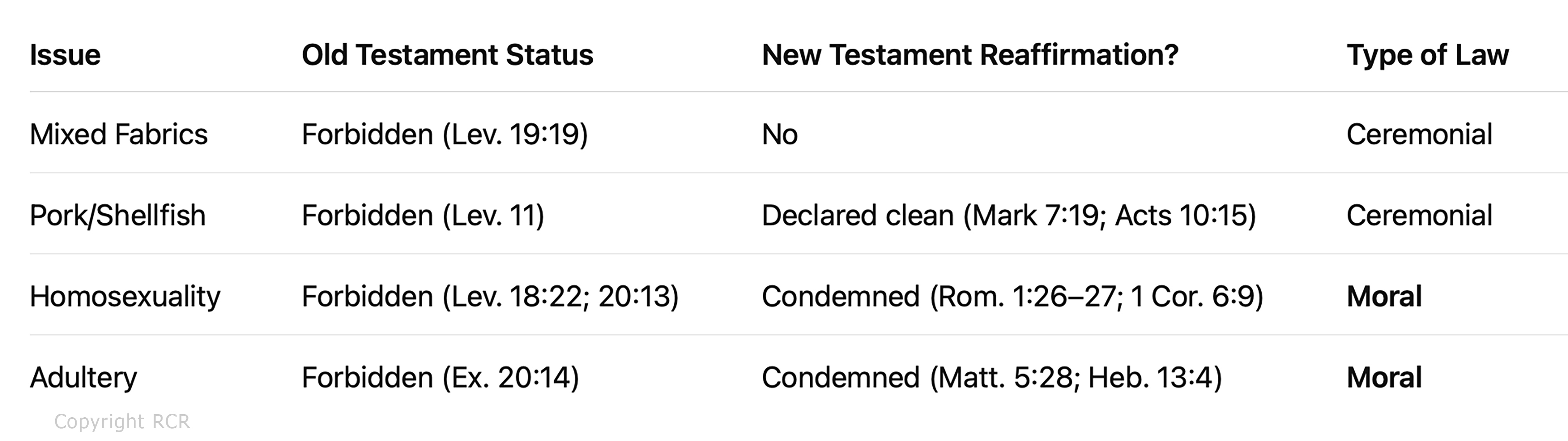
Progressive churches that dismiss Old Testament sexual ethics on the same grounds as dietary or clothing laws commit a category error.
- The ceremonial and civil laws were for Israel’s covenant identity and were fulfilled in Christ (Col. 2:16–17; Hebrews 10).
- The moral laws, especially concerning sexuality, reflect God’s unchanging character and are reaffirmed across the New Testament.
Biblical Consistency and Forensic Reliability
The Bible is unique among ancient texts in the following ways:
66 books by over 40 authors across 1,500 years with consistent theology and Messianic continuity
- Eyewitness testimony, especially in the Gospels and Acts (Luke 1:1–4; 2 Peter 1:16) There are 203 Eyewitness Statements in the New Testament
- Early manuscript evidence: 24,593 Extant New Testament Manuscripts, many from within 50-100 years of the original autographs. The Synoptic Gospels were completed by 44 AD
- Unmatched prophetic accuracy, especially in Messianic prophecies (e.g., Isaiah 53, Micah 5:2, Daniel 9:25). Jesus fulfilled the 400 Messianic Prophecies
- Scholars like Sir William Ramsay, a once-skeptical archaeologist, validated Luke as a “Historian of the First-Rank,” after testing his accuracy in Acts. The New Testament is a Valid Historical Narrative
- The Testimony about Jesus meets every legal standard for valid historical evidence. Legal Analysis Of The Four Gospels As Valid Eyewitness Testimony
Why No Error Has Ever Been Proven:

The position—that the Bible contains no proven errors, contradictions, or falsehoods—stands on solid, scholarly, evidentiary ground.
Every alleged discrepancy has either been resolved or remains open only in the absence of fuller information, not due to demonstrable falsity.
- 125 Biblical Laws That Are The Foundation Of Our Legal System
- Did All Species Evolve From One Common Ancestor? The Facts Of Science That Impeach Darwinian Evolution
- What Is The Difference Between Biblical New Testament Christianity And Man-Made Religions Of The World?
- AI, Artificial Intelligence, Says That The Biblical Jesus Is The Eternal God
No critic has ever presented irrefutable proof that any passage of the Bible is false. And across millennia, the text continues to vindicate itself in archaeology, manuscript evidence, prophecy, and historical coherence.
Categories: Robert Clifton Robinson
 Robert Clifton Robinson
Please see, "Guidelines For Debate," at the right-side menu. Post your comment or argument here: