The “Blasphemy of the Holy Spirit” — sometimes called “the unforgivable sin” — is a statement Jesus makes in the Synoptic Gospels where He warns that “every sin and blasphemy will be forgiven men, but the blasphemy against the Holy Spirit will not be forgiven” (Matthew 12:31–32; Mark 3:28–29; Luke 12:10).

Copyright, RCR
To understand what Jesus means by this text, we must look at the context, the meaning of blasphemy, and why this sin is unique.
Context of Jesus’ Statement
The Historical Moment
The Event: Jesus healed a man who was blind, mute, and demon-possessed (Matthew 12:22–24).
The Reaction of the Pharisees: Instead of acknowledging that this miracle was an act of God, they accused Jesus of performing it by the power of Satan: “This man casts out demons only by Beelzebul the ruler of the demons.” (Matt. 12:24)
Jesus’ Response: He explained that a kingdom divided against itself cannot stand — Satan would not cast out Satan. He said His miracles were done “by the Spirit of God” (v. 28).
Then He issued the solemn warning: “Whoever speaks a word against the Son of Man, it will be forgiven him; but whoever speaks against the Holy Spirit, it will not be forgiven him, either in this age or in the age to come.” (v. 32, NKJV)
The Key Detail
Jesus’ warning was not about an accidental or careless remark. It was directed toward persistent, willful rejection of the Spirit’s testimony about Him, to the point of attributing God’s work to Satan.
What “Blasphemy” Means in This Context
The Greek word blasphēmia (βλασφημία) means: to “slander, speech that injures another’s good name” “irreverent speech against God or sacred things”
In this case, the object of the blasphemy is the Holy Spirit. This means that to knowingly and willfully misrepresent the Spirit’s work as demonic, is blasphemy To reject the Spirit’s witness to Christ and our need to repent and fully trust in Jesus, is a decisive, final decision that excludes us permanently from eternal life.
By rejecting the only way that God has provided for all human beings to be saved from the penalty of our sins, we place ourselves outside the possibility of salvation. God does not exclude us, we keep ourselves out of heaven by refusing to trust in Jesus. God is ready to forgive any person who is truly sorry for their sins and ready to do something about it: stop their lifestyle of sin, and begin to live a new life seeking righteousness, because of our trust in what Jesus did for us.
Why This Sin Is Unforgivable
The Spirit’s Role in Salvation
According to Scripture: The Holy Spirit convicts the world of sin, righteousness, and judgment (John 16:8). He testifies to Jesus as the Messiah (John 15:26). He regenerates and draws people to saving faith (Titus 3:5–6).
If a person hardens their heart to the Spirit’s testimony — persistently rejecting Him and calling His work evil — they cut themselves off from the only means by which they can be brought to repentance. Again, this sin is not unforgivable because God is unwilling, but because the person becomes unwilling and unable to repent.
How does a person become unwilling? By continually refusing to repent and trust in Jesus. Each time we do this, we become progressively less able to change our mind and accept what Jesus has done for us. At some point, some people are not able to repent and turn to Jesus. When this happens it becomes impossible for them to be saved. A continual rejection of Jesus as the Holy Spirit speaks to our heart of our need for repentance, causes a progressive hardening of our heart. God wants to save all of us, but people become unable to be saved by their own hard hearts.
Clarification and a Few Common Misunderstandings
We do not cause ourselves to commit the unpardonable sin by a one-time slip of the tongue. A careless remark or a past doubt is not the unpardonable sin. This sin involves a deep, conscious, and ongoing hardness against God’s Spirit.
A Believer in Jesus who has repented of their sins and if fully following Jesus, cannot accidentally commit the unpardonable sin. If a person is worried that they have committed the unpardonable sin, that concern proves they haven’t committed this sin. A person who has genuinely committed the unpardonable sin, feels no conviction or desire for forgiveness.
If you try to be the friend of someone over and over and they continually reject you, eventually you no longer try. God is a person, we are created like Him. He tries many more times to reach us than we would try with another person. There is a point where the Holy Spirit has tried repeatedly to reach us and has been rejected, that He no longer tries to reach us. When this happens it become impossible for a person to be saved.
This Is The Blasphemy Of The Holy Spirit That Causes A Loss of Eternal Life
If someone speaks against Jesus in ignorance (as Paul did before his conversion; in 1 Timothy 1:13) this sin can be forgiven. But rejecting the Spirit’s witness to Jesus after a clear understanding is spiritually fatal. It doesn’t happen the first time, but each time someone hears about their need to repent and be saved and they reject Jesus, it become harder the next time. Eventually by a continual rejection of Jesus, a person develops a heart that is so hard it cannot repent, cannot be saved.
The Scriptural References:
- Matthew 12:31–32 – “Blasphemy against the Spirit will not be forgiven.”
- Mark 3:28–29 – “…is guilty of an eternal sin.”
- Luke 12:10 – “…will not be forgiven.”
- John 15:26; 16:8–11 – The Spirit’s role in testifying to Christ.
- Hebrews 6:4–6; 10:26–29 – Parallel warnings about final, willful rejection after knowing the truth.
The Blasphemy of the Holy Spirit is the deliberate, knowledgeable, and persistent rejection of the Holy Spirit’s testimony about Jesus Christ, or attributing His work to satan, thereby cutting us off from the only way God has provided for our salvation.
There is a substantial historical commentary by early Christian Church leaders who wrote about the blasphemy of the Holy Spirit:
Origen (c. 185–253 AD)
Source: Commentary on Matthew (Book 12, ch. 31)
View: Origen saw the blasphemy of the Holy Spirit as a permanent state of willful rejection of divine truth after one has been given clear light. He emphasized that attributing the works of the Spirit to an evil source (like the Pharisees did) was a sign of spiritual blindness beyond remedy.
Origen’s Primary Statement: He who having received the light of the divine Spirit still persists in the evil will, resisting the Spirit’s testimony, such a man sins unto death.”
Athanasius (c. 296–373 AD)
Source: Letters to Serapion (on the Holy Spirit)
View: Athanasius linked the sin directly to calling the Spirit’s witness to Christ demonic. He warned that this is not simply a doctrinal error, but a moral and spiritual rebellion.
Athanasius’ Primary Statement: For Athanasius, it was the willful hardening in the face of undeniable evidence, which prevents repentance and thus forgiveness.
John Chrysostom (c. 347–407 AD)
Source: Homilies on Matthew (Homily 41)
View: Chrysostom stressed the historical setting — the Pharisees had seen miracles of Jesus done by the Spirit and yet said it was the work of Satan. He taught that this sin was not about mere words, but about a settled disposition of heart:
Chrysostom’ Primary Statement: “It is not of words merely that He speaks, but of a purpose of the soul.”
Chrysostom also reassured believers that ordinary sins, doubts, or past ignorance do not qualify a person as committing the blasphemy of the Holy Spirit.
Augustine of Hippo (354–430 AD)
Sources: Sermon 71; City of God 21.24
View: Augustine saw this sin as final impenitence — the refusal to turn to God for forgiveness before death. While acknowledging the Pharisaic example, he broadened the application: The Holy Spirit is the One who forgives sins through Christ’s sacrifice. If someone rejects that forgiveness entirely, they commit the blasphemy.
Primary Statement:: “It is the impenitence itself which is the blasphemy against the Holy Spirit.”
Jerome (c. 347–420 AD)
Source: Commentary on Matthew 12:31
View: Jerome closely followed the Gospel’s context — the Pharisees resisting obvious truth. He emphasized that blasphemy here is knowingly and maliciously resisting the work of the Spirit, after full awareness of its divine origin. He connected it to Hebrews 6:4–6, where those who have “tasted of the heavenly gift” and still reject it cannot be renewed to repentance.
All of these early church leaders agree that blasphemy of the Holy Spirit Is:
- Deliberate and informed — done with full knowledge of what the person is doing.
- It is willful resistance — not accidental ignorance or impulsive speech.
- It shuts off repentance — the Spirit’s work is the only means of salvation; rejecting Him leaves no possibility of salvation.
- The Pharisees’ example is the historical example where they attributed Jesus Spirit-empowered miracles to satan.
Historical Agreement
The early church agreed that a person with a hardened heart and conscious rejection of the Holy Spirit’s testimony about Jesus, is blasphemy of the Holy Spirit. It is the primary work of the Holy Spirit to convict us of our sin, need for repentance, and the judgment that awaits us at the end of our life if we reject the salvation Jesus offered us.
A person who hears about what Jesus has done to save them; His death for their sins, and His command to repent from all sin, but rejects this witness, place themselves in an impossible situation. Rejecting the only way that God has provided for us to be saved, is the sin that God can never forgive.
In Hebrews chapter 6, we are presented with a person who has come close to salvation but never made a firm commitment. In this text this person is described as “making it impossible for them to be saved.”
The Context of Hebrews 6:
- The Audience: Jewish Christians under pressure to abandon their trust in Jesus and return to Judaism, to avoid persecution.
- The Danger of Refusing Jesus — after having understood and experienced the salvation He offers.
Hebrews 6:4-6 “For it is impossible to bring back to repentance those who were once enlightened—those who have experienced the good things of heaven and shared in the Holy Spirit, 5 who have tasted the goodness of the word of God and the power of the age to come—6 and who then turn away from God. It is impossible to bring such people back to repentance; by rejecting the Son of God, they themselves are nailing him to the cross once again and holding him up to public shame.
- Persons Who Were “Once enlightened” – Having received true spiritual illumination (John 1:9; Ephesians 1:18).
- Experienced the good things of heaven – Participation in the blessings of salvation in the body of Christ.
- Shared in the Holy Spirit – Not just exposure to His works, but active participation in His gifts and power.
- Tasted the goodness of the word of God – Direct experience of its transforming power.
- Tasted the powers of the age to come – Likely refers to the miraculous and eschatological signs of the Kingdom.
- Then turn away from God – The Greek (parapesontas, “falling away”) implies a decisive, willful departure from trust and salvation in Christ.
- The result: “It is impossible to bring such people back to repentance.”
The Language of Hebrews 6:4-6 describes people who received knowledge about Jesus, but never were saved. How do we know this is true? Jesus describes people who are genuinely saved as “always His.” This means that there can never be a time when they are not His. We will explore this fact of salvation in just a moment in John chapter 17.
The Connection of Hebrews 6 to the Blasphemy of the Holy Spirit
Copyright, RCR
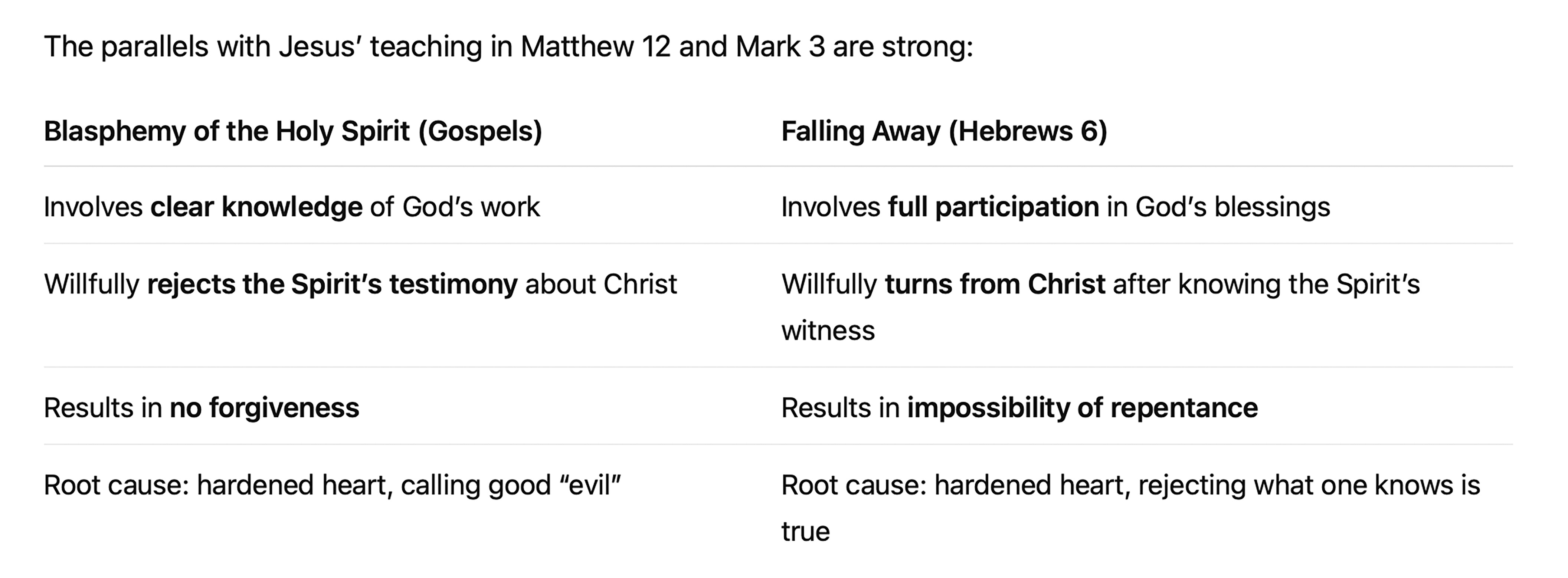
What is the difference between the Blasphemy of the Holy Spirit seen in the Gospels, and the Blasphemy of persons described in Hebrews 6?
In the Gospels: The sin of Blasphemy against the Holy Spirit is framed by the Pharisees as (1) attributing the work of the Holy Spirit Spirit to satan, (2) rejecting Jesus as our Savior from the penalty of sin.
In Hebrews 6: The sin of blasphemy against the Holy Spirit is framed as rejecting Jesus after coming into a full awareness of who Jesus is, what He has done, and what He requires for salvation.
In both of these examples, this rejection of the witness by the Holy Spirit, is a final, willful rejection of the Spirit’s testimony of Jesus, cutting removing any chance of salvation.
Why It Is “Impossible?”
The impossibility here is not because God is unwilling to forgive, but because the person who has heard all that is needed to make a decision for Jesus, has so fully rejected the Spirit’s witness that repentance is no longer possible.
This person has reached a hardness of their heart where they cannot repent. The imagery of “nailing Jesus to the cross again” reveals a total rejection of Jesus.
Notice the language of Hebrews 10:26–29: “If we deliberately continue sinning (by rejecting Jesus) after we have received knowledge of the truth, there is no longer any sacrifice that will cover these sins.”
What Jesus Said About The True Believer In John Chapter 17
Jesus said in His prayer to the Father in John 17:6 that “I have revealed you to the ones you gave me from this world. They were always yours.”
John 17:6 “Father I have revealed you to the ones you gave me from this world. They were always yours.”
Since those born again by the Spirit of God, as Jesus described in John 3:3 were “always His,” there can never be a time when they were not His.
Before God created the universe and placed man on earth, He knew who would believe in Jesus and continue to believe for all of their life. He knew these persons before they were created. God chose people for eternal life, based on this eternal knowledge of who would believe and continue to believe. God’s Sovereignty in choosing whomever He will save, originates in His knowledge of all things from eternity.
These are the persons that Jesus is speaking of to the Father in John 17:6: “They were always yours.”
The people described in Hebrews 6 had knowledge of who Jesus is. They “experienced the good things of heaven and shared in the Holy Spirit, tasted the goodness of the word of God and the power of the age to come, but then turn away from God.”
God knew those who would believe in Jesus and always believe in Him, before He created the universe, therefore… these persons who are “always his,” there can never be a time when they are not His.
This defines those in Hebrews 6 as close to salvation but not saved. The reason: if they were truly saved, they will always be saved (“always yours”).
In 1 John The Apostle defines people who claimed to belong to Jesus, but later leaving Him and the church, as never a part of Jesus.
1 John 2:19 “These people left our churches, but they never really belonged with us; otherwise they would have stayed with us. When they left, it proved that they did not belong with us.”
The argument could be made that these persons left the church but not Jesus. This is not possible in the context that John writes these words, because the church is the Body of Christ. People can leave a church but not leave Jesus, but people cannot leave the Body of Christ and still belong to Christ.
Romans 12:4-5 “Just as our bodies have many parts and each part has a special function, 5 so it is with Christ’s body. We are many parts of one body, and we all belong to each other.”
1 Corinthians 12:12 “The human body has many parts, but the many parts make up one whole body. So it is with the body of Christ.”
1 Corinthians 12:27 “All of you together are Christ’s body, and each of you is a part of it.”
In John 17:6 Jesus describes the people who are genuinely saved as never leaving Jesus (“they were always yours”) and John 3:3 (new birth) to the doctrine of God’s eternal foreknowledge of His elect (cf. Romans 8:29–30), concluding that Hebrews 6 cannot be describing truly regenerated believers, because true regeneration is an irreversible act in God’s eternal plan.
This view is a historically recognized interpretation of these texts:
The “Always Yours” Principle — John 17:6
Jesus says of the disciples: “They were always yours. You gave them to me.”
This is an eternal reality: those the Father has given the Son have always belonged to Him in God’s eternal decree (Ephesians 1:4 — “chosen in Him before the foundation of the world”).
If someone has truly been born again by the Spirit, that regeneration is a work of God’s will (John 1:13), not man’s, and is irreversible (Philippians. 1:6 — “He who began a good work in you will carry it on to completion”).
The Implication: If a person could lose salvation, then they were never part of that eternal “always yours” group in the first place.
1 John 2:19 — John’s Test
John describes people who left the fellowship: “They went out from us, but they were not really of us; for if they had been of us, they would have remained with us…”
The proof of true regeneration is perseverance in faith to the end. Apostasy, in this view, shows not a loss of salvation, but that salvation was never possessed in the first place.
Reading Hebrews 6 in Light of This
Hebrews 6:4–6 describing people who:
- Have been deeply involved in the life of the church.
- Have experienced the Spirit’s power (perhaps in gifts, fellowship, or miracles).
- Have been intellectually convinced of the truth.
- But have never been inwardly regenerated — they have not crossed from death to life (John 5:24).
An example of this is seen in Judas Iscariot. None of the other Apostles of Jesus knew that Judas had not been born again by the Holy Spirit. Jesus knew this and he allowed Judas to continue with Him till the very end. This illustrates for us the fact that Jesus will never give up on us even though He knows we are not saved—until the very end of our life.
The danger in Hebrews 6 is not that a true believer loses salvation, but that a person gets as close as possible without truly believing — and then decisively rejects Christ.
This rejection produces a hardness beyond remedy, like Pharaoh in Exodus.
The Key Word: “Shared in the Holy Spirit”
If we understand the term in Hebrews 6: “partakers of the Holy Spirit” (metochous genēthentas pneumatos hagiou) as association rather than indwelling, we can understand how close someone can come to genuine salvation, without actually being born again.
The Spirit can work in and through people without regenerating them (e.g., Saul in 1 Samuel 10:10–11; Judas Iscariot, who preached and healed but was never saved, John 6:70).
Why This Fits with the “Always His” View
People truly given by the Father to the Son (John 6:37, 39; John 17:6) will never be lost.
Hebrews 6 serves as a warning to the nearly converted — that proximity to salvation without faith is spiritually dangerous. The “impossible to renew” language reflects that once someone has had full exposure to the truth, rejected it, and hardened themselves, there’s nothing more God can reveal to bring them to repentance.
Experiencing the Spirit ≠ regeneration. People can be immersed in the Spirit’s work without being born again. Perseverance is the proof of salvation. True believers are “always His” and will be kept by His power (1 Peter 1:5).
Hebrews 6 is not describing people who were truly “born again” and lost salvation. It is describing people who had every possible advantage, yet never truly surrendered to Christ. Their final rejection of Christ is the clearest evidence they never belonged to Him in the eternal sense.
This Is The Blasphemy of the Holy Spirit: God Will Never Forgive This Sin
- The Mystery Of Salvation: Who Will Be Saved; Who Will Be Lost?
- The Fundamentals Of Salvation: Gods Responsibility; Our Responsibility
- We Must Have A Personal Relationship With Jesus And Make A Decision For Christ For Salvation
- The Supremacy Of Christ And The Present Possession Of Salvation For Every Believer
See All of Rob’s Published Books

Click Image To See All 45 of Rob’s Books
Sources and Citations:
Eternal Security of Those “Always His”
Key Scriptures:
- John 17:6 – “They were always yours. You gave them to me, and they have kept your word.”
- Ephesians 1:4–5 – “He chose us in Him before the foundation of the world… having predestined us to adoption as sons…”
- John 6:37, 39 – “All that the Father gives me will come to me… I shall lose none of all that he has given me.”
- Philippians 1:6 – “…He who began a good work in you will bring it to completion at the day of Jesus Christ.”
- 1 Peter 1:5 – “…who by God’s power are being guarded through faith for a salvation ready to be revealed in the last time.”
Scholarly Sources:
- Carson, D.A. The Gospel According to John. Pillar NT Commentary. Eerdmans, 1991, pp. 555–560. (On John 17:6 and eternal belonging to the Father.)
- Schreiner, Thomas R., and Ardel B. Caneday. The Race Set Before Us: A Biblical Theology of Perseverance and Assurance. IVP Academic, 2001, pp. 148–157.
- Grudem, Wayne. Systematic Theology. Zondervan, 1994, pp. 788–799 (on perseverance of the saints).
Leaving Jesus and Not Coming Back Reveals False Salvation
Key Scriptures:
- 1 John 2:19 – “They went out from us, but they were not of us; for if they had been of us, they would have continued with us…”
- Matthew 7:21–23 – “Not everyone who says to me, ‘Lord, Lord,’ will enter the kingdom of heaven… I never knew you.”
- Hebrews 3:14 – “We have come to share in Christ, if indeed we hold our original conviction firmly to the very end.”
Scholarly Sources:
- Stott, John R.W. The Letters of John. Tyndale NT Commentary. IVP Academic, 1988, pp. 106–107.
- MacArthur, John. The Gospel According to Jesus. Zondervan, 2008, pp. 158–165 (on false faith vs. true faith).
- Marshall, I. Howard. The Epistles of John. NICNT. Eerdmans, 1978, pp. 153–156.
Hebrews 6 as “Near to Salvation but Not Saved”
Key Scriptures:
- Hebrews 6:4–6 – Describes those who have been “enlightened,” “tasted,” “shared in the Holy Spirit,” yet fall away.
- Hebrews 10:26–29 – “If we deliberately keep on sinning after receiving the knowledge of the truth, no sacrifice for sins is left…”
- Numbers 14:22–23 – Israel saw God’s works and power, yet still perished in unbelief.
- John 12:37–40 – Those who saw His signs yet refused to believe.
Greek Word Study Sources:
- BDAG (Bauer, Danker, Arndt, Gingrich). A Greek-English Lexicon of the New Testament and Other Early Christian Literature. University of Chicago Press, 2000.
- metochos (“partaker, sharer”) — pp. 644–645.
- parapiptō (“fall away, commit apostasy”) — p. 765.
- Louw, Johannes P., and Eugene A. Nida. Greek-English Lexicon of the New Testament Based on Semantic Domains. United Bible Societies, 1989, Domain 34.53.
Commentaries:
- Lane, William L. Hebrews 1–8. Word Biblical Commentary, Vol. 47A. Thomas Nelson, 1991, pp. 141–153. (Argues these are professing Christians who never truly believed.)
- Bruce, F.F. The Epistle to the Hebrews. NICNT. Eerdmans, 1990, pp. 146–151.
- Guthrie, George H. Hebrews. NIV Application Commentary. Zondervan, 1998, pp. 219–226.
Experiencing the Spirit Without Salvation
Scriptural Examples:
- Saul – 1 Samuel 10:10–11; 16:14 (Spirit came upon him for service, later departed).
- Balaam – Numbers 22–24 (spoke God’s words, but was an enemy at heart; cf. 2 Peter 2:15).
- Judas Iscariot – Matthew 10:1–8 (given power to heal and cast out demons), yet John 6:70 — “one of you is a devil.”
- Matthew 7:22–23 – “Many will say… ‘Lord, Lord, did we not prophesy in your name…?’ And I will tell them plainly, ‘I never knew you.’”
Scholarly Sources:
- Owen, John. The Doctrine of the Saints’ Perseverance Explained and Confirmed. Banner of Truth, 2006 [1654], pp. 75–81.
- Pink, Arthur W. An Exposition of Hebrews. Baker Books, 2001, pp. 314–322.
- Calvin, John. Commentary on Hebrews. Baker, 2009 [1560], pp. 141–144.
Never Leaving Jesus as Proof of True Salvation
Key Scriptures:
- Matthew 24:13 – “He who stands firm to the end will be saved.”
- Colossians 1:22–23 – “…if indeed you continue in the faith, stable and steadfast.”
- 2 Timothy 2:12 – “If we endure, we will also reign with him; if we deny him, he also will deny us.”
Scholarly Sources:
- Piper, John. Finally Alive. Christian Focus, 2009, pp. 131–144.
- Schreiner, Thomas R. Run to Win the Prize: Perseverance in the New Testament. Crossway, 2010, pp. 89–97.
- Moo, Douglas J. The Letter of James. PNTC. Eerdmans, 2000, pp. 135–137 (on faith proved by endurance).
Categories: Robert Clifton Robinson
 Robert Clifton Robinson
As a former Jehovah’s Witness (an apostate in their eyes), I am grateful that the Holy Spirit has lead me to you, Pastor Rob, and to the truth about our Wonderful God. Each of the books shown above I own and have mostly read. You are a blessing to me and many others. My gratitude to the Lord and you can never be expressed truly in words.
This essay is comforting to me because as a former Jehovah’s Witness I denied the Deity of the Son and the Holy Spirit for 5 years. And then my sin of smoking, as the JWs see it, saw me disfellowshipped on April 1, 2000. It is funny how I remember that date. That date represents, to me, the day the Lord, through the Holy Spirit, sat me on the path to you and your books which have shown me the truth. And the Holy Spirit, that now indwells within me, has enlightened and taught me many wonderful things.
Even with that being said, I would wonder if my past remarks as a Jehovah’s Witness were somehow being held against me. Now. I know for certain that I have been forgiven all things through the Blood of Christ.
Thank you for this essay.
My prayers and God’s blessing will always fall on you.
The Beginning is Near!
LikeLiked by 1 person