Paul states in his letter to the Christians at Galatia that his gospel came to him personally from Jesus: Galatians 1:12: “I received my message from no human source, and no one taught me. Instead, I received it by direct revelation from Jesus Christ.” Direct revelation is the personal communication by God to an individual, telling them things that they would have no way of knowing.
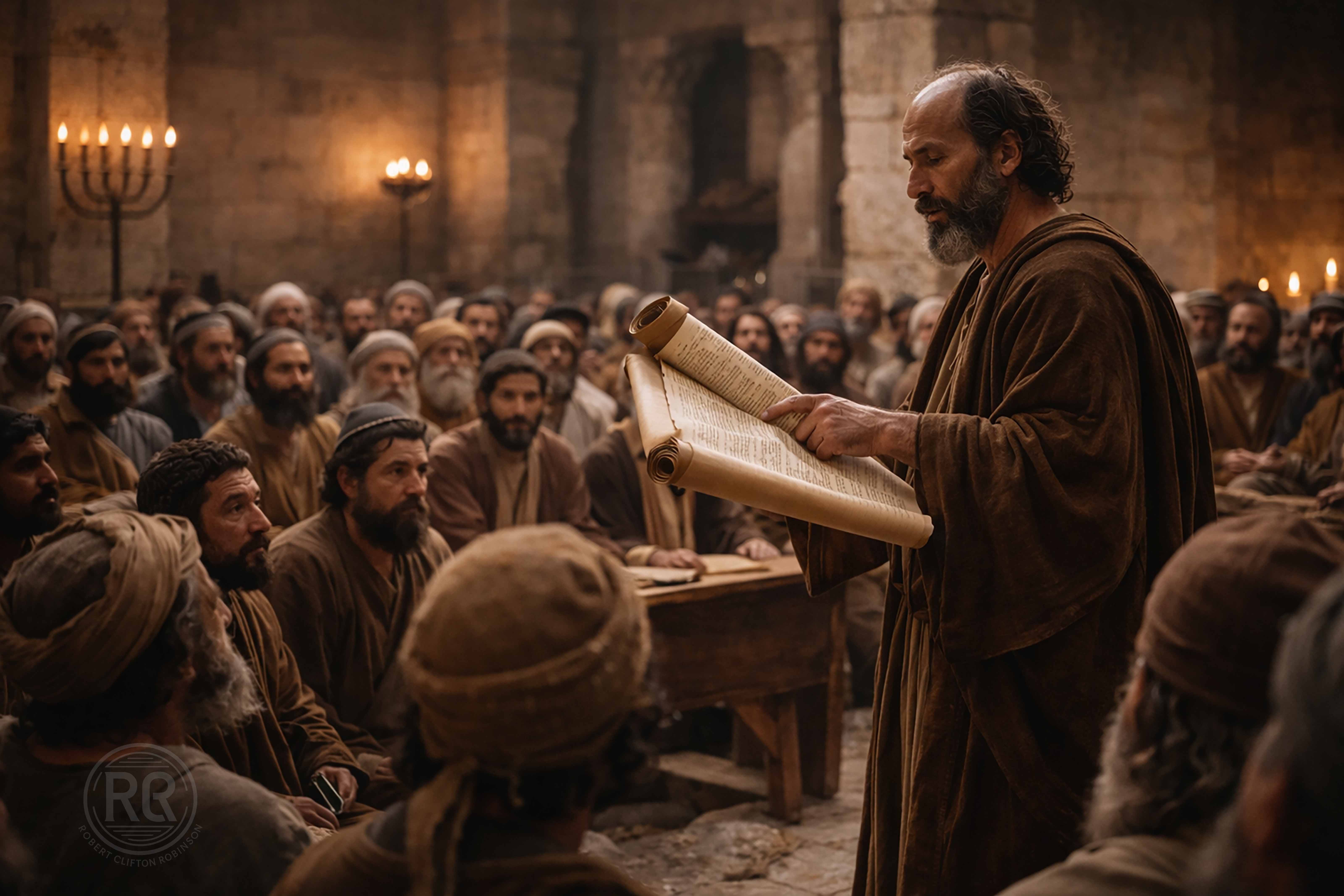
The Damascus Road was the beginning, not the completion, of Paul’s revelation from Jesus.
Acts 9:3-9 As Paul was approaching Damascus on this mission, a light from heaven suddenly shone down around him. 4 He fell to the ground and heard a voice saying to him, “Saul! Saul! Why are you persecuting me?” 5 “Who are you, lord?” Saul asked. And the voice replied, “I am Jesus, the one you are persecuting! 6 Now get up and go into the city, and you will be told what you must do.”
7 The men with Saul stood speechless, for they heard the sound of someone’s voice but saw no one! 8 Saul picked himself up off the ground, but when he opened his eyes, he was blind. So his companions led him by the hand to Damascus. 9 He remained there blind for three days and did not eat or drink.
One of the central questions regarding the authority of Paul is whether his teachings originated from human sources or from direct revelation given by Jesus Christ Himself. This issue is critically important because Paul authored fourteen New Testament letters that form a substantial portion of Christian doctrine.1 If Paul merely repeated ideas learned from other men, then his authority would rest entirely upon secondhand tradition. If, however, Paul truly received revelation directly from Jesus, then his writings carry God’s authority and must be regarded as inspired Scripture.
The testimony of the New Testament leaves no doubt on this issue. Paul repeatedly and clearly stated that the Gospel he preached came directly from Jesus Christ through direct revelation. He didn’t describe himself as a student of the apostles in Jerusalem who gradually developed theological ideas through discussion and debate. Instead, Paul consistently insisted that Christ Himself revealed truth to him personally.
Paul’s letter to the Galatians is our proof text for how, where, and why Jesus sent Paul with His Gospel to the Gentiles.
Galatians 1
11 “Dear brothers and sisters, I want you to understand that the gospel message I preach is not based on mere human reasoning. 12 I received my message from no human source, and no one taught me. Instead, I received it by direct revelation from Jesus Christ.”
In Galatians 1:11-12, we find that the authority Paul had to teach the Gospel of Christ came directly from Jesus, not from any human source. Jesus spoke to Paul by “direct revelation.” The Gospel, the details we find in Paul’s letters, and all the knowledge that Paul had of Jesus as the Messiah, predicted by 400 Messianic Prophecies from the Old Testament, and His fulfillment in the pages of the New Testament, were communicated to Paul directly from Jesus.
13 “You know what I was like before when I followed the Jewish religion—how I violently persecuted God’s church. I did my best to destroy it. 14 I was far ahead of my fellow Jews in my zeal for the traditions of my ancestors.”
Paul gives us his background as a former hater, persecutor, and destroyer of Christians before he met the risen Jesus and saw Him with his own eyes on the road to Damascus.2 This is literary forensic evidence that Paul’s testimony is true. There is no possibility that, as a Pharisee and member of the Sanhedrin, seeking the death of Christians, Paul would suddenly believe Jesus is the risen Messiah, unless he really did see Jesus alive after He was crucified.
15 “Before I was born, God chose me and called me by his marvelous grace. Then it pleased him 16 to reveal his Son to me so that I would proclaim the Good News about Jesus to the Gentiles.”
Here, Paul establishes his doctrine of God’s sovereignty in choosing people before they are born. He knew everything about us, choosing us based on His foreknowledge. Paul tells us that Jesus uniquely chose him for this work in telling the Gentiles the Good News of salvation that God was offering them.
“When this happened, I did not rush out to consult with any human being. 17 Nor did I go up to Jerusalem to consult with those who were apostles before I was. Instead, I went away into Arabia, and later I returned to the city of Damascus.”
The question of when Paul received this direct revelation from Jesus is stated by Paul in verses 16-17. “When this happened,” when Jesus revealed Himself to Paul on the road to Damascus, after He had risen from the dead, Paul didn’t go to the other Apostles. He went to Arabia, then back to Damascus. It was in Arabia that Paul was taught personally by Jesus and prepared for the ministry to the Gentiles that Jesus had planned.
18 “Then three years later, I went to Jerusalem to get to know Peter, and I stayed with him for fifteen days. 19 The only other apostle I met at that time was James, the Lord’s brother. 20 I declare before God that what I am writing to you is not a lie.”
After his first visit to Arabia, Paul returned to Jerusalem to meet Peter and James.
21 “After that, I went north into the provinces of Syria and Cilicia. 22 Still, the churches in Christ that are in Judea didn’t know me personally. 23 All they knew was that people were saying, ‘The one who used to persecute us is now preaching the very faith he tried to destroy!’ 24 And they praised God because of me.”
Then Paul went to Syria and Cilicia, which were important territories in the ancient Near East, stretching from modern-day southeastern Turkey and Syria. These two provinces were linked by geography and Roman administration. They functioned as a vital economic and cultural bridge between Anatolia and the eastern part of the Mediterranean (Levant).
Cilicia was an ancient region located on the southeastern coast of modern Turkey, bordered by the Taurus Mountains to the north and the Mediterranean Sea. The city of Tarsus, where Paul was born, was in Cilicia.
The Roman province of Syria was a vast and immensely wealthy territory lying to the east of the Mediterranean. It was one of the most strategic regions in the Roman and Byzantine Empires, serving as a heavily fortified eastern frontier and a lucrative hub for trade routes from the East.
Syria and Cilicia were highly significant regions where Paul taught the Gospel and established early Gentile churches.
Syria (Antioch): Antioch was the third-largest city in the Roman Empire and a major center for early Christianity. It was here that followers of Jesus were first called “Christians” and where a thriving, diverse community of Jewish and Gentile believers flourished. Paul spent years teaching the Gospel in this region alongside Barnabas.
Cilicia (Tarsus): As a Roman citizen from Tarsus, Paul spent considerable time (referred to as his “quiet years”) evangelizing his home region before his formal missionary journeys.
The Jerusalem Council Letter: The importance of the Gentile churches in these specific regions is highlighted in Acts 15:23, where early church leaders addressed an official letter specifically to the Gentile believers in “Antioch and Syria and Cilicia.”
Galatians 2
1 “Then fourteen years later, I went back to Jerusalem again, this time with Barnabas; and Titus came along, too. 2 I went there because God revealed to me that I should go. While I was there, I met privately with those considered to be leaders of the church and shared with them the message I had been preaching to the Gentiles. I wanted to make sure that we were in agreement, for fear that all my efforts had been wasted and I was running the race for nothing. 3 And they supported me and did not even demand that my companion Titus be circumcised, though he was a Gentile.”
According to Galatians 2:1, the term of Paul’s ministry to the region of Syria and Cilicia lasted 14 years. After these 14 years, Paul returned to Jerusalem with Barnabas and Titus, “because God revealed to me that I should go.”
It was in Jerusalem that Paul met with the leaders of the first-century church that Jesus established in Acts 2. Paul informed these men that Jesus had sent him to the Gentiles to teach the Gospel of Jesus Christ and offer them salvation. Paul says that the leaders of the church agreed that the Gentiles were also to receive salvation, and they supported Paul in his ministry.
Paul’s Claim of Direct Revelation From Jesus
Paul repeatedly states that the Gospel and doctrines he taught were given directly to him by Jesus Christ. One of the clearest statements is: “For I neither received it from man, nor was I taught it, but it came through the direct revelation of Jesus Christ” (Galatians 1:12).
This is an extraordinary claim. Paul insists that the central doctrines he preached did not originate from Peter, James, John, the Jerusalem church, rabbinical tradition, or human theological instruction. Instead, Paul says Jesus Himself revealed these truths directly to him.
The Arabian Period
The most mysterious part of Paul’s early years is his journey into “Arabia.” Many Bible Expositors believe this refers to the Nabataean Arabian region (Petra), east and south of Damascus, not the modern Arabian peninsula in general.
The New Testament doesn’t tell us exactly what happened there. But from Paul’s later writings, it is certain that this was a prolonged period of revelation directly from Jesus, meditation on the Old Testament Scriptures, direct instruction from Jesus to be taught in His church and to the Jews, and preparation for Paul’s ministry to the Gentiles.
In this sense, we can think of Arabia as Paul’s equivalent of Moses in Midian, Elijah in the wilderness, and Jesus’ forty days in the wilderness before public ministry. Whom God uses for great works of ministry, He prepares by great trials and difficulties. It is certain that, as a former Pharisee, now a Christian, Paul experienced tremendous persecution for teaching Jesus as the True Messiah.
Paul gives two time markers: Galatians 1:18 — “Then after three years I went up to Jerusalem…” Galatians 2:1 — “Then fourteen years after I went up again to Jerusalem with Barnabas…” This means Paul’s major public apostolic ministry to the Gentiles was preceded by about 17 years in total.
During this extended period, Paul was not being trained by the Jerusalem apostles. His point in Galatians is that the Gospel he preached came “not from man,” but “through the revelation of Jesus Christ” (Galatians 1:11-12). This would explain why Paul emerged with such great knowledge in applying the Old Testament Scriptures to all 400 of the Messianic Prophecies Jesus fulfilled in the New Testament.
Paul’s letter contains some of the deepest doctrinal revelations in the New Testament: justification by faith, union with Christ, the mystery of the Church, the indwelling Holy Spirit, the relationship between Law and Grace, the resurrection body, the Rapture, and the mystery that Gentiles would become fellow heirs with Israel in Christ. Paul specifically calls some of these truths “mysteries” previously hidden from earlier generations.
“By revelation there was made known to me the mystery” (Ephesians 3:3). And: “Behold, I tell you a mystery; we shall not all sleep, but we shall all be changed” (1 Corinthians 15:51). Paul believed that he had been entrusted with revelations not previously disclosed in Scripture with full clarity.
Did Jesus Reveal Things to Paul that Were Not Given to Others?
Yes, this is precisely what we find in our study of the New Testament. These new revelations are not in contradiction to the other apostles, but in expansion and clarification. It is important to understand that there is no new revelation given to the world after the Bible was completed. There is, however, greater revelation in serious Holy Spirit-led study of the Scriptures. People today who claim they have a new revelation from God are not telling the truth. The lesson from the New Testament is what Jude, the brother of Jesus, wrote: Jude 1:3: “Beloved, while I was very diligent to write to you concerning our common salvation, I found it necessary to write to you exhorting you to contend earnestly for the faith which was once for all delivered to the saints.”
God has once and for all delivered His truth to Jesus’ church in the completed 66 books of the Bible.
The original Twelve Apostles primarily knew Jesus during His earthly ministry, through His teachings in Israel, and through His death and resurrection. Paul was uniquely chosen to explain the biblical meaning of the cross, the nature of the Church as the Body of Christ, salvation by grace apart from works of the Law, the inclusion of Gentiles as equal heirs, and the prophetic truths concerning the Church age. This is why Paul could say: “For this reason I, Paul, the prisoner of Christ Jesus for the sake of you Gentiles—if indeed you have heard of the stewardship of God’s grace which was given to me for you” (Ephesians 3:1–2).
Although Paul likely began teaching about Jesus immediately after he met the risen Lord on the road to Damascus (Acts 9:20), he says that he “immediately” proclaimed Jesus in the synagogues. His larger apostolic ministry unfolded progressively over several years. So while Paul began speaking about Jesus almost immediately after he saw the risen Jesus, there appear to have been many years of revelation and teaching directly by Jesus and preparation before his major public apostolic ministry began.
Paul’s testimony is crucial because he was formerly a Pharisee, a persecutor of Christians, highly educated under Gamaliel, and exceedingly hostile to Jesus. Yet after encountering the risen Christ, he became the greatest defender and expositor of the Gospel. His insistence that he received direct revelation from Jesus is one of the foundations for understanding why his writings carry such doctrinal depth and authority in the New Testament.
The historical context surrounding this statement is important. Paul wrote Galatians to defend the authenticity of the Gospel against false teachers who claimed his authority was inferior to that of the original apostles. In response, Paul carefully explained that his message did not depend upon approval from men because it originated from Christ Himself. He then described the moment when he saw the risen Jesus with his own eyes and the immediate actions after encountering Jesus: “Immediately I conferred not with flesh and blood: Neither went I up to Jerusalem to them which were apostles before me.”3
Paul’s point is clear. When he saw Jesus risen from the dead after being brutally crucified, he didn’t rush to Jerusalem seeking instruction from the apostles. Instead, he withdrew for a period of time during which the Lord revealed Himself personally to Paul.
This revelation began with the appearance of Jesus on the road to Damascus. Before this event, Paul was a zealous Pharisee dedicated to destroying Christianity. He believed Jesus was a false Messiah and viewed Christians as dangerous enemies of Judaism.4 While traveling to Damascus to arrest believers, the great first-century historian, Luke, gives us the details of what happened to Paul:
Acts 9:3-6 As he was approaching Damascus on this mission (to arrest Christians), a light from heaven suddenly shone down around him. 4 He fell to the ground and heard a voice saying to him, “Saul! Saul! Why are you persecuting me?” 5 “Who are you, Lord?” Saul asked. And the voice replied, “I am Jesus, the one you are persecuting! 6 Now get up and go into the city, and you will be told what you must do.”
This was no vision, illusion, hallucination, or trance; it was a physical, visible appearance of Jesus to Paul after He had risen from the dead. There are eight places in the New Testament where Paul states that he saw Jesus; two additional places where Ananias and Barnabas state that Paul saw Jesus with his eyes.
“Am I not as free as anyone else? Am I not an apostle? Haven’t I seen Jesus our Lord with my own eyes?” 1 Corinthians 9:1.
- On the road to Damascus: Acts 9:3-6.
- Ananias said that Paul saw Jesus: Acts 9:17
- Barnabas said that Paul saw Jesus: Acts 9:27
- At Corinth: 1 Corinthians 15:8
- At Corinth: Acts 18:9-10
- At Jerusalem: Acts 22:6-10
- While praying at the Temple: Acts 22:12-21
- At the Roman barracks: Acts 23:11
- Before King Agrippa: Acts 26:12-18
In the tenth citation, we find Paul giving testimony to King Agrippa in his defense, stating that Jesus told Paul to tell people he had seen Him after He was raised from the dead:
Acts 26:12-16 “One day I was on a mission to Damascus, carrying with me the authority and commission of the leading priests. 13 About noon, Your Majesty, as I was on the road, a light from heaven brighter than the sun shone down on me and my companions. 14 We all fell down, and I heard a voice saying to me in Aramaic, ‘Saul, Saul, why are you persecuting me? It is useless for you to fight against my will.’ 15 ‘Who are you, lord?’ I asked. And the Lord replied, ‘I am Jesus, the one you are persecuting. 16 Now get to your feet! For I have appeared to you to appoint you as my servant and witness. Tell people that you have seen me, and tell them what I will show you in the future.’ ”
These ten citations will be important to us in our study of Romans because they lend authority to the testimony Paul gives us. Since Paul saw the risen Jesus and he received direct revelation of all that he is teaching us in the Book of Romans, we can have confidence in these texts.
Critics assert that Paul never saw the risen Jesus, but you can see for yourself in the texts of the New Testament that on ten occasions Paul is stated as seeing Jesus alive with his own eyes.
The depth of Paul’s biblical knowledge and understanding strongly supports the fact that he saw Jesus alive. His writings reveal extraordinary insight into subjects such as justification by faith, the relationship between Law and grace, the union of believers with Christ, the indwelling Holy Spirit, the resurrection, and the future restoration of Israel. Paul did not merely repeat what had been formerly stated in the Scriptures; he unpacked profound doctrinal truths that transformed the world. This is the reason that there are so many forceful attempts by critics to impugn Paul. It doesn’t work. We have the surviving manuscript evidence that proves what Paul said.
It is interesting that Paul understood that people in future generations, as well as those in the first century, would be resistant to Paul’s depth of teaching. We see this in his letter to the Ephesians:
Ephesians 3:3-5 “As I briefly wrote to you earlier, God himself revealed his mysterious plan to me. 4 As you read what I have written, you will understand my insight into this plan regarding Christ. 5 God did not reveal these mysteries to previous generations, but now by his Spirit he has revealed them to his holy apostles and prophets.”
An example of the knowledge Jesus gave to Paul that was not formerly understood is the fact of God’s eternal desire to unite Jews and Gentiles together into one Body of believers. Though the Old Testament prophecies anticipated blessing for the Gentiles, the full nature of this spiritual union had not been clearly revealed before Jesus taught them to Paul.
Paul also states that he received direct revelation regarding an important prophetic event, described by him in 1 Thessalonians Chapter 4. The Old Testament gives allusion to a future resurrection, but not the details that Paul published in this letter to a church that was in the midst of despair, wondering what happened to the deceased loved ones who believed in Jesus. Paul writes in chapter 4 that all those who have died believing in Jesus will be a part of the first resurrection, which Paul called “the harpazo” in the Koine Greek text, suddenly removed from the earth by Jesus with those who are still alive at the moment Jesus comes for us.
1 Thessalonians 4:13-18 “I do not want you to be ignorant, brethren, concerning those who have fallen asleep (died), lest you sorrow as others who have no hope. 14 For if we believe that Jesus died and rose again, even so God will bring with Him those who sleep in Jesus.
15 “For this we say to you by the word of the Lord, that we who are alive and remain until the coming of the Lord will by no means precede those who are asleep. 16 For the Lord Himself will descend from heaven with a shout, with the voice of an archangel, and with the trumpet of God. And the dead in Christ will rise first. 17 Then we who are alive and remain shall be caught up together with them in the clouds to meet the Lord in the air. And thus we shall always be with the Lord. 18 Therefore, comfort one another with these words.”
No one knew these events before Jesus revealed them to Paul, and he published them in his letter to the church at Thessalonica.
Paul also revealed details concerning the Lord’s Supper that were never known before.
1 Corinthians 11:23-26 “For I received from the Lord that which I also delivered to you: that the Lord Jesus on the same night in which He was betrayed took bread; 24 and when He had given thanks, He broke it and said, “Take, eat; this is My body which is broken for you; do this in remembrance of Me.” 25 In the same manner, He also took the cup after supper, saying, “This cup is the new covenant in My blood. This do, as often as you drink it, in remembrance of Me.” 26 For as often as you eat this bread and drink this cup, you proclaim the Lord’s death till He comes.”
This statement by Paul is remarkable because Paul was not present during the Last Supper before Jesus’ crucifixion. Yet he stated that he had “received” this teaching directly from the Lord.” Paul understood that Jesus Himself had revealed these truths to him.
The Book of Acts also records several occasions where Jesus communicated directly with Paul during his ministry. In Acts 18, the Lord appeared to Paul in a vision and encouraged him during opposition in Corinth:
First-century historian Luke records in Acts 18:9-11: “One night the Lord spoke to Paul in a vision and told him, ‘Don’t be afraid! Speak out! Don’t be silent! 10 For I am with you, and no one will attack and harm you, for many people in this city belong to me.’ 11 So Paul stayed there for the next year and a half, teaching the word of God.”
There is no possibility that Luke could have known these details unless Paul had told him. This confirms that Jesus spoke personally to Paul from the beginning.
Later, while Paul was imprisoned in Jerusalem, Luke in Acts 23 records another direct appearance from Jesus: Acts 23:11 “That night the Lord appeared to Paul and said, ‘Be encouraged, Paul. Just as you have been a witness to me here in Jerusalem, you must preach the Good News in Rome as well.’”
This is extant historical, eyewitness, manuscript evidence from the first century that there was a continual personal relationship between Jesus and Paul throughout his ministry.
Critics who seek to discount Paul’s knowledge of Jesus, or the fact that he received any direct knowledge from Jesus, haven’t studied the New Testament. As you can see, the texts are filled with evidence that Paul was told the things he recorded in the Book of Romans and all of his letters, directly by the risen Jesus.
Critical scholars often make claims that originate as their opinions rather than factual evidence-based literary forensic evidence, such as I have shown you here. They claim that Paul’s experiences were hallucinations and visions produced by emotion or religious imagination.
The surviving texts of the New Testament impeach these false claims. We have the historical texts that have remained through time and decay for nearly 2,000 years. They tell us that Paul was given direct revelation, then demonstrate these facts in the recorded texts of Paul’s letters.
The New Testament surviving manuscripts also prove that the original Apostles of Jesus accepted Paul and what he taught as directly from Jesus Himself:
Galatians 2:9 “In fact, James, Peter, and John, who were known as pillars of the church, recognized the gift God had given me, and they accepted Barnabas and me as their co-workers. They encouraged us to keep preaching to the Gentiles, while they continued their work with the Jews.”
The apostles recognized that Jesus Himself had commissioned Paul. This harmony between Paul and the original apostles is essential because it demonstrates continuity rather than contradiction. Paul didn’t invent a different Christianity. He proclaimed the same risen Christ revealed to the other apostles, while also receiving additional revelation concerning the full meaning and facts of the Gospel.
This evidence leads us to a clear conclusion. Paul believed that Jesus Christ directly revealed truth to him, and the New Testament consistently proves this claim. Paul’s authority rested not upon human tradition but upon direct revelation from the risen Jesus Himself.
For this reason, Paul wrote with certainty, confidence, and authority. He understood that he had been entrusted with revelation from Christ for the instruction of the Church and the proclamation of the Gospel to the world.
We can trust that what Paul wrote in the Book of Romans we are studying is accurate, reliable, truthful, and fully from Jesus Himself.
Hear and Excerpt From The AudioBook of Romans Chapter 8:
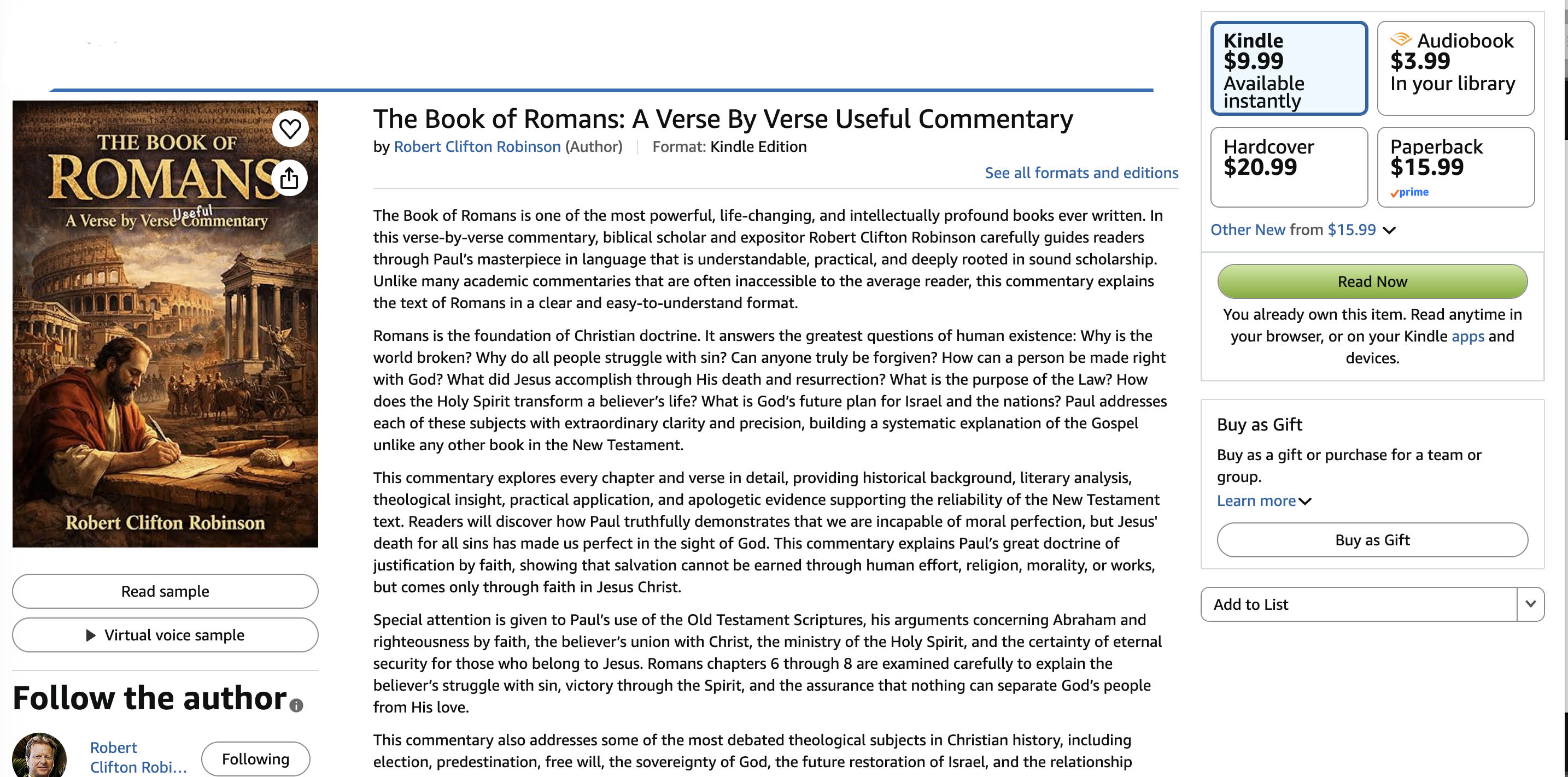
The Preceding Essay Is From Rob’s New Verse-by-Verse Commentary on the Book of Romans.
You can find it at the following link on his Amazon author’s Site:
Sources and Citations
1. Note: I believe that the text of Hebrews proves that Paul is the true writer. The style of Paul as a preeminent Hebrew scholar, with a vast knowledge of these ancient texts, is proven in the narratives of Hebrews. In all of Paul’s letters, he makes use of his vast knowledge of the Hebrew Scriptures and includes these texts in his letters as proof that what he is writing is true. In my opinion, only Paul was capable of the detailed scholarship we see in the narratives of Hebrews.
2. 1 Corinthians 9:1: “Am I not as free as anyone else? Am I not an apostle? Haven’t I seen Jesus our Lord with my own eyes?”
3. Galatians 1:16-17
4. Acts 8:1-3
Categories: Robert Clifton Robinson


Why did God create the world? The answer lies in understanding the meaning of the absolute first word of the Bible … bereshit.
Bereshit translates as “in the beginning”. But if you break the word apart, you get two words be and reshit. be is an inseparable preposition that is prefixed to nouns in Hebrew and has the meaning “in”, “with” or “by means of”. The word reshit has the meaning of “beginning”, “first” or “primary element” and is derive from the root word rosh which means “head” or “chief”.
So given this definition we can construct a new reading of Genesis 1:1 to read by means of the first God created the heavens and the earth. Reading it this way gives a different perspective than the time based version we typically read as In the beginning God created the heavens and the earth. We now have a reason WHY God created the heavens and the earth. God created the heavens and the earth by means of the first. But what does this mean? I have recently learnt that the Rabbis read this passage as On account of the Messiah, God created the heavens and the earth. Slightly different, but the reason has not changed, it just elevates WHO the FIRST (OR HEAD) is … the Messiah.
So the answer to our question, Why did God create the world? He created the world because He had the cure for sin – the sacrifice of His only begotten son. There is no justice for sin but death – Romans 6:23. But look at the back half of that verse – …, but the gift of God is eternal life in Christ Jesus our Lord”. What is this gift? There is way more to this story. Why was this cure available? A gift!
It said in Jewish custom, as I have recently learnt, that God the Father approached God the Son and said, “I will create this if you agree to go there, suffer and die to redeem it”. And the Son agreed to do this. We know this to be true because of Revelation 13:8. But there is so much more there that I am learning concerning this as I continue to unpack the layers of this onion (I say onion because if this doesn’t tear you up … nothing will).
Consider the response of the Son – “I will do it … send me”. This response has a two fold purpose: 1) to save all creation and 2) to glorify The Father. Giving His life did both of those things. However, if Jesus had chosen differently there would have been no creation; and thus, no glorification of the Father.
Consider John 15:13 which states: “Greater love has no one than this, to lay down one’s life for one’s friends.” This is how Jesus the Messiah saved all creation.
But that is only half the story.
The other half of the story comes from John 12:27-29 which states:
Giving His life gave us who believe life by giving us a cure for sin – His Blood and His Righteousness. Further, it glorified God in that God was able to create all these wonderful things in that God may be glorified through His creation – which He most certainly has.
But that does not tell the whole story – as I am beginning to understand. What I have written above does not completely explain the answer to the original question because we have yet to explore the greatest of all commandments which is found at Matthew 22:36-40 which states:
Now to the deepest part of my understanding – and I still do not think I have the whole picture. The greatest commandment was not a commandment that was originally given to us. It was a commandment exercised between the God the Father, God the Son and God the Holy Spirit throughout eternity and the Messiah was sharing Their success with us. This was how They treated each other. And now that we are in Their image this is how, by example, The Messiah is teaching us so that we remain in their image.
This is how they expect us to be with Them as well as with ourselves. And in doing so the question as to Why God created the heavens and the earth … simply answered is … LOVE of God and Neighbor. It was that commandment that brought the Heavens and Earth (this time properly spelt) into existence. No other thing or way was capable. It was simply the exercise of the Greatest Commandment EVER … IN ETERNITY.
The Book of Romans is a powerful illustration of God’s love for us through the hardships and sacrifices that Brother Rob endures to bring us the Words of the Holy Spirit. My brother … Rob … you are loved more than may you know. I know of the hate that you have endured. Satan wishes for your demise. But your Friend … The Holy Spirit … is clearly standing by you. There words … are LIFE … and they have come from You via the Holy Spirit. Blessed are you.
I shall now and forever … be your FRIEND. Thank you for all you do for us who are waiting on the Lord.
I will stand with you as a grateful spiritual leper now cleansed thanks to the Messiah (Luke 17:11-19).
I praise the Father, Son and Holy Spirit for that which you do for us. Because of your writings the Holy Spirit can bring this insight into that which was before Creation. Amen!
Thank you always.
LikeLike
This book is amazing. I have the Kindle version and I am about a hundred pages in and I can already tell this is a thought provoking work. So far I have had many eye opening moments. I recommend this book … thank you Holy Spirit and Brother Rob for this book.
LikeLiked by 1 person