The assertion that “everything written in the Bible is true” is frequently dismissed by critics as an example of circular reasoning. When we carefully examine the logical structure of this claim, the evidence reveals that this statement is without evidentiary support. The events described in the New Testament reside as the most thoroughly proven facts of all antiquity. These historical events are documented by multiple eyewitnesses as testified in the actual texts, and are inductive, evidential conclusions grounded in the same methods used in historical, legal, and scientific inquiry.
 Circular reasoning occurs when a conclusion is assumed within its own premises—when the claim being proved is simply restated as evidence for itself. For example, the statement “the Bible is true because the Bible says it is true” would indeed be circular, as it offers no independent basis for verification. However, the claim under consideration here is materially different. It consists of two propositions: first, that the Bible is true, and second, that no evidence exists demonstrating that anything within the New Testament is false. Crucially, the second statement does not depend upon the first; it is an evidential claim about the state of available data.¹
This distinction is essential. The argument does not assume the Bible’s truth in order to prove it. Instead, it asserts that extensive investigation across multiple disciplines, such as history, archaeology, textual criticism, and literary analysis, has failed to produce verifiable contradictions or falsifications. This form of reasoning is inductive, not deductive. It mirrors the way historians evaluate ancient documents, the way courts assess testimony, and the way scientists test hypotheses.²
An exact parallel may be seen in the evaluation of historical documents. When a historian concludes that a manuscript is authentic, the conclusion is not circular simply because it affirms authenticity. Rather, the judgment is based on the absence of evidence of forgery, the presence of corroborating details, internal consistency, and alignment with known historical facts.³ In the same way, the claim regarding the Bible’s truth is based on cumulative evidence: the lack of falsification, the coherence of its internal narratives, the preservation of its manuscripts, the corroboration of its historical details, and the fulfillment of its predictive elements.⁴
The logical structure of the argument may be stated as follows: after extensive and repeated examination, no verified evidence has been produced that contradicts the claims of Scripture; therefore, Scripture is reliable.
This is not a circular argument but an evidential inference. It does not begin with the assumption that the Bible is true; rather, it arrives at that conclusion through the absence of disconfirming evidence combined with the presence of supporting evidence.⁵
Critics often respond by claiming the maxim, “absence of evidence is not evidence.” While this statement has limited applicability in some contexts, it is not universally valid—particularly in historical and legal reasoning. The absence of expected evidence can indeed function as evidence when such evidence should exist if a claim were false.⁶ Courts routinely acquit defendants on the basis of insufficient evidence, and scientific theories are rejected when predicted falsifications fail to appear. In these fields, the absence of contrary evidence, especially after thorough investigation, is not meaningless; it carries probative weight.⁷
Applied to the Bible, this principle becomes significant. If the biblical texts were fundamentally unreliable, we would reasonably expect clear and irreconcilable historical contradictions, archaeological disconfirmations, demonstrably failed prophecies, or mutually exclusive eyewitness accounts. Yet the enduring record of scholarship shows that, despite intense and often hostile scrutiny over centuries, such decisive falsifications have not been established.⁸ While debates and interpretive challenges remain, as they do with any ancient corpus, the absence of definitive disproof, combined with substantial corroboration, proves the case for New Testament reliability.
At this point, the burden of proof shifts. Once a body of literature has been examined more rigorously than any comparable ancient work, such as the NT, and has withstood falsification, the responsibility falls to the critic to produce concrete evidence of error.⁹ This is a standard principle of rational inquiry: claims of falsity require demonstration. To demand proof of truth while offering no substantiated evidence of falsehood is not a neutral position but an asymmetrical one.
It is also important to recognize why the accusation of circular reasoning persists. In many cases, it arises from underlying philosophical assumptions rather than from a careful analysis of the argument itself. If a person begins with the presupposition that miracles are impossible or that supernatural revelation cannot occur, then any text containing such elements will be judged a false priori.¹⁰ This has been the procedure of atheist New Testament scholar Bart Ehrman. This stance, however, introduces its own form of circularity: miracles are deemed impossible because God is assumed not to exist, and God is assumed not to exist because miracles are deemed impossible. Such reasoning excludes evidence before it is considered.
For these reasons, the original claim, “everything written in the Bible is true,” is better understood as a falsifiability statement. It asserts that the Bible has been tested against multiple lines of inquiry and has not been disproven. This is precisely how knowledge advances in science, history, and law: hypotheses and claims are subjected to scrutiny, and those that withstand repeated attempts at falsification gain increasing credibility.¹¹ The longer a claim endures under such conditions, the stronger its evidential standing becomes.
Finally, the statement that the Bible is true because no evidence has demonstrated it to be false is not an example of circular reasoning. It is an inductive conclusion drawn from the cumulative weight of investigation that has produced massive evidence consistent with established methods of evaluating historical and evidential claims. Far from being logically flawed, it reflects a disciplined approach to truth—one that remains open to falsification, yet recognizes the significance of evidence that consistently confirms rather than contradicts.¹²
See Part 2: Falsification, Eyewitness Testimony, and the Reliability of the New Testament
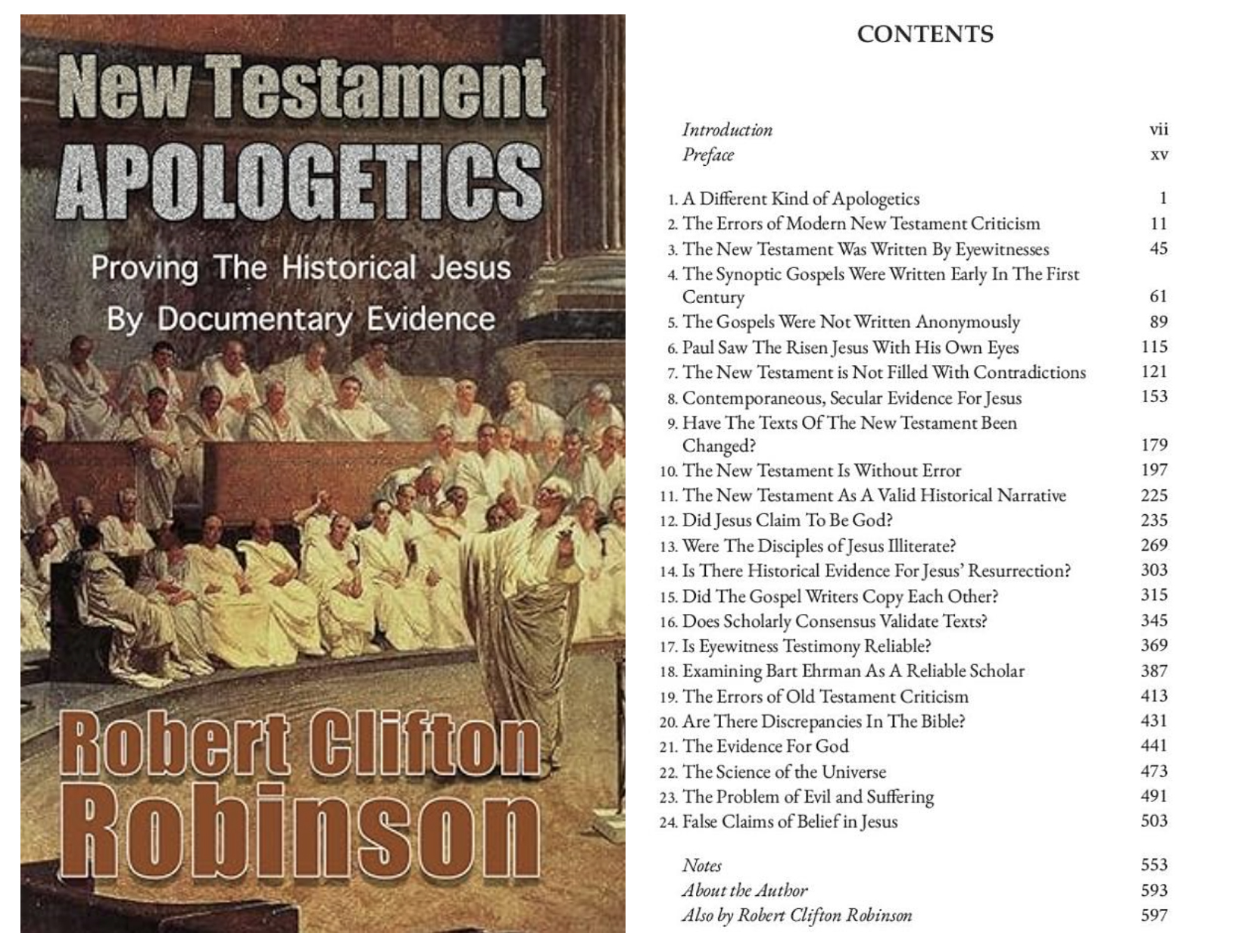
Sources and Citations:
¹ Aristotle, Prior Analytics, trans. A. J. Jenkinson (Oxford: Clarendon Press), on circular reasoning.
² C. Behan McCullagh, Justifying Historical Descriptions (Cambridge: Cambridge University Press, 1984).
³ Marc Bloch, The Historian’s Craft (Manchester: Manchester University Press, 1954).
⁴ F. F. Bruce, The New Testament Documents: Are They Reliable? (Grand Rapids: Eerdmans, 1981).
⁵ Richard Swinburne, The Existence of God (Oxford: Oxford University Press, 2004).
⁶ Carl G. Hempel, Philosophy of Natural Science (Englewood Cliffs: Prentice Hall, 1966).
⁷ Ronald J. Allen and Michael S. Pardo, “Relative Plausibility and Its Critics,” International Journal of Evidence & Proof.
⁸ William F. Albright, Archaeology and the Religion of Israel (Baltimore: Johns Hopkins Press).
⁹ Antony Flew, “Theology and Falsification,” University (1950).
¹⁰ David Hume, An Enquiry Concerning Human Understanding, Section X.
¹¹ Karl Popper, The Logic of Scientific Discovery (London: Routledge, 1959).
¹² Simon Greenleaf, The Testimony of the Evangelists (Boston: Little, Brown & Co., 1874).
Categories: Robert Clifton Robinson


Those that love their sin are happy within it and will say whatever they must to continue that love affair. For those of us that know we are sick and need a cure will never truly understand those that cannot see that they are sick too. Its like looking in a mirror, seeing the leprosy and just ignoring it. It is really sad. But this is what Satan desires the most … to kill as many of us as he can … through spiritual suicide.
Thank you Brother Rob for all you do.
LikeLike