The question of the New Testament’s reliability is not merely theological; it is fundamentally historical. Any serious evaluation must therefore proceed on the same grounds used in legal, historical, and scientific inquiry. One of the most rigorous tools available for such an evaluation is the principle of falsification: the identification of specific conditions which, if proven, would invalidate a claim.¹
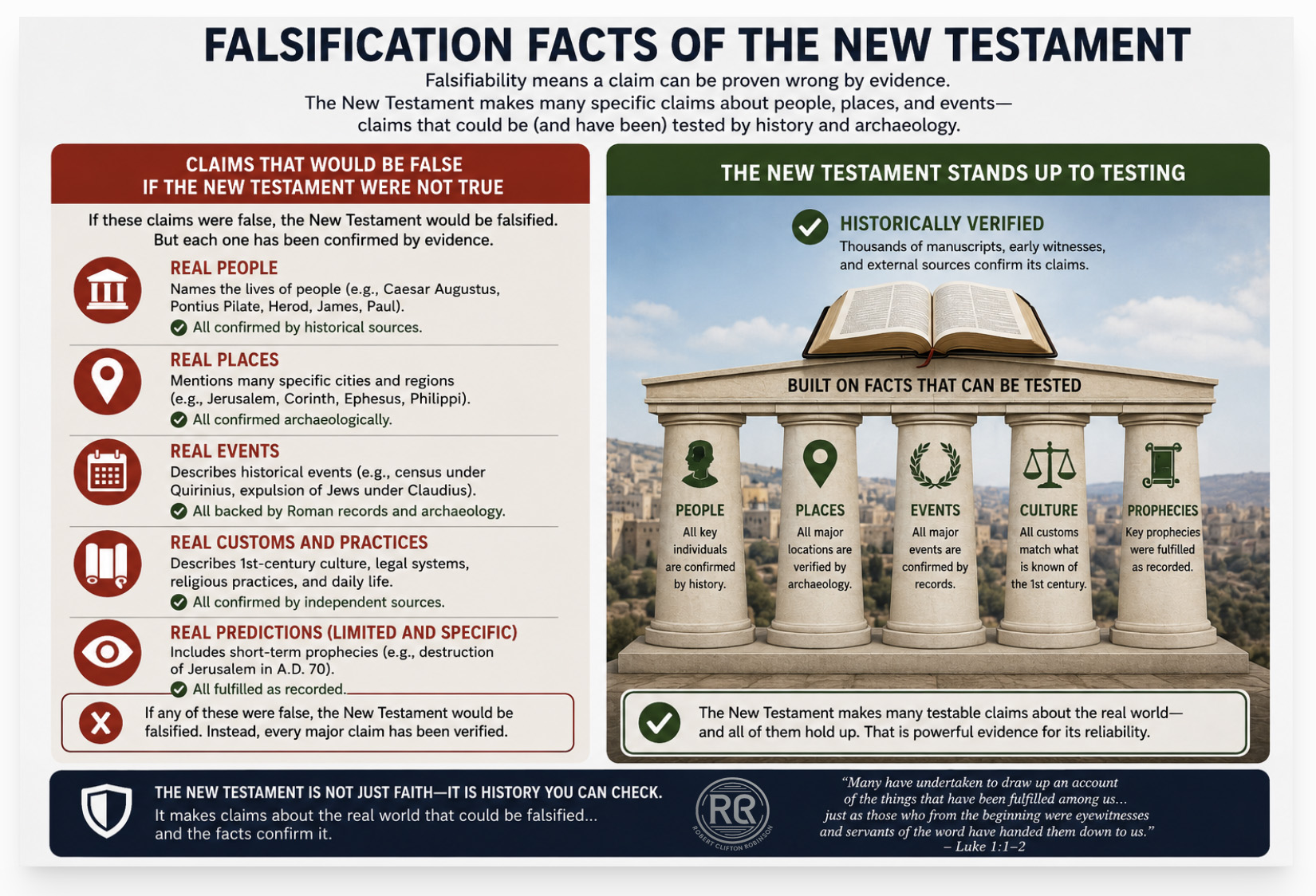
When applied to the New Testament, this falsification method asks a critical question: what kind of evidence, if discovered, would demonstrate that these writings in the New Testament are not reliable eyewitness testimony? The strength of the New Testament rests not in its immunity to testing, but in its openness to it. A claim that cannot be falsified is not historically meaningful; a claim that withstands falsification gains credibility.
Several major falsification claims have been proposed against the New Testament. If valid, they would decisively undermine its historical reliability. Yet when the actual claims of unreliability against the New Testament are examined against the internal evidence of Scripture itself, every assertion of inaccuracy, contradiction, late-date writing, and lack of eyewitness testimony fails.
The Claim of Irreconcilable Historical Contradictions
One of the most common assertions is that the New Testament contains contradictions in its core events, particularly in the accounts of the resurrection. If two accounts described the same event in logically irreconcilable ways, the reliability of the entire record would collapse.
However, the Gospel narratives consistently affirm the same central facts:
“He is not here: for he is risen, as he said.” (Matthew 28:6)²
“He is risen; he is not here.” (Mark 16:6)³
“He is not here, but is risen.” (Luke 24:6)⁴
These are not competing claims, but independent affirmations of a shared event. Differences in detail—such as the number of angels present or the sequence of appearances—reflect the natural variation expected in eyewitness testimony. Such variation strengthens, rather than weakens, historical credibility. Identical accounts would suggest collusion; complementary differences indicate independence.
No demonstrated contradiction exists that is both central and logically irreconcilable. Thus, this falsification claim fails.
The Claim of Late, Non-Eyewitness Authorship
A second major challenge asserts that the Gospels were written long after the events by individuals disconnected from eyewitnesses. If proven, this would severely weaken their authority.
Yet the New Testament explicitly grounds its accounts in eyewitness testimony:
- Paul: 1 Corinthians 9:1: “Am I not an apostle? Haven’t I seen Jesus our Lord with my own eyes?
- Peter: 1 Peter 1:16: “We saw his majestic splendor with our own eyes.”
- John: 1 John 1:1: “We saw him with our own eyes and touched him with our own hands.”
- James, Paul, all the Apostles: 1 Corinthians 15:7: “Then Jesus was seen alive by James and later by all the apostles. Last of all, as though I had been born at the wrong time, I also saw him.”
- Mary Magdalene: John 20:18: “Mary Magdalene found the disciples and told them, “I have seen the Lord!”
- Peter: Acts 5:29-32: “But Peter and the apostles replied… We are witnesses of these things…”
- John: 1 John 1:2-3: “This one who is life itself was revealed to us, and we have seen him. And now we testify and proclaim to you that he is the one who is eternal life. He was with the Father, and then he was revealed to us. We proclaim to you what we ourselves have actually seen and heard so that you may have fellowship with us.
The entire New Testament is a compilation of 27 letters that record 203 instances of eyewitness testimony in the 260 chapters of the New Testament. Not once in the entire record of antiquity is there any evidence that proves the writers were not eyewitnesses, and they wrote late in the first century.
Luke said that he interviewed all the eyewitnesses who had been with Jesus since the beginning of His public ministry.
Luke 1:1-4: “Many people have set out to write accounts about the events that have been fulfilled among us. 2 They used the eyewitness reports circulating among us from the early disciples. 3 Having carefully investigated everything from the beginning, I also have decided to write an accurate account for you, most honorable Theophilus, 4 so you can be certain of the truth of everything you were taught.
“Even as they delivered them unto us, which from the beginning were eyewitnesses…” (Luke 1:2)⁵
Luke further states that “many have taken in hand to set forth in order” these accounts (Luke 1:1), indicating the existence of multiple structured testimonies early on.⁶
The Apostles of Jesus made even more direct statements:
“We have not followed cunningly devised fables… but were eyewitnesses of his majesty.” (2 Peter 1:16)⁷
Paul’s own experience confirms this connection to primary witnesses:
Paul said: “Am I not as free as anyone else? Am I not an apostle? Haven’t I seen Jesus our Lord with my own eyes?” (1 Corinthians 9:1)
It is a frequent assertion by atheist New Testament scholars that Paul never saw the risen Jesus. This idea is particularly peculiar because the entire point of the New Testament is that eyewitnesses saw Jesus and they recorded a historical narrative about what they saw and heard. The argument that Paul never saw Jesus is even more spectacularly bizarre because there are ten citations in the New Testament that state Paul saw the risen Jesus.
There are eight places in the New Testament where Paul states that he saw Jesus; two additional places where Ananias and Barnabas state that Jesus appeared to Paul:
Paul’s statement (above): 1 Corinthians 9:1
- On the road to Damascus: Acts 9:3-6
- Ananias said that Paul saw Jesus: Acts 9:17
- Barnabas said that Paul saw Jesus: Acts 9:27
- At Corinth: 1 Corinthians 15:8
- At Corinth: Acts 18:9-10
- At Jerusalem: Acts 22:6-10
- While praying at the Temple: Acts 22:12-21
- At the Roman barracks: Acts 23:11
- Before King Agrippa: Acts 26:12-18
The personal visitation Paul had with Jesus in Acts 9, he later recounts in Acts 26:12-18 (above) as a part of his legal defense before King Agrippa. There is no ambiguity in what Paul recounts; Jesus personally appeared to Paul on the road to Damascus, and Paul saw Him with his own eyes.
As Paul recounts this event to King Agrippa, in Acts 26, he quotes the words that Jesus said to him at that time:
Acts 26:16: “Paul told Agrippa, Jesus said the following: “But rise and stand on your feet; for I have appeared to you for this purpose, to appoint you as my servant and witness. Tell people that you have seen me, and tell them what I will show you in the future.”
Jesus called Paul for the express purpose of being an eyewitness who saw the risen Jesus with his eyes and a minister to tell people about Jesus.
If Paul Did Not See The Risen Jesus, He Could Not Be An Apostle
Paul was accepted as a valid Apostle by the other 11 whom Jesus chose personally. If Paul had not seen the risen Jesus, he could not have been an Apostle, for this was the first and most important qualification of the 12 Apostles:
Acts 1:21-22: “So now we must choose a replacement for Judas from among the men who were with us the entire time we were traveling with the Lord Jesus—from the time he was baptized by John until the day he was taken from us. Whoever is chosen will join us as a witness of Jesus’ resurrection.”
Acts 4:33: “The apostles testified powerfully to the resurrection of the Lord Jesus.”
Jesus also told Paul that He would give him more knowledge in the future and a continuing revelation. Paul knew more about Jesus than any of the other Apostles. There are 18 mysteries Jesus gave to Paul that are described as previously hidden from the foundation of the world.1
18 Mysteries Revealed To Paul In The New Testament:
- The kingdom of heaven and the kingdom of God (Mt. 13:11; Mk. 4:11; Lk. 8:10)
- Israel’s blindness (Rom. 11:25)
- Salvation in Christ (Rom. 16:25)
- The wisdom of God (1Cor. 2:7)
- The doctrines of God (1Cor. 4:1; Col. 2:2; 1Tim. 3:16)
- The gospel (Eph. 6:19)
- Gift of knowledge (1Cor. 13:2)
- Speaking in tongues (1Cor. 14:2)
- The rapture of the church (1Cor. 15:23,51-58 Jn. 14:1-3 1Th. 4:13-16)
- God’s will (Eph. 1:9)
- The church (Eph. 3:1-9; 5:32)
- Christ in people (Col. 1:26-27)
- Doctrines of Christ (Col. 4:3)
- Spirit of lawlessness (2Th. 2:7)
- Faith of the gospel (1Tim. 3:9)
- Seven candlesticks (Rev. 1:20)
- God’s delay in casting out of Satan (Rev. 10:7; 12:7-17)
- Mystery Babylon (Rev. 17:5,7)
Paul states in his letter to the Christians at Galatia that his gospel came to him personally from Jesus: Galatians 1:12: “I received my message from no human source, and no one taught me. Instead, I received it by direct revelation from Jesus Christ.” Direct revelation is the personal communication by God to an individual, telling them things that they would have no way of knowing.
“Then after three years I went up to Jerusalem to see Peter… But other of the apostles saw I none, save James the Lord’s brother.” (Galatians 1:18–19)⁸
This establishes early, direct contact between Paul and the foundational eyewitnesses of the Christian proclamation.
The depth of Paul’s biblical knowledge and understanding strongly supports the fact that he saw Jesus alive. His writings reveal extraordinary insight into subjects such as justification by faith, the relationship between Law and grace, the union of believers with Christ, the indwelling Holy Spirit, the resurrection, and the future restoration of Israel. Paul did not merely repeat what had been formerly stated in the Scriptures; he unpacked profound doctrinal truths that transformed the world. This is the reason that there are so many forceful attempts by critics to impugn Paul. It doesn’t work. We have the surviving manuscript evidence that proves what Paul said.
To sustain the falsification claim, one would need evidence that the Gospel writers lived generations later with no access to such witnesses. Instead, the New Testament itself repeatedly affirms the opposite. The claim, therefore, collapses under its own evidentiary requirements.
Jesus rose from the dead in 32 AD, and by 44 AD, Paul was describing the written testimony about Jesus in the form of “Gospels” to people in Asia.
It was impossible for Paul to prove that Jesus was the fulfillment of the Old Testament prophets without the written testimony of the men who had seen Him fulfill these prophecies as He was crucified and risen from the dead.
We see many places in the text of the New Testament where this written testimony is referenced. In the third chapter of this book, there is an extensive and detailed timeline that accurately describes each of the important events that took place early in the first century. This timeline places the completion of the Synoptic Gospels at 44 AD, the year before Paul departed on his first missionary journey through Asia.
There is forensic evidence that these were honest men who were radically changed by their new relationship with Jesus and considered their honesty in accurately describing what Jesus had said and done their highest priority. For this reason, the Gospel accounts of Jesus are considered today reliable and credible accounts of the actual events that took place in the life and ministry of Jesus of Nazareth.[A]
The disciples of Jesus had committed to their memory each of the important events that occurred during His brief three-and-one-half-year ministry, rehearsing these events over and over, retelling them to groups of people who would also memorize the events, and teach others. The evidence that the early church considered these written testimonies by the men who saw and heard Jesus, as scripture—equal to the Old Testament scriptures—is proven in the text of the New Testament:
1 Thessalonians 2:13: “Therefore, we never stop thanking God that when you received his message from us, you didn’t think of our words as mere human ideas. You accepted what we said as the very word of God—which, of course, it is. And this word continues to work in you who believe.”
The New Testament Bears Evidence Of Early Writing
It is very easy to confirm that the Synoptic Gospels were completed by 44 AD. We can accomplish this by the internal evidence found in the Gospels and through the records of secular history.[B]
When we follow the timeline that is given to us in the New Testament and compare this with the timeline of secular history as found in the Roman and Jewish records, we discover that the writing of the Gospels began immediately after Jesus’ crucifixion and resurrection and was completed before Paul began his first missionary journey into Asia, carrying these Gospels with him.
Paul wrote his letter to the Galatians in 49 AD. In this letter, Paul describes a conversation he had with Peter and James 14 years before, in 35 AD. Paul penned the text in Galatians just before he appeared before Festus in 49 AD.
After Paul had completed his first eighteen-month missionary journey through Asia Minor, he received a report that the believers at Galatia were struggling due to false teachings that had crept into their church. Some of the Judaizers had tried to convince the Christians of Galatia that in addition to trusting in Jesus, they must also keep the laws of Moses. In response to this difficulty, Paul wrote to confirm his former words—that no Christian must keep the laws of Moses to be saved.
This issue continued to be a problem amongst the new Christian churches that precipitated the meeting with the Jerusalem Council, also in 49 AD, which is seen in Acts 15:1-30. During this meeting of the early church leaders, it was determined that only three laws would be imposed upon new Christians: Acts 15:20: (1.) abstain from things polluted by idols, (2.) from sexual immorality, (3.) from things strangled, and from blood.[C]
Once again, we are learning the correct dates for the events of the New Testament and eventually, the time of writing for the synoptic Gospels, starting with the coinage of Festus and the statement of Paul in Galatians 2.[D.E] These verified events allow us to forensically determine additional accurate dates for many other events in the New Testament.
The Claim of Textual Corruption Beyond Recovery
Another proposed falsification asserts that the New Testament text has been so altered over time that its original message cannot be reconstructed.
Yet the New Testament describes a model of transmission designed for preservation:
“And the things that thou hast heard of me among many witnesses, the same commit thou to faithful men…” (2 Timothy 2:2)⁹
This indicates a multi-generational, distributed system of transmission—precisely the kind that resists corruption. The theological confidence in preservation is also expressed:
“But the word of the Lord endureth for ever.” (1 Peter 1:25)¹⁰
For this falsification claim to succeed, one would need evidence of uncontrolled textual chaos and doctrinal instability. Instead, the manuscript tradition reflects remarkable consistency, and the core message remains intact. Thus, the claim fails.
The Claim of Archaeological Disconfirmation
A fourth challenge argues that archaeology contradicts the New Testament’s historical claims. If true, this would undermine its credibility.
Yet the New Testament anchors itself in verifiable history:
“In the fifteenth year of the reign of Tiberius Caesar, Pontius Pilate being governor of Judaea…” (Luke 3:1)¹¹
Similarly, Acts references identifiable historical figures:
“Sergius Paulus, a prudent man” (Acts 13:7)¹²
“Gallio was the deputy of Achaia” (Acts 18:12)¹³
For falsification to succeed, archaeology would need to demonstrate that such figures or locations never existed. Instead, discoveries have repeatedly confirmed the historical framework of the New Testament. Therefore, this claim also fails.
The Claim of Legendary Development (Myth Formation)
Finally, some argue that the New Testament reflects a gradual mythological evolution, with miraculous elements added over time.
Yet the earliest recorded proclamation already contains the full Gospel message:
“That Christ died for our sins… And that he was buried, and that he rose again the third day… And that he was seen of Cephas… of the twelve… After that, he was seen of above five hundred brethren at once…” (1 Corinthians 15:3–6)¹⁴
This is not a late embellishment but an early, structured summary of eyewitness testimony. There is no evidence of a non-miraculous “primitive” stage followed by later exaggeration. From the beginning, the message includes resurrection, appearances, and verification by living witnesses.
Peter explicitly rejects the idea of myth:
“We have not followed cunningly devised fables…” (2 Peter 1:16)⁷
Thus, the claim of legendary development fails because it lacks both textual and historical support.
The Central Role of Paul’s Mission as a Historical Test
The missionary activity of Paul provides a crucial real-world test of these claims. Beginning around AD 45, Paul proclaimed Jesus as the promised Messiah in regions far removed from Jerusalem.
His message was not mystical or subjective, but evidential:
“And Paul… reasoned with them out of the scriptures, opening and alleging, that Christ must needs have suffered, and risen again from the dead…” (Acts 17:2–3)¹⁵
He appealed directly to eyewitnesses:
“After that, he was seen of above five hundred brethren at once; of whom the greater part remain unto this present…” (1 Corinthians 15:6)¹⁶
Such arguments would have been immediately testable by his audiences. Without access to verifiable testimony, Paul’s message would have collapsed. Instead, it spread rapidly—because it rested on evidence that could be examined.
The Last Word
The falsification framework provides one of the most rigorous tests for the reliability of the New Testament. The claims that could, in principle, disprove it—contradictions, late authorship, textual corruption, archaeological failure, and mythological development—are all legitimate in form. But when examined against the evidence, each fails.
What emerges instead is a consistent and coherent historical picture: early, structured transmission of eyewitness testimony; direct connection to living witnesses; public proclamation grounded in verifiable events; and a message that has withstood sustained scrutiny.
The New Testament does not evade falsification—it invites it. And having been tested, it stands.
See Part 1: Is Proving The Bible by the Bible, Circular Reasoning?
Sources and Citations
¹ Karl Popper, The Logic of Scientific Discovery.
² Matthew 28:6 (KJV).
³ Mark 16:6 (KJV).
⁴ Luke 24:6 (KJV).
⁵ Luke 1:2 (KJV).
⁶ Luke 1:1 (KJV).
⁷ 2 Peter 1:16 (KJV).
⁸ Galatians 1:18–19 (KJV).
⁹ 2 Timothy 2:2 (KJV).
¹⁰ 1 Peter 1:25 (KJV).
¹¹ Luke 3:1 (KJV).
¹² Acts 13:7 (KJV).
¹³ Acts 18:12 (KJV).
¹⁴ 1 Corinthians 15:3–6 (KJV).
¹⁵ Acts 17:2–3 (KJV).
¹⁶ 1 Corinthians 15:6 (KJV).
[A] Gerhadsson, B. (1998). Memory and Manuscript: Oral Tradition and Written Transmission in Rabbinic Judaism and Early Christianity with Tradition and Transmission in Early Christianity Grand Rapids: Wm. B. Eerdmans Publishing Co.
[B] We know that the text of Luke was written before Acts, his second book. In Acts Luke details the missionary journeys of Paul in Asia Minor. In Acts 11:27 Luke writes: “During this time some prophets traveled from Jerusalem to Antioch. One of them named Agabus stood up in one of the meetings and predicted by the Spirit that a great famine was coming upon the entire Roman world.” (This was fulfilled during the reign of Claudius.) ~Acts 11:27-28
This reference to Roman Emperor Claudius allows us to date this verse from the book of Acts. Tiberius Claudius Caesar Augustus Germanicus was emperor from 41-54 A.D. Agabus said that this famine was fulfilled during the reign of Claudius. In the fourth century, Roman historian, Orosius, writes that this famine described by Agabus took place in 46 and 47 A.D. A translation from Orosius is found in the historical record written by King Alfred of England during the middle ages in the Anglo-Saxon Chronicle’. This Chronicle lists British history from 1 A.D. to 1154 A.D. and contains the following text: “A.D. 46. In this year, Claudius, the second Roman emperor to invade Britain, put much of the island under his control and added the Orkneys to Rome’s kingdom. This took place in the fourth year of his rule. In this same year, a great famine in Syria took place which Luke mentions in his book, ‘The Acts of the Apostles.’ Due to his incompetence, The Emperor Claudius Nero almost lost control of the British isle.”
Jewish historian, Josephus, also records in Antiquities 20 chapter 1.3-2.5: “Herod, the brother of Agrippa who had perished, was allowed to govern over Chalcis. He asked Claudius Caesar for control over the temple along with the sacred treasury, and the ability to choose the high priests, and he was given all that he had asked for.” Around this time lived queen Helena of Adiabene, along with her son Izates. They both began to follow the Jewish way, turning away from their past lifestyle . . . Her arrival was of great help to the masses in Jerusalem, for there was a famine in the land that overtook them and many people died of starvation.
Queen Helena sent some of her stewards to the city of Alexandria in order to purchase as much grain as possible. She sent others to the island of Cyprus to bring back dried figs. Helena’s efforts to save many people left a legacy in the historical record, that allows us to verify the date of this famine described by Luke in the Book of Acts.
Roman historian, Suetonius, also mentions this same famine in his writing, “Life of Claudius” Chapter 18: “There was a scarcity of food, which was the result of bad harvests that occurred during a span of several years.”
Roman historian, Tacitus, also writes in describing the famine, in his Annals, Chapter 11:4: “A vision that came to him at night was the reason charges were filed against the man. In this dream, he claimed to have seen Claudius crowned with a wreath made of wheat, the ears of which were folded downward. And from this vision, he predicted lean harvests to come.”
This presents us with a substantial secular and Biblical confirmation that the text of Acts, written by Luke, is not only accurate but confirmation that both Acts and Luke’s Gospel of Christ were written by 44 A.D.
[C] Acts 15:20
[D] In 59 A.D. Paul is before Porcius Festus, the Procurator of Judea while Paul is a prisoner at Caesarea. We know that Festus was here at this date because of coinage that has survived history, with the Provincial coinage of Judea attesting to Nero’s 5th year.(1. F.F. Bruce, New Testament History, 1983, pp. 345. 2. Antiquities, Book XX, Chr. 8, § 9 “Now when Porcius Festus was sent as successor to Felix by Nero, the principal of the Jewish inhabitants of Cesarea.” Josephus, Flavius. The Complete Works of Flavius Josephus: Josephus’s work, translated by William Whiston in 1737. Kindle Edition. 3. Yamazaki-Ransom, K., The Roman Empire in Luke’s Narrative, Continuum, 2010, p. 145 [26]F.F. Bruce, New Testament History, 1983, pp. 345.
This documents Porcius Festus in Judea at 58-59 A.D., with Paul before him. Josephus records this same event in Antiquities, Book XX, Chr. 8, § 9: “Now when Porcius Festus was sent as successor to Felix by Nero, the principal of the Jewish inhabitants of Cesarea.“(see references above)
Paul experienced his final hearing before Festus, in Acts 24:27. In Acts 25:12, Festus instructs Paul to go to Jerusalem in order to be tried. Paul states that he is a Roman citizen and requests that he be sent to Caesar for trial. Festus orders Paul to be taken to Rome for trial before Nero.
After a shipwreck and a three-month delay on Malta, Paul arrived in Rome about February, 60 A.D. (Acts 28:1-16). While in Rome, Paul meets with the Jews, in Acts 28:15-28.
Eusebius writes that Paul was beheaded by Nero early in 68 A.D.(Eusebius Ecclesiastical History 3.39.16).
This is verified by Eusebius, as he records the death of Nero on June 8, 68 A.D.(Bunson, Matthew (2009). Encyclopedia of the Roman Empire. Infobase Publishing. ISBN 978-1-4381-1027-1. Archived from the original on 2016-05-07. Retrieved 2015-12-27.)
Nero, unable to garner the courage to take his own life, requested that his secretary, Epaphroditos, should kill him.[E] These facts of the historical record allow us to understand other dates in the New Testament.
Categories: Robert Clifton Robinson


Please see, "Guidelines For Debate," at the right-side menu. Post your comment or argument here: