It is important to understand that the God of the Bible states clearly that He is no respecter of persons. This means that the One True Living God loves all people the same. When Jesus came into the world, He suffered and died for all people, for all time. When we examine the final book of the Bible, Revelation, we see in heaven at the conclusion of this present world, all colors, national origins, every race, creed, and type of person, standing in heaven before the throne of God.
“And they sang a new song, saying: “You (Jesus) are worthy to take the scroll, and to open its seals; for You were slain, and have redeemed us to God by Your blood out of every tribe and tongue and people and nation…” (Revelation 5:9)
God hates racism. Though Christians and Republicans are often cited as Racists, when we investigate the historical record, we find something very disturbing. The following is a well-researched essay on the facts of who committed the terrible atrocities of racism in American History: NOTE: this does not excuse or exclude racism in any political party or other organization. Racism in any form is always wrong, in the eyes of the One God, and it should always be wrong in America.
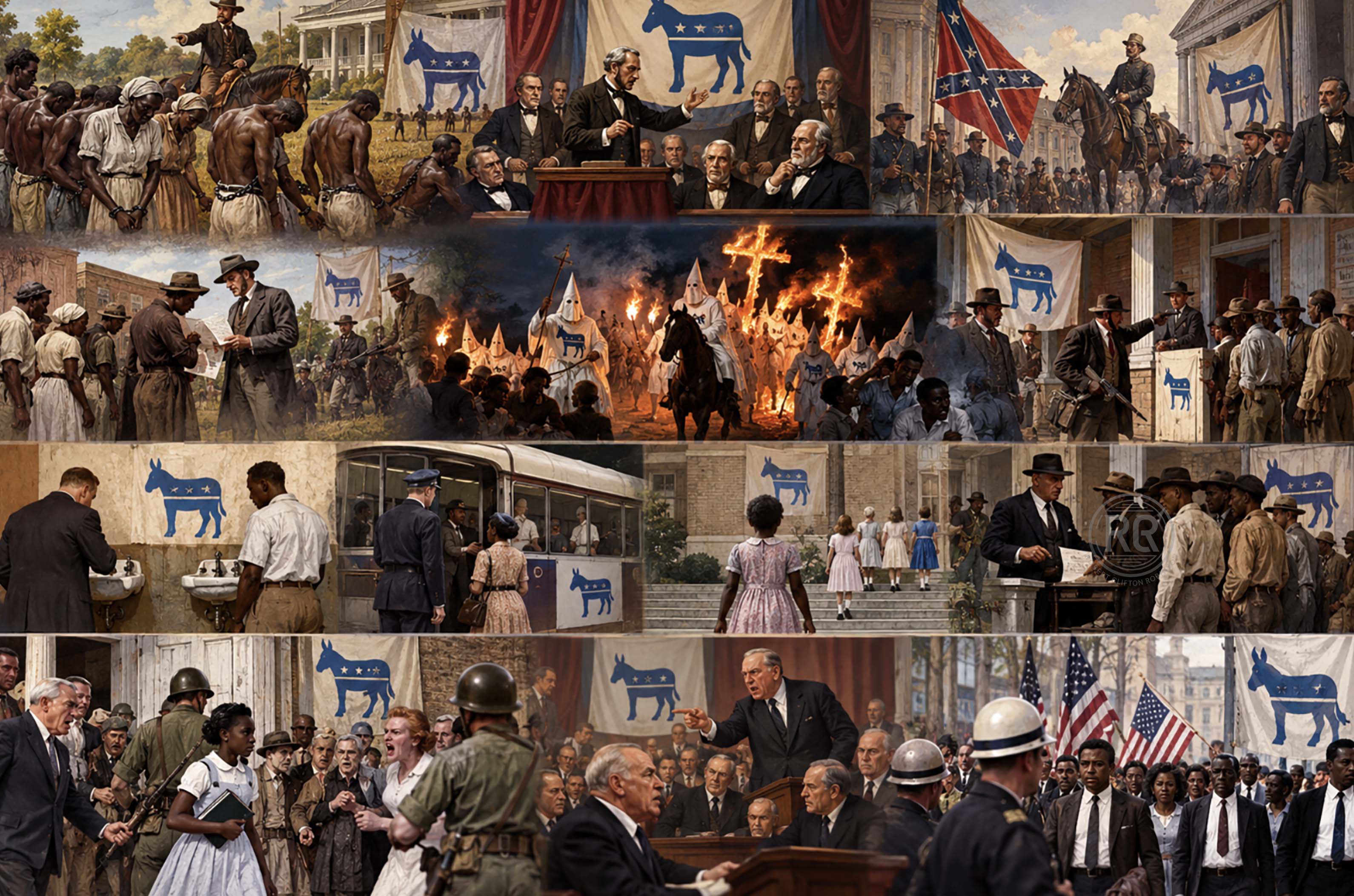
The Defense and expansion of slavery:
By the decades immediately preceding the Civil War, Democrats were the principal national political defenders of slavery and its expansion.
Opposition to abolition and Republican antislavery policies:
Pro-slavery Democrats resisted Republican efforts against slavery before and during the Civil War.
Secession and the Confederacy:
The political leadership of the seceding Southern states was overwhelmingly drawn from the Democratic political establishment.
Black Codes after the Civil War:
Democratic-controlled governments enacted laws restricting the freedom, employment, movement, and civil rights of newly freed African Americans.
The first Ku Klux Klan and Democratic politics:
The KKK was founded in Tennessee after the Civil War by former Confederates and developed into a terrorist organization attacking Black citizens and Republicans during Reconstruction.
An 1872 source preserved by the Library of Congress described the Klan as an “adjunct of the Democratic party” operating to achieve political results.
Violent suppression of Black Republican voters during Reconstruction:
Democratic political restoration was accompanied by intimidation and violence from the KKK and other white-supremacist organizations against Black voters and white Republicans.
The House historian states that Democrats “orchestrated a reign of terror” intended to disenfranchise Black voters and reverse Reconstruction.
Opposition to the Reconstruction civil-rights program:
Republicans enacted the Enforcement Acts of 1870–1871, including the Ku Klux Klan Act, to protect Black voting and constitutional rights against Klan terrorism.
Democratic legislators opposed important portions of this federal intervention, often on states’ rights and constitutional grounds.
The end of federal Reconstruction in the South:
Democrats pushed for the withdrawal of federal enforcement of Reconstruction.
The Library of Congress notes that during the disputed 1876 election, congressional Democrats demanded the removal of federal troops enforcing Reconstruction programs; after Reconstruction ended, Southern governments rapidly dismantled civil-rights protections.
Jim Crow segregation:
After regaining Southern state governments, Democratic political establishments enacted and maintained the Jim Crow system of legally enforced racial segregation.
Black voter disenfranchisement:
Democratic governments used poll taxes, literacy tests, registration requirements, white primaries, and other mechanisms to suppress Black voting.
The House historian describes the resulting legal and extralegal system as having “thoroughly disenfranchised African Americans” by the beginning of the twentieth century.
White-primary systems:
In much of the one-party Democratic South, Democratic primaries excluded Black voters. Because winning the Democratic primary frequently amounted to winning the election, exclusion from the primary effectively excluded Black citizens from meaningful electoral participation.
Resistance to federal anti-lynching legislation:
Democratic senators repeatedly used their institutional power to prevent federal anti-lynching legislation from becoming law during the first half of the twentieth century.
The “Solid South” segregationist political system:
For decades after Reconstruction, Democratic organizations dominated much of the former Confederacy and protected segregation and disenfranchisement.
Resistance to school desegregation after Brown v. Board of Education:
Many Southern Democratic politicians participated in “Massive Resistance” against federally mandated school integration during the 1950s and 1960s.
The Southern Manifesto (1956):
Democrat members of Congress issued the manifesto opposing the Supreme Court’s Brown decision. The signatories were overwhelmingly Democrats.
The filibuster against the Civil Rights Act of 1964:
The major Senate opposition came from the Democratic bloc. The Senate’s own history states that Democrats launched the filibuster and that Democratic leaders required substantial Republican assistance to break it. Cloture ultimately passed 71–29: 44 Democrats and 27 Republicans voted yes; 21 Democrats and 6 Republicans voted no.
Resistance to the Voting Rights Act of 1965:
Southern Democrat segregationists resisted the federal voting-rights legislation, although the measure ultimately received substantial bipartisan support. The Senate passed it 77–19.
Sources and Citations:
1. Democratic defense of slavery and its expansion
The Democratic Party’s own platforms provide some of the strongest primary-source evidence. The 1856 Democratic platform declared that Congress should not interfere with slavery in the states and endorsed the Kansas-Nebraska framework allowing territories to enter the Union “with or without domestic slavery.” The 1860 Southern Democratic platform went further, demanding federal protection for slaveholders’ property rights in the territories. Teaching
American History Citations:
Democratic National Convention. Official Proceedings of the National Democratic Convention, Held in Cincinnati, June 2–6, 1856. Cincinnati: Enquirer Company, 1856. See the party platform, resolutions concerning slavery.
Democratic Party. National Conventions: Conventions at Charleston and Baltimore, 1860. Washington, D.C.: published by order of the National Democratic Convention, 1860, esp. p. 248.
James M. McPherson. Battle Cry of Freedom: The Civil War Era. New York: Oxford University Press, 1988, esp. chapters 4–8.
David M. Potter. The Impending Crisis, 1848–1861. Edited by Don E. Fehrenbacher. New York: Harper & Row, 1976.
Eric Foner. Free Soil, Free Labor, Free Men: The Ideology of the Republican Party Before the Civil War. New York: Oxford University Press, 1970; rev. ed., 1995.
The primary sources are especially valuable because the claim does not depend upon a modern historian’s interpretation: the Democratic platforms themselves state the party’s position.
2. Opposition to abolition and restrictions upon slavery
The 1856 Democratic platform expressly declared that the party would resist renewed agitation of the slavery question and defended enforcement of the Fugitive Slave Act. The American Presidency Project
Citations:
Democratic National Convention. Official Proceedings of the National Democratic Convention, Held in Cincinnati, June 2–6, 1856. Cincinnati: Enquirer Company, 1856.
Michael F. Holt. The Political Crisis of the 1850s. New York: Wiley, 1978.
James M. McPherson. Battle Cry of Freedom: The Civil War Era. New York: Oxford University Press, 1988.
William W. Freehling. The Road to Disunion. 2 vols. New York: Oxford University Press, 1990–2007.
3. Secession and the Confederacy
The political leadership of the seceding states came overwhelmingly from the Democratic political establishment. However, I recommend saying “Southern Democratic leaders played a central role in secession” rather than “the Democratic Party created the Confederacy,” because the latter obscures divisions among Democrats, particularly Northern Democrats.
Citations:
William W. Freehling. The Road to Disunion, Volume II: Secessionists Triumphant, 1854–1861. New York: Oxford University Press, 2007.
Charles B. Dew. Apostles of Disunion: Southern Secession Commissioners and the Causes of the Civil War. Charlottesville: University Press of Virginia, 2001.
James M. McPherson. Battle Cry of Freedom: The Civil War Era. New York: Oxford University Press, 1988.
Alexander H. Stephens. “Cornerstone Speech,” Savannah, Georgia, March 21, 1861, in Henry Cleveland, Alexander H. Stephens, in Public and Private. Philadelphia: National Publishing Company, 1866, pp. 717–729.
The various Declarations of Causes of Seceding States are also extremely important primary documents because several explicitly identify slavery as central to secession.
4. Black Codes
After the Civil War, Southern governments enacted Black Codes restricting the rights, employment, mobility, contracts, and economic independence of freedmen.
Citations:
Eric Foner. Reconstruction: America’s Unfinished Revolution, 1863–1877. New York: Harper & Row, 1988, especially chapters 5–6.
Eric Foner. A Short History of Reconstruction, 1863–1877. New York: Harper & Row, 1990.
Leon F. Litwack. Been in the Storm So Long: The Aftermath of Slavery. New York: Alfred A. Knopf, 1979.
Theodore Brantner Wilson. The Black Codes of the South. University: University of Alabama Press, 1965.
Edward McPherson. The Political History of the United States of America During the Period of Reconstruction. Washington, D.C.: Philp & Solomons, 1871.
McPherson reproduces many of the actual Reconstruction-era statutes and political documents.
5. The Ku Klux Klan and Democratic politics
The first Klan was founded by former Confederates in Pulaski, Tennessee, in 1865–1866.
Historians document that the Reconstruction-era Klan operated closely with Democratic political interests, using terrorism against Black voters and Republicans to destroy Republican governments and restore white Democratic political control.
Historian Eric Foner describes the relationship explicitly: the Klan “worked very closely with the Democratic Party because its aims were the same—that is, to overturn Reconstruction and restore white supremacy.” Fresh Air Archive
Citations:
Eric Foner. Reconstruction: America’s Unfinished Revolution, 1863–1877. New York: Harper & Row, 1988, particularly the sections dealing with counterrevolution and Reconstruction violence.
Allen W. Trelease. White Terror: The Ku Klux Klan Conspiracy and Southern Reconstruction. New York: Harper & Row, 1971.
Elaine Frantz Parsons. Ku-Klux: The Birth of the Klan during Reconstruction. Chapel Hill: University of North Carolina Press, 2015.
Wyn Craig Wade. The Fiery Cross: The Ku Klux Klan in America. New York: Simon & Schuster, 1987.
U.S. Congress. Report of the Joint Select Committee to Inquire into the Condition of Affairs in the Late Insurrectionary States. 42nd Cong., 2nd sess., Senate Report No. 41, 13 vols. Washington: Government Printing Office, 1872.
6. Violence against Black and Republican voters during Reconstruction
Klan and related white-supremacist violence targeted freedmen, Republican politicians, teachers, officeholders, and Republican voters as part of the effort to overthrow Reconstruction governments.
Citations:
U.S. Congress. Report of the Joint Select Committee to Inquire into the Condition of Affairs in the Late Insurrectionary States. 42nd Cong., 2nd sess., Senate Report No. 41. Washington: Government Printing Office, 1872.
Allen W. Trelease. White Terror: The Ku Klux Klan Conspiracy and Southern Reconstruction. New York: Harper & Row, 1971.
Eric Foner. Reconstruction: America’s Unfinished Revolution, 1863–1877. New York: Harper & Row, 1988.
George C. Rable. But There Was No Peace: The Role of Violence in the Politics of Reconstruction. Athens: University of Georgia Press, 1984.
7. Opposition to Reconstruction
Democrats generally opposed Congressional Reconstruction, Republican state governments in the South, federal protection of freedmen’s rights, and federal intervention against white-supremacist violence.
Citations:
Eric Foner. Reconstruction: America’s Unfinished Revolution, 1863–1877. New York: Harper & Row, 1988.
Michael Perman. The Road to Redemption: Southern Politics, 1869–1879. Chapel Hill: University of North Carolina Press, 1984.
William Gillette. Retreat from Reconstruction, 1869–1879. Baton Rouge: Louisiana State University Press, 1979.
8. Jim Crow segregation
After Reconstruction, Democratic governments dominated the South and constructed the legal structure commonly called Jim Crow.
Two scholarly works are important:
C. Vann Woodward. The Strange Career of Jim Crow. New York: Oxford University Press, 1955; 3rd rev. ed., 1974.
V. O. Key Jr. Southern Politics in State and Nation. New York: Alfred A. Knopf, 1949.
Also:
J. Morgan Kousser. The Shaping of Southern Politics: Suffrage Restriction and the Establishment of the One-Party South, 1880–1910. New Haven: Yale University Press, 1974.
Michael Perman. Struggle for Mastery: Disfranchisement in the South, 1888–1908. Chapel Hill: University of North Carolina Press, 2001.
Woodward’s work remains one of the foundational historical studies of the development of Jim Crow.
9. Disenfranchisement of Black voters
Southern governments systematically employed poll taxes, literacy tests, registration requirements, grandfather clauses, and other devices that sharply reduced Black political participation.
Citations:
J. Morgan Kousser. The Shaping of Southern Politics: Suffrage Restriction and the Establishment of the One-Party South, 1880–1910. New Haven: Yale University Press, 1974.
Michael Perman. Struggle for Mastery: Disfranchisement in the South, 1888–1908. Chapel Hill: University of North Carolina Press, 2001.
V. O. Key Jr. Southern Politics in State and Nation. New York: Alfred A. Knopf, 1949.
C. Vann Woodward. Origins of the New South, 1877–1913. Baton Rouge: Louisiana State University Press, 1951.
10. The white primary
Because Democrats dominated Southern politics, excluding Black citizens from Democratic primaries could effectively exclude them from meaningful participation in elections.
The Supreme Court struck down the Texas white-primary system in Smith v. Allwright.
Primary legal citation:
Smith v. Allwright, 321 U.S. 649 (1944).
Also: V. O. Key Jr. Southern Politics in State and Nation. New York: Alfred A. Knopf, 1949.
Darlene Clark Hine. Black Victory: The Rise and Fall of the White Primary in Texas. Columbia: University of Missouri Press, 1979.
11. Blocking federal anti-lynching legislation
Democrat senators repeatedly used the filibuster and other legislative mechanisms to prevent federal anti-lynching legislation from passing. The Senate’s own historical account recognizes the use of filibusters by Southern senators to block anti-lynching and other civil-rights measures. U.S. Senate
Citations:
Robert L. Zangrando. The NAACP Crusade Against Lynching, 1909–1950. Philadelphia: Temple University Press, 1980.
George C. Rable. But There Was No Peace: The Role of Violence in the Politics of Reconstruction. Athens: University of Georgia Press, 1984.
U.S. Congress. Congressional Record, 75th Congress, 3rd Session, January–February 1938, debates concerning the Wagner–Van Nuys anti-lynching bill.
12. The “Solid South”
For decades following Reconstruction, the former Confederate states became overwhelmingly Democratic in national and state politics. Race, disfranchisement, and opposition to federal intervention were central components of this political structure.
Citations:
V. O. Key Jr. Southern Politics in State and Nation. New York: Alfred A. Knopf, 1949.
Dewey W. Grantham. The Life and Death of the Solid South: A Political History. Lexington: University Press of Kentucky, 1988.
C. Vann Woodward. Origins of the New South, 1877–1913. Baton Rouge: Louisiana State University Press, 1951.
J. Morgan Kousser. The Shaping of Southern Politics. New Haven: Yale University Press, 1974.
13. Resistance to Brown v. Board of Education
Following Brown v. Board of Education (1954), many Southern Democratic politicians supported what became known as Massive Resistance to school integration.
Citations:
Numan V. Bartley. The Rise of Massive Resistance: Race and Politics in the South During the 1950’s. Baton Rouge: Louisiana State University Press, 1969.
James W. Ely Jr. The Crisis of Conservative Virginia: The Byrd Organization and the Politics of Massive Resistance. Knoxville: University of Tennessee Press, 1976.
Brown v. Board of Education of Topeka, 347 U.S. 483 (1954).
14. The Southern Manifesto
The Declaration of Constitutional Principles, commonly called the Southern Manifesto, was issued in 1956 in opposition to Brown and school desegregation.
For precision, 97 of the 101 congressional signatories were Democrats, and four were Republicans. JSTOR
Primary citation: “Declaration of Constitutional Principles,” Congressional Record, 84th Cong., 2nd sess., March 12, 1956, vol. 102, pt. 4, pp. 4459–4460.
Major scholarly treatment: John Kyle Day. The Southern Manifesto: Massive Resistance and the Fight to Preserve Segregation. Jackson: University Press of Mississippi, 2014, esp. pp. 108–121 for the signatories.
15. Democratic Southern filibuster of the Civil Rights Act of 1964
This is well documented in the official Senate records. The Senate Historical Office states that the opposition came from the conservative Southern bloc and that Democratic proponents needed substantial Republican support to overcome it. The cloture vote was 71–29: 44 Democrats and 27 Republicans voted for cloture. U.S. Senate
Primary sources:
U.S. Congress. Congressional Record, 88th Cong., 2nd sess., 1964, vol. 110. See especially the Senate proceedings of March 30–June 10, 1964.
U.S. Senate, Records of the United States Senate. “Cloture Motion for the Civil Rights Act of 1964,” June 10, 1964, SEN 88A-M5, Record Group 46, National Archives.
Secondary sources:
Robert Mann. The Walls of Jericho: Lyndon Johnson, Hubert Humphrey, Richard Russell, and the Struggle for Civil Rights. New York: Harcourt Brace, 1996.
Charles Whalen and Barbara Whalen. The Longest Debate: A Legislative History of the 1964 Civil Rights Act. Cabin John, MD: Seven Locks Press, 1985.
16. Resistance to the Voting Rights Act of 1965
The Voting Rights Act likewise encountered substantial opposition from Southern segregationists, although by this point the national Democratic administration under Lyndon Johnson strongly supported the legislation.
Citations:
U.S. Congress. Congressional Record, 89th Cong., 1st sess., 1965, vol. 111.
Steven F. Lawson. Black Ballots: Voting Rights in the South, 1944–1969. New York: Columbia University Press, 1976.
Gary May. Bending Toward Justice: The Voting Rights Act and the Transformation of American Democracy. New York: Basic Books, 2013.
Eric Foner, Reconstruction: America’s Unfinished Revolution, 1863–1877. New York: Harper & Row, 1988.
James M. McPherson, Battle Cry of Freedom: The Civil War Era. New York: Oxford University Press, 1988.
C. Vann Woodward, The Strange Career of Jim Crow. New York: Oxford University Press, 1955; 3rd rev. ed., 1974.
V. O. Key Jr., Southern Politics in State and Nation. New York: Alfred A. Knopf, 1949.
J. Morgan Kousser, The Shaping of Southern Politics: Suffrage Restriction and the
Establishment of the One-Party South, 1880–1910. New Haven: Yale University Press, 1974.
Allen W. Trelease, White Terror: The Ku Klux Klan Conspiracy and Southern Reconstruction. New York: Harper & Row, 1971.
This is the copyrighted research of Robert Clifton Robinson. You may use it if you cite me as the source.
Categories: Robert Clifton Robinson


Vaše argumenty o morální odpovědnosti stran jsou formulovány přesněji než většina novinových komentářů, které čtu. Zajímalo by mě, jak byste tuto historickou kritiku aplikoval na selhání církevních institucí v 19. století.
LikeLike
This comment in English:
“Your arguments regarding the moral responsibility of the parties are formulated more precisely than most of the newspaper commentaries I read. I would be interested to know how you would apply this historical critique to the failures of church institutions in the 19th century.”
Thank you for you comment.
I agree that the church was horrible in the 19th century in the way it handled scripture, compared to tradition and the opinions of men.
LikeLike