Critics of God and the Bible often make incorrect observations regarding the texts of Genesis. Chief among these are the narratives in Genesis 6:19-20 and Genesis 7:2-3, regarding an alleged contradiction. This essay fully impeaches the false idea of a contradiction in these texts.
The Assertion:
“There are contradictions in Genesis including in the account of the flood – specifically how many pairs of animals were meant to be taken onto the ark.”
The Answer:
Genesis 6 gives the general requirement for preserving animal life; Genesis 7 adds a specific distinction for clean animals and birds.
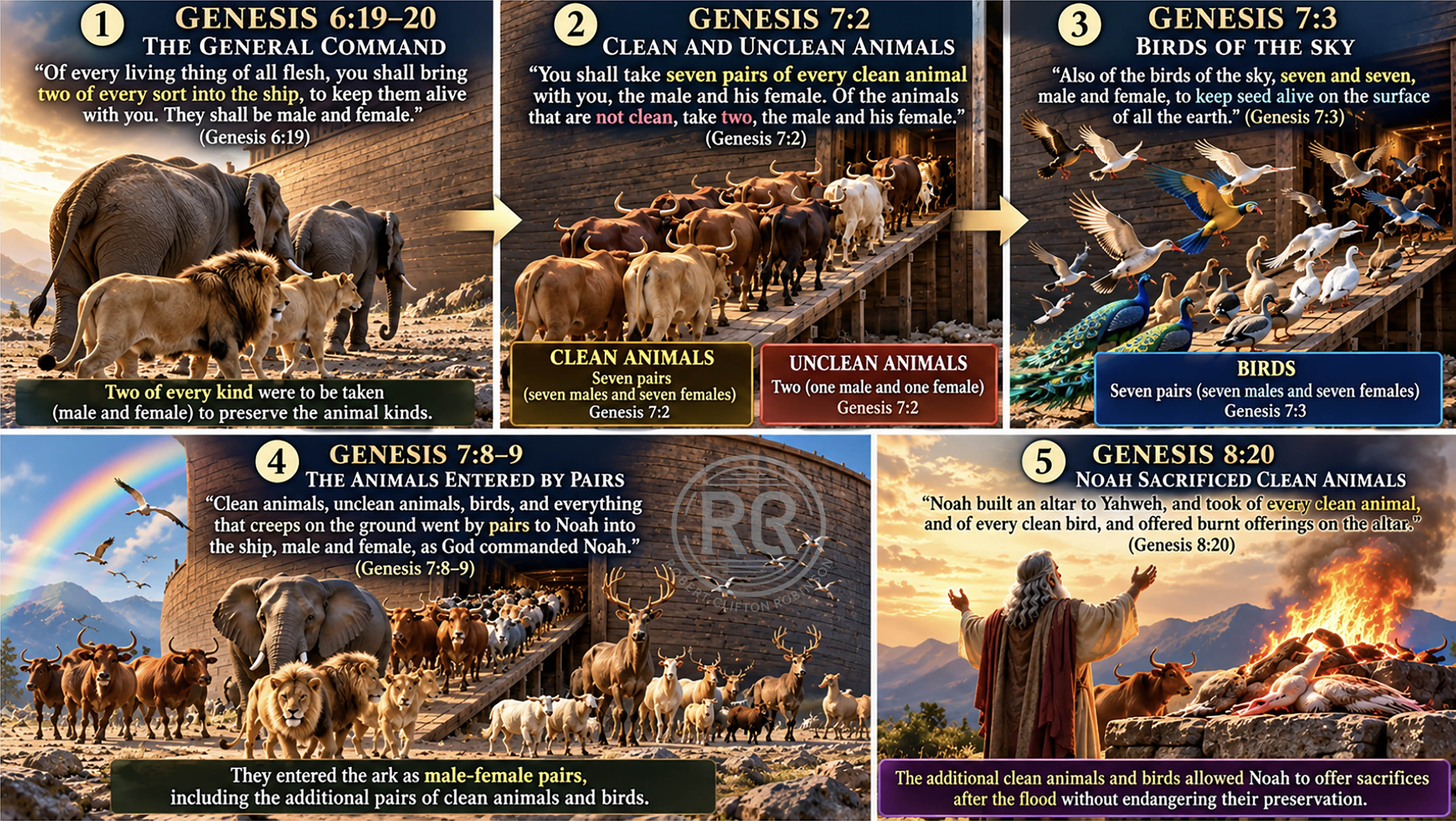
The relevant passages are: Genesis 6:19–20:
“Of every living thing of all flesh, you shall bring two of every sort into the ship, to keep them alive with you. They shall be male and female. Of the birds after their kind, of the livestock after their kind, of every creeping thing of the ground after its kind, two of every sort will come to you, to keep them alive.”
Then Genesis 7 provides additional detail: Genesis 7:2–3:
“You shall take seven pairs of every clean animal with you, the male and his female. Of the animals that are not clean, take two, the male and his female. Also of the birds of the sky, seven and seven, male and female, to keep seed alive on the surface of all the earth.”
And Genesis 7:8–9 describes their entrance:
“Clean animals, unclean animals, birds, and everything that creeps on the ground went by pairs to Noah into the ship, male and female, as God commanded Noah.”
There is no logical contradiction between these statements.
Genesis 6 establishes the minimum/general rule: animals were to be preserved male and female—two of each sort. Genesis 7 then distinguishes categories: Unclean animals: one pair, one male and one female. Clean animals: seven pairs—seven males and seven females. Birds: seven pairs according to Genesis 7:3.
The expression in Genesis 7:9 that the animals entered “by pairs” does not mean that only one pair of every animal entered. Seven pairs still enter in pairs. Fourteen animals can quite literally enter as seven male-female pairs.
The additional clean animals also make sense within the narrative itself. Immediately after leaving the ark, Noah sacrifices some of the clean animals:
Genesis 8:20:
“Noah built an altar to Yahweh, and took of every clean animal, and of every clean bird, and offered burnt offerings on the altar.”
Had Noah possessed only a single male-female pair of every clean animal, sacrificing one of them would have jeopardized the continuation of that kind. Genesis 7’s additional clean animals therefore anticipate what happens in Genesis 8.
This is an often used Hebrew manner of writing where supplementation is used, it is not contradiction.
A contradiction requires two propositions that cannot both be true at the same time and in the same sense.
For example:
Genesis 6: “Only one pair of every kind of animal shall enter the ark.”
and
Genesis 7: “More than one pair of some kinds shall enter the ark.”
That would create an actual contradiction because the word “only” would exclude additional animals.
But Genesis 6 never says “only two” or “exactly one pair and no more.” It says that two of every sort are to be brought aboard for preservation. Genesis 7 subsequently specifies that certain categories are to have additional pairs.
We use this form of description all the time:
“Bring two representatives from every department.”
followed by:
“From the accounting department, bring six.”
The second statement does not contradict the first unless the first statement specified exactly two and no more.
There is also an important Hebrew observation. Genesis 6:19 uses שְׁנַיִם מִכֹּל (šenayim mikkōl), essentially “two from/of every [kind].” Nothing in that construction inherently means “only two and no more.” Genesis 7:2 then gives the more specific instruction concerning clean animals, using שִׁבְעָה שִׁבְעָה (šivʿāh šivʿāh), literally “seven seven,” followed by “male and his female.” This naturally describes seven male-female units/pairs in context.
There is a minor translation issue worth acknowledging: some older English translations render Genesis 7:2 “by sevens,” which has produced debate over whether the Hebrew means seven individual clean animals or seven pairs. The WEB, ESV, NIV, NRSVue, and other modern translations understand the expression as seven pairs. But that translation question does not create the alleged contradiction either way: Genesis 6 does not state that only two clean animals may be aboard.
The larger literary point
This is actually a common feature of Genesis. The narrative frequently gives a broad statement and subsequently supplies greater specificity. A later passage containing additional information is not evidence that the earlier passage has been contradicted.
The Flood narrative gives us a coherent progression: Genesis 6:19–20: preserve representatives of every animal kind, male and female.
Genesis 7:2: specifies the distinction—seven pairs of clean animals, one pair of unclean animals.
Genesis 7:3: seven pairs of birds.
Genesis 7:8–9: these animals enter the ark as male-female pairs.
Genesis 8:17–19: the surviving animals leave the ark and reproduce.
Genesis 8:20: Noah sacrifices clean animals and clean birds, explaining narratively why additional clean animals were appropriate.
Genesis does not say in one place that Noah was commanded to take “only one pair of every animal” and elsewhere that he was commanded to take seven pairs of every animal. Genesis 6 gives the general preservation command; Genesis 7 differentiates between clean and unclean animals and provides additional detail. Those propositions can simultaneously be true, and therefore the alleged discrepancy does not meet the logical definition of a contradiction.
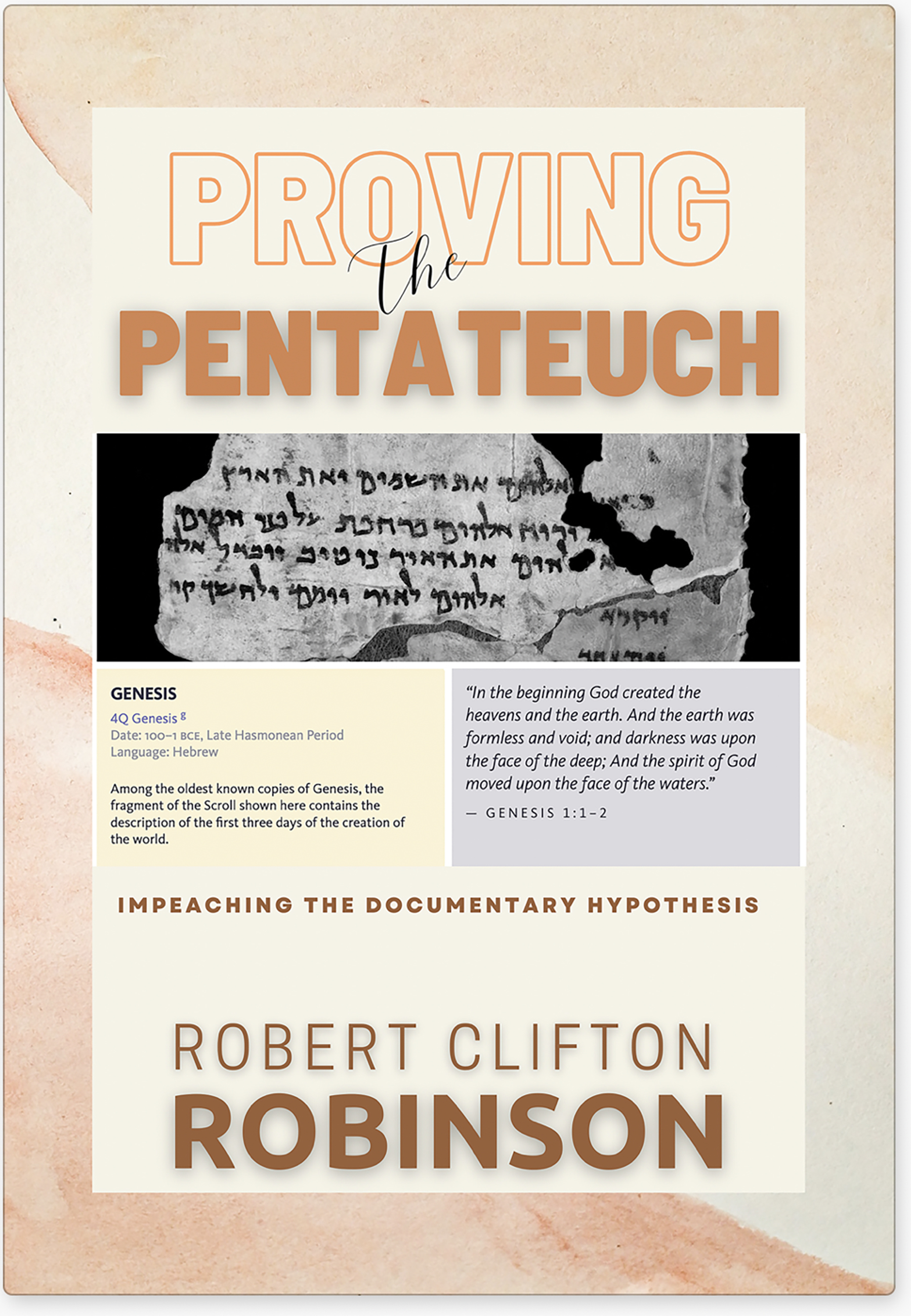
See The Treatise On The Exodus That Proves Moses Wrote The First Five Books of the Bible
“Proving The Pentateuch: Impeaching The Documentary Hypothesis”
Categories: Robert Clifton Robinson


Great article, thank you for sharing! The topic is genuinely interesting and the way you explained it makes it easy to follow. I’ll definitely keep this in mind.
LikeLiked by 1 person