I often receive comments from people who have been taught certain doctrine incorrectly. What makes their view incorrect is not my view v. theirs. It is the conclusion of the original language in the Bible, context, and proper hermeneutics: The Importance of a Proper Exegesis (explanation from Scripture) is required when certain people claim that Jesus meant a change of mind in what saves us, but not a change in behavior, by ending former sins.
The following is an in-depth exegesis of the Text from Matthew 18:3, regarding what Jesus means by using the word “Repentance,” μετανοέω (metanoeō)
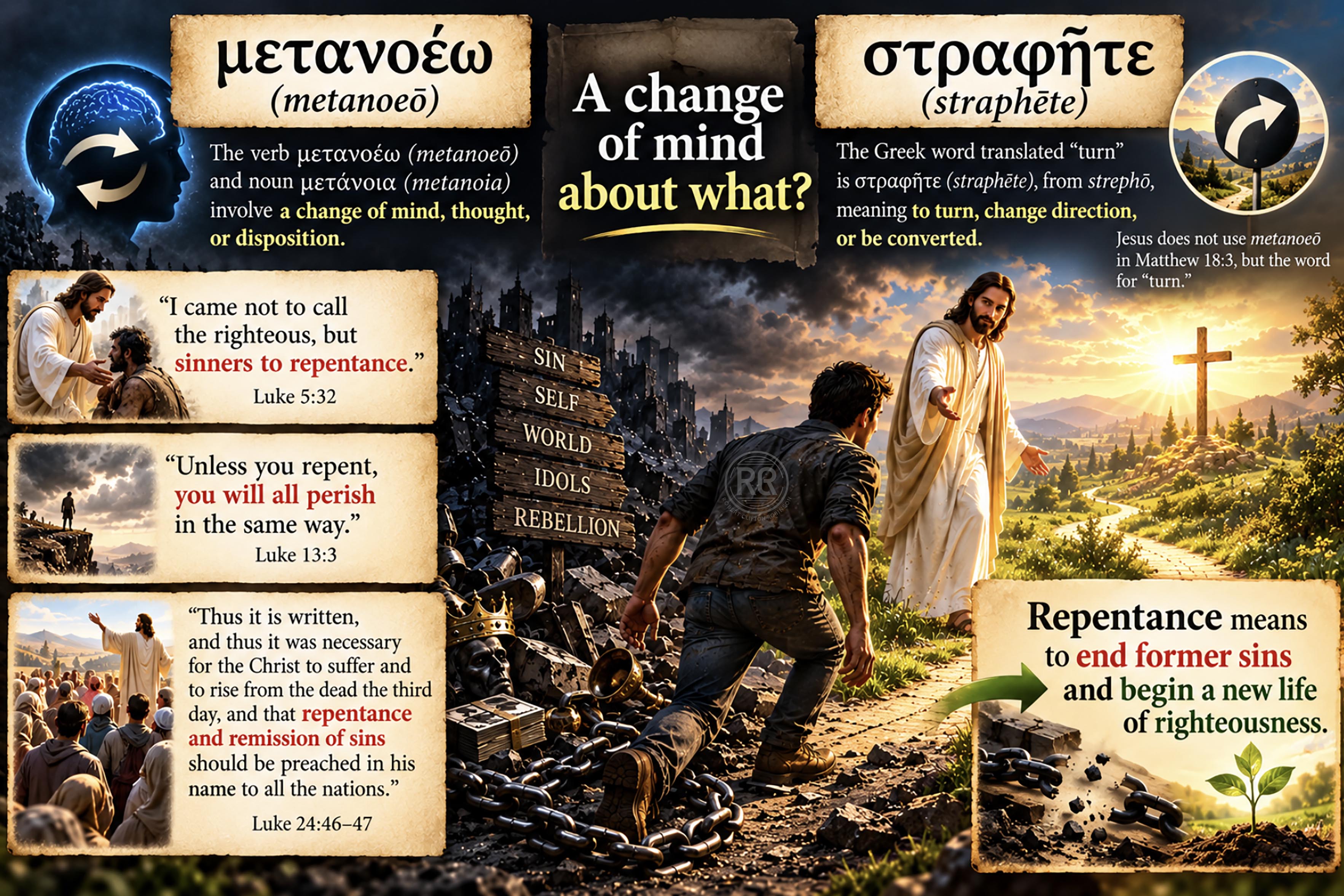
It is true that the Greek verb μετανοέω (metanoeō) and noun μετάνοια (metanoia) involve a change of mind, thought, or disposition. But in Koine Greek usage, the question is: a change of mind about what? In the preaching of Jesus and the apostles, repentance is repeatedly connected with sin, wickedness, turning to God, and a resulting change of life.
Matthew 18:3 is particularly important: “Most certainly I tell you, unless you turn and become as little children, you will in no way enter into the Kingdom of Heaven.”
The Greek word translated “turn” is στραφῆτε (straphēte), from strephō, meaning to turn, change direction, or be converted. Jesus does not use metanoeō in this particular verse. Therefore, appealing to the dictionary definition of metanoia, progressives seek to explain away that Matthew 18:3 doesn’t teach that we must change our behavior, only our mind.
In This Essay You Will See That The Entire Body of Scripture Proves This Is Wrong
We should never try to build a doctrine on one scripture, but use the Bible as it was intended; compare scripture with scripture to gain a complete knowledge of what a doctrine really means. When we try to prove our view with one verse, we always make an error. This is no clearer than in the issue of salvation:
Comparing Scripture with Scripture, we learn that changing our mind about Jesus and salvation also involves changing our behavior
The progressive claim that biblical repentance merely means changing one’s mind from trusting something else to trusting Christ is too narrow. Scripture explicitly defines repentance in radical life-changing terms that demand a change in how we live.
Jesus said: “I came not to call the righteous, but sinners to repentance.” (Luke 5:32)
The object is not merely an incorrect intellectual proposition. Jesus identifies those being called as sinners.
“Unless you all repent, you will all be lost.” (Luke 13:3; cf. v. 5)
Paul Illustrates The Need For A Change In Behavior—Ending Former Sins
In Paul’s first letter to the church at Corinth, a situation had arisen that required Paul to give instructions. A young man in the church was living in an open sexual relationship with his father’s wife. Paul asked the leaders of the church at Corinth why they put up with this sin. He told the leadership of this church to remove the young man from the church if he was not willing to repent after a first and second warning, so that he might have the opportunity to change his mind.
When Paul wrote his second letter to the church at Corinth, this young man had repented, ended the sexual relationship, and was ready to come back to the church. Paul encouraged the leadership to forgive and restore this young man and welcome him back to the church.
Paul wrote that he was sorry he had to write the first letter, but was happy that the young man had taken the advice to end the sin and live a righteous life, as God intended all people who love Him to live.
The key part of this letter is that the young man was not just sorry that he was caught in sexual sin, but sorry enough to change his behavior and end the sinful relationship.
2 Corinthians 7:8-10 (Paul) “I am not sorry that I sent that severe letter to you, though I was sorry at first, for I know it was painful to you for a little while. 9 Now I am glad I sent it, not because it hurt you, but because the pain caused you to repent and change your ways. It was the kind of sorrow God wants his people to have, so you were not harmed by us in any way. 10 For the kind of sorrow God wants us to experience leads us away from sin and results in salvation. There’s no regret for that kind of sorrow. But worldly sorrow, which lacks repentance, results in spiritual death.”
Before Jesus began His public ministry, John the Baptist was calling people to repent of their sins and change their ways, if they wanted to be saved:
Luke 3:7-8 When the crowds came to John for baptism, he said, “You brood of snakes! Who warned you to flee the coming wrath? 8 Prove by the way you live that you have repented of your sins and turned to God.”
Jesus Said That We Must End Our Former Sins
John 8:10-11: “Then Jesus stood up again and said to the woman, “Where are your accusers? Didn’t even one of them condemn you?” “No, Lord,” she said. and Jesus said, “Neither do I. Go and sin no more.”
John 5:14: “But afterward Jesus found him in the Temple and told him, “Now you are well; so stop sinning, or something even worse may happen to you.”
Genuine repentance results in a change of behavior. One of the ways that a misunderstanding of this important fact of repentance has drastically affected Jesus’ church is in the Progressive idea that sexual sin between two men or two women is now acceptable to God. Advocates in the new Progressive Christian Church claim that the church has misunderstood what Jesus meant by repentance. They say that Jesus was talking about changing your mind about what saves us: Jesus, and nothing else.
It is true that salvation is taught in the Bible as coming only through Jesus Christ, not anything that we do. What is left out of this discussion today is that the Bible, both the Old and New Testaments, has always prefaced salvation with a sorrow over our sins, a desire to be forgiven, and a change in our former behavior from sin to righteousness. If we have been a thief, we stop stealing. If we have been an adulterer, this relationship must end. If a person is in a same-sex relationship, this must end.
This is the point of Matthew 18:3 that is the subject of this essay. This text, spoken by Jesus in Matthew 18:3, has always meant that behavior must be changed as we end our former sins and live a new life of righteousness for Jesus. Not to say that we will never sin again, but that our life now is not in a constant state of sin, but only momentary lapses where we fail and fall. At those moments, we have confidence that if we continue in our repentance and recommit ourselves to live apart from sin, Jesus will continually forgive us and cleanse us of all sin.
John presents a reality in our relationship with Jesus that everyone who loves Him and follows Him knows: Even after we have believed in Jesus and are living for HIm, we will still sin on occasion. We are saved, but we are also being sanctified every day. Salvation is immediate, but sanctification is a lifelong process where we fail, repent, try again, and continue this throughout our life.
Salvation: Immediate and permanent; nothing further to do; Jesus has done all that is necessary. This happens the moment we are willing to turn from our sins and follow Jesus.
Sanctification: Continuous. The process of being set apart for God, which begins the moment we are saved, and continues for all of our lives. Our sanctification will not be complete until the day our body dies, and we are set free from the desires of our flesh.
This is the point of John’s letter to the church: that we will all still struggle with sin after we are saved. The way we overcome this struggle is by continual repentance when we sin, and continuing to trust in Jesus for the rest of our lives.
John begins by telling us that if we deny we have sinned after we are saved, we are only fooling ourselves; we are not living in the truth. But if we confess our ongoing sins after we are saved, and turn from them, Jesus continually cleanses us and forgives us.
1 John 1:8-10: “If we claim we have no sin, we are only fooling ourselves and not living in the truth. 9 But if we confess our sins to him, he is faithful and just to forgive us our sins and to cleanse us from all wickedness. 10 If we claim we have not sinned, we are calling God a liar and showing that his word has no place in our hearts.
John states that he is writing these words because he doesn’t want us to sin again after we are saved, but he knows we will, because all believers make mistakes after they are saved. So, John says, “But if anyone does sin…,” here is what you do…
1 John 2:1-2: “My dear children, I am writing this to you so that you will not sin. But if anyone does sin, we have an advocate who pleads our case before the Father. He is Jesus Christ, the one who is truly righteous. 2 He himself is the sacrifice that atones for our sins—and not only our sins but the sins of all the world.”
John called this continual state of repentance from ongoing sin that all of us struggle with, “living in the light.” By confessing each failure and turning away from sin each time we fail, we have the assurance that the blood of Jesus continues to cleanse us and we remain in fellowship with God.
1 John 1:7: “But if we are living in the light, as God is in the light, then we have fellowship with each other, and the blood of Jesus, his Son, cleanses us from all sin.”
The Problem That Has Taken Place Today Is That Modern Progressives Have Redefined What Jesus Meant by His Statement in Matthew 18:3
Progressives insist that a change in behavior is not what Jesus was talking about. They say that Jesus was speaking of our attitude about what saves us- Him, and Him alone, not behavior. The Gospel of Jesus Christ has always been prefaced with repentance from sin, before salvation takes place. Jesus didn’t die for all sins, only so that we would continue in them.
Paul begins chapter 6 of Romans, talking about this very subject, anticipating that it will be an issue in the future:
Romans 6:1-4: “1 Well then, should we keep on sinning so that God can show us more and more of his wonderful grace? 2 Of course not! Since we have died to sin, how can we continue to live in it? 3 Or have you forgotten that when we were joined with Christ Jesus in baptism, we joined him in his death? 4 For we died and were buried with Christ by baptism. And just as Christ was raised from the dead by the glorious power of the Father, now we also may live new lives.
Since our salvation is not based on keeping the Law of God or our personal performance, does this set us free to do whatever we want? Surprisingly, I have heard many people in the last 51 years say this exact thing. Prior to 1960, we never heard people make this claim. Today, there is such a prevalence of this idea that a new church has emerged called “The Progressive Christian Church,” where there is no New Testament message of repentance from sins preached. No need to change the former behavior. No requirement to live a life of righteousness.
The fundamental doctrine of this progressive movement is based only on Scriptures in the New Testament that emphasize love, acceptance, tolerance, and grace. Any texts of the Bible that teach sorrow over sin and repentance are omitted. People are accepted in the Progressive Christian church as they are, regardless of their current lifestyle or status. In other words, if you are in an adulterous affair, single and practicing fornication, or are a same-sex or transgender person, this church will accept you as you are. You don’t have to repent of these sins because they say Jesus never condemned people who live in this manner.
Jesus began his public ministry with a call to repent, and He ended his public ministry on earth with the words, “repent.”
Jesus began His ministry, Matthew 4:17: “From then on Jesus began to preach, “Repent of your sins and turn to God, for the Kingdom of Heaven is near.”
After Jesus rose from the dead, Luke 24:47: It was also written that this message would be proclaimed in the authority of his name to all the nations, beginning in Jerusalem: ‘There is forgiveness of sins for all who repent.’
When a change of behavior at repentance is no longer required, as the Progressive Church now claims, this opens the door for acceptance of many behaviors that were formerly understood as sin that must be ended.
God has not changed His mind about sin. What He said from the beginning is still true today
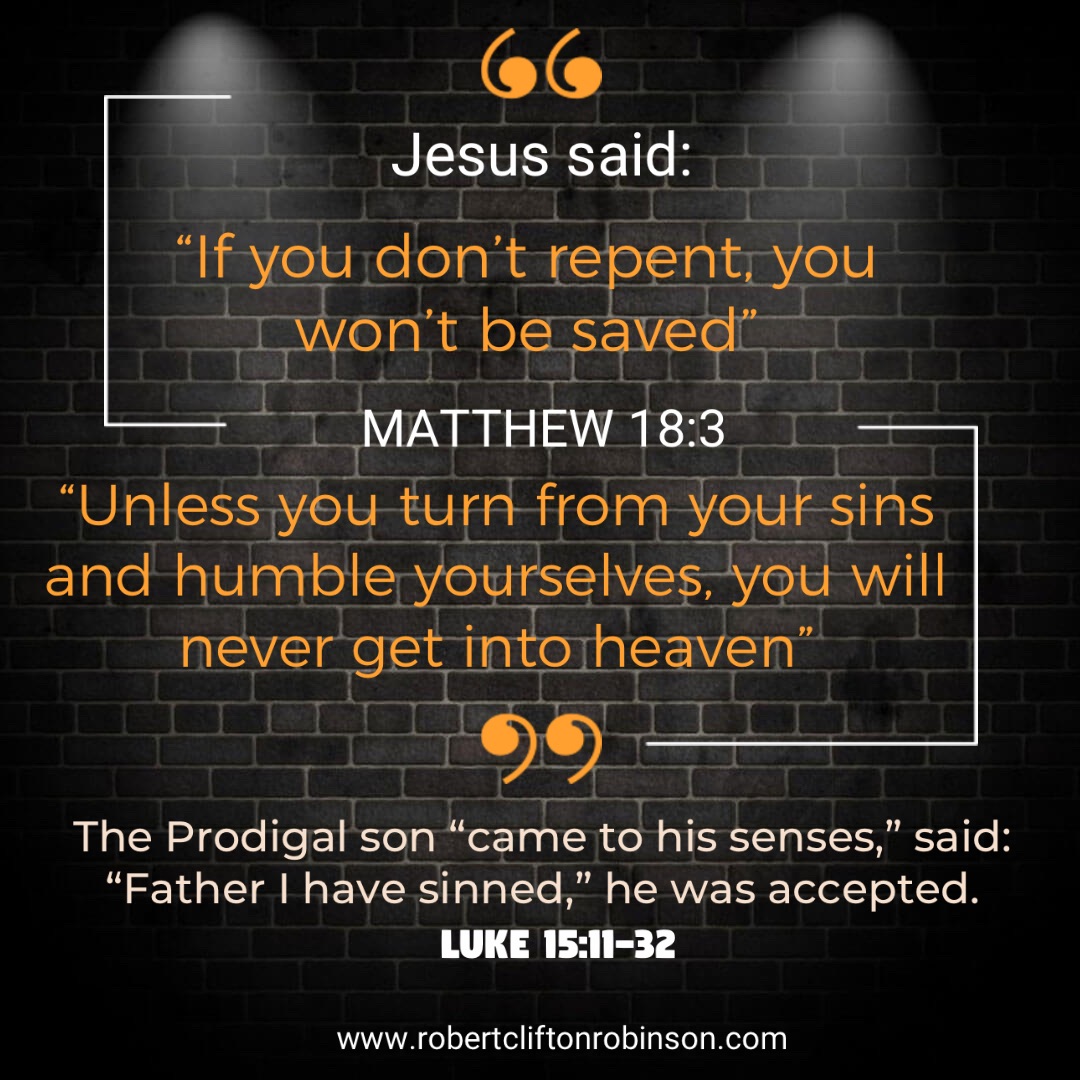 After His resurrection, Jesus summarized the gospel proclamation this way: “Thus it is written, and thus it was necessary for the Christ to suffer and to rise from the dead the third day, and that repentance and remission of sins should be preached in his name to all the nations.” (Luke 24:46–47)
Notice the inseparable relationship: repentance, forgiveness of sins. Repentance is part of Christ’s own description of the gospel message.
Peter preached the same thing: “Repent therefore, and turn again, that your sins may be blotted out.” (Acts 3:19)
Here we have metanoēsate, “repent,” followed by epistrepsate, “turn.” The repentance Peter commands concerns the sinner’s relationship to God and his sins.
Acts 8 is even clearer. Peter tells Simon: “Repent therefore of this, your wickedness, and ask God if perhaps the thought of your heart may be forgiven you.” (Acts 8:22)
That text directly contradicts the proposition that biblical repentance is simply changing our mind about what we trust for salvation. Peter clearly commands repentance “of this wickedness.”
Paul is clear: “God commands all people everywhere to repent.” (Acts 17:30)
And Paul later described his entire ministry: “I declared first to them of Damascus, at Jerusalem, and throughout all the country of Judea, and also to the Gentiles, that they should repent and turn to God, doing works worthy of repentance.” (Acts 26:20)
That verse is especially important because Paul distinguishes three related realities: repent, turn to God, produce conduct appropriate to repentance.
The works do not cause salvation. They are the fruit of genuine repentance. This is precisely what John the Baptist had taught: “Therefore produce fruit worthy of repentance!” (Matthew 3:8)
And Paul describes conversion among the Thessalonians similarly: “You turned to God from idols, to serve a living and true God.” (1 Thessalonians 1:9)
The Lexical Argument is Incomplete
It is often claimed that because metanoeō derives from meta + noeō, repentance therefore means nothing more than “change your mind.” That commits an etymological/root fallacy if the word’s components are treated as its complete definition.
Words are defined by their actual usage in context, not merely by decomposing them into their historical components.
BDAG, the standard Greek lexicon for New Testament scholarship, gives μετανοέω the sense of changing one’s mind with the implication of turning about, particularly in the religious and moral sense of repentance.¹
In the same way, Louw and Nida place metanoeō within the semantic domain of changing one’s way of life as the result of a complete change of thought and attitude with regard to sin and righteousness.²
The Old Testament background makes this even clearer. The prophetic concept underlying New Testament repentance is frequently expressed by Hebrew שׁוּב (shuv), “turn/return.” God repeatedly calls sinners to turn from their evil and return to Him: “Let the wicked forsake his way, and the unrighteous man his thoughts. Let him return to Yahweh, and he will have mercy on him.” (Isaiah 55:7)
Notice that this involves both thought and way. Ezekiel is even clearer: “Repent, and turn yourselves from all your transgressions.” (Ezekiel 18:30) And “Cast away from you all your transgressions, in which you have transgressed; and make yourself a new heart and a new spirit.” (Ezekiel 18:31)
This is the Biblical Conceptual World From Which Jesus’ Preaching Comes
But repentance is not salvation by works. This distinction is essential. Biblical repentance does not mean: “Stop committing sins sufficiently well so that God will save you.”
Salvation is entirely by God’s grace through faith in Christ, not by meritorious works (Ephesians 2:8–9; Romans 3:28; Titus 3:5).
Repentance means that the sinner undergoes a genuine change of mind and heart concerning God, Christ, himself, and his sin, resulting in a turning toward God. Faith and repentance are therefore closely related aspects of conversion.
Paul summarizes them perfectly: “Repentance toward God, and faith toward our Lord Jesus.” (Acts 20:21)
That is much broader than merely “changing your mind about what you were trusting.”
Paul also writes: “Godly sorrow produces repentance to salvation, which brings no regret.” (2 Corinthians 7:10). And he describes what that repentance produced in the Corinthians—earnestness, concern, indignation toward wrongdoing, and a desire to correct what had occurred (2 Corinthians 7:11). Their repentance was not merely an intellectual adjustment.
The first statement made regarding Matthew 18:3 asserts that “Matthew 18:3 does not say ‘repent from your sins’ to be saved.” Technically, that is true, but it proves very little because Matthew 18:3 does not contain metanoia at all.
Jesus says: “unless you turn/change/be converted.”
ἐὰν μὴ στραφῆτε
ean mē straphēte
Jesus then says that without this turning:
οὐ μὴ εἰσέλθητε εἰς τὴν βασιλείαν τῶν οὐρανῶν
“you will certainly not enter the kingdom of heaven.”
So Matthew 18:3 cannot legitimately be reduced to: “Change your mind from trusting something else and place your faith in Christ alone.”
That concept is simply not contained in the Greek sentence. Jesus is describing a profound conversion—a turning accompanied by becoming like a little child in humility and dependence.
The strongest evidence comes from Jesus Himself. At the beginning of His ministry: “The time is fulfilled, and God’s Kingdom is at hand! Repent, and believe in the Good News.” (Mark 1:15)
Jesus distinguishes grammatically between:
μετανοεῖτε — repent
and
πιστεύετε — believe.
If repentance simply meant “change your mind by believing in Christ,” Jesus’ formulation becomes unnecessarily redundant. Instead, repentance and faith are intimately connected but distinguishable responses: turn from rebellion toward God and trust the good news God has provided in Christ.
Jesus also said: “There is joy in the presence of the angels of God over one sinner repenting.” (Luke 15:10). And immediately before that, He described it as: “joy in heaven over one sinner who repents.” (Luke 15:7). The context is the recovery of someone who was lost.
Yes, metanoia involves a change of mind—but Scripture does not permit us to stop there. Biblical repentance is a change of mind, heart, and the practice of sin.
Jesus taught: “Repent, and believe.” (Mark 1:15)
Paul taught: “Repentance toward God, and faith toward our Lord Jesus.” (Acts 20:21)
Peter taught: “Repent therefore, and turn again, that your sins may be blotted out.” (Acts 3:19)
And Paul summarized genuine conversion as: “repent and turn to God, doing works worthy of repentance.” (Acts 26:20)
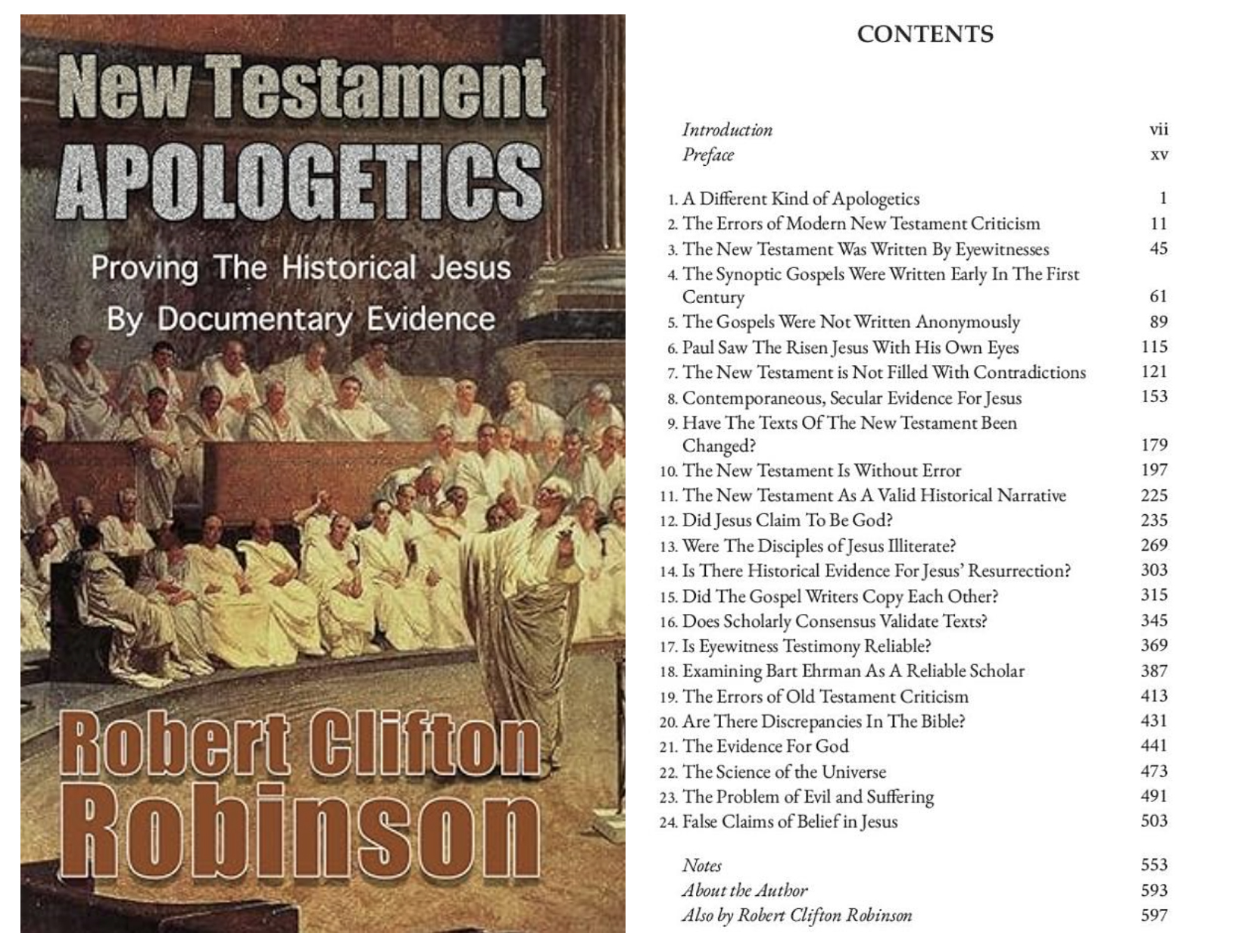
See Rob’s In-depth New Testament Apologetics Work, describing the 21 primary arguments presented by atheists and critics of God and the Bible:
“New Testament Apologetics”
Sources and Citations
1. Walter Bauer, Frederick W. Danker, William F. Arndt, and F. Wilbur Gingrich, A Greek-English Lexicon of the New Testament and Other Early Christian Literature, 3rd ed. (Chicago: University of Chicago Press, 2000), s.v. “μετανοέω,” P. 640.
2. Johannes P. Louw and Eugene A. Nida, Greek-English Lexicon of the New Testament Based on Semantic Domains, 2nd ed. (New York: United Bible Societies, 1989), §41.52, “μετανοέω; μετάνοια.”
Categories: Robert Clifton Robinson


Please see, "Guidelines For Debate," at the right-side menu. Post your comment or argument here: