There is substantial historical and textual evidence that the longer ending of Mark (16:9–20) existed very early in Christianity, long before our oldest surviving complete Greek manuscripts of Mark were produced.
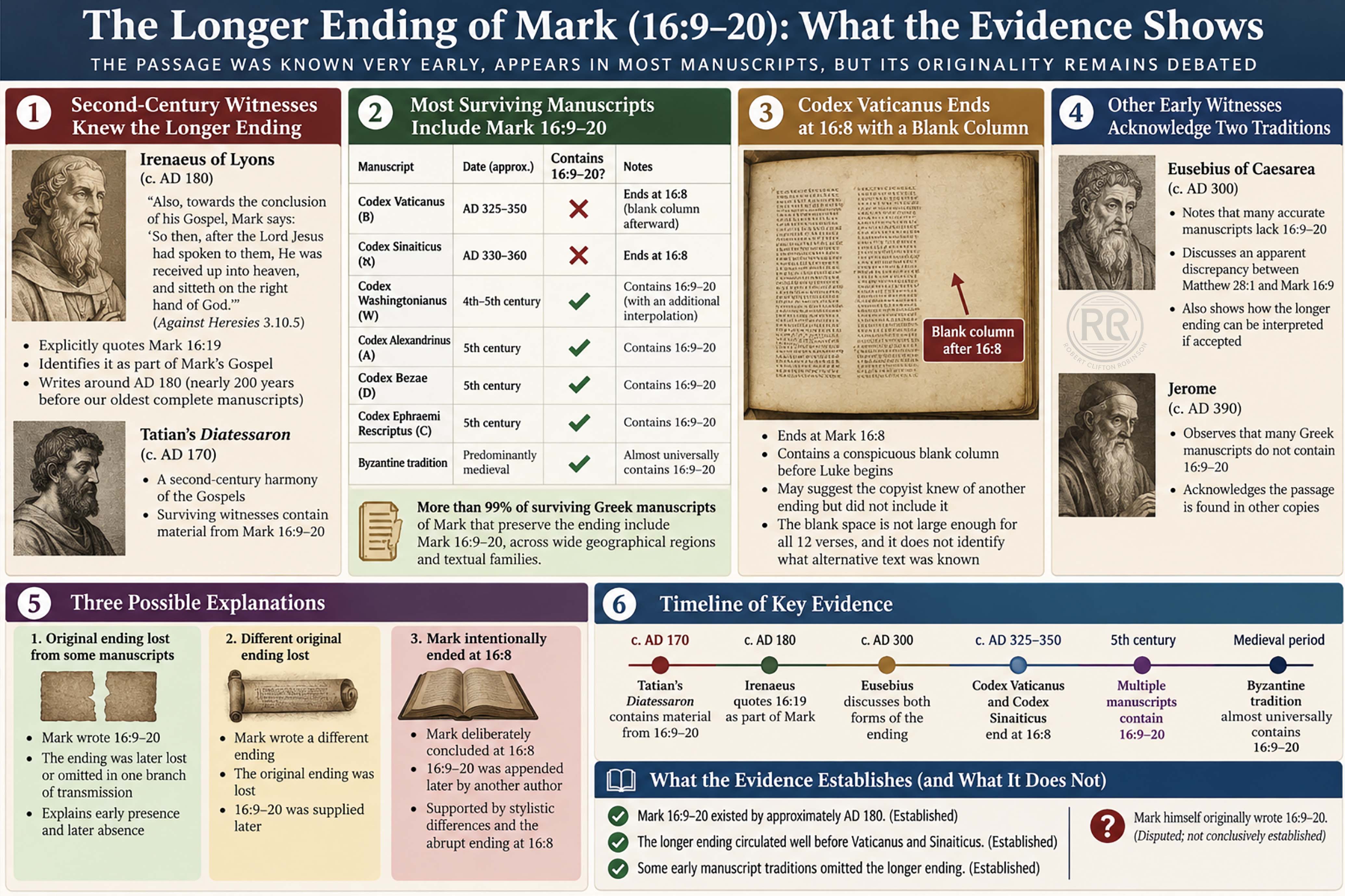
The historical and literary evidence for Mark 16:9-20, is important because the longer ending is absent from two important fourth-century Greek manuscripts, yet it was apparently known to Christian writers nearly two centuries earlier. This means that the longer ending cannot reasonably be dismissed as a medieval invention or a passage created centuries after the apostolic period.
The central question is whether the shorter manuscripts preserve Mark’s original conclusion, or whether they depart from a textual tradition in which the original ending had been lost or omitted.
Irenaeus cites Mark 16:19 around AD 180
One of the strongest pieces of evidence comes from Irenaeus of Lyons, writing approximately AD 180. In “Against Heresies,” Book 3, Chapter 10, Section 5, Irenaeus wrote:
“Also, towards the conclusion of his Gospel, Mark says: ‘So then, after the Lord Jesus had spoken to them, He was received up into heaven, and sitteth on the right hand of God.’”
Here in 180 AD, Irenaeus cites Mark 16:19. Irenaeus clearly identifies Mark as the author of these words. He identifies the text as being present at the end of Mark’s Gospel. His testimony predates Codex Vaticanus and Codex Sinaiticus by approximately 170 years. Irenaeus was also associated with Polycarp, who had connections to the apostolic generation through his recollections of John and other eyewitnesses.
The historical importance of this citation by Irenaeus, in AD 180, as a prominent Christian writer, demonstrates, by evidence, that Mark was the known writer of this Gospel, and up to verse 19, this text was in Mark’s Gospel.
That is substantial and compelling evidence against the claim that the longer ending of Mark originated only in the fourth century or later.
Tatian’s Diatessaron provides another second-century witness
Near AD 170, Tatian, a Christian writer and student of Justin Martyr, composed the Diatessaron, a harmony combining the four canonical Gospels. This is important to our investigation of Mark’s Gospel because the surviving witnesses to the Diatessaron contain material corresponding to Mark 16:9–20.
Nicholas J. Zola published a detailed study in 2022 examining the evidence for Mark’s ending in Tatian’s work. He concluded that Tatian almost certainly incorporated significant portions of the longer ending. This gives us a second early line of evidence that the text of Mark 16:9-20 was validated by the early Christian church and widely circulating in the second century.
The overwhelming majority of surviving Greek manuscripts contain Mark 16:9–20
The manuscript evidence is extremely important.
Manuscript Approximate date Mark 16:9–20
- Codex Sinaiticus (א) AD 330–360 Absent
- Codex Vaticanus (B) AD 325–350 Absent
- Codex Alexandrinus (A) 5th century Present
- Codex Bezae (D) 5th century Present
- Codex Ephraemi Rescriptus (C) 5th century Present
- Codex Washingtonianus
 4th–5th century Present, with an additional interpolation
Byzantine manuscript tradition.
More than 99 percent of surviving Greek manuscripts of Mark preserve the ending, including verses 9–20. This majority is important as it gives us very early attestation that the text of Mark 16:9-20 was a part of the original document.
Codex Vaticanus contains a conspicuous blank column
One interesting fact of Codex Vaticanus is observed in the layout at the conclusion of Mark. The manuscript ends at Mark 16:8 and leaves an unusual blank column before Luke begins. This is significant because it may suggest that the copyist knew of an alternative ending but did not reproduce it. The blank column is a reasonable answer to the question of a longer ending for Mark 16:9–20 that was physically removed from Vaticanus.
Could the original ending have been lost from an early manuscript?
Yes. This is a possible historical explanation. Ancient books were copied by hand. If the final leaf of an early exemplar became detached, damaged, or lost, subsequent copies could reproduce an incomplete ending. In this view, an early copy of Mark lost its final portion, and subsequent copies ended at 16:8. This explanation makes sense because Mark 16:8 ends abruptly: “They said nothing to anyone; for they were afraid.” (Mark 16:8)
The narrative that comes before this abrupt ending anticipates a meeting between Jesus and His disciples in Galilee (Mark 14:28; 16:7), but no meeting is stated before verse 8. This raises the question of whether Mark intended to conclude his Gospel at that point.
There are three principal possibilities:
- Mark originally wrote verses 9–20, which were lost from one branch of transmission.
- Mark wrote a different ending that was lost, and verses 9–20 were supplied later.
- Mark deliberately concluded his Gospel at 16:8, and verses 9–20 were subsequently appended.
The first possibility is the conclusion that is most reasonable in consideration of the evidence presented in this essay so far. The second and third arguments are the often stated view of modern textual criticism.
Does the Greek vocabulary prove Mark did not write the longer ending?
Some critical scholars argue that Mark 16:9–20 differs from the preceding Gospel in vocabulary, syntax, and narrative continuity. This argument is more the opinion of those who assert it, rather than a finding proven by actual evidence.
For example, verse 9 reintroduces Mary Magdalene despite her having appeared earlier in the chapter. Of course authors often repeat persons, places, and events, an attribute of all biblical writers. I have published over 10 million words in my 52 books, and I often venture into different texts and styles, depending on my thoughts at that time. My writing style varies widely from those first written 30 years ago to the present day. Yet I am still the writer.
Every writer can vary vocabulary and style according to subject matter. The resurrection appearances and the instructions by Jesus to the Apostles vary substantially in subject throughout all the Gospels. Bruce M. Metzger discusses these issues in A Textual Commentary on the Greek New Testament, second edition (1994), pages 102–106.
What Does the Evidence Prove?
The text of Mark 16:9–20 existed by AD 180. Established by Irenaeus, proving this text was an early-known attribute of Mark’s Gospel, proven by evidence.
The longer ending was already in wide circulation in the church long before Vaticanus and Sinaiticus, proven by evidence
The historical and literary evidence proves a strong argument that Mark 16:9–20 was present in the Christian textual tradition long before our oldest surviving complete Greek manuscripts.
Irenaeus is compelling because he identifies verse 19 as belonging to Mark’s Gospel around AD 180. Tatian states additional early evidence, and the overwhelming majority of surviving Greek manuscripts preserve the passage.
The evidence proves that Mark 16:9–20 belonged to an early form of the Gospel and was lost or omitted in the ancestry of some manuscripts.
A critic who claims that Mark 16:9–20 was unknown before the fourth century is contradicted by second-century evidence, demonstrating that these texts already existed in the historical record.
There Are 21 Primary Arguments That Atheists and Critics Assert Against the New Testament. See the Evidence that proves these assertions are wrong. See Them in:
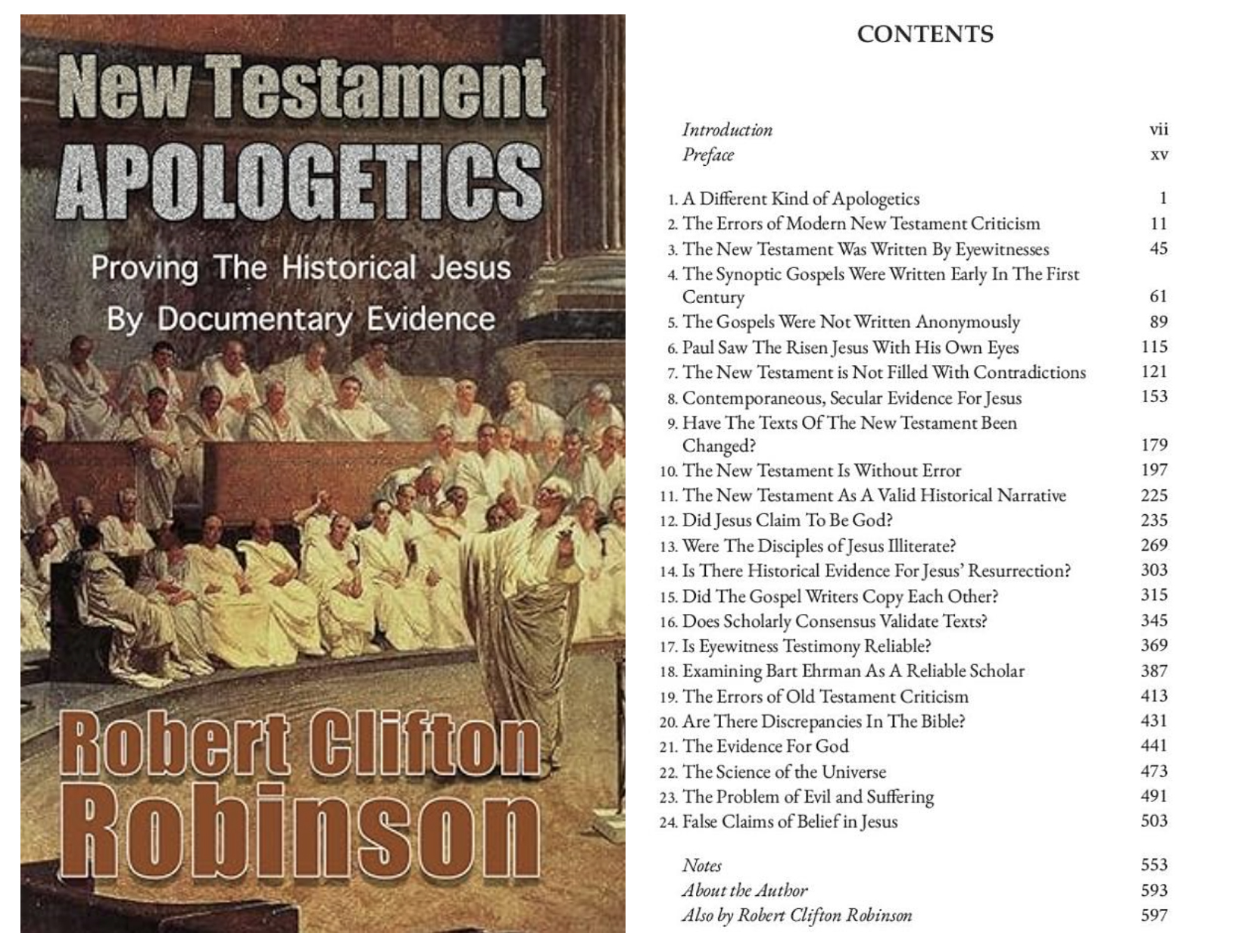
“New Testament Apologetics” by Robert Clifton Robinson
Sources and Citations
1. Irenaeus of Lyons. Against Heresies, 3.10.5, approximately AD 180. Explicitly attributes Mark 16:19 to the conclusion of Mark’s Gospel.
2. Eusebius of Caesarea. Quaestiones ad Marinum, Question 1, in J.-P. Migne, Patrologia Graeca, vol. 22, columns 937–940. Discusses manuscript evidence and the apparent discrepancy between Matthew 28:1 and Mark 16:9.
3. Jerome. Epistle 120, To Hedibia, Question 3. Discusses the longer ending and its absence from many Greek manuscripts.
4. Bruce M. Metzger. A Textual Commentary on the Greek New Testament, 2nd ed. Stuttgart: Deutsche Bibelgesellschaft, 1994, pp. 102–106. An influential critical assessment of the manuscript, patristic, and internal evidence.
5. Nicholas J. Zola. “The Ending of Mark in Tatian’s Diatessaron.” Journal of Theological Studies (2022). Examines the evidence for the longer ending in Tatian’s second-century Gospel harmony.
6. James A. Kelhoffer. Miracle and Mission: The Authentication of Missionaries and Their Message in the Longer Ending of Mark. Wissenschaftliche Untersuchungen zum Neuen Testament 2/112. Tübingen: Mohr Siebeck, 2000. A substantial investigation of the passage’s origins, theology, and early reception.
7. David Alan Black, ed. Perspectives on the Ending of Mark: Four Views. Nashville: Broadman & Holman, 2008. Presents competing scholarly interpretations, including arguments favorable to the traditional ending.
8. Nicholas P. Lunn. The Original Ending of Mark: A New Case for the Authenticity of Mark 16:9–20. Eugene, OR: Pickwick Publications, 2014. A detailed defense of the longer ending’s authenticity.
Categories: Robert Clifton Robinson


Please see, "Guidelines For Debate," at the right-side menu. Post your comment or argument here: