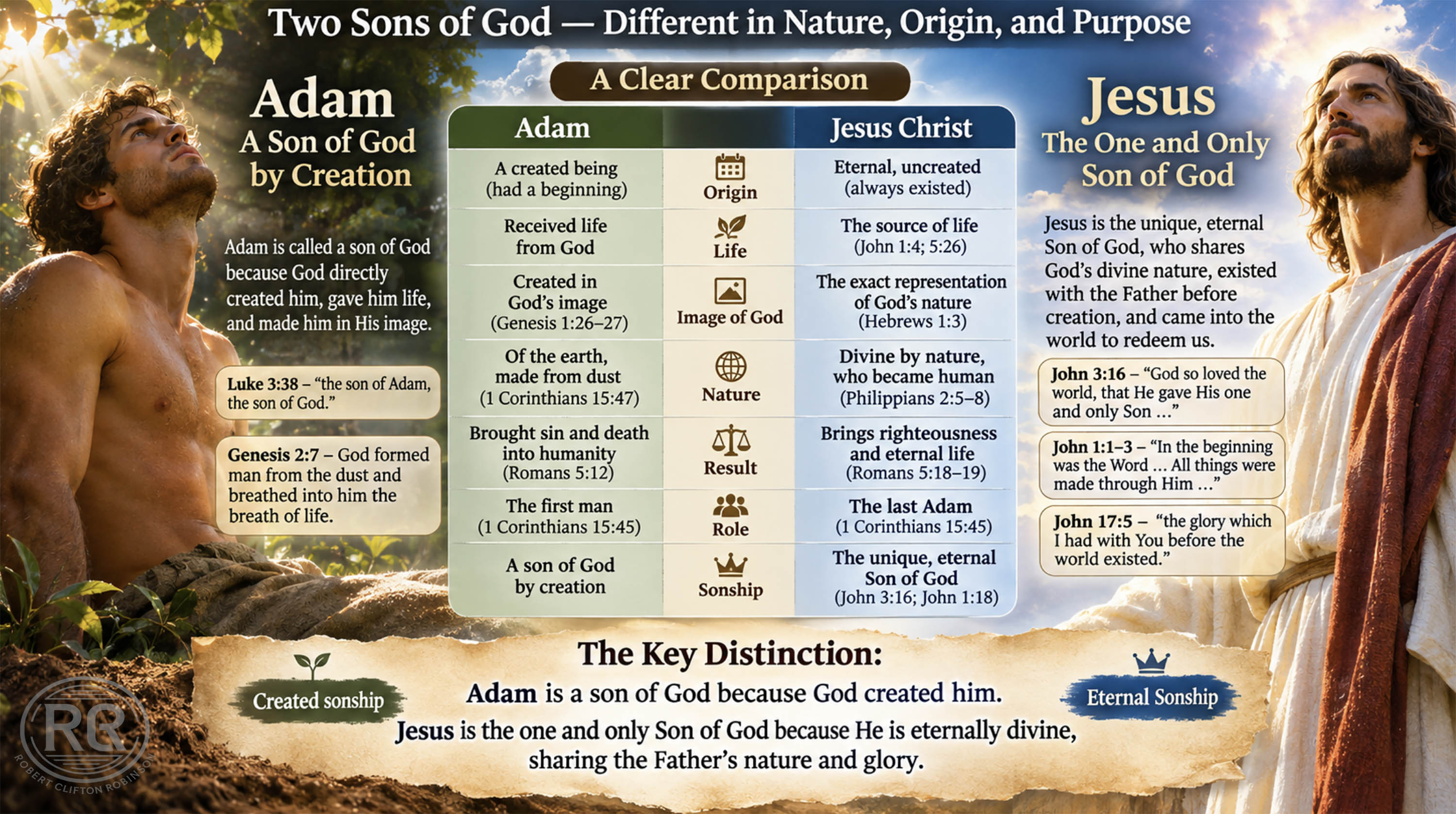
The distinction between Jesus being called the only begotten Son of God in John 3:16 and Adam being called the son of God in Luke 3:38 is fundamental to understanding the deity of Jesus Christ, His eternal existence, and the difference between the Creator and His creation.
Although both Adam and Jesus are called sons of God, they are not sons in the same sense. Adam is a son of God by creation; Jesus is the eternal Son of God by His divine nature.
There is also an important clarification: Genesis describes Adam’s creation in Genesis 1:26–27 and 2:7, but it is Luke 3:38 that explicitly calls Adam the son of God.
Adam is called the son of God because God created him
Luke 3:38:
“the son of Enos, the son of Seth, the son of Adam, the son of God.”
Luke traces the genealogy of Jesus backward through human history, eventually arriving at Adam. Unlike every other person in the genealogy, Adam had no human father.
Genesis 2:7:
“Yahweh God formed man from the dust of the ground, and breathed into his nostrils the breath of life; and man became a living soul.”
Adam is called God’s son because:
- God directly created him.Adam did not come into existence through human reproduction.
- God gave Adam life.
- Adam was created in God’s image and likeness (Genesis 1:26–27).
- Adam was a created being who had a beginning.
The Greek word translated in Luke 3:38 is:
τοῦ Ἀδὰμ, τοῦ θεοῦ
Tou Adam, tou Theou.
Literally, “of Adam, of God.”
The word son is supplied in English from the genealogical construction established earlier in Luke 3:23. Luke identifies Adam as belonging directly to God in the genealogical sense because God was the source of Adam’s existence. Adam did not possess God’s divine nature. He was a human being created by God. This distinction is important.
Jesus is the only begotten (Unique) Son of God because He is unique and eternal
John 3:16:
“For God so loved the world, that he gave his one and only Son, that whoever believes in him should not perish, but have eternal life.”
The Greek word translated “one and only Son” is:
τὸν υἱὸν τὸν μονογενῆ
Ton huion ton monogenē.
The key word is monogenēs (μονογενής), which describes someone who is unique, one of a kind, or the only one of a particular relationship. Older English translations, including the KJV, render this word as “only begotten.”
However, monogenēs does not necessarily describe the biological act of begetting. Its primary emphasis is uniqueness, singular, the only one. For example, Hebrews 11:17 calls Isaac Abraham’s monogenēs, even though Abraham also fathered Ishmael and other sons (Genesis 16:15; 25:1–2). Isaac was Abraham’s unique son in relation to God’s covenant promise. In John 3:16, Jesus is the Father’s unique Son in a sense that no created being, including Adam, can claim.
This uniqueness is explained by John’s opening declaration.
John 1:1–3:
“In the beginning was the Word, and the Word was with God, and the Word was God. The same was in the beginning with God. All things were made through him. Without him, nothing was made that has been made.”
Notice the distinction:
Adam was created. Jesus is the Creator, the One through whom everything that was made came into existence.
Colossians 1:15-17:
“Jesus is the visible image of the invisible God. He existed before anything was created and is first over all creation, for through him God created everything in the heavenly realms and on earth. He made the things we can see and the things we can’t see—such as thrones, kingdoms, rulers, and authorities in the unseen world. Everything was created through Jesus and for him. He existed before anything else, and he holds all creation together.”
John does not place Jesus among the things that were created. Paul states that Jesus is the Creator of all that exists, and that He is the source and sustainer of all that exists.
John identifies Jesus as the eternal Word who already existed in the beginning and through whom all created things came into existence. John 1:14 then identifies this eternal Word as the One who became flesh.
Adam was a creation of Jesus. Therefore, Jesus’ divine Sonship is not equivalent to Adam’s created sonship.
Jesus existed before Adam, and He created Adam
This is the clearest distinction between Jesus and Adam.
In John 8:58, Jesus declared:
“Most certainly, (Jesus said) I tell you, before Abraham came into existence, I AM.” Jesus existed as the Eternal God, Yahweh, before anyone else or anything, was created.
Jesus did not merely claim to be older than Abraham. His statement compares Abraham’s coming into existence with His own Eternal existence. This is consistent with the identity of Jesus as the Eternal God in John 1:1–3.
Colossians 1:16–17:
“For by him all things were created, in the heavens and on the earth, visible things and invisible things, whether thrones or dominions or principalities or powers. All things have been created through him and for him. He is before all things, and in him all things are held together.”
If all created things came into existence through Jesus, then Adam himself came into existence through Jesus.
The distinction is unmistakable:
- Adam began to exist when God created him.
- Jesus already existed before Adam.
- Adam received life from God.
- Jesus is the source of life (John 1:4; 5:26).
- Adam was created in God’s image.
- Jesus is the image of the invisible God (Colossians 1:15), revealing the Father perfectly.
Jesus is not simply another son of God among created sons. He is the eternal Son through whom the created sons came into existence.
Jesus is the Son of God by nature; believers become children of God by adoption
John makes another important distinction in John 1:12–13:
“But as many as received him, to them he gave the right to become God’s children, to those who believe in his name: who were born not of blood, nor of the will of the flesh, nor of the will of man, but of God.”
Notice that believers become God’s children through faith in Jesus. Jesus does not become the Son of God through faith, adoption, or creation. He is already the Son. Romans 8:15 describes believers receiving the Spirit of adoption, while Galatians 4:4–5 explains that God sent His Son into the world so that believers might receive adoption as children.
This is significant: God sent His Son so that we might become His children. The Son already existed in that relationship before He was sent.
John 17:5 records Jesus praying:
“Now, Father, glorify me with your own self with the glory which I had with you before the world existed.”
And in John 17:24, Jesus says that the Father loved Him before the foundation of the world. These statements demonstrate that the relationship between the Father and the Son existed before creation.
Adam could never make such a claim.
Paul distinguishes Adam from Jesus
In 1 Corinthians 15, Paul makes a remarkable comparison between Adam and Jesus.
1 Corinthians 15:45:
“So also it is written, ‘The first man Adam became a living soul.’ The last Adam became a life-giving spirit.”
Paul continues in verse 47:
“The first man is of the earth, made of dust. The second man is the Lord from heaven.”
Here Paul establishes a theological contrast.
|
Adam |
Jesus Christ |
|---|---|
|
First man |
Last Adam |
|
Created from dust |
Came from heaven |
|
Became a living soul |
Life-giving Spirit |
|
Brought sin and death into humanity |
Brings righteousness and resurrection life |
|
A created human being |
The eternal Son who became human |
|
Father of the fallen human race |
Head of the redeemed humanity |
Paul further develops this distinction in Romans 5:12–21. Through Adam’s disobedience, sin and death entered human experience. Through Jesus Christ’s obedience, grace and the gift of righteousness are made available.
Romans 5:19:
“For as through the one man’s disobedience many were made sinners, even so through the obedience of the one, many will be made righteous.”
Jesus is called the last Adam because He came as a true human being to accomplish what the first Adam failed to accomplish. But unlike the first Adam, Jesus is also the eternal Son of God. Jesus as a man began at Bethlehem; His existence as Yahweh-God did not.
Jesus is the Son of God in a way that identifies Him with God Himself
John 5:17–18 is very important.
Jesus declared:
“My Father is still working, so I am working, too.”
John then explains:
“For this cause therefore the Jews sought all the more to kill him, because he not only broke the Sabbath, but also called God his own Father, making himself equal with God.” (John 5:18
The Jewish leaders understood that Jesus was making a claim about His relationship with the Father that went beyond ordinary human sonship. The Greek expression for “his own Father” includes the word ἴδιον (idion), emphasizing a relationship belonging particularly to Him. John 5:18 reports their understanding that Jesus was making Himself equal with God. The remainder of the chapter develops Jesus’ extraordinary claims concerning divine works, judgment, life, and honor.
In John 5:23, Jesus declares that all should honor the Son just as they honor the Father. No ordinary created son of God could rightly demand such honor.
This is consistent with John 10:30, where Jesus declares:
“I and the Father are one.”
Jesus is distinct from the Father as a person, yet shares the one divine nature.
Adam never possessed this divine identity.
Why Jesus can be called the only Son when others are called sons of God
The Bible uses the expression sons of God in several different contexts. Angelic beings are called sons of God in Job 1:6 and 2:1. Israel is called God’s son in Exodus 4:22. Adam is identified as God’s son in Luke 3:38. Believers are called children of God in John 1:12 and Romans 8:14–17. But none of these scriptures teaches that angels, Israel, Adam, or believers possess the eternal divine Sonship that belongs to Jesus Christ.
The word “Son” describes different relationships according to its context. Jesus is uniquely the Son because He shares the Father’s divine nature and existed with the Father before the world began. This is why John can acknowledge that believers are God’s children in John 1:12 while also declaring that Jesus is God’s one and only Son in John 3:16.
There is no contradiction.
The two texts describe different kinds of sonship.
Jesus is eternally God, but became human
Philippians 2:5–8 describes Jesus as existing in the form of God and then taking the form of a servant, being made in human likeness. Jesus did not surrender His divine nature when He became human. He took upon Himself a genuine human nature while remaining fully divine.
Philippians 2:6-11:
“Though Jesus was God, he did not think of equality with God as something to cling to. Instead, he gave up his rights as God; he took the humble position of a servant and was born as a human being. When he appeared in human form, he humbled himself in obedience to God and died a criminal’s death on a cross. Therefore, God elevated him to the place of highest honor and gave him the name above all other names, that at the name of Jesus every knee should bow, in heaven and on earth and under the earth, and every tongue declare that Jesus Christ is Lord, to the glory of God the Father.”
Hebrews 1:2–3 describes the Son as the One through whom God made the worlds and as the radiance of God’s glory and the exact representation of His nature.
Hebrews 1:8 even addresses the Son as God.
This means that Jesus’ identity as the Son is not merely a title assigned to Him at His birth in Bethlehem. His birth at Bethlehem brought the eternal Son into human history as a true man. Adam, by contrast, was never anything other than a created human being.
- Adam was a son of God because God created him. Jesus is the one and only Son of God because He is eternally divine, sharing the Father’s nature and glory.
- Adam was created in the image of God; Jesus is the eternal Son who perfectly reveals God.
- Adam received life; Jesus gives life.
- Adam was made from the dust of the earth; Jesus came from heaven.
- Adam’s disobedience brought death; Jesus’ obedience and resurrection bring eternal life to those who believe in Him.
One final scripture brings the entire distinction into focus.
John 1:18:
“No one has seen God at any time. The one and only Son, who is in the bosom of the Father, he has declared him.”
The textual tradition of John 1:18 also preserves the reading “the only begotten God” (monogenēs theos) in important early manuscripts, explicitly joining Christ’s uniqueness with His existence as God. The central point is that Adam is God’s son by an act of creation, whereas Jesus is God’s Son in an eternal relationship that precedes creation itself.
John 3:16 does not contradict Luke 3:38. The two passages reveal a profound distinction between the created son of God, Adam, and the eternal Son of God, Jesus Christ, who came into the world to redeem Adam’s descendants.
Categories: Robert Clifton Robinson


Please see, "Guidelines For Debate," at the right-side menu. Post your comment or argument here: