The Eyewitness Command of Jesus and the Early Writing of the New Testament
One of the most compelling arguments for the early composition of the New Testament narratives is found in the stated purpose for which Jesus selected, trained, and commissioned His disciples. According to the New Testament, these men were not merely appointed to establish a religious movement. They were specifically chosen to become witnesses of historical events and to communicate what they had personally seen and heard to the entire world.
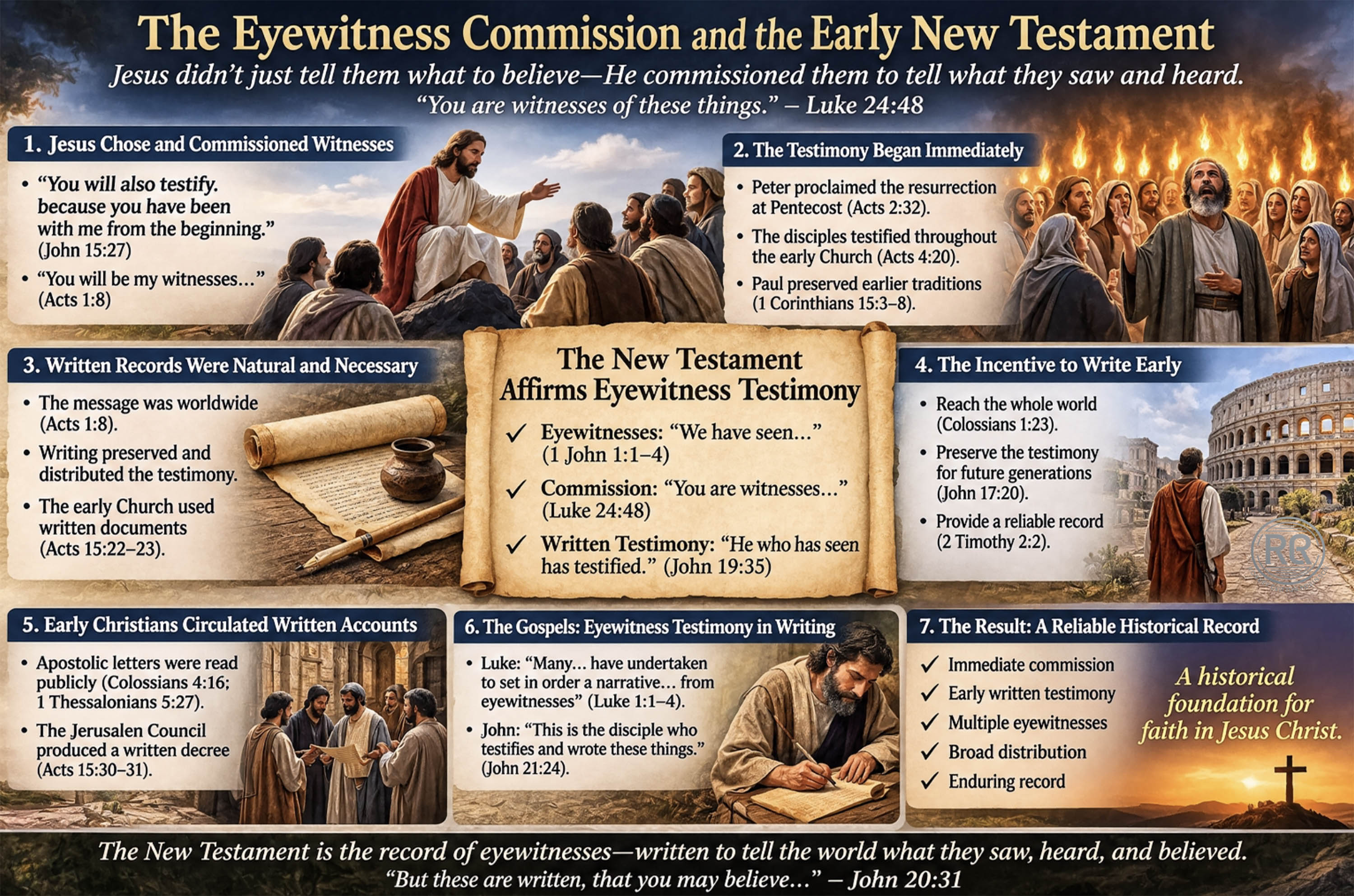
This commission provides a substantial historical and practical argument for the early recording of the words and works of Jesus, potentially beginning during His earthly ministry and continuing in the years immediately following His resurrection.
Although the eyewitness commission does not, by itself, establish the precise date on which each of the four canonical Gospels was completed, it provides a compelling reason to investigate whether written records of Jesus existed substantially earlier than the dates commonly assigned to the completed Gospels by modern critical scholarship.
Jesus deliberately selected men to become historical witnesses
The selection of the apostles was not incidental to the ministry of Jesus. Their appointment served a purpose that extended beyond the three years they spent with Him.
Mark 3:14:
He appointed twelve, that they might be with him, and that he might send them out to preach.
Two distinct purposes are identified in this text. The first was that these men would accompany Jesus, personally observing His works and hearing His teaching. The second was that they would subsequently communicate what they had learned.
Jesus explicitly connects these two purposes in John 15:27.
John 15:27:
You will also testify, because you have been with me from the beginning.
The Koine Greek is particularly important: καὶ ὑμεῖς δὲ μαρτυρεῖτε, ὅτι ἀπ᾽ ἀρχῆς μετ᾽ ἐμοῦ ἐστε.
The conjunction ὅτι (hoti) introduces the reason these men were qualified to testify: they had been with Jesus from the beginning. Their authority as witnesses was grounded in their personal association with Him. This is consistent with the ordinary historical and forensic distinction between someone who personally observed an event and someone who subsequently learned about that event from another person.
Jesus was establishing a body of individuals whose testimony would originate in their own experiences.
The command by Jesus to testify to the world about Him was immediate, not something to be written and declared decades later
Following His resurrection, Jesus did not instruct His disciples to wait thirty, forty, or sixty years before communicating what they had witnessed.
He commanded them to begin their work following the coming of the Holy Spirit.
Luke 24:46–49:
He said to them, “Thus it is written, and thus it was necessary for the Christ to suffer and to rise from the dead the third day, and that repentance and remission of sins should be preached in his name to all the nations, beginning at Jerusalem. You are witnesses of these things. Behold, I send out the promise of my Father on you. But wait in the city of Jerusalem until you are clothed with power from on high.”
Acts 1:8:
But you will receive power when the Holy Spirit has come upon you. You will be witnesses to me in Jerusalem, in all Judea and Samaria, and to the uttermost parts of the earth.
The geographical progression of this commission is significant. The testimony was to begin in Jerusalem, extend throughout Judea and Samaria, and ultimately reach the entire world.
The apostles were commanded to communicate their testimony concerning specific historical events:
- The identity of Jesus
- His teaching and public ministry.
- His miracles and supernatural works.
- His fulfillment of the 400 Old Testament Messianic Prophecies
- His arrest, trial, and crucifixion.
- His burial and bodily resurrection.
- His appearances to numerous witnesses.
- His instructions concerning repentance, forgiveness, and eternal life.
The command by Jesus was immediately obeyed, according to Acts 2, when Peter publicly proclaimed the resurrection of Jesus at Pentecost.
Acts 2:32:
This Jesus God raised up, to which we all are witnesses.
The testimony concerning Jesus was already being publicly communicated within weeks of His crucifixion, according to the chronology presented in Acts. The historical question is not when Christians first began communicating information about Jesus. The New Testament places that activity at the very beginning of the Christian movement. The question is how early that information was also committed to writing.
The practical necessity of preserving the testimony in writing
The commands Jesus gave His disciples were worldwide in intent and goal. This creates a practical problem that written testimony was particularly suited to solve. A single eyewitness can be physically present in only one geographical location at a time. A written record of that eyewitness’s testimony, however, can be copied, transported, translated, read publicly, and distributed among numerous communities.
The eyewitnesses of Jesus didn’t have access to planes, trains, or automobiles. The only way they could distribute their eyewitness testimony about Jesus was through written letters, sent out to the churches in Asia, to be further distributed to the known world in the Roman Empire.
The apostles could not personally remain in Jerusalem, Antioch, Ephesus, Corinth, Philippi, Thessalonica, and Rome simultaneously. Written documents would enable their testimony to reach individuals who had never personally met them.
They would also accomplish several important objectives:
| Purpose | Function of written testimony |
|---|---|
| Preservation | Preserve the words and works of Jesus beyond the lifetime of the witnesses. |
| Accuracy | Provide a stable record against which subsequent teaching could be compared. |
| Distribution | Enable testimony to reach geographically separated communities. |
| Authentication | Associate information with identifiable witnesses and authoritative sources. |
| Instruction | Provide churches with consistent teaching concerning Jesus. |
| Permanence | Preserve testimony for generations that could never meet the original witnesses. |
| Accountability | Enable readers and hearers to compare competing claims with established testimony. |
The existence of these practical needs demonstrates that the Apostles had to write their testimony very early, as the events were happening, and send it to the churches that existed in Israel and all of the Roman Empire. They plainly did so, according to Acts. Nevertheless, those same needs provide a strong incentive for the early production of written records alongside oral proclamation.
It would be historically impossible to make Jesus known to the world if these men did not quickly record their testimony about Jesus and send these eyewitness accounts to the churches already in existence in Asia.
Jesus expected that future generations would believe through the testimony of these men
One of the most important and frequently overlooked statements concerning the preservation of apostolic testimony is found in the prayer of Jesus shortly before His arrest.
John 17:20:
(Jesus prayed to the Father) Not for these only do I pray, but for those also who will believe in me through their word.
The Greek text reads: ἀλλὰ καὶ περὶ τῶν πιστευόντων διὰ τοῦ λόγου αὐτῶν εἰς ἐμέ.
Literally: But also concerning those who believe in me through their word.
Jesus anticipated that people who had never personally seen Him would subsequently believe in Him through the testimony of those He had commissioned.
This establishes a distinction between two generations of believers:
- Those who personally saw and heard Jesus.
- Those who would subsequently believe through their testimony.
The same distinction is found in the words Jesus spoke to Thomas following His resurrection.
John 20:29:
Because you have seen me, you have believed. Blessed are those who have not seen, and have believed.
How would those who had never seen Jesus acquire sufficient information concerning Him to believe, unless they received written testimony from the men who had been with Jesus from the beginning?
The Gospel of John supplies an answer immediately following this statement.
John 20:30–31:
Therefore Jesus did many other signs in the presence of his disciples, which are not written in this book; but these are written, that you may believe that Jesus is the Christ, the Son of God, and that believing you may have life in his name.
The relationship between these three texts is significant.
Jesus anticipated that future generations would believe through the written and preserved words of His witnesses. He pronounced a blessing upon those who would believe without personally seeing Him, but believed what those who did see Him recorded. The Gospel writer states that the purpose of recording the works of Jesus in writing was to enable these individuals to believe.
Written eyewitness testimony is presented by the Gospel of John as a means by which the commission of Jesus would continue to be fulfilled beyond the physical presence of the original witnesses.
Jesus promised that the Holy Spirit would enable the witnesses of Jesus to remember what He said and did
Another important consideration is the promise Jesus made concerning the work of the Holy Spirit in the lives of the apostles.
John 14:26:
But the Counselor, the Holy Spirit, whom the Father will send in my name, will teach you all things, and will remind you of all that I said to you.
The Greek expression is: ὑπομνήσει ὑμᾶς πάντα ἃ εἶπον ὑμῖν ἐγώ. Hypomnēsei hymas panta ha eipon hymin egō.
“He will remind you of everything that I said to you.”
Within the biblical framework of the New Testament, Jesus anticipated the necessity of accurately preserving His words after His departure. His promise concerns the recollection of specific information that Jesus had previously communicated to His disciples.
John 16:13:
However, when he, the Spirit of truth, has come, he will guide you into all truth, for he will not speak from himself; but whatever he hears, he will speak. He will declare to you things that are coming.
These texts provide a biblical explanation for the preservation and communication of the teaching of Jesus. Because of Jesus’ imperative to “quickly complete the work” He gave them to do: witness, write, and distribute their testimony to the world, it is certain these men did this very thing.
From the perspective of the men who had been with Jesus since the beginning of His ministry (Luke 1), this was assurance that when they wrote what they had seen and heard, the Holy Spirit would help them to remember so that an accurate and truthful account could be written.
The existence of earlier written narratives is acknowledged by Luke
Perhaps the strongest direct textual evidence that written accounts of Jesus preceded at least one of our canonical Gospels is found in the opening statement of Luke.
Luke 1:1–4:
Since many have undertaken to set in order a narrative concerning those matters which have been fulfilled among us, even as those who from the beginning were eyewitnesses and servants of the word delivered them to us, it seemed good to me also, having traced the course of all things accurately from the first, to write to you in order, most excellent Theophilus; that you might know the certainty concerning the things in which you were instructed.
The significance of this statement cannot be overstated. Luke does not present himself as the first person to undertake the recording of the life and ministry of Jesus. He acknowledges that “many had already undertaken this work.” It was upon this foundation of eyewitness testimony by the men who had “been with Jesus from the beginning” that Luke interviewed these eyewitnesses and recorded their testimony. This likely included the 8 Apostles who didn’t write their own testimony about Jesus, but gave these accounts to Luke to write for them, in Koine Greek.
The opening Greek text is: Ἐπειδήπερ πολλοὶ ἐπεχείρησαν ἀνατάξασθαι διήγησιν: Epeidēper polloi epecheirēsan anataxasthai diēgēsin.
“Since indeed many have undertaken to compile a narrative.”
Several words are important:
| Greek | Meaning |
|---|---|
| πολλοί — polloi | Many |
| ἐπεχείρησαν — epecheirēsan | Undertook or attempted |
| ἀνατάξασθαι — anataxasthai | To arrange or compile |
| διήγησιν — diēgēsin | A narrative or account |
| αὐτόπται — autoptai | Eyewitnesses |
| παρέδοσαν — paredosan | Delivered or handed down |
| ἀκριβῶς — akribōs | Accurately or carefully |
| ἀσφάλειαν — asphaleian | Certainty or reliability |
Luke establishes that, before he completed his own Gospel, a body of narrative material concerning Jesus already existed, and that the tradition (from the 8) he received originated with those who had been eyewitnesses from the beginning. Luke says that the testimony he is writing in his Gospel came from “those who had been with Jesus from the beginning of His public ministry, the 12 Apostles.
When Paul departed for Asia on his first missionary journey in 45 AD, he carried with him the eyewitness testimony that Luke specifies. Without the words of the men who had seen and heard Jesus, it is not possible that the people of these areas in Asia would believe Paul. With their own words, Paul could easily prove and convince great numbers of people to believe Jesus is the fulfillment of the Hebrew scriptures, as he showed them the Messianic Prophecies from the Old Testament, and Jesus’ fulfillment of these texts in the New Testament narratives about Jesus.
Paul was already communicating detailed information concerning Jesus in the 40s and 50s
The missionary journeys of Paul provide another substantial reason to consider the early production and distribution of written material concerning Jesus. Paul’s first missionary journey is commonly dated to 45 AD. According to Acts 13–14, Paul and Barnabas traveled through Cyprus and regions of Asia Minor, proclaiming Jesus in numerous cities.
These included Salamis, Paphos, Pisidian Antioch, Iconium, Lystra, and Derbe.
These communities required instruction concerning a person whom most of their inhabitants had never personally encountered. They needed information concerning who Jesus was, His teaching, His death, His resurrection, and the relationship between these events and the Hebrew Scriptures.
By the early to mid-50s, Paul’s surviving letters demonstrate that substantial information concerning Jesus was already being transmitted among geographically separated Christian communities. This is textual and historical evidence that Paul must have carried the eyewitness testimonies about Jesus that these men wrote down as the events took place.
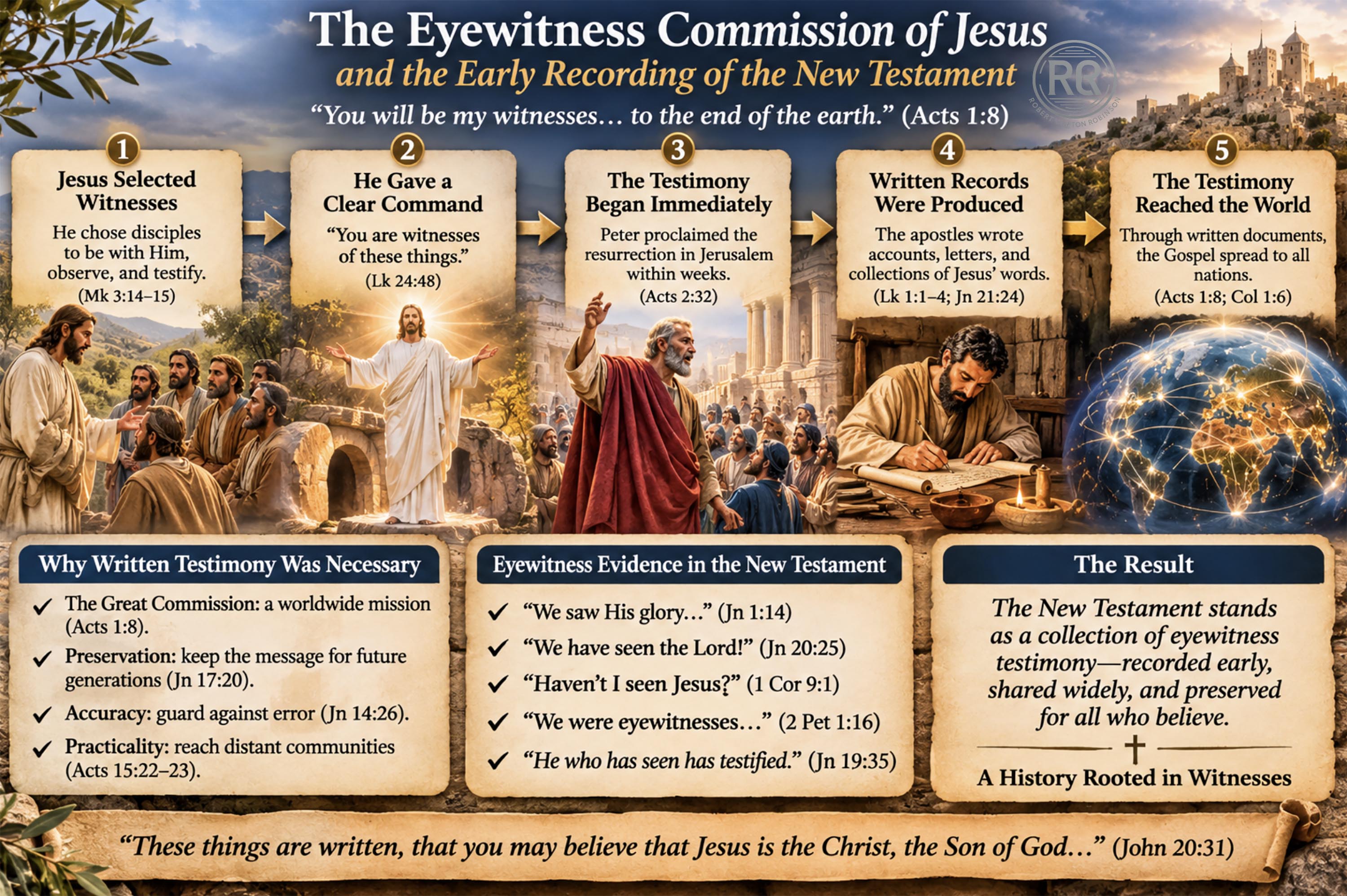
The resurrection testimony preserved in 1 Corinthians
1 Corinthians 15:3–8:
For I delivered to you first of all that which I also received: that Christ died for our sins according to the Scriptures, that he was buried, that he was raised on the third day according to the Scriptures, and that he appeared to Cephas, then to the twelve. Then he appeared to over five hundred brothers at once, most of whom remain until now, but some have also fallen asleep. Then he appeared to James, then to all the apostles, and last of all, as to the child born at the wrong time, he appeared to me also.
Paul uses two important Greek terms: παρέδωκα — paredōka: I delivered or handed down. παρέλαβον — parelabon: “I received.” These terms describe the transmission of established information. First Corinthians is generally dated to approximately AD 53–55. However, Paul expressly states that he had previously received and delivered this information.
The testimony therefore predates the composition of the letter itself. This testimony that Paul is describing came from the eyewitness records of the men who had been with Jesus from the beginning.
Many New Testament scholars, including those who do not accept the supernatural claims of Christianity, recognize that at least the central formula in 1 Corinthians 15:3–5 preserves a tradition substantially earlier than Paul’s letter.¹ Some scholars place the formation of this tradition within the first years following the crucifixion.
This does establish that the central historical claims concerning the death, burial, resurrection, and appearances of Jesus were being transmitted long before the commonly proposed dates of the completed canonical Gospels.
Paul’s knowledge of the teaching of Jesus
Paul also demonstrates knowledge of specific teachings and events from the life of Jesus.
| Pauline text | Teaching or Event | Gospel Parallel |
|---|---|---|
| 1 Corinthians 7:10–11 | Jesus’ teaching concerning divorce | Mark 10:2–12 |
| 1 Corinthians 9:14 | The right of Gospel workers to receive support | Luke 10:7 |
| 1 Corinthians 11:23–25 | The Last Supper | Luke 22:19–20 |
| 1 Corinthians 15:3–8 | Death, burial, resurrection, and appearances | Matthew 27–28; Luke 23–24; John 19–21 |
| 1 Thessalonians 4:15–17 | Teaching concerning the coming of the Lord | Matthew 24:30–31 |
| Romans 12:14 | Blessing those who persecute believers | Matthew 5:44 |
| Romans 13:9 | Loving one’s neighbor | Matthew 22:39 |
These parallels establish that substantial information concerning Jesus was already available to Paul and the churches to which he wrote. They establish that Paul possessed copies of Matthew, Mark, or Luke in some form. The evidence is entirely compatible with the existence of written collections of Jesus’ teachings and eyewitness narratives during the earliest missionary activity of the Church.
The first-century world possessed the means to record the words of Jesus as He spoke them
There is no historical basis for assuming that the disciples of Jesus lived in a society incapable of recording, preserving, and distributing written information. Writing was routinely employed throughout the Roman Empire for commercial, governmental, religious, legal, and personal purposes. Archaeological discoveries have preserved numerous examples of ancient written material, including commercial transactions, private correspondence, contracts, military records, religious manuscripts, and administrative documents.
The materials available during the first century included papyrus, parchment, wax tablets, wooden writing tablets, and pottery fragments known as ostraca.
The New Testament identifies writing materials in ordinary use.
Luke 1:63:
He asked for a writing tablet, and wrote, “His name is John.”
2 Timothy 4:13:
Bring the cloak that I left at Troas with Carpus when you come, and the books, especially the parchments.
2 John 12:
Having many things to write to you, I don’t want to do so with paper and ink, but I hope to come to you and to speak face to face, that our joy may be made full.
3 John 13:
I had many things to write to you, but I am unwilling to write to you with ink and pen.
These passages demonstrate that oral communication and written communication existed alongside one another within the earliest Christian communities. The possibility that some of Jesus’ disciples made written records during His earthly ministry is therefore neither technologically nor historically impossible. The idea that critical scholars like Bart Ehrman have, that these men whom Jesus called to follow Him were illiterate and unable to write Koine Greek or Hebrew is preposterous! There is no evidence this is true.
Matthew’s occupation as a tax collector
Matthew is particularly relevant to this discussion. In order for the Roman government to invest the time and money in hiring Matthew to be a Tax Collector, he had to be highly literate in Hebrew and Greek, as well as other foreign languages.
Matthew 9:9:
As Jesus passed by from there, he saw a man called Matthew sitting at the tax collection office. He said to him, “Follow me.” He got up and followed him.
Tax collection involved financial administration, numerical calculations, and the maintenance of records. Matthew’s occupation therefore provides a reasonable basis for considering whether he possessed practical literacy or experience with written documentation. This does prove his literacy in Koine Greek and establishes that he likely maintained a notebook during the ministry of Jesus. It also demonstrates that the idea of critical scholars that none of Jesus’ disciples could have recorded His teaching is not true.
Ancient authors also frequently employed secretaries and scribes. An individual’s ability to produce written testimony did not necessarily depend upon his personally inscribing every word.
Paul’s letter to the Romans provides an explicit example.
Romans 16:22:
I, Tertius, who write the letter, greet you in the Lord.
Paul was the author of Romans, but Tertius identifies himself as the individual who physically wrote the letter. The use of an amanuensis was an established practice in the ancient world.² Even if some of the Apostles possessed limited literary education, this would not have prevented them from producing written testimony through the assistance of others.
The earliest Christian communities were already using written documents to establish authoritative teaching
Acts 15 records an important example of the early Church employing written communication to transmit authoritative decisions to geographically separated believers. The Jerusalem Council is commonly dated to approximately AD 48–50. Following the council, the apostles and elders prepared a written document to be delivered to the churches.
Acts 15:22–23:
Then it seemed good to the apostles and the elders, with the whole assembly, to choose men out of their company, and send them to Antioch with Paul and Barnabas: Judas called Barsabbas, and Silas, chief men among the brothers. They wrote these things by their hand.
Acts 15:30–31:
So, when they were sent off, they came to Antioch. Having gathered the multitude together, they delivered the letter. When they had read it, they rejoiced over the encouragement.
Acts 16:4:
As they went on their way through the cities, they delivered the decrees to them to keep which had been ordained by the apostles and elders who were at Jerusalem.
These texts describe an organized system for the production, authentication, transportation, and distribution of written instructions by the Apostles and eyewitnesses of Jesus. According to Acts, by approximately AD 49, the Church was already employing written documents to preserve authoritative decisions and ensure consistency of teaching among geographically separated congregations.
This raises an important historical question:
If the apostles recognized the importance of committing administrative and doctrinal decisions to writing within the first two decades of Christianity, would they not have possessed an equally compelling incentive to preserve the words and works of Jesus Himself?
This fact demonstrates that the early Christian Church possessed both the means and the organizational infrastructure necessary to produce and distribute written apostolic material.
Paul instructed churches to circulate and publicly read written documents
The practice of circulating Christian writings is expressly documented in the New Testament.
Colossians 4:16:
When this letter has been read among you, cause it to be read also in the assembly of the Laodiceans; and that you also read the letter from Laodicea.
1 Thessalonians 5:27:
I solemnly command you by the Lord that this letter be read to all the holy brothers.
First Thessalonians is generally dated to approximately AD 49–51 and is widely regarded as one of the earliest surviving New Testament documents. Paul was already instructing Christian communities to receive and publicly read written Christian teaching less than twenty years after the crucifixion of Jesus.
The practice of circulating written material was not a late development that emerged only after the original eyewitnesses had died. It was already established during the apostolic period. Paul recognized the necessity of transmitting authoritative written teaching through many generations.
2 Timothy 2:2:
The things which you have heard from me among many witnesses, commit the same things to faithful men who will be able to teach others also.
This text describes four successive stages of transmission: Paul, Timothy, faithful teachers, and those subsequently instructed by those teachers. Written records would provide an effective way of maintaining consistency throughout this process.
John identifies himself as the eyewitness who wrote his testimony
The Gospel of John contains two particularly important statements concerning the relationship between eyewitness observation and written documentation.
John 19:35:
He who has seen has testified, and his testimony is true. He knows that he tells the truth, that you may believe.
The Greek verb μεμαρτύρηκεν (memartyrēken) is a perfect active indicative form of μαρτυρέω, meaning to testify or bear witness. The perfect tense presents the testimony as an accomplished act with continuing relevance. The eyewitness had provided testimony, and that testimony remained available for the benefit of future believers.
John 21:24:
This is the disciple who testifies about these things, and wrote these things. We know that his testimony is true.
The Greek text is particularly clear: Οὗτός ἐστιν ὁ μαθητὴς ὁ μαρτυρῶν περὶ τούτων καὶ ὁ γράψας ταῦτα. Houtos estin ho mathētēs ho martyrōn peri toutōn kai ho grapsas tauta.
“This is the disciple who testifies concerning these things and who wrote these things.”
Two distinct activities are attributed to the same disciple: ὁ μαρτυρῶν — ho martyrōn: The one who testifies. ὁ γράψας — ho grapsas: The one who wrote. The text associates the testimony with the act of writing. It does not merely describe an unidentified tradition circulating among Christian communities. It attributes the testimony and writing to a particular disciple identified within the narrative.
This is precisely the relationship we would expect from the commission recorded in John 15:27. Jesus selected individuals to testify because they had been with Him from the beginning. The Gospel concludes by identifying a disciple who testified and wrote concerning these things.
The testimony recorded in First John is expressly presented as firsthand evidence
1 John 1:1–4:
That which was from the beginning, that which we have heard, that which we have seen with our eyes, that which we saw, and our hands touched, concerning the Word of life (and the life was revealed, and we have seen, and testify, and declare to you the life, the eternal life, which was with the Father, and was revealed to us); that which we have seen and heard we declare to you, that you also may have fellowship with us. Yes, and our fellowship is with the Father, and with his Son, Jesus Christ. And we write these things to you, that our joy may be fulfilled.
The progression of the author’s argument is remarkable.
Personal observation
“We have seen with our eyes”
Personal hearing experience
“That which we have heard”
Physical contact
“Our hands touched”
Eyewitness testimony
“We have seen, and testify”
Written preservation
“We write these things to you”
The writer connects personal experience, seeing and hearing, with the testimony being preserved in writing. This is not the literary presentation of a writer who claims merely to have inherited an anonymous religious tradition. The author presents the information as originating in personal experience. The historical credibility of that claim must be evaluated separately, but its explicit presence in the document is beyond dispute.
The testimony of Papias concerning the early recording of the words of Jesus
An important source outside the New Testament is Papias, bishop of Hierapolis, who wrote during the early second century. His work, Exposition of the Sayings of the Lord, were preserved by Eusebius in his Ecclesiastical History.
Papias wrote concerning Mark:
Mark having become the interpreter of Peter, wrote down accurately whatsoever he remembered.
Papias further explains that Mark was careful not to omit what he had heard or introduce false information into his account.³
Concerning Matthew, Papias states:
Matthew put together the oracles in the Hebrew language, and each one interpreted them as best he could.⁴
These statements are important because they preserve an early Christian tradition concerning the relationship between the apostles, the sayings of Jesus, and the production of written accounts. It also proves that Matthew and Mark were not illiterate. This is historical evidence that the words of Jesus existed before the completed canonical Gospels and is consistent with both the testimony of Papias and the opening statement of Luke.
Papias provides evidence for an early tradition of Apostolic testimony being committed to writing.
The distinction between original eyewitness records and the completed canonical Gospels
This is perhaps the most important distinction to establish when discussing the dating of the New Testament with critical scholars.
There are at least four distinct chronological questions.
| Historical question | What is being dated? |
|---|---|
| When did the events occur? | The earthly ministry, death, and resurrection of Jesus. |
| When was testimony first communicated? | The earliest reports made by those who witnessed the events. |
| When was the testimony first recorded? | The earliest written notes, sayings, accounts, and collections. |
| When was the canonical Gospel completed? | The final literary form of the document preserved in the New Testament. |
These are not all necessarily the same dates. A historian could accept that a particular Gospel reached its completed literary form in AD 70 while also recognizing that some of its sources originated in the 30s or 40s. This is important because the certainty that the men who had been with Jesus “since the beginning of His ministry, recorded the words and events of Jesus because this is what Jesus wanted them to do.
When we examine the texts from Jesus where He made it clear that He called these men for the express purpose of preserving a testimony about Him, it is certain that this is what they did. This is particularly true when Jesus began to perform the tens of thousands of miracles that took place.
When someone asserts that the Gospels were written forty to sixty years after Jesus, this is often a disingenuous claim because the total text of these narratives may have been added for years after the primary events took place and were written. It is certain that by the time Paul departed for Asia on his first missionary journey in 45, Paul was carrying these early written accounts of Jesus with him.
There is no evidence in the historical record that men who never met Jesus recorded the New Testament late in the first century, as critical scholars sometimes claim. Neither the Christian Church in the second century, nor any other source from the first or second centuries, has produced written evidence that the four Gospels we have in manuscript form today were composed by non-eyewitnesses who never met Jesus, and that these Gospels were written later in the first century. This is purely a fabricated and unsubstantiated assertion.
Luke acknowledges that these earlier narratives existed from the men who had been with Jesus, even before he began to write his Gospel. Paul also preserves knowledge of texts about Jesus that predate his letters. Papias describes the recording of apostolic testimony. The New Testament documents the early use and circulation of Christian writings.
All of these considerations make the possibility of substantially earlier written sources historically credible.
A chronology of the earliest testimony concerning Jesus:
Approximate chronology of events and documented testimony
-
AD 27–32— Earthly ministry of Jesus
Jesus selects disciples to accompany Him, hear His teaching, observe His works, and subsequently testify. Contemporary written notes are possible, but no surviving document establishes their existence.
-
AD 32— Crucifixion and resurrection
The disciples claim to have witnessed Jesus alive following His execution.
-
Within weeks — Public testimony at Pentecost
Peter publicly proclaims the resurrection in Jerusalem, according to Acts 2.
-
Early to mid-30s — Earliest resurrection traditions
The central tradition subsequently preserved in 1 Corinthians 15 is often dated by scholars to this early period.
-
AD 35–39 — Paul meets Peter and James
Galatians 1:18–19 records Paul’s personal contact with two individuals identified as resurrection witnesses.
-
AD 45–48 — First missionary journey
Paul and Barnabas establish Christian communities in Cyprus and Asia Minor.
-
AD 48–50 — Jerusalem Council
Apostolic instructions are committed to writing and distributed among the churches, according to Acts 15–16.
-
AD 49–51 — First Thessalonians
Surviving written evidence of established Christian teaching and public reading of apostolic correspondence.
-
AD 53–55 — First Corinthians
Paul records the earlier resurrection testimony and identifies numerous witnesses, many reportedly still alive.
-
AD 60–100 — Commonly proposed Gospel composition dates by critics that are without evidence.
Historical and Critical/Progressive Scholars assign differing dates to the completed canonical Gospels. Earlier dates are also defended..
The historical argument for contemporaneous written testimony
The argument for the early recording of the words and works of Jesus can be formulated as a cumulative historical argument.
Premise 1: Jesus deliberately selected individuals to personally observe His life, teaching, and works.
Premise 2: Jesus expressly commissioned these individuals to communicate what they had seen and heard to the entire world.
Premise 3: This commission was implemented immediately, as events took place, and following His resurrection, according to the earliest Christian narratives.
Premise 4: Jesus anticipated that future generations would believe through the written testimony of these men He called to be His witnesses.
Premise 5: Written documentation was an established means of preserving and distributing information in the first-century Roman world.
Premise 6: The early Christian Church demonstrably employed written communication during the lifetime of the apostles.
Premise 7: Luke expressly acknowledges that numerous narrative accounts preceded his Gospel.
Premise 8: Paul preserves testimony concerning Jesus that originated substantially earlier than his surviving letters.
Premise 9: The Gospel of John and First John expressly associate eyewitness testimony with written documentation.
The early production of written records concerning Jesus is historically proven, consistent with the stated purposes of the apostolic commission, and supported by multiple lines of textual and circumstantial evidence. The likelihood that these records originated during the earthly ministry of Jesus, as they happened, deserves serious historical consideration.
This is an inductive historical argument rather than a deductive demonstration of the precise dates of the original autographs. Its strength lies in the convergence of multiple considerations.
Why the absence of surviving contemporary autographs does not establish their nonexistence
No original autograph of any canonical New Testament book, or any secular book or event, is presently known to survive.
However, the absence of an original document does not establish that the document never existed at an earlier date. Historians routinely distinguish between the date of an original composition and the date of the earliest surviving manuscript copy. The survival of ancient writing materials was dependent upon numerous circumstances, including climate, humidity, storage conditions, frequency of use, and accidental destruction. Papyrus can survive for thousands of years under exceptional conditions, particularly in arid environments. Under ordinary conditions, however, it was susceptible to deterioration within 200 years.
Early Christian documents were also functional writings. They were intended to be read, transported, copied, and circulated. Consequently, the absence of surviving written notes from the ministry of Jesus cannot legitimately be used as conclusive evidence that no such notes were produced. Historical investigation must therefore evaluate the cumulative textual, literary, and circumstantial evidence rather than treating manuscript survival as the sole criterion for determining when information was first recorded.
Does the eyewitness commission demand that the Gospels were written early?
There are three different propositions that should be distinguished.
| Proposition | Evidentiary assessment |
|---|---|
| Testimony concerning Jesus originated during His ministry and immediately following His resurrection. | Explicitly asserted by the New Testament. |
| Written records concerning Jesus existed before the completion of the canonical Gospels. | Substantially supported by Luke 1:1–4 and the evidence of earlier sources. |
| The original autographs of all four canonical Gospels were written as the events occurred. | Possible only in the sense of preliminary records; not directly established for the completed Gospels. |
The distinction is important because the Gospels include events that occurred at the conclusion of Jesus’ earthly ministry. Their completed forms necessarily postdate at least those events. Jesus’ command to testify could initially be fulfilled through these written texts. The command requires every event to be documented in writing at the moment it occurred, because this is the only way that persons in distant lands could access this testimony. What the commandments of Jesus do establish is an immediate responsibility to preserve and communicate the testimony. Written documentation was a natural and effective means of fulfilling that responsibility.
The strongest defensible historical position is therefore that the testimony underlying the New Testament originated with the events themselves, and there were substantial practical, biblical, and historical incentives for that testimony to be committed to writing during the lifetime of Jesus and the eyewitnesses, potentially beginning during the ministry of Jesus.
This position does not require proving more than the available evidence permits.
Jesus established a system for preserving historical testimony
The New Testament presents Jesus as deliberately establishing a system through which knowledge of His life, teaching, death, and resurrection would be communicated to future generations. He selected the witnesses. He instructed them. He permitted them to personally observe His works. He commissioned them to testify. He promised the assistance of the Holy Spirit. He anticipated that subsequent generations would believe through their testimony. All these required an immediate writing of what was seen and heard.
The apostles subsequently identified themselves as witnesses, publicly proclaimed what they claimed to have seen, established churches throughout the Roman Empire, and employed written documents to preserve and distribute authoritative Christian teaching.
The Gospel of John identifies a disciple who both testified and wrote concerning these things. First John describes testimony originating in sight, hearing, and physical contact that was subsequently committed to writing. Although John does not name himself at the beginning of His Gospel, he does identify himself throughout the Gospel that bears his name. Luke acknowledges numerous earlier narratives derived from a tradition originating with eyewitnesses.
These facts provide a substantial historical basis for challenging the assumption that information concerning Jesus necessarily remained unwritten for several decades following His resurrection. The dates commonly assigned to the completed canonical Gospels cannot, by themselves, establish the dates on which the testimony contained within them was first recorded.
The possibility of contemporary written records, early collections of the sayings of Jesus, accounts of His miracles, and narratives of His death and resurrection is entirely consistent with the historical environment and stated purposes of the earliest Christian movement.
The commission of Jesus created the immediate responsibility to testify. The geographical expansion of Christianity created the incentive to distribute that testimony. The mortality of the witnesses created the incentive to preserve it. Written documentation provided the means by which all three objectives could be accomplished.
The historical argument for early written eyewitness testimony rests not upon speculation alone, but upon the stated purpose of the apostolic commission, the documented practices of the earliest Christian communities, and the explicit declarations of the New Testament writers themselves.
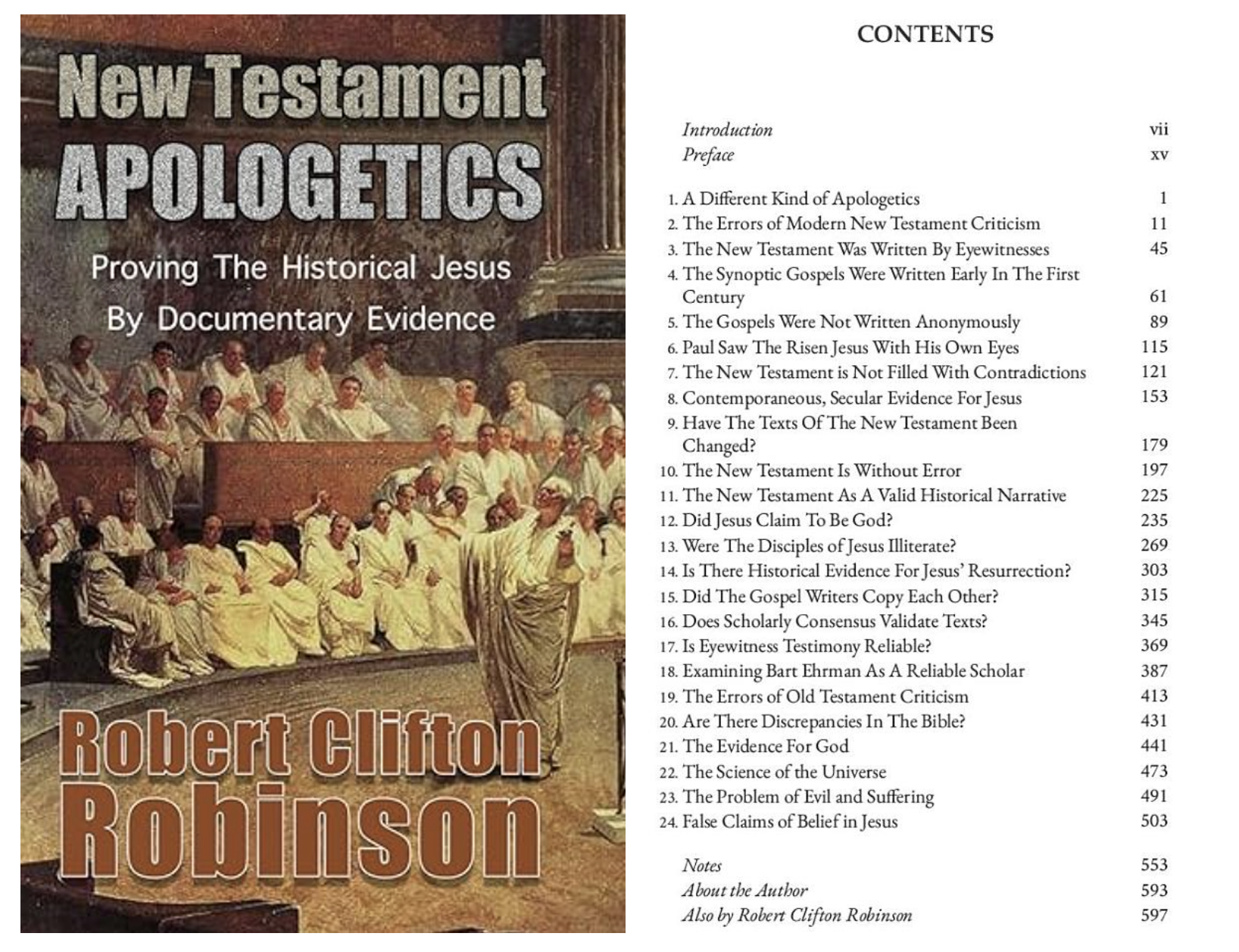
See Rob’s Extensive Apologetic Work on the New Testament That Impeaches the 21 Primary Arguments of Atheists Regarding the Reliability of the New Testament.
“New Testament Apologetics,” by Robert Clifton Robinson
Sources and Citations
1. James D. G. Dunn, Jesus Remembered, Christianity in the Making, vol. 1 (Grand Rapids: Eerdmans, 2003), 855. Dunn discusses the exceptionally early origin of the resurrection tradition preserved in 1 Corinthians 15. See also N. T. Wright, The Resurrection of the Son of God (Minneapolis: Fortress Press, 2003), 319–338.
2. E. Randolph Richards, Paul and First-Century Letter Writing: Secretaries, Composition and Collection (Downers Grove, IL: InterVarsity Press, 2004). An extensive examination of ancient secretarial practices, letter composition, and the production of Pauline correspondence.
3. Eusebius, Ecclesiastical History, 3.39.15. Papias’s testimony concerning Mark’s preservation of the preaching of Peter.
4. Eusebius, Ecclesiastical History, 3.39.16. Papias’s statement concerning Matthew’s compilation of the logia of Jesus.
Additional Scholarly Resources
The following works are particularly useful for further developing this argument into a comprehensive apologetic treatment of the early composition of the New Testament:
5. Richard Bauckham, Jesus and the Eyewitnesses: The Gospels as Eyewitness Testimony, 2nd ed. (Grand Rapids: Eerdmans, 2017).
6. Birger Gerhardsson, Memory and Manuscript: Oral Tradition and Written Transmission in Rabbinic Judaism and Early Christianity (Lund: Gleerup, 1961).
7. Alan Millard, Reading and Writing in the Time of Jesus (Sheffield: Sheffield Academic Press, 2000). Particularly relevant to the possibility of written records being produced during the earthly ministry of Jesus.
8. Craig S. Keener, Christobiography: Memory, History, and the Reliability of the Gospels (Grand Rapids: Eerdmans, 2019).
9. Colin J. Hemer, The Book of Acts in the Setting of Hellenistic History, ed. Conrad H. Gempf (Tübingen: Mohr Siebeck, 1989).
10. John A. T. Robinson, Redating the New Testament (London: SCM Press, 1976). A sustained scholarly argument for dating the New Testament documents before the destruction of Jerusalem in AD 70.
11. Martin Hengel, The Four Gospels and the One Gospel of Jesus Christ, trans. John Bowden (London: SCM Press, 2000).
12. Rainer Riesner, Jesus als Lehrer: Eine Untersuchung zum Ursprung der Evangelien-Überlieferung, 3rd ed. (Tübingen: Mohr Siebeck, 1988). A detailed investigation of Jesus as a teacher and the origins of the Gospel tradition.
13. Harry Y. Gamble, Books and Readers in the Early Church: A History of Early Christian Texts (New Haven: Yale University Press, 1995).
14. Larry W. Hurtado, The Earliest Christian Artifacts: Manuscripts and Christian Origins (Grand Rapids: Eerdmans, 2006).
15. Frederick William Danker, ed., A Greek-English Lexicon of the New Testament and Other Early Christian Literature, 3rd ed. (Chicago: University of Chicago Press, 2000).
All biblical quotations are from the World English Bible. The scholarly references are supplied for further research; the individual editions and page references have not been independently rechecked for this response.
Categories: Robert Clifton Robinson


Please see, "Guidelines For Debate," at the right-side menu. Post your comment or argument here: