It is a frequent claim by critics of the New Testament that eyewitnesses didn’t write these texts, and that men who never saw or heard Jesus wrote the New Testament late in the first century.
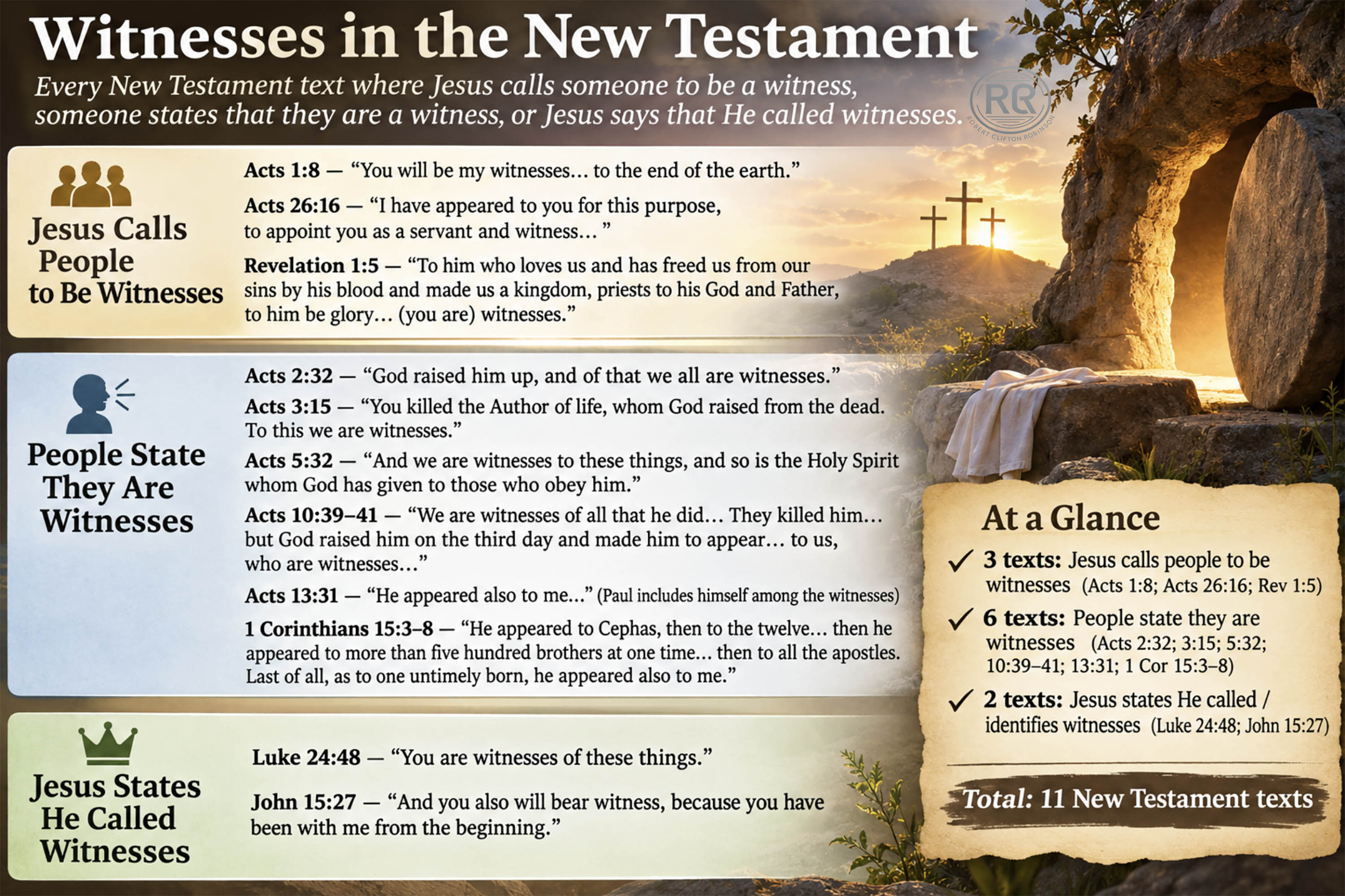
Jesus specifically called people to be His witnesses. The apostles identified themselves as witnesses, publicly testified that they had seen Jesus resurrected, and recorded that God had intentionally chosen people to provide testimony concerning Him.
The Greek terms specified in these texts are significant:
|
Koine Greek |
Transliteration |
Meaning |
|---|---|---|
|
μάρτυς |
martys |
A witness; one who provides testimony |
|
μαρτυρέω |
martyreō |
To bear witness, testify, or attest |
|
μαρτυρία |
martyria |
Testimony or evidence given by a witness |
|
μαρτύριον |
martyrion |
Testimony or attestation |
|
αὐτόπτης |
autoptēs |
An eyewitness; one who has personally seen something |
|
ἐπόπτης |
epoptēs |
An eyewitness or personal observer |
|
διαμαρτύρομαι |
diamartyromai |
To testify solemnly or emphatically |
I have organized the following collection according to the nature of the testimony, distinguishing explicit declarations of eyewitness status from statements of commissioning, personal observation, and written testimony.
All Scripture quotations are from the World English Bible (WEB).
Jesus specifically calls and calls His witnesses
Mark 3:14–15
He appointed twelve, that they might be with him, and that he might send them out to preach, and to have authority to heal sicknesses and to cast out demons.
Notice the sequence: Jesus first appointed individuals to be with Him, and subsequently sent them out to proclaim His message. Their personal association with Jesus preceded their public ministry.
Luke 24:46–49
He said to them, “Thus it is written, and thus it was necessary for the Christ to suffer and to rise from the dead the third day, and that repentance and remission of sins should be preached in his name to all the nations, beginning at Jerusalem. You are witnesses of these things. Behold, I send out the promise of my Father on you. But wait in the city of Jerusalem until you are clothed with power from on high.”
Jesus identifies these persons as witnesses to His miracles that prove He is God, His suffering, death, and resurrection.
The Greek text in Luke 24 verse 48 is: ὑμεῖς μάρτυρες τούτων, Hymeis martyres toutōn.
Literally: “You are witnesses of these things.”
John 15:26–27
“When the Counselor has come, whom I will send to you from the Father, the Spirit of truth, who proceeds from the Father, he will testify about me. You will also testify, because you have been with me from the beginning.”
This is one of the most important statements concerning the evidentiary qualifications of the apostles. Jesus identifies their continuous personal relationship with Him as the foundation for their testimony.
John 17:18
As you sent me into the world, even so I have sent them into the world.
John 17:20
Not for these only do I pray, but for those also who will believe in me through their word.
Jesus knew that in every generation, people would believe in Him through the testimony of the men He had personally called to be His witnesses.
John 20:21
Jesus therefore said to them again, “Peace be to you. As the Father has sent me, even so I send you.”
Acts 1:8
But you will receive power when the Holy Spirit has come upon you. You will be witnesses to me in Jerusalem, in all Judea and Samaria, and to the uttermost parts of the earth.
The Greek text reads: καὶ ἔσεσθέ μου μάρτυρες, Kai esesthe mou martyres. “And you will be my witnesses.”
This is a clear commission from the resurrected Jesus for His disciples to provide testimony concerning Him throughout the world.
Acts 22:14–15
Ananias explains to Paul why God had chosen him:
He said, “The God of our fathers has appointed you to know his will, and to see the Righteous One, and to hear a voice from his mouth. For you will be a witness for him to all men of what you have seen and heard.”
Paul’s appointment involved three specific qualifications: seeing Jesus, hearing Jesus, and testifying concerning what he had personally seen and heard.
Acts 26:15–18
Paul recounts the words that Jesus personally spoke to him:
“I said, ‘Who are you, Lord?’
He said, ‘I am Jesus, whom you are persecuting. But arise, and stand on your feet, for I have appeared to you for this purpose: to appoint you a servant and a witness both of the things which you have seen and of the things which I will reveal to you; delivering you from the people and from the Gentiles, to whom I send you, to open their eyes, that they may turn from darkness to light and from the power of Satan to God, that they may receive remission of sins and an inheritance among those who are sanctified by faith in me.’”
Here Jesus expressly states that one of the purposes of His appearance to Paul was to appoint him as a witness.
The Apostles establish eyewitness testimony as a qualification for Apostleship
Acts 1:21–22
Peter describes the qualifications necessary for the individual who would replace Judas Iscariot:
“Of the men therefore who have accompanied us all the time that the Lord Jesus went in and out among us, beginning from the baptism of John, to the day that he was received up from us, of these one must become a witness with us of his resurrection.”
This establishes a specific historical qualification for Judas’s replacement; the Apostle must have seen the risen Jesus:
- He must have accompanied Jesus during His earthly ministry.
- He must have been present from the time of John’s baptism.
- He must have been associated with the disciples through the ascension of Jesus.
- He must have been a witness to the resurrection of Jesus.
The selection of Judas’s replacement was not merely based upon biblical knowledge or personal conviction. Peter required that a witness for Jesus had to be an eyewitness of all He said and did, and especially His resurrection.
The apostles publicly declare themselves witnesses of Jesus
Acts 2:32
This Jesus God raised up, to which we all are witnesses.
Koine Greek: οὗ πάντες ἡμεῖς ἐσμεν μάρτυρες “Of which we all are witnesses.” Peter publicly identifies the apostles as witnesses to the resurrection of Jesus in Jerusalem.
Acts 3:15
And killed the Prince of life, whom God raised from the dead, to which we are witnesses.
Peter again expressly identifies himself and others as witnesses to the resurrection.
Acts 4:20
For we can’t help telling the things which we saw and heard.
Peter and John make this declaration before the Jewish authorities who had commanded them to cease speaking in the name of Jesus. Their defense was based upon what they had personally seen and heard.
Acts 4:33
With great power, the apostles gave their testimony of the resurrection of the Lord Jesus. Great grace was on them all.
Luke describes the combined testimony of the Apostles concerning the resurrection.
Acts 5:30–32
The God of our fathers raised up Jesus, whom you killed, hanging him on a tree. God exalted him with his right hand to be a Prince and a Savior, to give repentance to Israel, and remission of sins. We are his witnesses of these things; and so also is the Holy Spirit, whom God has given to those who obey him.
The apostles identify themselves as witnesses before the Jewish council.
Acts 10:39–43
This is among the most comprehensive statements of eyewitness testimony in the New Testament.
We are witnesses of everything he did both in the country of the Jews and in Jerusalem; whom they also killed, hanging him on a tree. God raised him up the third day, and gave him to be revealed, not to all the people, but to witnesses who were chosen before by God, to us, who ate and drank with him after he rose from the dead. He commanded us to preach to the people and to testify that this is he who is appointed by God as the Judge of the living and the dead. All the prophets testify about him, that through his name everyone who believes in him will receive remission of sins.
Peter makes several extraordinary claims concerning the witnesses of Jesus:
- They witnessed His earthly ministry.
- They testified concerning His execution.
- They witnessed Him alive after His resurrection.
- They had been specifically chosen by God to be witnesses.
- They ate and drank with Jesus after His resurrection.
- Jesus commanded them to provide testimony concerning Him.
The Greek texts in Acts 10:41 is important: μάρτυσιν τοῖς προκεχειροτονημένοις ὑπὸ τοῦ θεοῦ, Marty sin tois prokecheirotonēmenois hypo tou theou.
“To witnesses who had been chosen beforehand by God.”
According to Peter, the selection of witnesses was a deliberate act of God.
Acts 13:30–31
Paul, speaking in the synagogue at Pisidian Antioch:
But God raised him from the dead, and he was seen for many days by those who came up with him from Galilee to Jerusalem, who are his witnesses to the people.
Paul distinguishes those who accompanied Jesus during His earthly ministry and subsequently saw Him resurrected.
Acts 20:24
Paul describes the ministry he received directly from Jesus:
But these things don’t count; nor do I hold my life dear to myself, so that I may finish my race with joy, and the ministry which I received from the Lord Jesus, to fully testify to the Good News of the grace of God.
Acts 22:20
Paul recounts his former persecution of Christians:
When the blood of Stephen, your witness, was shed, I also was standing by, and consenting to his death, and guarding the cloaks of those who killed him.
Stephen is identified by the Hebrew scholar Paul as a witness of Jesus.
Acts 23:11
The resurrected Jesus speaks directly to Paul:
The following night, the Lord stood by him and said, “Cheer up, Paul, for as you have testified about me at Jerusalem, so you must testify also at Rome.”
Jesus personally acknowledges Paul’s testimony concerning Him and commissions him to continue that testimony in Rome.
Acts 26:22–23
Having therefore obtained the help that is from God, I stand to this day testifying both to small and great, saying nothing but what the prophets and Moses said would happen, how the Christ must suffer, and how, by the resurrection of the dead, he would be first to proclaim light both to these people and to the Gentiles.
Acts 28:23
When they had appointed him a day, many people came to him at his lodging. He explained to them, testifying about God’s Kingdom, and persuading them concerning Jesus, both from the law of Moses and from the prophets, from morning until evening.
The Gospel writers identify eyewitness testimony as the basis of their narratives
Luke 1:1–4
Since many have undertaken to set in order a narrative concerning those matters which have been fulfilled among us, even as those who from the beginning were eyewitnesses and servants of the word delivered them to us, it seemed good to me also, having traced the course of all things accurately from the first, to write to you in order, most excellent Theophilus; that you might know the certainty concerning the things in which you were instructed.
Luke specifically identifies eyewitness testimony as the foundation of his historical investigation.
The Greek word translated “eyewitnesses” is: αὐτόπται — autoptai. The term denotes individuals who have personally seen the events concerning which they provide information.
Luke describes four elements of his historical methodology:
- Previous written narratives concerning Jesus.
- Information delivered by eyewitnesses.
- Careful investigation of the events from their beginning.
- An orderly written account intended to establish certainty.
Luke does not claim in this text that he personally witnessed the entire earthly ministry of Jesus. Rather, he explicitly identifies eyewitnesses as the sources from whom the historical information was received. Luke was acting as a precise and accurate historian of the true events that concern Jesus.
John 1:14
The Word became flesh and lived among us. We saw his glory, such glory as of the only born Son of the Father, full of grace and truth.
Greek: καὶ ἐθεασάμεθα τὴν δόξαν αὐτοῦ
Kai etheasametha tēn doxan autou. “And we beheld His glory.”
John includes himself within this public declaration of things he personally saw and heard.
John 19:35
He who has seen has testified, and his testimony is true. He knows that he tells the truth, that you may believe.
This statement occurs immediately following the description of the Roman soldier piercing the side of Jesus.
The Greek text reads: καὶ ὁ ἑωρακὼς μεμαρτύρηκεν, καὶ ἀληθινὴ αὐτοῦ ἐστιν ἡ μαρτυρία
Kai ho heōrakōs memartyrēken, kai alēthinē autou estin hē martyria.
“And the one who has seen has testified, and his testimony is true.”
The text connects personal observation, testimony, truthfulness, and the purpose for which the testimony was recorded.
John 20:30–31
Therefore Jesus did many other signs in the presence of his disciples, which are not written in this book; but these are written, that you may believe that Jesus is the Christ, the Son of God, and that believing you may have life in his name.
The writer explains that the events recorded in his Gospel were selected from a larger body of events that occurred in the presence of the disciples. Jesus healed tens of thousands of people, but only 40 specific events of healing were chosen to write into the historical record.
John 21:24–25
This is the disciple who testifies about these things, and wrote these things. We know that his testimony is true. There are also many other things which Jesus did, which if they would all be written, I suppose that even the world itself wouldn’t have room for the books that would be written.
The Gospel explicitly associates the disciple who provides the testimony with the writing of these things.
The Greek text of verse 24 reads: Οὗτός ἐστιν ὁ μαθητὴς ὁ μαρτυρῶν περὶ τούτων καὶ ὁ γράψας ταῦτα
“This is the disciple who testifies concerning these things and who wrote these things.”
The text also contains an affirmation by the witnesses of Jesus of their truthful testimony.
People personally declare that they have seen Jesus resurrected
Luke 24:33–35
They rose up that very hour, returned to Jerusalem, and found the eleven gathered together, and those who were with them, saying, “The Lord is risen indeed, and has appeared to Simon!” They related the things that happened along the way, and how he was recognized by them in the breaking of the bread.
The two disciples who encountered Jesus on the road to Emmaus reported their personal experience to the disciples.
John 20:18
Mary Magdalene came and told the disciples that she had seen the Lord, and that he had said these things to her.
Mary Magdalene provides testimony concerning both what she saw and what Jesus said to her. This is a unique and exceptional testimony included in the New Testament record, for no woman during the first century was held credible by the leaders of Israel, yet Jesus wanted Mary’s testimony included in His record.
John 20:25
The other disciples therefore said to him, “We have seen the Lord!”
Greek: Ἑωράκαμεν τὸν κύριον, Heōrakamen ton kyrion.
“We have seen the Lord.”
This is the personal statement of the disciples to Thomas concerning their personal encounter with the resurrected Jesus.
John 20:27–29
Then he said to Thomas, “Reach here your finger, and see my hands. Reach here your hand, and put it into my side. Don’t be unbelieving, but believing.”
Thomas answered him, “My Lord and my God!”
Jesus said to him, “Because you have seen me, you have believed. Blessed are those who have not seen, and have believed.”
Jesus expressly acknowledges that Thomas had seen Him. Thomas’s declaration concerning the identity of Jesus follows that personal encounter.
1 Corinthians 9:1
Paul writes:
Am I not free? Am I not an apostle? Haven’t I seen Jesus Christ, our Lord with my own eyes? Aren’t you my work in the Lord?
Greek: οὐχὶ Ἰησοῦν τὸν κύριον ἡμῶν ἑόρακα; Ouchi Iēsoun ton kyrion hēmōn heōraka?
“Have I not seen Jesus our Lord with my eyes?”
Paul appeals to his personal encounter with Jesus in the context of defending his apostleship.
1 Corinthians 15:3–8
For I delivered to you first of all that which I also received: that Christ died for our sins according to the Scriptures, that he was buried, that he was raised on the third day according to the Scriptures, and that he appeared to Cephas, then to the twelve. Then he appeared to over five hundred brothers at once, most of whom remain until now, but some have also fallen asleep. Then he appeared to James, then to all the apostles, and last of all, as to the child born at the wrong time, he appeared to me also.
Paul identifies multiple individuals and groups who had seen Jesus after His resurrection.
|
Witnesses identified by Paul |
Reference |
|---|---|
|
Cephas (Peter) |
1 Corinthians 15:5 |
|
The Twelve |
1 Corinthians 15:5 |
|
More than 500 people at once |
1 Corinthians 15:6 |
|
James |
1 Corinthians 15:7 |
|
All the apostles |
1 Corinthians 15:7 |
|
Paul himself |
1 Corinthians 15:8 |
Paul specifically writes that most of the five hundred were still alive when he wrote.
This is historically significant because Paul presents the resurrection as an event witnessed by numerous individuals, many of whom were still alive when people first read these texts, early in the first century. The text Paul reports is their testimony, rather than five hundred individually preserved depositions.
1 Corinthians 15:14–15
If Christ has not been raised, then our preaching is in vain, and your faith also is in vain. Yes, we are also found false witnesses of God, because we testified about God that he raised up Christ, whom he didn’t raise up, if it is so that the dead are not raised.
Paul recognizes that the truthfulness of the testimony by the Apostles depends upon whether the resurrection actually occurred, and these men can testify that they saw the risen Jesus. If Jesus had not been raised, Paul acknowledges that the apostles would be false witnesses.
This is a remarkable statement of the historical foundation upon which Christianity rests.
Peter identifies himself as an eyewitness
1 Peter 5:1
Therefore I exhort the elders among you, as a fellow elder and a witness of the sufferings of Christ, and who will also share in the glory that will be revealed.
Greek: μάρτυς τῶν τοῦ Χριστοῦ παθημάτων. Martys tōn tou Christou pathēmatōn.
“A witness of the sufferings of Christ.”
Peter identifies himself as a witness of the sufferings of Jesus.
2 Peter 1:16–18
For we didn’t follow cunningly devised fables when we made known to you the power and coming of our Lord Jesus Christ, but we were eyewitnesses of his majesty. For he received from God the Father honor and glory when the voice came to him from the Majestic Glory, “This is my beloved Son, in whom I am well pleased.” We heard this voice come out of heaven when we were with him on the holy mountain.
This is one of the strongest statement of eyewitness testimony in the New Testament.
The Greek text reads: ἀλλ᾽ ἐπόπται γενηθέντες τῆς ἐκείνου μεγαλειότητος. All’ epoptai genēthentes tēs ekeinou megaleiotētos.
“But having become eyewitnesses of His majesty.”
Peter makes three specific claims:
- The narratives were not cleverly devised myths.
- The individuals personally witnessed the majesty of Jesus.
- They personally heard the voice from heaven while accompanying Jesus on the mountain.
The passage corresponds to the narratives of the transfiguration recorded in Matthew 17:1–8, Mark 9:2–8, and Luke 9:28–36.
John writes that he saw, heard, and physically touched Jesus
1 John 1:1–4
That which was from the beginning, that which we have heard, that which we have seen with our eyes, that which we saw, and our hands touched, concerning the Word of life (and the life was revealed, and we have seen, and testify, and declare to you the life, the eternal life, which was with the Father, and was revealed to us); that which we have seen and heard we declare to you, that you also may have fellowship with us. Yes, and our fellowship is with the Father, and with his Son, Jesus Christ. And we write these things to you, that our joy may be fulfilled.
This text contains several distinct expressions of personal sensory experience.
|
Greek Text |
Meaning |
|---|---|
|
ὃ ἀκηκόαμεν |
That which we have heard |
|
ὃ ἑωράκαμεν |
That which we have seen |
|
τοῖς ὀφθαλμοῖς ἡμῶν |
With our own eyes |
|
ὃ ἐθεασάμεθα |
That which we have beheld |
|
αἱ χεῖρες ἡμῶν ἐψηλάφησαν |
Our hands have touched |
|
μαρτυροῦμεν |
We testify |
The writer does not merely claim to have received information about Jesus. He expressly appeals to sight, hearing, physical contact, and personal observation as the foundation for the testimony being communicated.
1 John 4:14
We have seen and testify that the Father has sent the Son as the Savior of the world.
Greek: καὶ ἡμεῖς τεθεάμεθα καὶ μαρτυροῦμεν, Kai hēmeis tetheametha kai martyroumen.
“And we have seen and we testify.”
Once again, personal observation is directly associated with testimony.
Paul states that his knowledge and commission came directly from Jesus
Galatians 1:1
Paul, an apostle—not from men, neither through man, but through Jesus Christ and God the Father, who raised him from the dead.
Galatians 1:11–12
But I make known to you, brothers, concerning the Good News which was preached by me, that it is not according to man. For I didn’t receive it from man, nor was I taught it, but it came to me through revelation of Jesus Christ.
Galatians 1:15–16
But when it was the good pleasure of God, who separated me from my mother’s womb and called me through his grace, to reveal his Son in me, that I might preach him among the Gentiles, I didn’t immediately confer with flesh and blood.
Acts 9:15–17
Jesus speaks to Ananias concerning Paul:
But the Lord said to him, “Go your way, for he is my chosen vessel to bear my name before the nations and kings, and the children of Israel. For I will show him how many things he must suffer for my name’s sake.”
Ananias departed and entered into the house. Laying his hands on him, he said, “Brother Saul, the Lord, who appeared to you on the road by which you came, has sent me, that you may receive your sight and be filled with the Holy Spirit.”
Acts 9:27
But Barnabas took him and brought him to the apostles, and declared to them how he had seen the Lord on the way, and that he had spoken to him, and how at Damascus he had preached boldly in the name of Jesus.
This is an additional report of Paul’s encounter with Jesus, communicated by Barnabas to the apostles.
1 Timothy 2:7
To which I was appointed a preacher and an apostle (I am telling the truth in Christ, not lying), a teacher of the Gentiles in faith and truth.
2 Timothy 1:10–11
But has now been revealed by the appearing of our Savior, Christ Jesus, who abolished death, and brought life and immortality to light through the Good News. For this I was appointed as a preacher, an apostle, and a teacher of the Gentiles.
These texts establish the fact that Paul’s calling as an Apostle, was directly by Jesus Himself
John the Baptist was specifically sent by God to be a witness of Jesus
John 1:6–8
There came a man sent from God, whose name was John. The same came as a witness, that he might testify about the light, that all might believe through him. He was not the light, but was sent that he might testify about the light.
The stated purpose of John’s ministry was to provide testimony concerning Jesus.
John 1:15
John testified about him. He cried out, saying, “This was he of whom I said, ‘He who comes after me has surpassed me, for he was before me.’”
John 1:19–20
This is John’s testimony, when the Jews sent priests and Levites from Jerusalem to ask him, “Who are you?”
He declared, and didn’t deny, but he declared, “I am not the Christ.”
John 1:29–34
The next day, he saw Jesus coming to him, and said, “Behold, the Lamb of God, who takes away the sin of the world! This is he of whom I said, ‘After me comes a man who is preferred before me, for he was before me.’ I didn’t know him, but for this reason I came baptizing in water: that he would be revealed to Israel.” John testified, saying, “I have seen the Spirit descending like a dove out of heaven, and it remained on him. I didn’t recognize him, but he who sent me to baptize in water said to me, ‘On whomever you will see the Spirit descending and remaining on him is he who baptizes in the Holy Spirit.’ I have seen, and have testified that this is the Son of God.”
John identifies both his calling by Jesus and the specific events he personally witnessed.
John 3:26
They came to John and said to him, “Rabbi, he who was with you beyond the Jordan, to whom you have testified, behold, he baptizes, and everyone is coming to him.”
John 5:33–35
Jesus personally acknowledges the testimony of John:
You have sent to John, and he has testified to the truth. But the testimony which I receive is not from man. However, I say these things that you may be saved. He was the burning and shining lamp, and you were willing to rejoice for a while in his light.
John 10:41
Many came to him. They said, “John indeed did no sign, but everything that John said about this man is true.”
The Other witnesses who provide personal testimony concerning Jesus
John 4:28–29
The Samaritan woman reports her encounter with Jesus:
So the woman left her water pot, went away into the city, and said to the people, “Come, see a man who told me everything that I did. Can this be the Christ?”
John 4:39
From that city many of the Samaritans believed in him because of the word of the woman, who testified, “He told me everything that I did.”
John 4:42
They said to the woman, “Now we believe, not because of your speaking; for we have heard for ourselves, and know that this is indeed the Christ, the Savior of the world.”
John 9:25
The man who had been born blind testifies concerning his healing:
He therefore answered, “I don’t know if he is a sinner. One thing I do know: that though I was blind, now I see.”
John 12:17
The multitude therefore that was with him when he called Lazarus out of the tomb and raised him from the dead was testifying about it.
This text identifies a multitude of people who provided testimony concerning the raising of Lazarus.
Mark 5:19–20
Jesus commissions the man whom He had delivered from demonic possession to report what had happened to him:
He didn’t allow him, but said to him, “Go to your house, to your friends, and tell them what great things the Lord has done for you and how he had mercy on you.”
He went his way, and began to proclaim in Decapolis how Jesus had done great things for him, and everyone marveled.
The parallel accounts are Matthew 8:28–34 and Luke 8:26–39, with Luke also recording the commission to testify.
Luke 8:39
“Return to your house, and declare what great things God has done for you.” He went his way, proclaiming throughout the whole city what great things Jesus had done for him.
Matthew 28:7–10
“Go quickly and tell his disciples, ‘He has risen from the dead, and behold, he goes before you into Galilee; there you will see him.’ Behold, I have told you.”
They departed quickly from the tomb with fear and great joy, and ran to bring his disciples word. As they went to tell his disciples, behold, Jesus met them, saying, “Rejoice!”
They came and took hold of his feet, and worshiped him.
Then Jesus said to them, “Don’t be afraid. Go tell my brothers that they should go into Galilee, and there they will see me.”
The women were not merely observers of the resurrected Jesus. Jesus personally commissioned them to communicate what had occurred.
Acts 7:55–56
Stephen personally declares that he sees Jesus:
But he, being full of the Holy Spirit, looked up steadfastly into heaven and saw the glory of God, and Jesus standing on the right hand of God, and said, “Behold, I see the heavens opened and the Son of Man standing at the right hand of God!”
Stephen is identified as a witness of Jesus in Acts 22:20.
Paul identifies those who personally heard Jesus as the source of the testimony
Hebrews 2:3–4
How will we escape if we neglect so great a salvation—which at the first having been spoken through the Lord, was confirmed to us by those who heard, God also testifying with them, both by signs and wonders, by various works of power, and by gifts of the Holy Spirit, according to his own will?
Paul describes a chain of testimony:
- Jesus personally proclaimed the message.
- Those who heard Jesus confirmed the message to others.
- God bore witness alongside them through signs and wonders.
Like Luke 1:1–4, this passage identifies individuals who personally heard Jesus as the sources of the transmitted testimony.
John records his personal testimony in Revelation
Revelation 1:1–2
This is the Revelation of Jesus Christ, which God gave him to show to his servants the things which must happen soon, which he sent and made known by his angel to his servant, John, who testified to God’s word and of the testimony of Jesus Christ, about everything that he saw.
Revelation 1:9–11
I John, your brother and partner with you in the oppression, Kingdom, and perseverance in Christ Jesus, was on the isle that is called Patmos because of God’s Word and the testimony of Jesus Christ. I was in the Spirit on the Lord’s day, and I heard behind me a loud voice, like a trumpet saying, “What you see, write in a book and send to the seven assemblies.”
Revelation 1:17–19
When I saw him, I fell at his feet like a dead man.
He laid his right hand on me, saying, “Don’t be afraid. I am the first and the last, and the Living one. I was dead, and behold, I am alive forever and ever. Amen. I have the keys of Death and of Hades. Write therefore the things which you have seen, and the things which are, and the things which will happen hereafter.”
Jesus specifically commands John to write concerning the things he has seen.
Revelation 2:13
Jesus identifies Antipas as His witness:
I know your works and where you dwell, where Satan’s throne is. You hold firmly to my name, and didn’t deny my faith in the days of Antipas my witness, my faithful one, who was killed among you, where Satan dwells.
Greek: Ἀντιπᾶς ὁ μάρτυς μου ὁ πιστός μου
“Antipas, my witness, my faithful one.”
Revelation 22:8
Now I, John, am the one who heard and saw these things. When I heard and saw, I fell down to worship before the feet of the angel who had shown me these things.
Revelation 22:16
I, Jesus, have sent my angel to testify these things to you for the assemblies. I am the root and the offspring of David, the Bright and Morning Star.
Revelation 22:20
He who testifies these things says, “Yes, I am coming soon.”
Amen! Yes, come, Lord Jesus.
These scriptures concern testimony, which should be distinguished from eyewitness testimony concerning the earthly ministry of Jesus.
Jesus describes Himself as a witness and identifies other witnesses who testify concerning Him
John 3:11
Most certainly I tell you, we speak that which we know, and testify of that which we have seen, and you don’t receive our witness.
John 3:31–33
He who comes from above is above all. He who is from the earth belongs to the earth and speaks of the earth. He who comes from heaven is above all. What he has seen and heard, of that he testifies; and no one receives his witness. He who has received his witness has set his seal to this, that God is true.
John 5:31–32
If I testify about myself, my witness is not valid. It is another who testifies about me. I know that the testimony which he testifies about me is true.
John 5:36–37
But the testimony which I have is greater than that of John, for the works which the Father gave me to accomplish, the very works that I do, testify about me, that the Father has sent me. The Father himself, who sent me, has testified about me.
John 5:39
You search the Scriptures, because you think that in them you have eternal life; and these are they which testify about me.
John 8:14
Jesus answered them, “Even if I testify about myself, my testimony is true, for I know where I came from, and where I am going; but you don’t know where I came from, or where I am going.”
John 8:17–18
“It’s also written in your law that the testimony of two people is valid. I am one who testifies about myself, and the Father who sent me testifies about me.”
Jesus appeals to the legal principle of multiple witnesses, established in Deuteronomy 19:15.
John 10:25
Jesus answered them, “I told you, and you don’t believe. The works that I do in my Father’s name, these testify about me.”
John 18:37
Pilate therefore said to him, “Are you a king then?”
Jesus answered, “You say that I am a king. For this reason I have been born, and for this reason I have come into the world, that I should testify to the truth. Everyone who is of the truth listens to my voice.”
1 Timothy 6:13
I command you before God, who gives life to all things, and before Christ Jesus, who before Pontius Pilate testified the good confession.
Revelation 1:5
And from Jesus Christ, the faithful witness, the firstborn of the dead, and the ruler of the kings of the earth.
Revelation 3:14
To the angel of the assembly in Laodicea write:
“The Amen, the Faithful and True Witness, the Beginning of God’s creation, says these things.”
Additional references concerning the commissioning and testimony of Jesus’ witnesses
The following passages also contribute to the New Testament’s presentation of testimony, commissioning, and the transmission of information concerning Jesus, although they do not all explicitly assert personal eyewitness status.
|
Scripture |
Nature of Testimony |
|---|---|
|
Matthew 10:1–8 |
Jesus commissions the twelve apostles. |
|
Matthew 10:18–20 |
Jesus anticipates testimony before governors and kings. |
|
Matthew 24:14 |
The Gospel will be proclaimed as a testimony to all nations. |
|
Matthew 28:18–20 |
Jesus commissions the disciples to teach all nations. |
|
Mark 6:7–13 |
Jesus sends out the Twelve. |
|
Mark 13:9–11 |
The disciples will testify before rulers. |
|
Mark 16:15–20 |
Jesus commissions the proclamation of the Gospel. |
|
Luke 9:1–6 |
Jesus commissions the Twelve. |
|
Luke 10:1–20 |
Jesus appoints and sends additional disciples. |
|
Luke 21:12–15 |
Persecution will provide an opportunity for testimony. |
|
Acts 8:25 |
Peter and John testify and speak the word of the Lord. |
|
Acts 18:5 |
Paul testifies that Jesus is the Christ. |
|
Acts 20:21 |
Paul testifies to Jews and Greeks concerning repentance and faith in Jesus. |
|
Romans 1:1–5 |
Paul identifies his commission through Jesus Christ. |
|
Romans 15:18 |
Paul describes what Christ accomplished through him. |
|
1 Corinthians 1:6 |
The testimony of Christ was confirmed among the Corinthians. |
|
1 Corinthians 11:23–26 |
Paul identifies the Lord as the source of his teaching concerning the Last Supper. |
|
2 Corinthians 4:13–14 |
Paul declares his conviction concerning the resurrection. |
|
1 Thessalonians 2:4 |
Paul describes being entrusted with the Gospel by God. |
|
2 Thessalonians 1:10 |
Paul refers to the apostolic testimony that was believed. |
|
2 Timothy 1:8 |
Paul refers to the testimony of the Lord. |
|
2 Timothy 2:2 |
Timothy is instructed to transmit what he heard from Paul among many witnesses. |
|
1 John 5:6–12 |
John describes the testimony of God and the Spirit concerning Jesus. |
|
3 John 12 |
The writer affirms the truthfulness of his testimony. |
|
Revelation 6:9 |
Those killed because of the word of God and their testimony. |
|
Revelation 11:3–7 |
Jesus commissions His two prophetic witnesses. |
|
Revelation 12:11 |
Believers overcome through the blood of the Lamb and their testimony. |
|
Revelation 12:17 |
Those who hold the testimony of Jesus. |
|
Revelation 17:6 |
The witnesses of Jesus who were killed. |
|
Revelation 19:10 |
The testimony of Jesus is identified with the spirit of prophecy. |
|
Revelation 20:4 |
Those executed because of their testimony concerning Jesus. |
Mark 16:15–20 is included as part of the traditional longer ending of Mark, whose textual history is disputed.
The most important eyewitness statements:
For purposes of New Testament apologetics, the following texts are included because they expressly identify witnesses, personal observation, divine selection of witnesses, or a commission from Jesus to provide testimony.
|
Scripture |
Evidentiary Declaration |
|---|---|
|
Luke 1:1–4 |
The narratives were derived from eyewitnesses. |
|
Luke 24:48 |
Jesus: “You are witnesses of these things.” |
|
John 1:14 |
“We saw his glory.” |
|
John 1:34 |
“I have seen, and have testified.” |
|
John 15:27 |
“You will also testify, because you have been with me from the beginning.” |
|
John 19:35 |
“He who has seen has testified.” |
|
John 20:18 |
Mary Magdalene reports seeing Jesus. |
|
John 20:25 |
“We have seen the Lord!” |
|
John 21:24 |
The disciple testifies and writes concerning these things. |
|
Acts 1:8 |
Jesus: “You will be witnesses to me.” |
|
Acts 1:21–22 |
Personal association with Jesus required for Judas’s replacement. |
|
Acts 2:32 |
“We all are witnesses.” |
|
Acts 3:15 |
“To which we are witnesses.” |
|
Acts 4:20 |
“The things which we saw and heard.” |
|
Acts 4:33 |
The apostles testify concerning the resurrection. |
|
Acts 5:32 |
“We are his witnesses of these things.” |
|
Acts 10:39 |
“We are witnesses of everything he did.” |
|
Acts 10:41 |
“Witnesses who were chosen before by God.” |
|
Acts 10:42 |
Jesus commanded the witnesses to testify. |
|
Acts 13:31 |
“Who are his witnesses to the people.” |
|
Acts 22:15 |
Paul appointed a witness of what he saw and heard. |
|
Acts 23:11 |
Jesus acknowledges Paul’s testimony. |
|
Acts 26:16 |
Jesus appoints Paul as a witness. |
|
1 Corinthians 9:1 |
Paul: “Haven’t I seen Jesus Christ, our Lord?” |
|
1 Corinthians 15:3–8 |
Paul identifies multiple resurrection witnesses. |
|
1 Corinthians 15:15 |
Paul identifies the apostles as witnesses of God. |
|
Hebrews 2:3–4 |
The message was confirmed by those who heard Jesus. |
|
1 Peter 5:1 |
“A witness of the sufferings of Christ.” |
|
2 Peter 1:16–18 |
“We were eyewitnesses of his majesty.” |
|
1 John 1:1–4 |
Personal sight, hearing, physical contact, and testimony. |
|
1 John 4:14 |
“We have seen and testify.” |
The significance of these statements in establishing the historical claims of the New Testament
The New Testament presents a deliberate system of selecting, commissioning, preserving, and communicating testimony concerning Jesus. Its writers claim that Jesus did not merely appear in the world, teach certain religious principles, and leave subsequent generations to speculate concerning His identity. The narratives describe Jesus as deliberately selecting individuals who would accompany Him, observe His works, hear His teaching, witness His resurrection, and subsequently communicate their testimony to the world.
This is evident when the following five passages are examined together:
John 15:27 — The qualification of the witnesses:
You will also testify, because you have been with me from the beginning.
Acts 10:41 — The selection of the witnesses:
Witnesses who were chosen before by God.
Acts 1:8 — The commission of the witnesses:
You will be witnesses to me.
Acts 4:20 — The content of their testimony:
For we can’t help telling the things which we saw and heard.
John 21:24 — The written preservation of their testimony:
This is the disciple who testifies about these things, and wrote these things. We know that his testimony is true.
These five scriptures describe the selection, qualification, commissioning, public testimony, and written preservation of the testimony concerning Jesus.
The distinction is important in historical and forensic apologetics. The New Testament does not present its central claims merely as abstract religious philosophy. It presents them as assertions concerning events that allegedly occurred in history, accompanied by express claims of personal observation and testimony.
Whether a historian accepts those claims is a separate question from whether the documents contain them. Questions concerning authorship, independence, dating, transmission, and credibility require additional historical investigation. Nevertheless, the existence of these explicit eyewitness claims within the New Testament is indisputable as a matter of textual content.
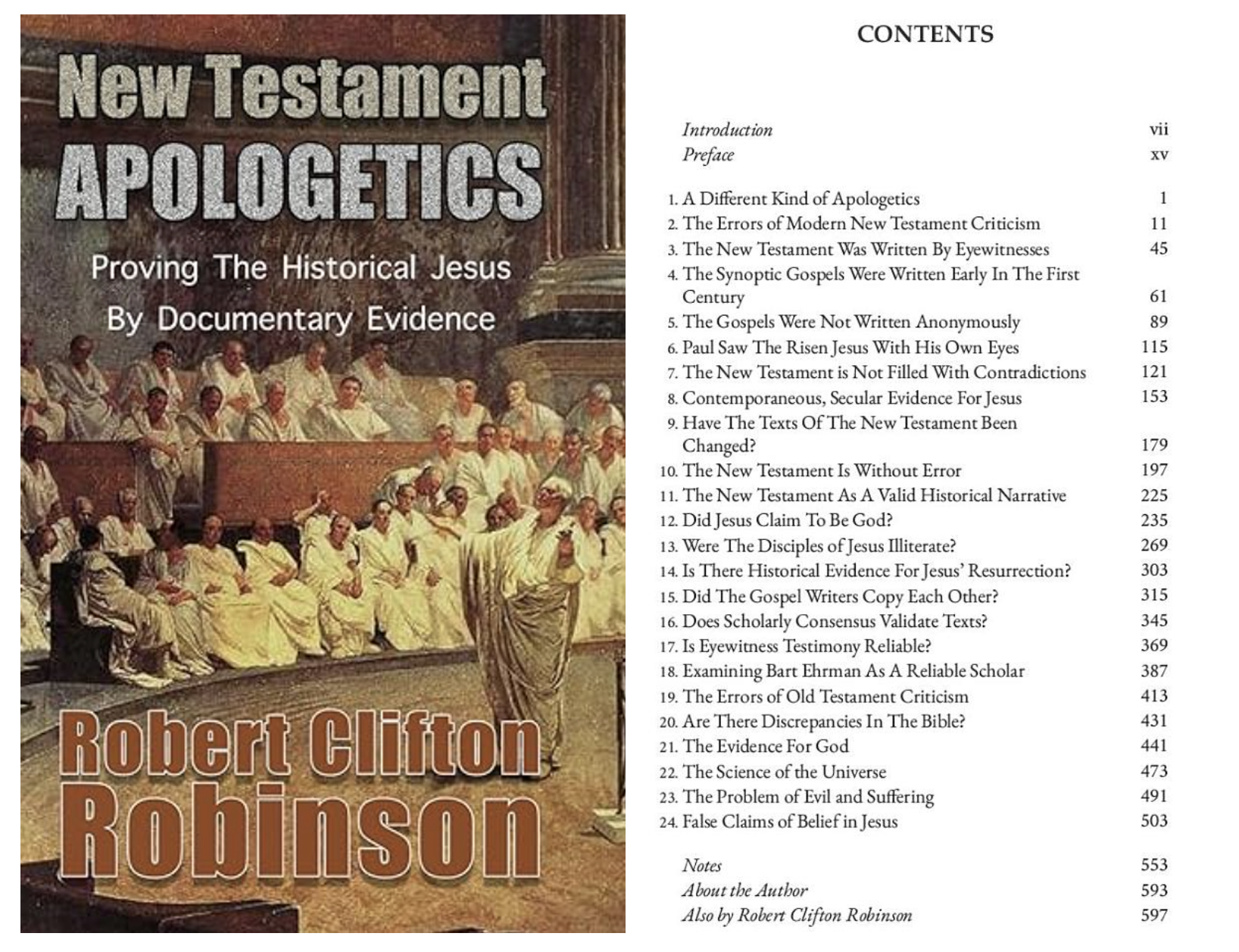
See Rob’s New Book That Documents The 21 Primary Arguments of Critics Who Seek To Impeach The Historical Reliability of the New Testament: “New Testament Apologetics“
Sources and Citations
-
World English Bible. Public-domain English translation of the Holy Scriptures.
-
Nestle-Aland. Novum Testamentum Graece. 28th revised edition. Stuttgart: Deutsche Bibelgesellschaft, 2012.
-
Danker, Frederick William, ed. A Greek-English Lexicon of the New Testament and Other Early Christian Literature. 3rd edition. Chicago: University of Chicago Press, 2000. See entries for μάρτυς, μαρτυρέω, μαρτυρία, αὐτόπτης, and ἐπόπτης.
-
Bauckham, Richard. Jesus and the Eyewitnesses: The Gospels as Eyewitness Testimony. 2nd edition. Grand Rapids: Eerdmans, 2017.
-
Hemer, Colin J. The Book of Acts in the Setting of Hellenistic History. Edited by Conrad H. Gempf. Tübingen: J. C. B. Mohr (Paul Siebeck), 1989.
-
Keener, Craig S. Christobiography: Memory, History, and the Reliability of the Gospels. Grand Rapids: Eerdmans, 2019.
-
Keener, Craig S. Acts: An Exegetical Commentary. 4 volumes. Grand Rapids: Baker Academic, 2012–2015.
-
Wright, N. T. The Resurrection of the Son of God. Minneapolis: Fortress Press, 2003.
-
Licona, Michael R. The Resurrection of Jesus: A New Historiographical Approach. Downers Grove: IVP Academic, 2010.
Categories: Robert Clifton Robinson


Please see, "Guidelines For Debate," at the right-side menu. Post your comment or argument here: