Kebar Enis
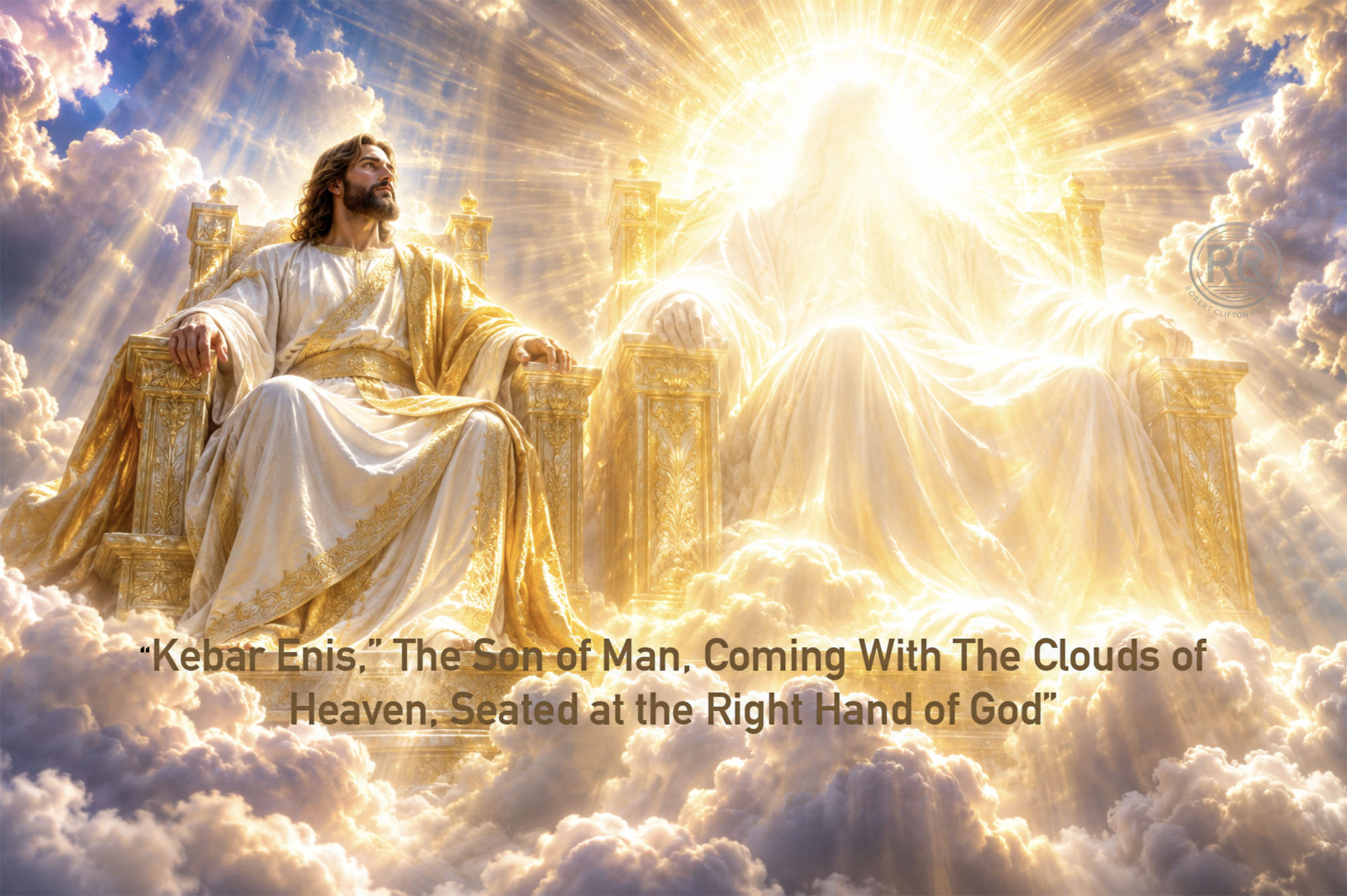
Aramaic, Hebrew, and Koine Greek words are defined by their context and usage in the Bible. The Aramaic words “Kebar Enis” are used to describe the Messiah, who, in context, is the “One who will sit at the Right Hand of God, and “Comes with the Clouds of Heaven.” This usage to describe Yahweh, the Living God, as the Messiah was so well known during the time that Jesus was on earth that when Jesus used these terms for Himself, the High Priest, Caiaphas, understood that Jesus was claiming to be Yahweh, the Eternal God, and accused Jesus of “Blasphemy,” condemning Him to death.
Matthew 26:62-66 “And the high priest arose and said to Him, “Do You answer nothing? What is it these men testify against You?” 63 But Jesus kept silent. And the high priest answered and said to Him, “I put You under oath by the living God: Tell us if You are the Christ, the Son of God!”
64 Jesus said to him, “It is as you said. Nevertheless, I say to you, hereafter you will see the Son of Man sitting at the right hand of the Power, and coming on the clouds of heaven.” 65 Then the high priest tore his clothes, saying, “He has spoken blasphemy! What further need do we have of witnesses? Look, now you have heard His blasphemy! 66 What do you think?” They answered and said, “He is deserving of death.”
There are three citations from early church fathers who confirm the context and meaning of kebar enis in Daniel 7: 13; Justin Martyr, Jerome, Hippolytus
Daniel 7:13 “I was watching in the night visions, and behold, One like the Son of Man, Coming with the clouds of heaven!
Psalms 110:1 “A psalm of David. The LORD said to my Lord, “Sit in the place of honor at my right hand
until I humble your enemies, making them a footstool under your feet.”
Daniel 7:13 (Ancient Christian Commentary on Scripture) JUSTIN MARTYR: Does not Daniel allude to this very truth when he says that he who received the eternal kingdom is “as a Son of man”? The words “as a Son of man” indicate that he would become man and appear as such but that he would not be born of a human seed. DIALOGUE WITH TRYPHO 76.
Daniel 7:13 (Ancient Christian Commentary on Scripture) THE SON OF MAN AS THE ROCK NOW INCARNATE. JEROME: He who was described in the dream of Nebuchadnezzar as a rock cut without hands, which also grew to be a large mountain and smashed the earthenware, the iron, the bronze, the silver and the gold, is now introduced as the very person of the Son of man, so as to indicate in the case of the Son of God how he took on himself human flesh. 7.13–14.
Daniel 7:13 (Ancient Christian Commentary on Scripture) THE WORD UNINCARNATE. HIPPOLYTUS: Who was in heaven but the Word unincarnate, who was dispatched to show that he was on earth and was also in heaven? For he was Word, he was Spirit, he was Power. The same took to himself the name common and current among humankind and was called from the beginning the Son of man on account of what he was to be, although he was not yet man, as Daniel testifies when he says, “I saw, and behold, one like the Son of man came on the clouds of heaven.” Rightly, then, did he say that he who was in heaven was called from the beginning by this name, the Word of God, as being that from the beginning. AGAINST NOETUS 4.
Kebar Enis is only used in Daniel 7:13; it is not found anywhere else in the Bible. In its full context here in Daniel 7:13, and later confirmed by Jesus in the New Testament, there is no doubt that Kebar Enis means the Messiah who is God in human flesh.
Jesus’ words at his trial describe Daniel’s description of the Messiah, and early Christian writers understood that figure to point to Jesus
What does “kebar enis” mean?
Daniel 7:13 has the Aramaic כְּבַר אֱנָשׁ, often transliterated kəḇar ʾĕnāš or kebar enash. Your spelling “kebar enis” is a transliteration of the same phrase, though enash may be easier for readers to recognize in reference works.
The parts mean approximately:
- kə — “like” or “as”
- bar — “son”
- enash — “man” or “human being”
The phrase means “like a son of man,” or more naturally, “like a human being.” The “like” matters: Daniel describes what the figure in the Messiah will be. The context and usage of this term give us the full meaning. For a correct exposition of any original language term, we should investigate the entire text of the Bible for its usage. In doing this, we find what Daniel meant by “kebar enis“: Jesus, who is God in human flesh, coming to earth as the Son of Man, the Messiah. This is confirmed by the texts above from Matthew 26:62-66, where the High Priest of Israel understood kebar enis as God in human flesh.
Daniel Sees The Messiah Coming With Clouds, Sitting At God’s Right Hand
Daniel sees the humanlike figure coming with the clouds to the Ancient of Days, who gives him dominion, glory, and an everlasting kingdom (Daniel 7:13–14). This is clearly a description of Yahweh coming to earth as Messiah in an exalted scene. The cloud imagery can also invite comparison with Old Testament descriptions of God coming or riding on clouds, such as Psalm 104:3, also describing Messiah as God in human flesh.
At the same time, the vision portrays the figure before the Ancient of Days and receiving authority from him. The interpretation later in the chapter says that the holy ones of the Most High receive the kingdom (7:18, 27).
Also, concerning “sitting at God’s right hand,” Jesus’ statement in Matthew combines descriptions from Daniel 7 with the right-hand language of Psalm 110:1. In Daniel, the movement is toward the Ancient of Days; in Matthew, the combined imagery is applied to the Son of Man’s exaltation and coming as God in human flesh.
What can we conclude from the High Priest, Caiaphas?
Matthew clearly presents Jesus’ answer as the occasion for the high priest’s accusation of blasphemy. Jesus answers a question about whether he is “the Christ, the Son of God” and speaks of the Son of Man at the right hand of Power and coming on heaven’s clouds. This is an exceptionally exalted claim, and the reader can clearly understand this declaration by Jesus as the fulfillment of Daniel’s Prophecy of the Messiah coming as Yahweh in human flesh.
The context of Matthew’s record concerning the Daniel 7:13 texts supports what Caiaphas said concerning Jesus and his belief that Jesus’ words were blasphemous. There is no argument from anyone in the Sanhedrin or among the Pharisees regarding Caiaphas’ interpretation of Jesus’ usage of Daniel 7:13. No objection is noted that this text, “kebar enis,” did not mean God in human flesh.
Confirmation by the early Church Fathers
The three citations are valuable evidence for early Christian interpretation, and they support the larger Christological argument:
- Justin Martyr applies Daniel’s figure to Christ and sees “like a son of man” as pointing to his becoming human and to his extraordinary birth. That is Justin’s theological interpretation, not a literal translation of the Aramaic. Dialogue with Trypho 76
- Jerome connects the figure with the Son of God taking human flesh, and also relates him to the stone in Daniel 2.
- Hippolytus identifies the figure with the preexistent Word, who would become human. The Hippolytus passage appears twice in your notes, so one copy can be removed. Jerome and Hippolytus on Daniel 7
These writers show that the incarnational reading has deep roots in Christian tradition. They do give us confirmation that the Aramaic phrase meant “God incarnate” for the Messiah in Daniel 7:13 is accurate.
See: “Prophecies of the Messiah,” a seven-volume print series, or the singular eBook in Kindle that presents all seven volumes at once, at Amazon
Categories: Robert Clifton Robinson


Please see, "Guidelines For Debate," at the right-side menu. Post your comment or argument here: