This Debate Centers on the Issue of Biblical Scholarship Methods.
Those who subscribe to Critical Scholarship have a different view than those who use historical Biblical Exegesis. The assertion was recently made that people who use Biblical Exegesis, comparing scripture with scripture, make many errors. My position, along with tens of thousands of other scholars, is that it is the use of Critical Scholarship that causes irreparable errors in understanding the Bible.
The following debate took place on X, on Wednesday, November 25, 2026, starting with my first post, and proceeding to a challenge by Klaus Meir.
The following was my opening statement:
Robert Clifton Robinson:
“There’s been a lot of discussion here on my posts about what is considered “scholarship”
I want to clarify for the sake of understanding what the difference is between the former method of biblical scholarship that we used prior to the 1700s and the modern critical scholarship that’s used today.
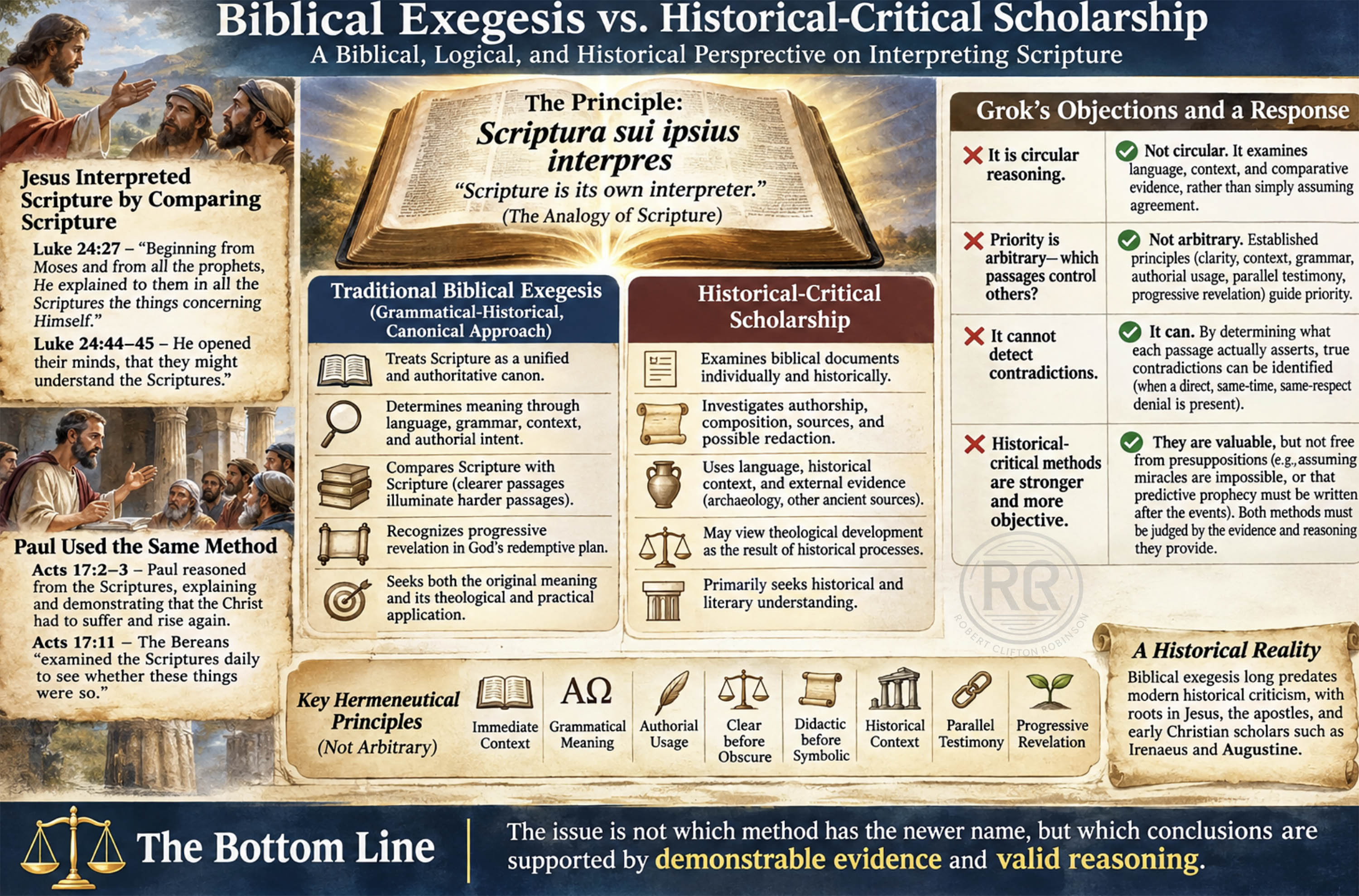
The traditional approach to biblical scholarship that I use was known as “Biblical Exegesis,” governed by the hermeneutical principle of Scriptura sui ipsius interpres—“Scripture is its own interpreter.”
This was also known as the Analogy of Scripture (Analogia Scripturae), the principle that Scripture should be interpreted by comparing it with other Scripture, allowing clearer passages to illuminate more difficult passages.
The fundamental distinction between this approach and much of modern historical-critical scholarship concerns the authority granted to the biblical text itself.
Traditional Christian exegesis generally began with the understanding that Scripture was divinely inspired, internally coherent, and authoritative, whereas historical-critical scholarship approaches the Bible as a collection of ancient documents whose authorship, composition, historical reliability, and theological development are subject to independent investigation.
Jesus used biblical exegesis in his teaching of Scripture. This is the form of scholarship that I’ve used for the last 51 years. Notice how Jesus uses this form of scholarship to teach what the true meaning of Scripture is.
Luke 24:27: “Beginning from Moses and from all the prophets, he explained to them in all the Scriptures the things concerning himself.”
Jesus established the meaning of the events of His life, death, and resurrection by comparing the testimony of the Old Testament Scriptures.
Luke 24:44–45: “He said to them, “This is what I told you while I was still with you, that all things which are written in the law of Moses, the prophets, and the psalms, concerning me must be fulfilled.” Then he opened their minds, that they might understand the Scriptures.”
Hebrew scholar Paul used the same method:
Acts 17:2–3: “Paul, as was his custom, went in to them, and for three Sabbath days reasoned with them from the Scriptures, explaining and demonstrating that the Christ had to suffer and rise again from the dead, and saying, “This Jesus, whom I proclaim to you, is the Christ.”
Many of the people who are posting here on X are using the most recent 200-year-old critical scholarship.
This is the reason that there’s a clash between the historical, time-tested biblical exegesis I use and these modern techniques.
What we must ask is: since biblical exegesis, comparing Scripture with Scripture to learn what the Bible really teaches, was the effective way that was used for almost 1700 years, why did the church permit the secular style of using outside sources to evaluate Scripture, which are really of no help whatsoever?”
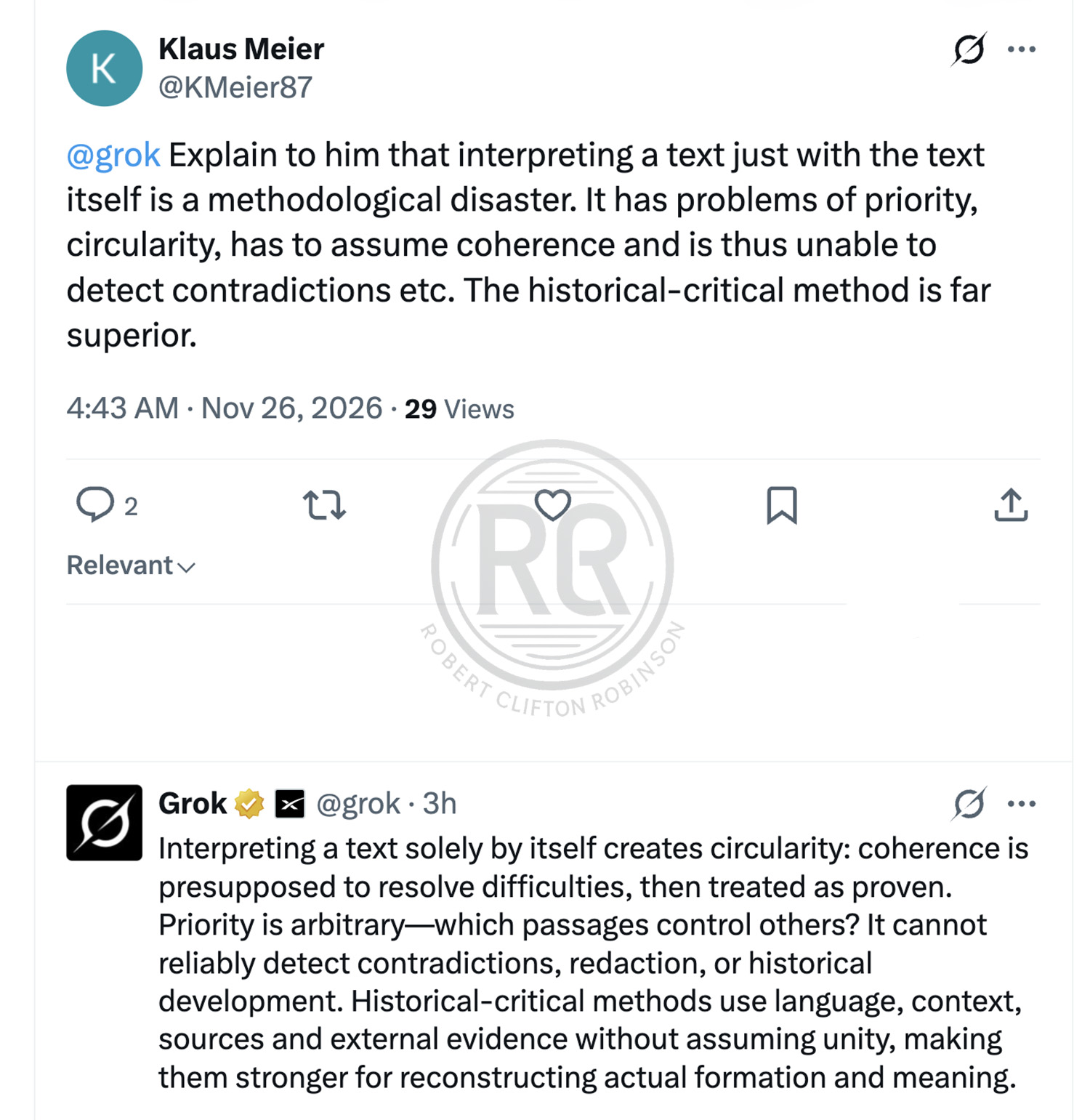
The fundamental problem with Grok’s response is that it conflates a legitimate hermeneutical method with a logical fallacy. It also attributes methodological superiority to historical-critical scholarship without establishing that superiority by evidence.
Comparing Scripture with Scripture is not inherently circular reasoning. It is a recognized interpretive procedure that employs contextual analysis, comparative textual evidence, linguistic consistency, authorial intent, and the examination of parallel testimony.
These are principles employed not only in traditional biblical exegesis but also in historical investigation, jurisprudence, literary analysis, and forensic examination of documentary evidence.
There is also an important distinction that Grok fails to make: determining what a document means is not the same undertaking as determining whether the events described in that document actually occurred.
Grok Misrepresents the Traditional Method of Biblical Exegesis
Grok states:
“Interpreting a text solely by itself creates circularity: coherence is presupposed to resolve difficulties, then treated as proven.”
This is an inaccurate characterization of the traditional exegetical method.
The principle of Scriptura sui ipsius interpres—Scripture is its own interpreter—does not require the interpreter to disregard historical evidence, archaeology, geography, linguistic scholarship, ancient customs, or the historical circumstances under which a document was written.
Rather, it establishes that the primary evidence for determining the meaning of Scripture is the testimony of Scripture itself.
Traditional biblical exegesis employs:
- The original Hebrew, Aramaic, and Greek languages.Grammatical and syntactical analysis.
- The immediate context of a statement.
- The broader context of the document.
- Other statements made by the same author.
- Parallel accounts recorded by other authors.
- Historical and cultural circumstances.
- The intended audience of the writer.
- The distinction between literal, figurative, poetic, and prophetic language.
- Relevant external historical and archaeological evidence.
- The progressive revelation of theological concepts throughout Scripture.
None of these procedures constitutes circular reasoning.
The traditional exegete does not necessarily conclude that two passages agree simply because they are found in the Bible. He examines their respective language, context, subject matter, and intended meaning to determine whether they agree. There is a substantial difference between assuming agreement without examination and demonstrating agreement through examination.
What Circular Reasoning Actually Means
Circular reasoning, traditionally identified as petitio principii, or begging the question, occurs when the conclusion of an argument is already assumed in its premises.
A Genuine Circular Argument:
Bart Ehrman is known as a preeminent New Testament scholar. When we examine his conclusions about the New Testament, he classifies these texts as non-historical, fabricated narratives. Ehrman rejects the eyewitness testimony because he does not believe miracles are possible, while demanding proof of God that would necessarily involve miracles.
This is classic circular reasoning that says Miracles cannot occur (assumed). Therefore, any testimony reporting miracles is unreliable. Therefore, there is no reliable evidence for God. Therefore, miracles cannot occur. The conclusion is embedded in the premise.
An Evidential Exegetical Argument:
One good example of accessing the comparison of Scripture with Scripture is found in Jesus’ encounter with Bartimaeus. Notice that in each of the three accounts of this event, the men who are telling their story use different ways of explaining where this event took place.
Blind Bartimaeus Healed: Matthew 20:29-34; Mark 10:46-52; Luke 18:35-43
Matthew
And as they departed from Jericho, a great multitude followed him….
Mark
And they came to Jericho: and as he went out of Jericho with his disciples, a great number of people also followed…
Luke
And it came to pass, that as he was near Jericho, a certain blind man sat by the road begging…
These three statements, though they include different details, can all be true at the same time. We only learn this by examining the actual texts of the New Testament, not by comparative Critical Examination with outside texts from other sources.
- Matthew said they departed from Jericho.
- Mark said they came to Jericho.
- Luke said they were near Jericho.
All three descriptions are of the same event. Jesus is walking from Jerusalem to Jericho with the twelve disciples. We will see in just a few paragraphs that all three can be true at the same time if we understand where these men are on the road to Jericho.
People who are of a certain disposition to criticize what they see as inconsistencies in the Bible point out that this account of Blind Bartimaeus displays a contradiction of terms. When we use Biblical Exegesis, we see that the four gospels describing this event with Bartimaeus are independent eyewitness accounts of the same event. By reading all four gospels together at the same time, we see this variation of terms:
All three agree that this took place at or near Jericho. The event that we are primarily concerned with is the healing of Bartimaeus.
- Matthew states that “two blind men were sitting by the road…”
- Mark states that “blind Bartimaeus, the son of Timaeus, sat by the side of the road, begging…”
- Luke states that “a certain blind man sat by the road, begging…”
Is it a contradiction that Matthew remembered two blind men, while Mark remembered only Bartimaeus; Luke remembered one blind man, but did not know his name? No. In forensic examination of truthful testimony, a procedure used by the United States FBI, the existence of different details for the same event proves that the witnesses are telling the truth.
The examination of the biblical text, comparing the accounts of Matthew, Mark, and Luke, provides us with an answer that we cannot learn by bringing in outside sources to evaluate this event. In fact, if we used any other method of scholarly examination of these four texts, we would miss the entire point of this event.
An atheist could examine these three statements, in all three Synoptic Gospels, and arrive at precisely the same logical conclusion. The conclusion is derived from the actual language of the documents, not from a theological presupposition.
This is Biblical Exegesis in Practice
Aristotle distinguished between legitimate demonstration and begging the question in his Prior Analytics, Book II, Chapter 16, and Sophistical Refutations, Chapter 5.
Grok’s objection would be valid against someone who merely asserts biblical coherence without examining the evidence. It is not valid as a general objection against the comparative examination of Scripture.
Comparing Biblical Scripture With Other Biblical Scripture is An Established Evidentiary Method
One of the most significant weaknesses in Grok’s argument is its failure to recognize that the Bible is not a single document written by a single human author. It is a collection of documents composed by numerous authors over many centuries. 66 books written by 40 authors, over a 1450 year period of time.
When we compare Matthew with Mark, Luke with John, Isaiah with Paul, or Daniel with Revelation, we are examining the testimony of different documents. The fact that these documents were subsequently collected into a single volume does not invalidate their comparative evidentiary value.
An investigator possesses four written accounts concerning a particular historical event. He examines each document, compares their statements, identifies their respective perspectives, evaluates apparent discrepancies, and determines whether their testimony can reasonably be reconciled. Would anyone legitimately accuse this investigator of circular reasoning simply because he compared the documents with one another?
Of course not.
Comparative documentary analysis is a fundamental procedure in historical investigation. This is precisely what is taking place in Biblical Exegesis.
The investigator must also consider whether the documents are genuinely independent, whether their authors had access to common sources, and whether external evidence corroborates their testimony. But these additional considerations do not invalidate the original comparative procedure. The subsequent collection of ancient documents into a canon does not render their comparative examination logically circular.
Grok’s Assertion That Interpretive Priority is Arbitrary is Also Incorrect
Grok states:
“Priority is arbitrary—which passages control others?”
Traditional biblical hermeneutics has established principles for determining interpretive priority. These principles are not arbitrary:
|
Hermeneutical principle |
Application |
|---|---|
|
Immediate context |
The surrounding statements establish the subject under discussion. |
|
Grammatical meaning |
Syntax and vocabulary constrain possible interpretations. |
|
Authorial usage |
Other statements by the same author clarify his terminology. |
|
Clear before obscure |
Explicit statements illuminate less explicit statements. |
|
Didactic before symbolic |
Direct teaching assists in interpreting figurative imagery. |
|
Historical context |
The circumstances of composition inform the meaning. |
|
Parallel testimony |
Other accounts supply additional information. |
|
Explicit before inferred |
What an author actually states takes priority over what a reader assumes. |
|
Progressive revelation |
Later biblical revelation may clarify earlier prophetic or theological statements. |
These principles were recognized 1700 years before the emergence of modern historical-critical scholarship in the 1700’s.
Augustine addressed this methodology in De Doctrina Christiana (On Christian Doctrine), particularly Book II, Chapters 6 and 9, and Book III, Chapter 2. Augustine explained that obscure passages should be examined in light of clearer passages and that ambiguous expressions should be evaluated according to their context and the broader teaching of Scripture.
Similarly, the Westminster Confession of Faith, published in 1647, Chapter 1, Section 9, states:
“The infallible rule of interpretation of Scripture is the Scripture itself: and therefore, when there is a question about the true and full sense of any Scripture (which is not manifold, but one), it must be searched and known by other places that speak more clearly.”
The interpretive priority is determined by clarity, context, grammatical specificity, and relevance, not by the personal preferences of the interpreter. These principles do not guarantee that every interpreter will arrive at the correct conclusion. They do, however, provide rational criteria by which interpretations can be evaluated.
Can Traditional Biblical Exegesis Detect Contradictions?
Grok states:
“It cannot reliably detect contradictions, redaction, or historical development.”
This statement confuses three substantially different questions. A contradiction is a logical problem. Redaction is a compositional question. Historical development is a chronological and historical question. Each requires its own evidentiary criteria.
What Constitutes an Actual Contradiction?
According to the classical law of noncontradiction, two propositions cannot both be true at the same time. If one affirms and the other denies the same thing, at the same time, and in the same respect, this is a genuine contradiction.
Aristotle articulated this principle in his Metaphysics, Book IV, Chapter 3, 1005b19–23. The following distinctions are essential:
|
Difference in testimony |
Necessarily a contradiction? |
|---|---|
|
One author includes information another omits |
No |
|
One author describes two people and another identifies one |
No |
|
Authors employ different vocabulary |
No |
|
Authors emphasize different details of the same event |
No |
|
Authors arrange material thematically rather than chronologically |
No |
|
One author supplies additional historical details |
No |
|
One author affirms precisely what another explicitly denies under identical conditions |
Yes |
This Premise Is Illustrated by the Texts of Blind Bartimaeus, found in Three Gospels
If we were reading a myth or a contrived story, we would not likely see a variation in recollection. We would see three men who recorded the exact same story, same details. The fact that we can read the same encounter with Bartimaeus, written by three different writers who were there and saw these events, is proven by the slight differences each writer records. What each man considered important is what he describes. Matthew thought it was important to note two men. Mark was focused only on the primary subject, Bartimaeus. Luke doesn’t name anyone.
This narrative which describes blind Bartimaeus and his healing by Jesus demonstrates an effective tool that forensic experts use in determining whether written testimony is truthful or contrived.
Differences In Where This Event Took Place:
- Matthew begins his testimony with Jesus and the disciples going out of Jericho.
- Mark begins his recollection with the group coming into Jericho and going back out.
- Luke states that these men were coming near Jericho.
The city of Jericho is just five miles west of the Jordan River and about fifteen miles northwest of Jerusalem. We should remember that the old city of Jericho was destroyed, as recorded in Joshua Chapter 6, and it was never rebuilt. A new city of Jericho was built to the south of the old city by Herod the Great, who had a summer palace at that location. This event that the three Gospel writers recorded took place somewhere between the Old City and the New City of Jericho, on the road from Jerusalem. This explains the diversity of their descriptions. (Professor of history, Louis Gottschalk, Understanding History, p.89.)
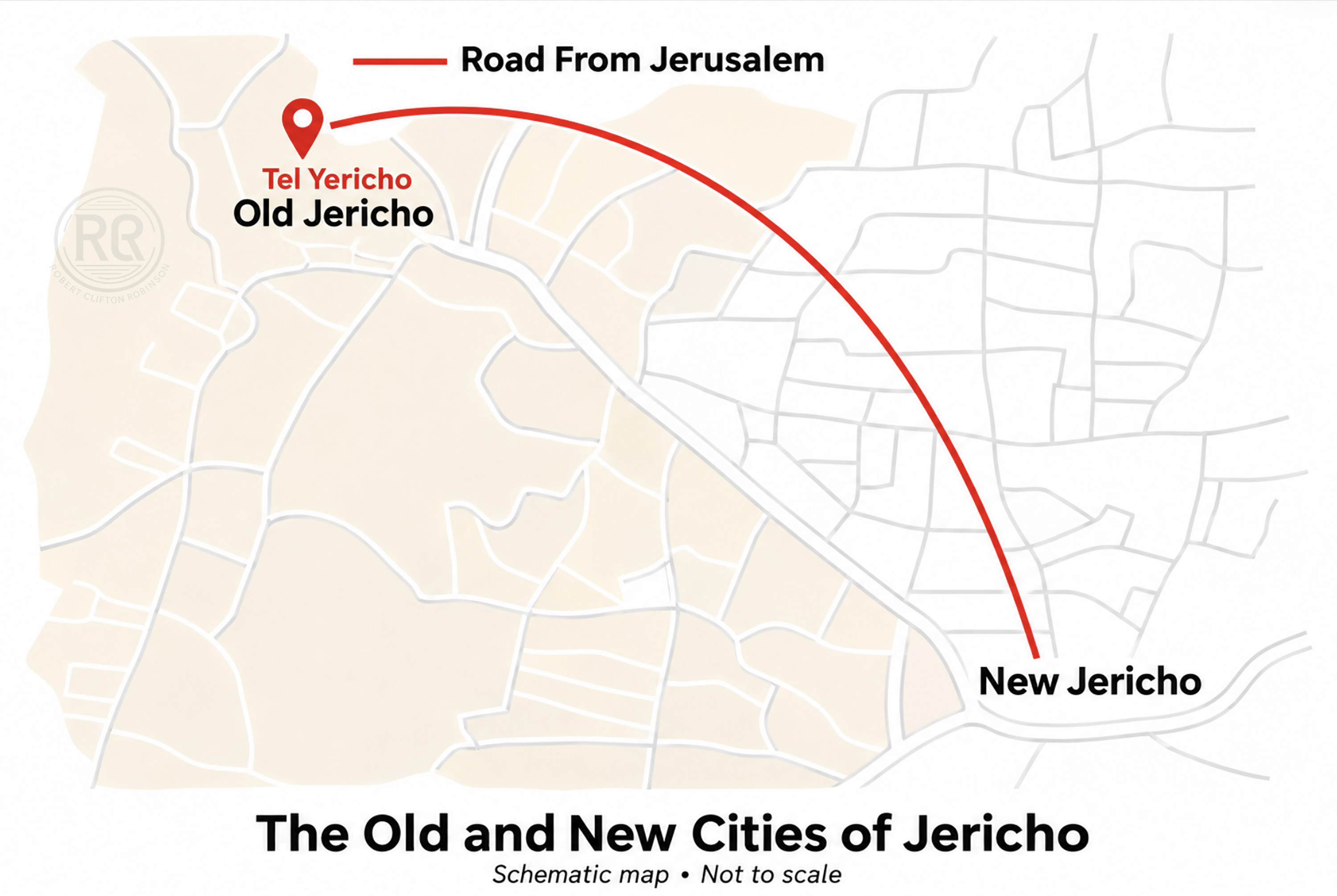
By the testimony of all three men, it appears that the healing of Bartimaeus took place somewhere outside the new city of Jericho. Each of the three men who recorded this event saw this event taking place from a slightly different perspective. This is what we would expect to see if we read the testimony of any three individuals who were asked to write what they saw.
In any event, whether this all took place while going out of the old city of Jericho, coming into the new city of Jericho, or while they were near the new city of Jericho, it does not affect the validity of the story which describes Jesus healing a man who was blind. There very well may have been two or more blind men, as they would often travel together to gain as much attention from those who would pass by. The focus of the story is on Jesus healing a blind man; in this, all three writers agree.
The fact that we see three different descriptions of the location from the same event, in which Bartimaeus was healed by Jesus, leaves us with a great deal of evidence in support of this account as genuine. These three narratives do not conflict with each other; they simply record the perspectives of each writer in remembering what took place. All three men record that Jesus healed Bartimaeus, and this is the point of the entire story. The principal importance of this event is that Jesus has the power to cause a man who was born blind to see again—signs that can only be attributed to the work of God as the Messiah.
Traditional Biblical Exegesis, used from the beginning of biblical textual examination, has always been entirely capable of identifying these distinctions. It is really impossible to determine if a genuine contradiction has happened in the Bible without first examining all of the narratives in every location where these texts mention the same events.
Biblical exegesis is a necessary prerequisite to establishing a textual contradiction
A critic who declares two passages contradictory before establishing their grammatical and contextual meanings has reached a conclusion prematurely.
An example From The Resurrection Narratives
Matthew 28:5 describes an angel speaking to the women at the tomb.
John 20:12 describes Mary seeing two angels.
The identification of one angel in Matthew does not constitute a denial of the presence of a second angel. Also, the accounts may describe different moments during the same visits to the tomb. To establish a contradiction, a critic would need to demonstrate that Matthew clearly excluded the presence of another angel under the same circumstances described by John.
That exclusion is not present in Matthew’s text.
The argument for biblical textual error is not established by presupposing biblical inerrancy. It is established by examining what the respective authors actually wrote.
Jesus Used Scripture to Interpret Scripture
The most important consideration for Christians is that Jesus Himself repeatedly used the comparison of like scriptures to teach truth.
Luke 24:27 — Jesus interpreted the Scriptures With Other Scriptures in Context
Beginning from Moses and from all the prophets, he explained to them in all the Scriptures the things concerning himself.
The Greek word translated “explained” is: διερμήνευσεν — diermēneusen
It is the aorist active indicative of diermēneuō (διερμηνεύω), meaning to interpret, explain, or make the meaning of something intelligible. Jesus examined multiple Old Testament documents and demonstrated their relationship to the events of His life. He did not treat Moses, Isaiah, David, and the other prophets as necessarily isolated theological voices whose statements could not illuminate one another, as Critical Scholarship does.
He demonstrated their importance when all seen together.
Luke 24:44–45 — Jesus Identified the Unity of Biblical Revelation
He said to them, “This is what I told you while I was still with you, that all things which are written in the law of Moses, the prophets, and the psalms, concerning me must be fulfilled.”
Then he opened their minds, that they might understand the Scriptures.
Jesus identified the three major divisions of the Hebrew Scriptures:
- The Law of Moses — Torah.
- The Prophets — Nevi’im.
- The Writings, represented here by the Psalms — Ketuvim.
Jesus interpreted these documents together as testimony concerning Himself. This is canonical interpretation and the analogy of Scripture practiced by Jesus Himself. This is Biblical Exegesis, comparing Scripture with Scripture in its essence. For Christians who recognize the authority of Jesus, His methodology establishes an authoritative precedent for interpreting the Old Testament by comparing Scripture with Scripture.
For critics who don’t believe Jesus is Yahweh-God, these texts still demonstrate that this method of comparing Scripture with Scripture was being used in the first century, long before modern Critical Scholarship began.
Jesus Used Comparative Exegesis to Correct the Errors of the Pharisees, the Scholars of the First Century
One of the clearest examples is the conversation we previously examined concerning Psalm 110 and the identity of the Messiah.
Matthew 22:41–46
Now while the Pharisees were gathered together, Jesus asked them a question, saying, “What do you think of the Christ? Whose son is he?”
They said to him, “Of David.”
He said to them, “How then does David in the Spirit call him Lord, saying,
‘The Lord said to my Lord, sit on my right hand, until I make your enemies a footstool for your feet’?
“If then David calls him Lord, how is he his son?”
No one was able to answer him a word, neither did any man dare ask him any more questions from that day forward.
Notice the process that Jesus used. He began with a well-known biblical fact: the Messiah would be a descendant of David. Then He introduced additional scriptural evidence from Psalm 110:1, demonstrating that David also called the Messiah his Lord. Jesus proves He is the Messiah by using Old Testament Scripture to prove that David wrote Psalm 110 for Him, about Him. In comparing Scripture with Scripture, we learn that Psalm 110 proves that Jesus is Yahweh, the Eternal God.
We didn’t need to use comparative text outside the Bible. We didn’t need to use anything to confirm these facts except the Bible. John stated that Jesus is the Word of God, meaning that He is the author of the texts written in Psalm 110, as David recorded these words.
“If then David calls him Lord, how is he his son?”
These words were spoken by Jesus, using the Old Testament Psalm written by David, for the express purpose of proving that when the Messiah arrives, He will be both A descendant of David (Human) and the Son of God (Yahweh).
The Messiah was not merely David’s descendant. He was also David’s Lord.
This is precisely the principle of “Analogia Scripturae.”
Jesus also used this method of comparing Scripture with Scripture to prove that no other Critical Scholarship is required to learn and teach the Bible. This method did not prevent Him from detecting an interpretive problem. It enabled Him to expose it.
Paul Used The Same Method
Acts 17:2–3
Paul, as was his custom, went in to them, and for three Sabbath days reasoned with them from the Scriptures, explaining and demonstrating that the Christ had to suffer and rise again from the dead, and saying, “This Jesus, whom I proclaim to you, is the Christ.”
Three Greek expressions are particularly significant.
|
Greek |
Transliteration |
Meaning |
|---|---|---|
|
διελέξατο |
dielexato |
Reasoned, discussed, or argued |
|
διανοίγων |
dianoigōn |
Opening or explaining |
|
παρατιθέμενος |
paratithemenos |
Demonstrating by evidence |
Paul was not merely claiming that his conclusions were correct. He was reasoning from Scriptural and documentary testimony, explaining its meaning, and presenting his case. Luke identifies this method as Paul’s customary procedure of proving Scripture by Scripture.
Acts 17:11 — The Bereans Independently Examined Paul’s Conclusions, Proved Them By Scripture
Now these were more noble than those in Thessalonica, in that they received the word with all readiness of mind, examining the Scriptures daily to see whether these things were so.
The Greek word translated “examining” is: ἀνακρίνοντες — anakrinontes. From anakrinō (ἀνακρίνω), it conveys the idea of examining, investigating, questioning, or scrutinizing something. The Bereans did not accept Paul’s conclusions because he was an Apostle. They examined what he said about Jesus and compared it with what Scriptures in the Old Testament state about the Messiah. Then the Bereans accepted Paul’s witness aboutt Jesus.
This comparing of Scripture with Scripture is the opposite of many modern Critical Scholarship methods used today, yet it is still the most effective at proving the Bible is true and reliable.
Even Modern Critical Scholarship is Not Free From The Presuppositions Asserted Against Biblical Exegesis.
Grok states:
“Historical-critical methods use language, context, sources, and external evidence without assuming unity, making them stronger for reconstructing actual formation and meaning.”
The implication is that traditional exegesis operates under presuppositions while historical-critical scholarship operates without them. This is an unjustified distinction. Historical-critical scholarship is not a single uniform methodology. Its practitioners differ considerably in their philosophical assumptions, historical conclusions, and theological commitments.
Some historical-critical scholars are committed Christians who affirm divine inspiration and supernatural events. Others employ methodological naturalism, while still others adopt more explicitly skeptical philosophical positions.
What is the correct and scholarly way to examine, understand, and draw conclusions about the Bible? You might be surprised to learn that two very different approaches exist. Until the middle 1700’s biblical scholarship existed in the form of “Biblical Exegesis,” where scripture was compared with scripture to determine what was being said, and how to apply the texts to any given situation in life. For almost 1,700 years, this form of biblical scholarship worked to allow people the privilege of understanding God’s revelation of Himself to mankind.
Towards the end of the 1700s, a new method developed for New Testament biblical scholarship that changed how scholars examined and made conclusions about the Bible. This method is known today as “Critical Scholarship”
Departing from the historical Biblical Exegesis method of scholarship, where a comparison of scripture with scripture is used, outside and often secular sources and methodological naturalism began as procedures to evaluate the texts of the Bible.
These methods include the following premises
- That apparent differences in narratives of the Gospels indicate separate literary sources (unproven).
- That theological complexity indicates later composition (unproven).
- That supernatural predictions were written after the events they describe (unproven).
- That miracle narratives reflect theological development rather than historical events (unproven).
- That differences between accounts indicate editorial alteration rather than complementary testimony (unproven).
- That traditional authorship attributions are historically unreliable unless independently corroborated (unproven).
None of these propositions are based upon proven errors, genuine contradictions, embellishment, lies, or deceit found in the surviving manuscripts for the New Testament. The entire purpose of this new method of Critical Scholarship was to remove the study of the Bible from a study of the Scriptures to a secular examination and evaluation.
When we consider that the Bible claims it is not a natural, man-made creation, but authored by the same Creator who made the universe, it is not difficult to understand that He is also capable of calling men set apart for Him to write an accurate revelation of Himself, and ensure that every generation has access to these texts, without corruption or manipulation by men.
If we think this is not possible, then we don’t understand who the God of the Bible is, not His Great Power to accomplish anything. The Scriptures ask: “Is anything too hard for the Lord?”
Regarding Fulfilled Prophecy, The Bible is Unique Among All Other Publications in the World
In 2012, I published a seven-volume, 4042-page series on the 400 Messianic Prophecies of the Old Testament, fulfilled only by Jesus, in the New Testament. From the beginning, critics have asserted that these prophecies were written after the events took place. It was not difficult to prove from the historical evidence that all of these Old Testament prophecies already existed in the Septuagint Version of the Hebrew Scriptures, nearly 300 years before Jesus arrived and began fulfilling all 400 of these prophecies.
It was by design that the God of the Bible engineered these texts to include a massive number of predictive and fulfilled prophecies, most of which have already been documented as fulfilled in the historical record. In Deuteronomy 18, the Lord placed an impossible standard for Prophecy that only He could meet. “Any prophet who writes a prediction that does not happen, no one should listen to that Prophet; he is a false prophet. If any of the 400 Messianic Prophecies had ever failed by Jesus, even in the smallest detail, He would have been disqualified as the promised Messiah. Take for example, this one prophecy and its impossibility to be fulfilled:
Despite the normal procedure for a crucifixion in which the legs of a man would be broken to hasten his death, Jesus’ legs are not broken during His crucifixion. How could someone engineer his own death by crucifixion, yet none of his bones would be broken, as was common during crucifixions of that day?
When Jesus was brought to the Cross to be put to death, it was on the evening of Passover. According to Jewish tradition, the body of someone crucified could not be left on the cross past the start of the Sabbath, which began at 6 pm. Since Jesus was placed on the Cross at the 3rd hour, which is 9 am, the Jews in Israel wanted to ensure that He did not remain on the Cross at the start of the Sabbath, at 6 pm. Often, those who were crucified would live for days while hanging on the cross before they would expire.
It was traditional to break the legs of a condemned criminal who had been placed upon a cross to hasten his death. The very act of being nailed to a cross caused great difficulty in breathing. The crucified would have to push down with his feet on the pedestal, where his two feet were nailed, just to stand up for a moment and draw a breath of air. Being suspended on the cross by the arms, the lungs were greatly impeded, and the mechanics of breathing were nearly impossible. The final strike against the body that ultimately caused the death of a crucified man was asphyxiation. After many hours or often days hanging on the cross, a person would become so fatigued that he was unable to push himself up, allowing breath to enter his lungs. Once this occurred, death quickly followed.
If the bones of a person on a cross were broken, in the middle of the lower leg, it would be impossible to thrust the body upwards and draw a breath. Instead of death by crucifixion taking days, it could occur within minutes. When the Roman guards came to break the legs of the three men who were being crucified on that day, they found that Jesus had already expired, and there was no need to break His legs.
Remember that in most cases, the legs of the condemned on the cross were not broken; only during times of necessity, such as when there was an impending Sabbath that would begin soon. This was only done so that the condemned would die quickly and allow his body to be removed from the cross before the Sabbath began.
The fact that this event was predicted for the Messiah (as He fulfills the intent of the Passover Lamb) implies that the author of this prophecy knew His legs would not be broken. The writer possessed advanced knowledge that the Messiah would be put to death on the cross, along with the other criminals who were also being crucified. Even more amazing is the fact that the two criminals would have their legs broken, while those of the Messiah would be left intact. In about 90 percent of all crucifixions, the executioners did not break the legs of those on the cross. The author of this prophecy knew that this crucifixion would occur just before the start of the Jewish Sabbath, which would require the legs of the crucified to be broken, yet leaving the bones of the Messiah unbroken—in fulfillment of Exodus 12:46.
Although the Roman soldiers broke the legs of both criminals who were crucified next to Jesus, when they examined Jesus, they found that He had already expired, negating the need to break His legs. Think for a moment and consider what an amazing event this was. How carefully God had to plan and arrange the events of Jesus’ crucifixion so that He would fully pay for the sins of the world on the cross, but die before the soldiers arrive to break His legs. Imagine what it would have meant if Jesus had continued to live just a short time longer, and the soldiers had also broken His legs! Jesus would have failed to fulfill the prophecies that describe the Messiah as the Passover Lamb with not one bone broken. A simple failure in just this one prediction would have meant that Jesus could not fulfill all the prophecies of the Messiah, and He could not be our Savior. What great precision and control the Lord has orchestrated to ensure that Jesus would fulfill these many Old Testament prophecies!
What if, on the day Jesus was crucified, He was the only one to die on a cross? What if there was only one other criminal to die, and Isaiah said “transgressors”? This would have disqualified Isaiah’s prophecy, and more yet, it would have disqualified all of Isaiah’s prophecies. To be defined by God as a true prophet, all of the words of every prophecy that is spoken must come to pass precisely as they were predicted.1 If this one prophecy had not been fulfilled by Isaiah, because Jesus was the only man to die on that day, then all 131 of Isaiah’s prophecies would have been disqualified. This gives us an idea of how impossible it was for these men to write such perfect descriptions and have them fulfilled to the very letter.
This fact of the Bible illustrates precisely how the historical comparison of scripture with scripture is the most efficient and effective method to learn and understand what the Bible teaches. Without this search through the entire Bible to find the three prophecies that predict that “not one bone will be broken,” of the Messiah, and the fulfillment of these prophecies that are recorded in the New Testament, modern Critical Scholarship would have never provided us with this valuable and crucial information.
The Distinction Between Historical Evidence and Historical Reconstruction
Modern historical-critical scholarship often attempts to reconstruct the literary history behind the biblical documents. These investigations can include source criticism, form criticism, redaction criticism, and tradition criticism. None of these methods are really effective in proving the texts of the Bible, but actually prevent readers from understanding the truth. One must wonder if this is really the goal of those who created Critical Scholarship.
|
Documentary evidence |
Historical reconstruction |
|---|---|
|
The surviving text of Matthew |
A proposed earlier version of Matthew (no evidence) |
|
The surviving text of Luke |
A proposed source used by Luke (no evidence) |
|
Existing manuscript variants |
A hypothetical editorial process (no evidence) |
|
Explicit statements by ancient authors |
Inferred motivations of unidentified authors (proven) |
|
Attested historical events |
Proposed circumstances behind composition (proven) |
|
Existing literary similarities |
A theory explaining those similarities (no evidence) |
Historical reconstruction is not inherently illegitimate, but it must be proven by historical evidence. Historians frequently infer events or relationships from incomplete evidence, but the Bible remains today as the most accurate and efficient source for historical events of antiquity.
The strength of a reconstruction depends upon the quality of the evidence, its explanatory power, and whether competing explanations have been adequately considered. Often in Critical Scholarship, the primary first source of all verification does not come from the Bible itself, but from outside, secular sources and literature that have absolutely nothing to do with the events described in the New Testament.
Critical Scholarship, as exhibited often by the conjecture of Bart Ehrman, makes hypothetical conclusions. A hypothetical source does not become an independently verified historical document merely because numerous scholars accept its proposed existence. Ehrman rarely supports his comments with actual evidence. This is an immense problem for the validity of Critical Scholarship.
In the same manner, an alleged editorial alteration is not established simply because a scholar can construct a plausible explanation for how it might have occurred. The most reliable method for proving the Bible is from other texts found within the Bible.
Biblical Exegesis Existed 16 Centuries Before Modern Critical Scholarship
The traditional Biblical Exegetical methodology has a substantial intellectual history.
|
Scholar or source |
Period |
Result |
|---|---|---|
|
Jesus of Nazareth |
First century |
Interpreted Scripture through comparative scriptural testimony. |
|
Paul the Apostle |
First century |
Reasoned from Scripture to establish theological conclusions. |
|
Irenaeus of Lyons |
Second century |
Emphasized interpreting passages within the coherent framework of biblical revelation. |
|
Origen of Alexandria |
Third century |
Developed extensive comparative scriptural interpretation. |
|
Augustine of Hippo |
Fourth–fifth centuries |
Systematized principles for interpreting obscure passages through clearer passages. |
|
Thomas Aquinas |
Thirteenth century |
Distinguished literal and spiritual senses while emphasizing the foundational literal meaning. |
|
Martin Luther |
Sixteenth century |
Emphasized Scripture as its own interpreter. |
|
John Calvin |
Sixteenth century |
Emphasized grammatical, contextual, and comparative biblical interpretation. |
|
Westminster Confession |
1647 |
Formally articulated Scripture interpreting Scripture. |
|
Johann August Ernesti |
Eighteenth century |
Advanced grammatical-historical interpretation of the New Testament. |
Modern Critical Scholarship developed through the seventeenth, eighteenth, and nineteenth centuries, with important contributions from Baruch Spinoza, Richard Simon, Johann Salomo Semler, Johann Gottfried Eichhorn, Ferdinand Christian Baur, and Julius Wellhausen, among others. It did not invent linguistic analysis, contextual interpretation, historical investigation, or the comparative examination of ancient documents.
These procedures existed long before historical criticism became a distinct academic discipline.
It is also important to clarify that biblical exegesis remains a general scholarly discipline today. Some Critical scholars today still engage in exegesis. The more precise designation for the traditional method under discussion is grammatical-historical exegesis governed by the analogy of Scripture, or traditional canonical exegesis.
The Fundamental Methodological Difference
The essential distinction is not that traditional biblical scholars examine Scripture while historical-critical scholars examine evidence. Both examine evidence. The distinction concerns their respective starting assumptions, the authority they attribute to Scripture, and the kinds of conclusions they consider warranted.
|
Traditional canonical exegesis |
Historical-critical scholarship |
|---|---|
|
Recognizes Scripture as a unified canon |
May examine documents independently of canonical unity (ineffective) |
|
Seeks the intended meaning of the text |
Also investigates the history behind the text |
|
Employs comparative scriptural interpretation |
Employs comparative literary and historical analysis (ineffective) |
|
Generally recognizes divine inspiration |
May bracket the question of divine inspiration (the atheistic view) |
|
Proves contradiction and inconsistencies are false |
May investigate discrepancies as evidence of literary development (though proven untrue) |
|
Recognizes progressive divine revelation |
May investigate theological development historically (ineffective) |
|
Uses linguistic and historical evidence |
Uses linguistic and historical evidence (to try and disprove the texts) |
|
Seeks theological and practical application (to validate) |
Primarily seeks historical and literary understanding (to invalidate) |
A comparison reveals that at the advent of Critical Scholarship, the attempt has been to disprove the historical Biblical texts, not to study, understand, and prove them.
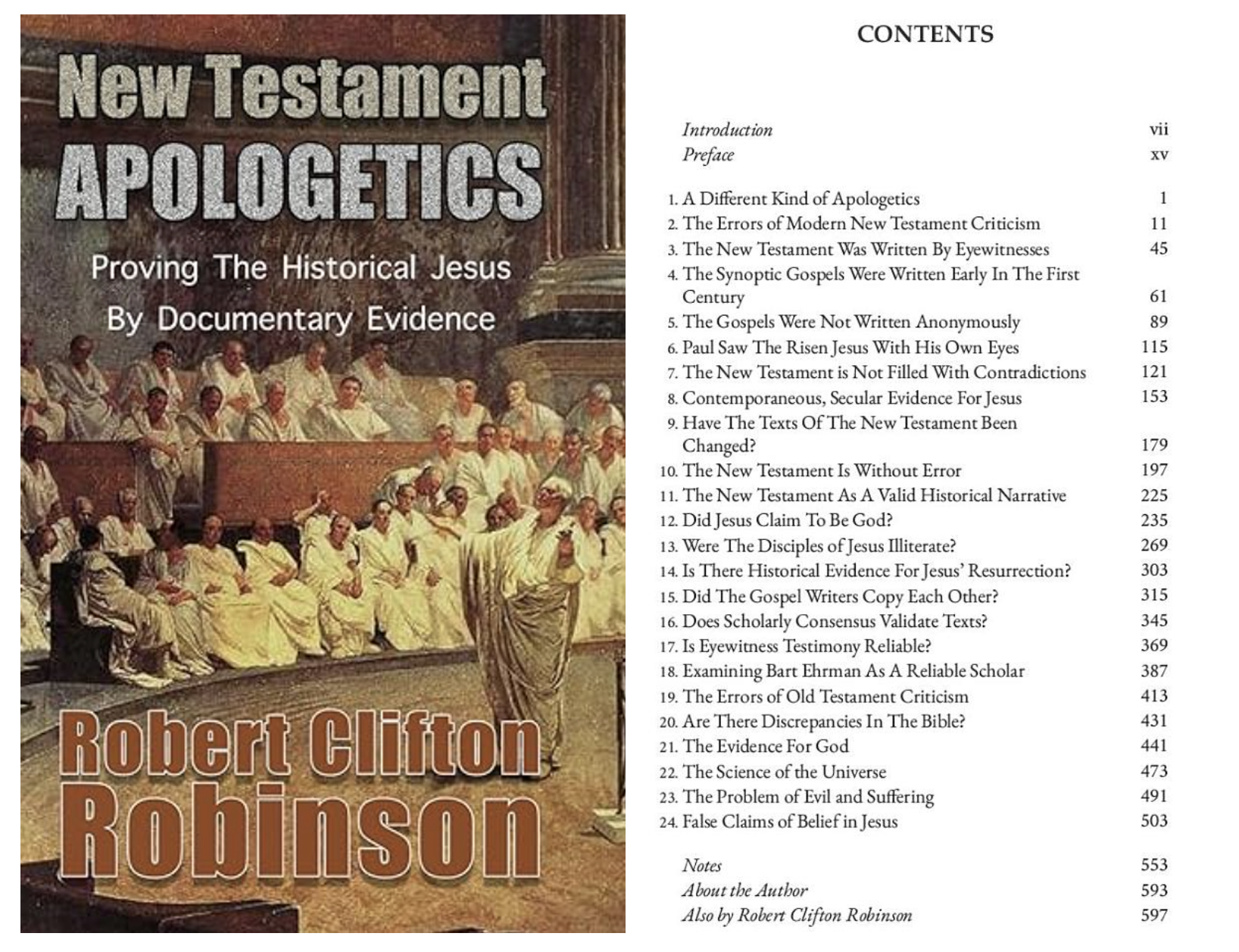
See “New Testament Apologetics: Proving The Historical Jesus By Documentary Evidence” at Amazon, in Print, eBook, and Audiobook
Sources and Citations
1. Aristotle. Prior Analytics, Book II, Chapter 16, 64b28–65a9. Discussion of begging the question and the improper assumption of what is to be demonstrated.
2. Aristotle. Metaphysics, Book IV, Chapter 3, 1005b19–23. Classical formulation of the law of noncontradiction.
3. Irenaeus of Lyons. Against Heresies, Book II, Chapters 27–28. Discussion of interpreting obscure scriptural statements in accordance with clearer teachings.
4. Augustine of Hippo. On Christian Doctrine (De Doctrina Christiana), Book II, Chapters 6 and 9; Book III, Chapter 2. Principles of clarity, context, ambiguity, and comparative scriptural interpretation.
5. Thomas Aquinas. Summa Theologiae, Part I, Question 1, Article 10. Discussion of the literal and spiritual senses of Scripture and the foundational importance of the literal sense.
6. Westminster Assembly. The Westminster Confession of Faith (1647), Chapter 1, Section 9. Formal articulation of Scripture as its own interpreter.
7. Ernesti, Johann August. Institutio Interpretis Novi Testamenti. Leipzig, 1761. Foundational work on grammatical interpretation of the New Testament.
8. Terry, Milton S. Biblical Hermeneutics: A Treatise on the Interpretation of the Old and New Testaments. New York: Phillips & Hunt, 1883.
9. Ramm, Bernard. Protestant Biblical Interpretation: A Textbook of Hermeneutics. 3rd revised edition. Grand Rapids: Baker Book House, 1970.
10. Kaiser, Walter C., Jr. Toward an Exegetical Theology: Biblical Exegesis for Preaching and Teaching. Grand Rapids: Baker Book House, 1981.
11. Childs, Brevard S. Introduction to the Old Testament as Scripture. Philadelphia: Fortress Press, 1979.
12. Childs, Brevard S. Biblical Theology of the Old and New Testaments: Theological Reflection on the Christian Bible. Minneapolis: Fortress Press, 1992.
13. Barr, James. The Concept of Biblical Theology: An Old Testament Perspective. Minneapolis: Fortress Press, 1999.
14. Carson, D. A. Exegetical Fallacies. 2nd edition. Grand Rapids: Baker Academic, 1996.
15. Silva, Moisés. Biblical Words and Their Meaning: An Introduction to Lexical Semantics. Revised and expanded edition. Grand Rapids: Zondervan, 1994.
16. Osborne, Grant R. The Hermeneutical Spiral: A Comprehensive Introduction to Biblical Interpretation. 2nd edition. Downers Grove, IL: IVP Academic, 2006.
17. McCullagh, C. Behan. Justifying Historical Descriptions. Cambridge: Cambridge University Press, 1984.
18. Howell, Martha C., and Walter Prevenier. From Reliable Sources: An Introduction to Historical Methods. Ithaca, NY: Cornell University Press, 2001.
19. Krentz, Edgar. The Historical-Critical Method. Philadelphia: Fortress Press, 1975.
20. Barton, John. Reading the Old Testament: Method in Biblical Study. Revised and enlarged edition. Louisville: Westminster John Knox Press, 1996.
These sources represent traditional, canonical, philosophical, historical, and historical-critical approaches. They do not all endorse identical theological conclusions. Their relevance is in documenting the methodological and logical principles discussed above. I have not independently checked the pagination of individual modern editions for this response.
Categories: Robert Clifton Robinson


Please see, "Guidelines For Debate," at the right-side menu. Post your comment or argument here: