This essay is Part 2 of a continuing examination of the fabricated false facts that atheists present in an attempt to impugn God and the Bible. After 51 years of debating these subjects and demonstrating by evidence that there are no contradictions, errors, or discrepancies in the Bible, they persist today. See Part 1
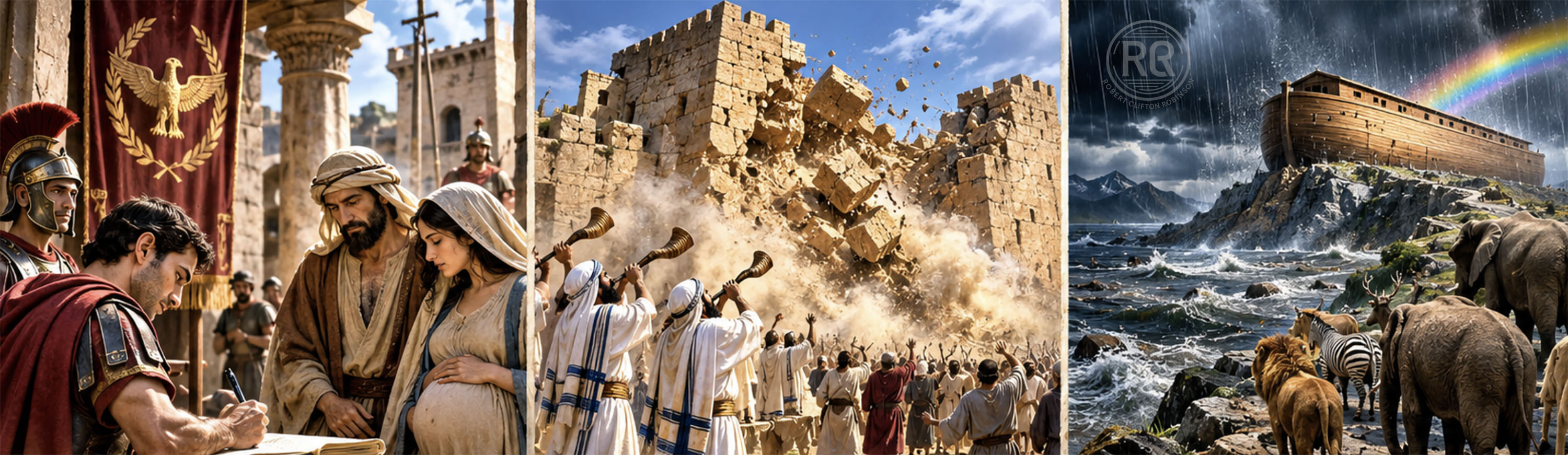
Examining Three Alleged Historical and Archaeological Discrepancies in the Bible
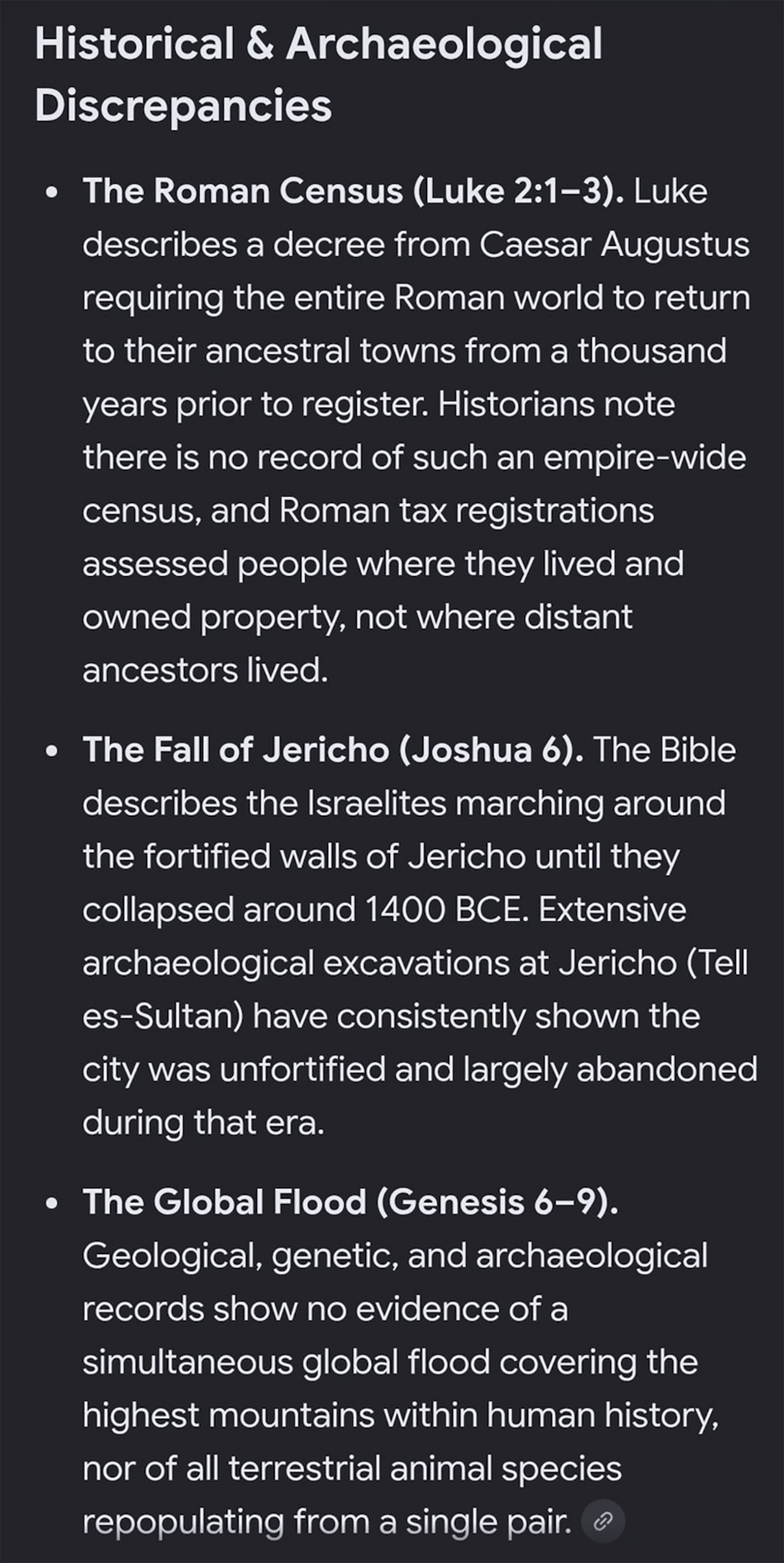 The critic presents three objections to the historical reliability of the Bible:
-
The Roman census recorded by Luke.
-
The destruction of Jericho recorded by Joshua.
-
The flood recorded in Genesis.
Each of these objections deserves examination, but we must distinguish between what the biblical text actually states, what the historical and archaeological evidence establishes, and what conclusions scholars draw from that evidence.
One of the problems with the critic’s presentation is that it does not distinguish sufficiently between an established historical contradiction, an unresolved historical difficulty, and a disputed interpretation of Scripture. These are three substantially different things.
There are also several instances in which the critic attributes statements to the Bible that the biblical writers themselves never made.
The Roman Census: Luke 2:1–3
The critic states:
Luke describes a decree from Caesar Augustus requiring the entire Roman world to return to their ancestral towns from a thousand years prior to register.
One of the criticisms of Luke’s account of Jesus’ life is found in his description of the census that he says was ordered by Caesar Augustus.
Luke 2:1-3: “And it came to pass in those days that a decree went out from Caesar Augustus that all the world should be registered. This census first took place while Quirinius was governing Syria. So all went to be registered, everyone to his own city.”
Because no previous archeological discovery had ever verified that such a census took place, Luke was regarded as having embellished this story. A later discovery regarding the taxes of the kingdom of the Roman government revealed that the taxpayers were enrolled every 14 years by the use of a census. Archeology has uncovered facts that verify Caesar Augustus did conduct the precise census described during the period Luke specified, near the birth of Jesus at Bethlehem.[1]
Further, an inscription discovered in Antioch describes Quirinius in 7 BC, who was the governor of Syria on two occasions, 7 BC and 6 AD—a fact that is confirmed by the Jewish historian, Josephus.[2]
An archeological discovery in Egypt uncovered a Papyrus that specifically describes the details of this census, spoken of by Luke, under Caesar Augustus:
“Because of the approaching census, it is necessary that all those residing for any cause away from their homes should at once prepare to return to their own governments in order that they may complete the family registration of the enrollment and that the tilled lands may retain those belonging to them.”[3]
In his book, Archeological Confirmation of the New Testament, Dr. F. F. Bruce describes a problem that was present in Luke’s description of the Tetrarch of Abilene, in Luke 3:1:
Luke 3:1: “Now in the fifteenth year of the reign of Tiberius Caesar, Pontius Pilate being governor of Judea, Herod being tetrarch of Galilee, his brother Philip tetrarch of Iturea and the region of Trachonitis, and Lysanias tetrarch of Abilene.”
Previously, there was no record of anyone called “Lysanias” as the tetrarch of Abilene during the time Luke specified he was there. In recent history, an archeological discovery made in Damascus, Syria describes a person called the “Freedman of Lysanias the Tetrarch.” Scholars date this inscription between 14 AD and 29 AD.[4] This is the same period in which Luke had written in his gospel describing Lysanias.
An interesting discovery in 1910 by Sir William Ramsay debunked the secular record of Cicero of the Romans, who described Iconium as being in Lycaonia. Luke describes Lystra and Derbe as being in Lycaonia.
Acts 14:6: “…they became aware of it and fled to Lystra and Derbe, cities of Lycaonia, and to the surrounding region.”
This secular record was erroneously held as more reliable and accurate than the Biblical record in history. Today, we know that the Bible was correct all along. This continues to be a common error that is frequently repeated today. The facts bearing witness—the Bible is always right in matters of history, and the secular record is consistently wrong. This truth has been confirmed by archeological discoveries over the entire course of human history all over the world.
Other noted scholars such as Dr. Adrian Nicholas Sherwin-White, a British historian and scholar regarding Ancient Rome, wrote his doctoral thesis on the treatment of the New Testament from the point of view of Roman law and society.
Dr. Sherwin-White said this regarding the work of Dr. Ramsay’s conclusions on the book of Acts:
F. F. Bruce: “Any attempt to reject its (the New Testament’s) basic historicity even in matters of detail must now appear absurd. Roman historians have long taken it for granted.”[5]
Dr. Sherwin-White examined the records of Rome and concluded that their history proved the narrative of the New Testament scriptures regarding the death and resurrection of Jesus Christ.[6]
Of all four gospel writers, Luke exhibits the greatest precision in recording specific details. This has allowed for the verification of every statement Luke has made in his account of Jesus. As a result of Luke’s meticulous record, and the verification of his writing as accurate and reliable, we have great confidence as the readers of this gospel that what Luke recorded is true. When a man takes the time to ensure that everything he writes is accurate, we can be certain that even events that seem unlikely to us are truthful. Because Luke is classified as a scholarly historian by accomplished experts, we can have great confidence that his accounts of Jesus’ resurrection are also truthful.
In the case of Luke, we find that every word he recorded for us about the specific events of the period he was writing about is true. Integrity is a quality a person either has or they don’t have. Luke’s integrity as a historian is unparalleled amongst the writers of the New Testament. Although all the men who penned the pages of scripture that are in our Bible today were men of honor, integrity, and honesty, Luke exceeds every standard of excellence.
If a man tells the truth about the smallest details, he can be relied upon when he describes magnificent details. If Luke exercised such honesty in preserving the details of his gospel, we can also trust that what he said about Jesus’ resurrection from the dead is also a true account.
The Greek text
The relevant portion of Luke 2:3 reads:
ἕκαστος εἰς τὴν ἑαυτοῦ πόλιν
-
ἕκαστος (hekastos): Each person.
-
ἑαυτοῦ (heautou): His own.
-
πόλιν (polin): City or town.
Literally: “Each to his own city.”
A surviving Roman census decree confirms that people were required to travel
In A.D. 104, Gaius Vibius Maximus, the Roman prefect of Egypt, issued a census decree requiring people who were living away from their homes to return for registration.
The original document survives as Papyrus London 904, in the British Library collection.
It establishes that Roman census procedures could require individuals to leave their current place of residence and travel elsewhere to register.¹
Although this document dates approximately a century after Jesus’ birth, it establishes a historical precedent for the general administrative practice Luke describes. It does not, however, independently establish that Joseph was required to return to Bethlehem specifically because of his Davidic ancestry.
Caesar Augustus personally documented his census activities
We also possess an account written by Caesar Augustus himself, known as the Res Gestae Divi Augusti (The Deeds of the Divine Augustus).
In section 8, Augustus records three censuses of Roman citizens:
|
Date |
Roman citizens registered |
|---|---|
|
28 B.C. |
4,063,000 |
|
8 B.C. |
4,233,000 |
|
A.D. 14 |
4,937,000 |
These are not merely the conclusions of modern historians. They are figures recorded by Augustus himself.²
The fact that Augustus conducted a census in 8 B.C., relatively close to the period in which Jesus was born, is historically significant.
However, these particular censuses concerned Roman citizens. They must not be confused with provincial registrations of noncitizens. They establish Augustus’s extensive census activities but do not independently authenticate the particular enrollment described by Luke.
Luke’s expression πᾶσαν τὴν οἰκουμένην (pasan tēn oikoumenēn), translated as “all the world,” refers in this context to the Roman world. Luke does not state that the registration was conducted simultaneously in every Roman province. An imperial decree could have been implemented at different times in different territories.
The chronological question concerning Quirinius
Josephus records a census conducted under Quirinius around A.D. 6, following the removal of Archelaus. This was several years after the conventional date of Herod the Great’s death in 4 B.C.³
Luke places the beginning of his narrative during Herod’s reign (Luke 1:5).
Several explanations have been proposed:
-
Quirinius may have exercised an earlier administrative or military authority in the region.
-
Luke may have been distinguishing an earlier registration from the better-known census of A.D. 6.
-
The registration may have originated under Augustus and been implemented through different stages of administration.
The Greek word πρώτη (prōtē), translated as “first,” has also been examined as potentially indicating an enrollment preceding the better-known census under Quirinius. This interpretation has scholarly support.⁴
The Destruction of Jericho: Joshua 6
The critic states:
Extensive archaeological excavations at Jericho (Tell es-Sultan) have consistently shown the city was unfortified and largely abandoned during that era.
Why A 1446 BC Exodus Is Important
The primary reason that many modern scholars have rejected the reliability of the Exodus narrative has been due to an incorrect dating of the Exodus. Placing the Exodus during the time of Ramses ll, who ruled over a kingdom that existed in the 19th Dynasty of Egypt, near 1250 BC, this date conflicts with all of the archeological evidence that has been found.
When we correctly date the Exodus at 1446 BC, which is the time we find Joseph at Avaris as the “Ankhu” of Egypt, all of the other archeological evidence fits with this date.
One of these archeological difficulties that was caused by a later date of 1250 for the Exodus was uncovered in the 1950’s by British Archeologist Kathleen Kenyon concerning Jericho. Using the later 1250 BC date for the Exodus, this would place the Israelites at Jericho too late. By the time the Israelites left Egypt in 1250 and arrived at Jericho, the walls had already fallen down 200 years before.
When we correctly date the Exodus at 1446 BC, this places the Israelites at Jericho at the right time when Kathleen Kenyon said the fall of Jericho took place.
Every other archeological difficulty that has resulted from the incorrect date of 1250 BC for the Exodus is also rectified by the correct Exodus date of 1446 BC.
There is no evidence anywhere, outside the Bible, that the Ramesses referred to in Exodus chapter 1 was the city that existed during the reign of Ramesses II. In subsequent chapters of this book, I will demonstrate by archeological evidence that an error has been made by those dating the Exodus of the Bible during the reign of Ramesses ll.
This error has caused the date for the Jericho narrative to also be wrong, further leading to the conclusion that the Biblical narrative about Moses and the Exodus is wrong.
This incorrect dating of the Exodus has resulted in a great number of scholars concluding that the Pentateuch that contains the Exodus narrative is a fabrication that never happened. Under this hypothesis, Moses is a fictitious person, and the Exodus narrative is a later contrived story with no historical validation.
This single error of incorrectly dating the time when Moses led the Israelites out of Egypt has resulted in the entire Bible falling under doubt in accuracy and reliability.
If the Bible is placing the Exodus during the reign of Ramesses ll, in 1250 BC, then the entire Pentateuch is wrong, and everything that follows in the Bible is also wrong. This means that Jesus, Paul, and the New Testament writers cannot be trusted, and the narratives about Jesus are doubtful.
Thankfully, the archeological evidence that has been discovered in Egypt in the last 50 years has proven that it is the date that scholars have chosen for the Exodus that is wrong, not the Bible. It is really quite easy to prove that the Exodus described in Exodus chapter 1, took place in 1466 BC, not 1250 BC.
It was this realization that caused me to understand why modern scholars like Joel Baden and Josh Bowen, laugh whenever I state that Jesus and Paul were certain that Moses wrote the Pentateuch.
In the minds of these scholars, I simply don’t know that the Biblical narrative about Moses and the Exodus, are a fabrication, because the Exodus could not have happened in 1250 BC.
This incorrect date resulted in Jesus and Paul also mistaking the facts of the Exodus, Moses, and who the true writers were. Baden and Bowen think that I and many others are simply uneducated.
The facts of archeology, prove that the date relied upon for the Documentary Hypothesis, is the error. The true Exodus took place in 1466 BC, and this date can be substantiated by physical, archeological evidence.
You can see how important it is that we get the historicity of Moses and the Exodus right.
Spoiler Alert: This book documents and proves that it is archeologists and modern scholars who have the date for the Exodus wrong. The Bible has been right all along. I will prove this to you in this book.
A New Archeological Discovery
The modern city of Tell el-Dab’a, is the location of the ancient city of Ramesses. This is the place where the Pentateuch located the Israelites living in Egypt before the Exodus took place.
Up to this time no archeological evidence had ever been found in Egypt that places the Israelites in Egypt in 125o BC.
Professor Manfred Bietak, the director of the Austrian Archeological Institute at Cairo, heads the dig at Tell el-Dab’a. Professor Bietak has located the remains of a large town of about 250 Hectares that once had a population of about 25-30,000 inhabitants. Bietak states that the people who lived in this area were from Canaan, Syrian-Palestine, originally. These are the Israelites described in the book of Exodus, living in Egypt as slaves of Pharaoh, just as the Bible describes.
Bietak said that he thinks these people must have come to this location as subjects of the Egyptian government, with their permission. The facts of the excavation site indicate that these people were allowed to develop, grow and prosper. This is the exact description given to us in the Pentateuch, Genesis 45, for the early Hebrew people who came to Egypt by invitation.
“Then Pharaoh said to Joseph, “Tell your brothers, ‘Take wagons from the land of Egypt to carry your little children and your wives, and bring your father here. Don’t worry about your personal belongings, for the best of all the land of Egypt is yours.’”1
In Genesis 47:1-4, we see that the Israelites were shepherds with flocks and herds and in the subsequent verses, the Pharaoh of Egypt invites Joseph’s family to come and live in the best part of the land, Goshen.
Genesis 47:5-6 “Then Pharaoh said to Joseph, “Now that your father and brothers have joined you here, choose any place in the entire land of Egypt for them to live. Give them the best land of Egypt. Let them live in the region of Goshen. And if any of them have special skills, put them in charge of my livestock, too.”
Avaris Was The Capital In The Province of Goshen
Professor Bietak said there is substantial evidence that the Israelites were living at Avaris and began to grow in their numbers exponentially. Today we know that the Israelites prospered from 70 descendants at the beginning to over 600,000 men, not including women and children, by the time of the Exodus took place in 1466 BC. In total, there were about 2.5 million people who departed Egypt.
Exodus 1:1-7 “These are the names of the sons of Israel (that is, Jacob) who moved to Egypt with their father, each with his family: Reuben, Simeon, Levi, Judah, Issachar, Zebulun, Benjamin, Dan, Naphtali, Gad, and Asher. In all, Jacob had seventy descendants in Egypt, including Joseph, who was already there.”
In time, Joseph and all of his brothers died, ending that entire generation. But their descendants, the Israelites, had many children and grandchildren. In fact, they multiplied so greatly that they became extremely powerful and filled the land.
Exodus 12:37-38 “That night the people of Israel left Rameses and started for Succoth. There were about 600,000 men, plus all the women and children. A rabble of non-Israelites went with them, along with great flocks and herds of livestock.”
The place where Joseph and his brother settled in Egypt was the “region of Ramses,” at the city of Avaris.
Genesis 47:11-12 “So Joseph assigned the best land of Egypt—the region of Ramesses—to his father and his brothers, and he settled them there, just as Pharaoh had commanded. And Joseph provided food for his father and his brothers in amounts appropriate to the number of their dependents, including the smallest children.”
The Israelites Lived In Avaris—The Region of Ramesses
What is interesting about the ancient city of Ramesses, is that upon excavation of that ancient city of Ramesses, under the city, archeologists have discovered an older city called, “Avaris.”
Avaris is located at the southern edge of Ramesses, the place where Exodus 1:11, describes the departure of the Israelites from Egypt. This is the city that Jacob settled at, with his 70 descendants and grew into a multitude of over 2.5 million.2
The problem for many scholars has been that Avaris was established hundreds of centuries earlier than the city that was later known as Ramesses—after the reign of Pharaoh Ramses ll. In the first illustration above, we see that Avaris is deeper, under Ramesses, proving it is an older, earlier city.
Until recently, a majority of scholars ignored Avaris because it was too old, holding that the Exodus the Bible describes happened in 1250 BC. Archeological discoveries now confirm that the actual Exodus took place about 200 years earlier in 1466 BC.
During the past 200 years of archeology, a majority of scholars have been searching for the events described in the book of Exodus at the right places, but tragically, during the wrong period of history.
This misdating of the Exodus departure time has led to an inaccurate account of the period when the Israelites first went to Egypt and began their 430 years in that land.
In this reality, we see why many scholars have placed the settlement of the Israelites in the twelfth century, when the excavation at Avaris proves the Israelites departed in 1466 BC.
Archaeologists have reached substantially different conclusions concerning the date of Jericho’s destruction in error
Archaeology has established that ancient Jericho possessed substantial fortifications, suffered a catastrophic destruction, and was consumed by fire. The principal dispute concerns when this destruction occurred and whether it corresponds to the events recorded in Joshua.
What Joshua actually records
Joshua 6:20
So the people shouted and the priests blew the trumpets. When the people heard the sound of the trumpet, the people shouted with a great shout, and the wall fell down flat, so that the people went up into the city, every man straight before him, and they took the city.
Joshua 6:24
They burned the city with fire, and all that was in it. Only they put the silver, the gold, and the vessels of bronze and of iron into the treasury of Yahweh’s house.
Several specific details emerge from Joshua’s narrative:
-
Jericho was a fortified city.
-
Its protective walls collapsed.
-
The Israelites were able to enter the city.
-
The city was subsequently destroyed by fire.
-
The Israelites were prohibited from taking ordinary spoils.
-
The destruction occurred around the time of the harvest (Joshua 3:15).
These details are particularly interesting when compared with the archaeological discoveries at Tell es-Sultan.
Archaeologist John Garstang: 1930–1936
British archaeologist John Garstang conducted extensive excavations at Jericho between 1930 and 1936. Garstang discovered the remains of a fortified Bronze Age city that had experienced a violent destruction and extensive burning. He dated the destruction of what became known as City IV to approximately 1400 B.C., corresponding closely to the traditional early chronology of Joshua’s conquest.
Garstang published his findings in archaeological reports and subsequently in The Story of Jericho, coauthored with J. B. E. Garstang.⁵
His conclusions directly contradict the critic’s assertion that archaeological excavations have consistently placed the destruction outside the biblical period.
Archaeologist Kathleen Kenyon: 1952–1958
Kathleen Kenyon subsequently excavated Jericho between 1952 and 1958. Kenyon confirmed that the fortified Bronze Age city had suffered extensive destruction and burning. However, she concluded that the destruction. Her conclusions were based on archaeological stratigraphy and pottery chronology.
Archaeologist Bryant G. Wood: 1990
In 1990, archaeologist Bryant G. Wood published a reassessment of the archaeological evidence in Biblical Archaeology Review, entitled: Did the Israelites Conquer Jericho? A New Look at the Archaeological Evidence. Wood challenged Kenyon’s interpretation of the pottery and argued that the destruction should be dated to approximately 1400 B.C., restoring Garstang’s earlier conclusion.⁷
Wood identified several archaeological features consistent with Joshua’s narrative.
|
Biblical narrative |
Archaeological discovery |
|---|---|
|
Jericho was fortified. |
Substantial stone and mudbrick fortifications. |
|
The walls collapsed. |
Collapsed mudbrick fortifications. |
|
The city was burned. |
Extensive evidence of burning. |
|
Destruction occurred around harvest. |
Supplies of stored grain. |
|
Ordinary spoils were prohibited. |
Significant quantities of grain remained unconsumed. |
|
Jericho was not immediately rebuilt as a fortified city. |
A prolonged interruption in major urban occupation. |
These are genuine archaeological observations, although their association with Joshua depends upon establishing the correct chronology.
Additional research by Titus Kennedy
In 2023, archaeologist Titus Kennedy published a scholarly paper entitled: “The Bronze Age Destruction of Jericho, Archaeology, and the Book of Joshua.” Published in the journal Religions, Kennedy’s paper reassessed the archaeological discoveries, including pottery, fortifications, destruction layers and chronological evidence, presenting arguments for reconsidering the relationship between Jericho’s destruction and the biblical narrative.⁸ The critic’s statement creates the impression that archaeological research has been unanimous. The published literature demonstrates otherwise.
The Flood: Genesis 6–9
The critic states:
Geological, genetic, and archaeological records show no evidence of a simultaneous global flood covering the highest mountains within human history, nor of all terrestrial animal species repopulating from a single pair.
Evidence from Geology
Many researchers cite geological phenomena as evidence of a global flood, though these interpretations remain controversial:
Global Sedimentary Layers
- Widespread sedimentary rock layers are often interpreted as evidence of a massive, water-driven catastrophe.
- Example: The Grand Canyon shows vast, flat-lying sedimentary layers, which some argue could have been deposited rapidly under flood conditions.
- Proponents of flood geology suggest that these layers were deposited in quick succession by a global deluge, not over millions of years.
Fossil Graveyards
- Massive fossil graveyards with remains of various species buried together suggest rapid burial.
- Locations like the Karoo Supergroup in South Africa contain billions of fossils, which some interpret as a result of a sudden, catastrophic event.
Marine Fossils on Mountains
- Marine fossils have been found on high-altitude mountains, including the Himalayas and Andes.
- Flood proponents argue these fossils were deposited as floodwaters receded and tectonic activity uplifted the mountains.
Polystrate Fossils
- Fossils of trees that extend through multiple sedimentary layers (polystrate fossils) are argued to demonstrate rapid burial and sedimentation, consistent with a global flood.
Evidence from Archaeology
Although direct archaeological evidence for Noah’s Ark remains elusive, there are significant claims and findings worth noting:
Claims of Ark Discoveries
- Mount Ararat (Turkey): Numerous expeditions have claimed to find remains or formations resembling the Ark, with wood-like materials discovered at high altitudes. One notable example is the Durupınar site, though it remains debated whether this is a natural formation or man-made.
- Radiocarbon dating of wood samples from alleged “Ark sites” supports ancient dates, supporting the biblical narrative.
Flood Narratives Across Cultures
- Over 300 flood legends from cultures worldwide (e.g., Mesopotamian, Chinese, Native American) share remarkable similarities:
- A deity or divine figure warns a righteous person of a coming flood.
- A vessel is constructed to save humanity and animals.
- Survivors repopulate the earth post-flood.
- Example: The Epic of Gilgamesh from Mesopotamia is similar to the Biblical account and features a flood narrative with striking parallels to Noah’s story (Moses’ narrative predates the Gilgamesh narrative).
- These widespread traditions are argued to preserve collective memories of a real, ancient flood event.
Moses received what he recorded in the Bible, directly from God. This includes the creation of the universe, and the Flood of Noah. Moses also received reliable evidence from men (Enoch and Methuselah) who had actually lived during the period of history immediately before the flood of Noah, and Moses recorded this information in the Bible.
It is significant that the Gilgamesh texts also describe the occurrence of a universal flood with near identical parallels to the Flood of Noah’s day. These texts are recorded after. This provides us with significant physical evidence that the Gilgamesh flood is the same flood of Noah, confirmed by a second source that is non-biblical, yet nearly identical to the texts of the Bible.
The flood of Gilgamesh took place in the third millennium B.C., and was clearly recorded by a polytheistic people, yet documenting the same events presented to us by Moses, much earlier.
The earliest written versions of the Mesopotamian flood stories include:
- The Atrahasis Epic (Old Babylonian, ~17th century B.C.)
- The Sumerian Flood Story (~18th–17th century B.C.)
- The Epic of Gilgamesh, Tablet XI (Standard Babylonian version ~12th–10th century B.C.)
Thus these Mesopotamian texts are second-millennium B.C., but the event described is third-millennium B.C.
Moses wrote the Torah around 1446 B.C. However, the Flood event described by Moses, following biblical chronology—occurred long before the third millennium B.C., using the Septuagint chronology: earlier, often estimated ~3200–3000 B.C.
This means Noah’s Flood event predates the Mesopotamian traditions.
Noah’s flood predates the Gilgamesh flood, as well as the many other flood narratives which recount the same global flood Noah records.
- See: Rehwinkel, Alfred M., The Flood in the Light of the Bible, Geology, and Archaeology, (St. Louis: Concordia Publishing, 1951), p. 129
- There was one historical, global flood (the flood of Noah in Genesis).
- Polytheistic and non-biblical flood traditions (including Mesopotamian ones like Gilgamesh, as well as Chinese and others) are later, culturally colored retellings of that same event.
- These traditions have been altered by local culture and mythic embellishment, but when you strip away the “accretions,” their core elements line up with the Genesis account (global destruction by water, a vessel of salvation, a preserved remnant, and often divine judgment for human wickedness).
Flood stories written on cuneiform tablets, have often been described as written before the Noah account. This is primarily due to an agenda set forth by scholars who oppose the Bible and the idea that God exists.
The Jews of the the first century, and the extant record of the Dead Sea Scrolls, provide us with substantial evidence to prove that the global flood of Noah, predates all other records in the historical record.
Noah’s flood is historically earlier as the original event, and the Mesopotamian narratives are later, polytheistic retellings of that same worldwide catastrophe.” This fully impeaches the false assertion the Mesopotamian traditions are earlier than the biblical account.
Evidence from Science
Scientific disciplines like hydrology and genetics have also been explored for evidence of a global flood.
Genetic Evidence
- Human Genetic Bottleneck: Studies of mitochondrial DNA suggest humanity may have originated from a small population (sometimes interpreted as 2–10 individuals) tens of thousands of years ago. Proponents connect this with the survivors of Noah’s Flood.
- Animal Genetic Bottlenecks: Similar bottlenecks in various animal species could align with a mass extinction and subsequent repopulation.
The Biblical Definition Of Kinds In Comparison With The Evolutionary Definition Of Species
Paleoclimatology
- Evidence of sudden climate shifts, such as the Younger Dryas period (~12,000 years ago), could suggest catastrophic flooding events on a regional or global scale.
Rapid Ice Melt and Megafloods
- Post-Ice Age melting around 10,000 BCE led to massive flooding events, including:
- The Black Sea deluge hypothesis, which suggests the Mediterranean Sea burst through a natural dam into the Black Sea basin, flooding vast areas.
- The Missoula Floods in North America, caused by glacial ice dams breaking, which rapidly reshaped landscapes.
Hydrological Feasibility
A common objection to the flood narrative is the sheer volume of water required. Proponents counter:
- Subterranean water sources: Genesis 7:11 mentions “the fountains of the great deep” breaking open, possibly referring to vast underground aquifers.
- Canopy Theory: Some creationists propose a pre-Flood vapor canopy that collapsed, releasing water.
- Tectonic Movements: Plate tectonics could explain how oceans could have temporarily covered the land during a flood.
The evidence cited by proponents of Noah’s Flood includes geological formations, cultural flood traditions, and genetic data. This evidence does support the Biblical account, many scientists support this conclusion.
For those interested in the biblical perspective, the evidence affirms the biblical record, as well as the requirements of science.The Flood of Noah is a consistent theme found throughout the entire scope of the 66 books of the Bible.
Jesus confirms Noah, the Flood, and that this was a judgment determined by God because of the global sin on earth had reached catastrophic proportions.
Texts Throughout The Bible, Old And New Testament, That Support the Flood Of Noah:
Old Testament Passages
Genesis (Primary Account of the Flood)
- Genesis 6:1–8 – The wickedness of humanity and God’s decision to bring judgment.
- Genesis 6:9–22 – God commands Noah to build the Ark and gives specifications.
- Genesis 7:1–16 – Noah, his family, and the animals enter the Ark; the flood begins.
- Genesis 7:17–24 – The floodwaters prevail on the earth; all life outside the Ark perishes.
- Genesis 8:1–19 – The floodwaters recede, and Noah and his family leave the Ark.
- Genesis 8:20–22 – Noah builds an altar, and God makes a promise never to destroy the earth by flood again.
- Genesis 9:1–17 – The Noahic Covenant: God’s promise symbolized by the rainbow.
Psalms
- Psalm 29:10 – “The LORD sits enthroned over the flood; the LORD sits enthroned as king forever.”
- Some interpret this as a reference to God’s sovereignty over the Flood of Noah.
Job
- Job 22:15–17 – Eliphaz references the destruction of the wicked in an event some equate with the Flood.
Isaiah
- Isaiah 54:9 – “Just as I swore in the time of Noah that I would never again let a flood cover the earth.” This is a reference to the Noahic Covenant.
Ezekiel
- Ezekiel 14:14, 20 – Noah is mentioned alongside Daniel and Job as an example of righteousness.
New Testament Scriptures
The Teachings of Jesus
- Matthew 24:37–39 – “As it was in the days of Noah, so it will be at the coming of the Son of Man. For in the days before the flood, people were eating and drinking, marrying and giving in marriage, up to the day Noah entered the ark; and they knew nothing about what would happen until the flood came and took them all away.”
- Jesus uses the Flood as an analogy for the suddenness of His second coming.
- Luke 17:26–27 – A parallel to the passage in Matthew, emphasizing the sudden and universal judgment during Noah’s time.
The Epistles
- Hebrews 11:7 – “By faith Noah, when warned about things not yet seen, in holy fear built an ark to save his family. By his faith he condemned the world and became heir of the righteousness that is in keeping with faith.”
- Noah is presented as an example of faith in the “Hall of Faith.”
- 1 Peter 3:20–21 – “To those who were disobedient long ago when God waited patiently in the days of Noah while the ark was being built. In it only a few people, eight in all, were saved through water, and this water symbolizes baptism that now saves you also…”
- Peter draws a theological connection between the Flood and Christian baptism.
- 2 Peter 2:5 – “If he did not spare the ancient world when he brought the flood on its ungodly people, but protected Noah, a preacher of righteousness, and seven others…”
- Peter describes Noah as a preacher of righteousness and the Flood as a judgment by God.
- 2 Peter 3:5–6 – “But they deliberately forget that long ago by God’s word the heavens came into being and the earth was formed out of water and by water. By these waters also the world of that time was deluged and destroyed.”
- Peter refers to the Flood to illustrate the certainty of future divine judgment.
The story of Noah’s Flood is central to Genesis but also deeply interwoven into the New Testament narrative as a symbol of judgment, salvation, and the righteousness of faith. Together, these passages present the Flood as both a historical and theological event, with lasting implications for understanding God’s justice, mercy, and covenantal faithfulness.
Could The Ark of Noah Contain Enough Animals That Would Account For Every Species Today?
The concept of “kinds” in the context of Noah’s Ark is often associated with a creationist interpretation of the Genesis Flood account. While there is no universally agreed-upon number, researchers within the creationist framework have provided evidence for the number of “kinds” based on biblical and biological considerations.
The following is a detailed exploration of this topic:
What is a “Kind”?
- The term “kind” is derived from the Hebrew word min (מִין), used in Genesis 1 to describe groups of living creatures.
- It is generally interpreted by creationists to correspond to a broader taxonomic classification, often at the level of family rather than species (e.g., the Canidae family includes wolves, foxes, and domestic dogs as one “kind”).
The Biblical Definition Of Kinds In Comparison With The Evolutionary Definition Of Species
Creationist Estimates of Ark “Kinds”
- Baraminology: A creationist framework used to identify “created kinds” based on reproductive compatibility and morphological similarity.
- Estimates vary, but key studies suggest: 1,398 “kinds” (minimum estimate):
- This number comes from research conducted by John Woodmorappe in Noah’s Ark: A Feasibility Study (1996). ~1,000–1,400 “kinds”:
- The Ark Encounter museum (Answers in Genesis) estimates about 1,398 animal kinds, translating to about 7,000–7,400 individual animals aboard the Ark.
Example:
- The Canidae family (wolves, foxes, and domestic dogs) represents one “kind.”
- Similarly, all species of felines (lions, tigers, domestic cats) may be derived from a single “kind.”
Accounting for Biodiversity Today
Creationists argue that the diversity of species observed today arose from:
- Rapid Speciation: Following the Flood, animals diversified within their “kinds” through microevolutionary processes.
- Example: All modern breeds of dogs, wolves, and coyotes descended from a single ancestral canine kind.
- Mechanisms include natural selection, genetic drift, and adaptation to environments.
Space Requirements on the Ark
Feasibility of Housing the Animals:
- Using the dimensions of the Ark given in Genesis 6:15 (300 cubits long, 50 cubits wide, and 30 cubits high), researchers calculated the total available space as approximately 1.5 million cubic feet.
- This is sufficient cargo capacity to house the estimated number of animals, food, and supplies, necessary to repopulate the Earth after the Global Flood,
Example Calculations:
- The average size of the animals on the Ark is comparable to a sheep.
- Studies suggest that about 85% of animals would have been smaller than a sheep, and only a small percentage would require significant space (e.g., large reptiles or mammals).
- Dinosaurs were not on the Ark, they were a species who lived and died before Noah and the Global Flood.
Implications for Post-Flood Biodiversity
- Creationists maintain that speciation occurred rapidly after the Flood to fill ecological niches.
- This rapid diversification is argued to be consistent with observations of speciation rates in certain groups (e.g., cichlid fish, Galápagos finches).
Comparison with Modern Species
Modern Estimates of Species:
- There are ~8.7 million eukaryotic species on Earth (Mora et al., 2011), but many are aquatic or microscopic and would not need to be on the Ark.
The number of terrestrial vertebrates is much smaller:
- Mammals: ~5,500 species
- Birds: ~10,000 species
- Reptiles: ~11,000 species
- Amphibians: ~8,000 species
- Total terrestrial vertebrates: ~35,000 species
Creationist models argue that these species are derived from a much smaller number of ancestral kinds.
- The number of “kinds” on the Ark is estimated at ~1,000–1,400 (representing around 7,000–14,000 animals in total).
- This allows for post-Flood speciation to account for modern biodiversity.
- These estimates are rooted in a literal interpretation of Genesis and rely on the assumption that kinds correspond roughly to taxonomic families.
The ancient world preserved accounts of catastrophic floods
There are several ancient Mesopotamian records describing a devastating flood, divine judgment, the construction of a vessel and the preservation of life.
Among these are:
-
The Sumerian account of Ziusudra.
-
The Akkadian Epic of Atrahasis.
-
Tablet XI of the Epic of Gilgamesh.
-
The account of the Babylonian historian Berossus.
These ancient sources contain parallels with Genesis, including warnings of destruction, the preservation of a family or individuals, the construction of a vessel, the survival of animals, and the use of birds to determine whether the waters had receded.
The existence of these traditions establishes that accounts of a catastrophic ancient flood were widespread in Mesopotamia.
There are several possible explanations for these similarities, including a shared historical memory, the transmission of earlier literary traditions, or some combination of the two.
The existence of earlier surviving manuscripts of Mesopotamian flood stories does not, by itself, establish that the Hebrew author copied directly from them. Conversely, the similarities alone do not establish that all these accounts independently document the identical historical event.¹⁰
Archaeologists have discovered evidence of ancient catastrophic flooding
During excavations in Mesopotamia, archaeologists discovered significant flood deposits at several ancient cities.
These include investigations conducted at:
|
Archaeological site |
Evidence |
|---|---|
|
Ur |
Extensive deposits of water-laid sediment discovered by Leonard Woolley. |
|
Kish |
Multiple flood deposits within ancient occupation layers. |
|
Shuruppak |
Flood deposits generally associated with approximately 2900 B.C. |
These discoveries demonstrate that catastrophic flooding occurred in the ancient Mesopotamian world.¹¹
However, the flood deposits at these different sites do not all date to the same event. They cannot simply be combined and presented as archaeological proof of one simultaneous worldwide flood.
They do establish the historical plausibility of devastating floods within the geographical world associated with the Genesis narrative.
Does Genesis say that every terrestrial species descended from a single pair?
The critic’s statement is also imprecise concerning the animals.
Genesis 7:2–3
You shall take seven pairs of every clean animal with you, the male and his female. Of the animals that are not clean, take two, the male and his female. Also of the birds of the sky, seven and seven, male and female, to keep seed alive on the surface of all the earth.
Genesis does not state that every animal population represented aboard the ark began again from a single pair.
Additionally, the Hebrew word מִין (min), translated as “kind,” is an ancient classification of living organisms, not a modern scientific definition of a biological species.
The critic has imposed modern scientific terminology upon an ancient Hebrew text.
Nevertheless, changing the terminology from species to kinds does not, by itself, resolve the scientific difficulties associated with a recent worldwide population bottleneck.
What does the geological evidence establish?
The conventional geological, genetic and archaeological evidence presents substantial difficulties for a recent flood that simultaneously covered every mountain on the planet.
These include:
-
Antarctic and Greenland ice cores preserving long sequences of climatic history.
-
Tree-ring chronologies extending across thousands of years.
-
Archaeological evidence of continuing civilizations during periods sometimes proposed for Noah’s flood.
-
Genetic evidence inconsistent with a simultaneous recent reduction of all terrestrial animal populations to a few individuals.
-
Geological formations that record distinct depositional environments across extensive periods of time.
For example, the European Project for Ice Coring in Antarctica published climatic records extending approximately 800,000 years into the past.¹²
These are not merely arguments from the absence of evidence. They constitute positive physical evidence that must be addressed by proponents of a recent global flood.
Theologically, God’s ability to produce a supernatural flood is a separate question from whether the surviving physical evidence establishes that such an event occurred.
Conclusion concerning Genesis: There is substantial archaeological evidence for devastating ancient regional floods, and ancient literature preserves numerous accounts of catastrophic flooding. There is not comparable scientific confirmation of a recent flood covering the entire physical planet. Whether Genesis requires that geographical interpretation remains an important exegetical question.
See The Sources and Citations For The Flood Examination in This Essay
The difference between a lack of corroboration and a demonstrated historical error
A sound historical investigation must distinguish between four categories of evidence:
Absence of corroboration: An event is recorded in an ancient document, but no independent record of that particular event has yet been identified.
Partial corroboration: Independent evidence confirms some of the historical circumstances described in the document without confirming the entire narrative.
Contrary evidence: Independent evidence supports a conclusion that is difficult to reconcile with a particular reading of the document.
Demonstrated contradiction: Two established propositions cannot both be true in the same sense, at the same time, under the same circumstances.
It would be methodologically unsound to classify every instance of missing corroboration as a demonstrated historical error. It would also be unsound to dismiss positive contrary evidence merely because it challenges a preferred interpretation.
The same historical standards should be applied to the Bible that are applied to other documents of antiquity.
Historical investigation should neither presuppose that the Bible must be wrong nor force archaeological discoveries to conform to a predetermined chronology.
The critic has identified some genuine historical and scientific questions, but has also included misrepresentations of the biblical text, omitted relevant archaeological discoveries, and overstated the unanimity of historical scholarship.
Citations
1. William M. Ramsay, The Bearing of Recent Discovery on the Trustworthiness of the New Testament, 1915, page 222.
2. 1. John Elder, “Prophets, Idols and Diggers.” Indianapolis, New York: Bobbs-Merrill,1960. Pages 159, 160.
2.Joseph Free,. “Archaeology and Bible History.” Wheaton: Scripture Press Publications, 1969, Page 285.
3. Elder, John. Prophets, Idols and Diggers. Indianapolis, New York: Bobbs-Merrill,1960, Page 160.
4. 1. Elder, John. Prophets, Idols and Diggers. Indianapolis, New York: Bobbs-Merrill,1960, Pages 159, 160.
2. Free, Joseph. Archaeology and Bible History. Wheaton: Scripture Press Publications, 1969, page 285.
5. F. F. Bruce, “Archaeological Confirmation of the New Testament.” Revelation and the Bible. Edited by Carl Henry. Grand Rapids: Baker Book House, 1969. Page 321.
6. Adrian Nicholas Sherwin-White, Roman Society and Roman Law in the New Testament, 1963, page 189.
Sources
1. A. S. Hunt and C. C. Edgar, Select Papyri, Volume II: Public Documents, Loeb Classical Library 282 (Cambridge, MA: Harvard University Press, 1934), no. 221, pp. 208–211. Roman census edict of Gaius Vibius Maximus, A.D. 104, P. London III 904.
2. Augustus, Res Gestae Divi Augusti, section 8. See Alison E. Cooley, Res Gestae Divi Augusti: Text, Translation, and Commentary (Cambridge: Cambridge University Press, 2009).
3. Flavius Josephus, Antiquities of the Jews, 17.13.5; 18.1.1–2. Account of Quirinius, the registration of property and the subsequent revolt.
4. Brook W. R. Pearson, “The Lucan Censuses, Revisited,” Catholic Biblical Quarterly 61, no. 2 (1999): 262–282.
5. John Garstang and J. B. E. Garstang, The Story of Jericho (London: Marshall, Morgan & Scott, 1948).
6. Kathleen M. Kenyon, Digging Up Jericho (London: Ernest Benn, 1957), pp. 261–262; Kathleen M. Kenyon and Thomas A. Holland, Excavations at Jericho, vols. 3–5 (British School of Archaeology in Jerusalem, 1981–1983).
7. Bryant G. Wood, “Did the Israelites Conquer Jericho? A New Look at the Archaeological Evidence,” Biblical Archaeology Review 16, no. 2 (March/April 1990): 44–58.
8. Titus Kennedy, “The Bronze Age Destruction of Jericho, Archaeology, and the Book of Joshua,” Religions 14, no. 6 (2023): article 796. DOI: 10.3390/rel14060796.
9. Hendrik J. Bruins and Johannes van der Plicht, “Tell es-Sultan (Jericho): Radiocarbon Results of Short-Lived Cereal and Multiyear Charcoal Samples from the End of the Middle Bronze Age,” Radiocarbon 37, no. 2 (1995): 213–220; Piotr Bienkowski, “Jericho Was Destroyed in the Middle Bronze Age, Not the Late Bronze Age,” Biblical Archaeology Review 16, no. 5 (1990).
10. W. G. Lambert and A. R. Millard, Atra-Ḫasīs: The Babylonian Story of the Flood (Oxford: Clarendon Press, 1969); Andrew R. George, The Babylonian Gilgamesh Epic: Introduction, Critical Edition and Cuneiform Texts, 2 vols. (Oxford: Oxford University Press, 2003), Tablet XI.
11. C. Leonard Woolley, Ur Excavations, Volume IV: The Early Periods (London and Philadelphia, 1955); Max Mallowan, “Noah’s Flood Reconsidered,” Iraq 26, no. 2 (1964): 62–82.
12. EPICA Community Members, “Eight Glacial Cycles from an Antarctic Ice Core,” Nature 429 (2004): 623–628. DOI: 10.1038/nature02599.
Categories: Robert Clifton Robinson


Thank you brother for these articles. Your book on Romans explains very clearly why many choose not to believe the Bible.
The beauty of our God is that he gave us free will to choose heaven or hell. People do not realize they are spiritual sick, actually dead. Further, they do not realize Heaven is a hospital-like place where the cured are. Hell is whatever is outside that hospital where those that refuse the cure are. Just as you would not allow a physical leper in your house, God will not let a spiritual leper in His.
The cure, what is it you ask? Jesus. Accepting Jesus as your Lord and Savior. Repenting of your sins which will change your life. You will still sin, in this life, but you will hate your sins, and have a sense of shame. And because of that, the cross will bring forgiveness, and removal, of those sins, once you acknowledge you have sinned.
Every Atheist should know this, not one Christian, on their own, is capable of a sinless day that I am aware of no matter how hard this person would try. You would literally go insane. And this is why God make forgiveness a simple thing.
For if this God were not a God of love, it is my belief that we would not have been created in the manner we were. Consider Satan here.
LikeLiked by 1 person
Thanks, Tony for your insight!
LikeLike
Last week, a Calvinist told me to accept Jesus as my Lord and Savior.
Should I follow that advice? Or does the fact that I accept Jesus in the context of Calvinism dramatically enhance the fearful probability that I’ll become a Calvinist, and thus engage in perhaps years of born-again blindness to “clear” biblical truth?
LikeLike