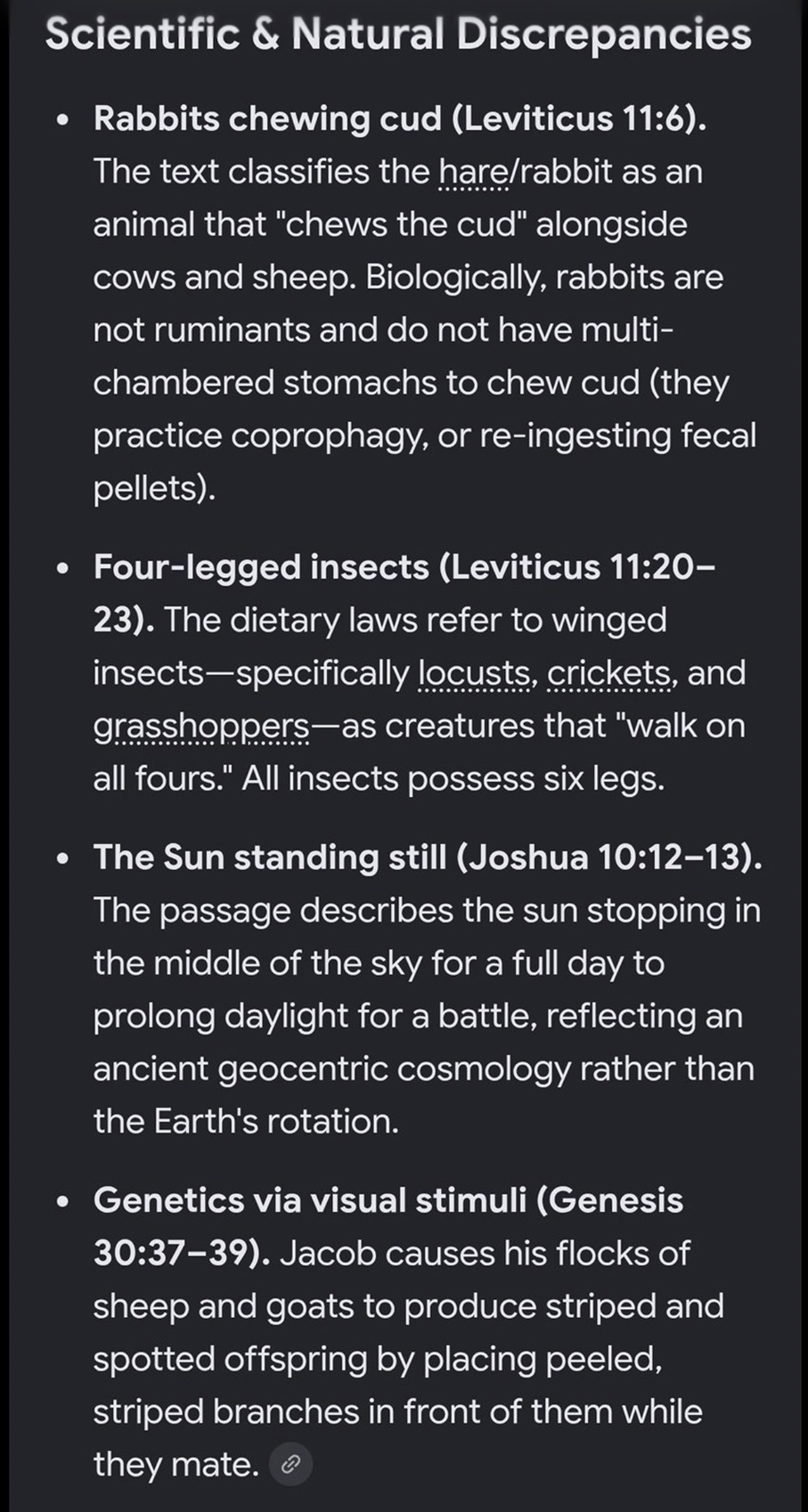
The four allegations presented in this image require an examination of the original Hebrew, the literary context, the purpose for which each passage was written, and the distinction between observational language and technical scientific descriptions.
In several instances, the critic attributes a scientific assertion to the biblical writer that the writer never explicitly made. In others, there are legitimate interpretive difficulties that require further examination rather than a premature declaration of error.
Rabbits chewing cud — Leviticus 11:6
The allegation: Rabbits are not ruminants, do not possess multichambered stomachs, and therefore the Bible is scientifically incorrect.
The biblical text:
Leviticus 11:6 — The hare, because she chews the cud but doesn’t have a parted hoof, she is unclean to you.
The original Hebrew is:
וְאֶת־הָאַרְנֶבֶת כִּי־מַעֲלַת גֵּרָה הִוא
We’et-ha’arnevet ki-ma‘alat gerah hi.
The relevant Hebrew words are:
-
אַרְנֶבֶת — arnevet: Hare.
-
מַעֲלַת — ma‘alat: Bringing up, raising, or causing to ascend.
-
גֵּרָה — gerah: Cud.
The Hebrew expression describes bringing up cud. It does not explicitly describe the internal anatomical structure of the animal’s digestive system.
What modern biology tells us
Hares and rabbits practice a specialized digestive process known as cecotrophy, which is distinct from ordinary coprophagy.
Rabbits produce two different types of digestive material: ordinary fecal pellets and soft, nutrient-rich cecotropes. They consume the latter directly, allowing partially processed nutrients to pass through their digestive system a second time.
|
True rumination |
Cecotrophy |
|---|---|
|
Practiced by cattle and sheep |
Practiced by rabbits and hares |
|
Food is regurgitated internally |
Cecotropes are reingested |
|
Food undergoes additional processing |
Food undergoes additional processing |
|
Specialized multichambered stomach |
Specialized hindgut fermentation |
|
Extracts additional nutrients |
Extracts additional nutrients |
Both processes permit the animal to obtain additional nutritional benefits from previously processed food, although the anatomical mechanisms are different.
The distinction is important because Moses was establishing dietary classifications for the Israelites, not writing a textbook on comparative mammalian anatomy.
The text does not state that hares possess four stomach compartments, belong to the modern suborder Ruminantia, or digest food by precisely the same anatomical mechanism as cattle.
Nevertheless, we should acknowledge that the ordinary Hebrew expression for bringing up cud describes rumination, and cecotrophy is not literally regurgitation. Understanding the expression as a broader ancient classification of digestive behavior is a plausible interpretation, rather than an established alternative lexical definition.
Conclusion: The critic correctly distinguishes rumination from cecotrophy but has not established that Moses intended to employ the technical anatomical classifications of modern zoology.
Four-legged insects — Leviticus 11:20–23
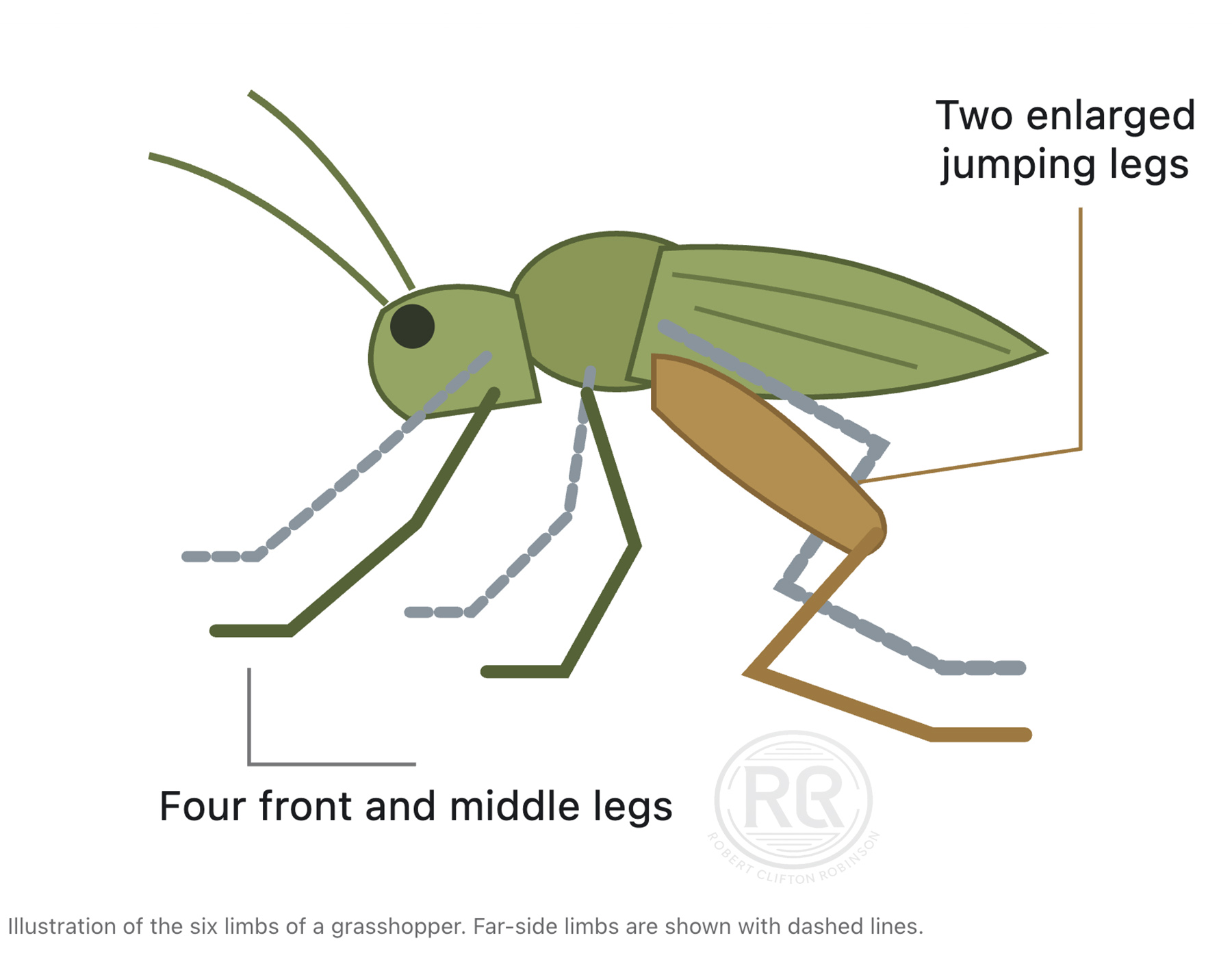
The allegation: The Bible incorrectly describes insects as possessing four legs when all insects possess six.
This objection is considerably weakened by reading the very next verse.
Leviticus 11:20–21 — All flying insects that walk on all fours are an abomination to you. Yet you may eat these of all winged creeping things that go on all fours, which have legs above their feet, with which to hop on the earth.
Notice that the biblical writer explicitly distinguishes the ordinary walking limbs from the additional limbs used for jumping.
The Hebrew terminology includes:
-
רֶגֶל — regel: Foot or leg.
-
כְּרָעַיִם — kera‘ayim: A pair of legs, here referring to the specialized jumping limbs.
-
לְנַתֵּר — lenatter: To leap or spring.
Grasshoppers, locusts, and crickets belong to the order Orthoptera. They possess three pairs of legs, with the hind pair particularly adapted for jumping. Although these hind legs can also participate in walking, their specialized function is unmistakable.
The biblical writer recognizes this functional distinction.
The critic treats the expression “walk on all fours” as though it were an exhaustive anatomical inventory, while overlooking the additional limbs explicitly described in verse 21.
There remains some interpretive difficulty concerning the broader expression in verses 20 and 23, but the description of the permitted jumping insects is entirely consistent with recognition of six limbs.
Conclusion: The passage does not demonstrate that Moses was unaware that grasshoppers possessed six legs. On the contrary, the text distinguishes four ordinary walking limbs from an additional pair of specialized jumping limbs.
The sun standing still — Joshua 10:12–13
The allegation: Joshua describes the sun stopping in the sky, demonstrating that the biblical writers believed in a scientifically erroneous geocentric universe.
The biblical text:
Joshua 10:12–13 (WEB) — Then Joshua spoke to Yahweh in the day when Yahweh delivered up the Amorites before the children of Israel. He said in the sight of Israel, “Sun, stand still on Gibeon! You, moon, stop in the valley of Aijalon!”
The sun stood still, and the moon stayed, until the nation had avenged themselves of their enemies. Isn’t this written in the book of Jashar? The sun stayed in the middle of the sky, and didn’t hurry to go down about a whole day.
The critic confuses phenomenological language with cosmological assertions.
Phenomenological language describes events as they appear to an observer, without necessarily explaining their underlying physical mechanisms.
Even today, astronomers, physicists, meteorologists, and NASA use expressions such as sunrise, sunset, moonrise, and moonset.
None of these expressions requires a belief that the sun revolves around a stationary Earth.
What the Hebrew actually says
The Hebrew command in Joshua 10:12 is:
שֶׁמֶשׁ בְּגִבְעוֹן דּוֹם
Shemesh be-Giv‘on dom.
Literally: Sun, over Gibeon, be still.
The Hebrew verb דָּמַם — damam can mean to be silent, still, motionless, or to cease.
Joshua describes what was observed from the surface of the Earth. He does not describe the astronomical mechanism responsible for the event.
Nowhere in this passage does Joshua state that:
-
The Earth is stationary.
-
The Earth does not rotate.
-
The sun revolves around the Earth.
-
The Earth occupies the physical center of the universe.
-
The prolonged daylight resulted from a particular astronomical mechanism.
All of these assertions would have to be imported into the text by the critic.
The distinction between a miracle and a scientific error
Joshua presents this event as an extraordinary act of God, not an ordinary natural phenomenon.
Joshua 10:14 — There was no day like that before it or after it, that Yahweh listened to the voice of a man; for Yahweh fought for Israel.
If the Earth’s rotation were abruptly stopped through an ordinary physical process, the consequences would be catastrophic. However, the passage does not specify that this occurred or explain how the event was accomplished.
The difficulty that some people have is believing that God could do something like Joshua describes. The first sentence of the Bible states: “In the beginning God created the heavens and the earth.” Understanding the immense power and intelligence required to create our universe, why would anyone be surprised that the God of the Bible could cause the Sun to stand still?
The earth rotates at 1,000 miles per hour. If this rotation slowed by 50 percent, the day would last twice as long. The Sun would appear to stand still.
For a short duration, this would be possible. The sun would not be affected, nor would the other planets. Earth would only experience minor changes if the rotation slowed by 50 percent for less than 12 hours. People on Earth would not notice this slowdown in rotation, with the exception of an increase in earthquakes, storms, and wind speed.
The effects would be minimal and would not destroy Earth or human life. The only perceivable change would be the sun slowing in its progression into darkness and resulting in a much longer day.
There is also evidence from ethnology in other cultures around the world that there was a long day. In the writings of the ancient Chinese, there is a legend of a long day. The Incas of Peru and the Aztecs of Mexico also have a similar record. The Babylonians and Persians record a story of a day that was miraculously extended. Herodotus describes that while in Egypt, a priest showed him their temple records, which describe a day that was twice the length of any day that was ever recorded.
The text itself does not tell us the physical mechanism, and there is no established scientific confirmation of this particular event.
Nevertheless, the critic cannot demonstrate that Joshua taught geocentrism merely because he described the apparent position of the sun from an earthly perspective.
Conclusion: Joshua 10 describes an extraordinary event that is common for the God of the Bible, in observational language. It does not present a geocentric model of the universe.
Genetics through visual stimuli — Genesis 30:37–39
The allegation: The Bible teaches that animals produce striped or spotted offspring by looking at striped branches while mating, contradicting modern genetics.
This allegation illustrates the importance of comparing Scripture with Scripture and reading the entire narrative before reaching a conclusion.
Genesis 30:37–39 (WEB) — Jacob took to himself rods of fresh poplar, almond, and plane tree, peeled white streaks in them, and made the white appear which was in the rods. He set the rods which he had peeled opposite the flocks in the gutters in the watering troughs where the flocks came to drink. They conceived when they came to drink. The flocks conceived before the rods, and the flocks produced streaked, speckled, and spotted.
The critic stops reading at Genesis 30:39 and fails to consider the explanation provided in the following chapter.
Genesis 31 explains what happened in Genesis 30
Genesis 31:8–9 (WEB) — If he said, ‘The speckled will be your wages,’ then all the flock bore speckled. If he said, ‘The streaked will be your wages,’ then all the flock bore streaked. Thus God has taken away your father’s livestock, and given them to me.
Jacob then describes a revelation he received from God:
Genesis 31:10–12 — During mating season, I lifted up my eyes, and saw in a dream, and behold, the male goats which leaped on the flock were streaked, speckled, and grizzled. The angel of God said to me in the dream, ‘Jacob,’ and I said, ‘Here I am.’ He said, ‘Now lift up your eyes, and behold, all the male goats which leap on the flock are streaked, speckled, and grizzled, for I have seen all that Laban does to you.’
There are three distinct elements in this narrative:
First, Jacob employed a particular breeding practice.
The Bible records Jacob placing striped branches before the animals. It does not explicitly establish that the visual appearance of those branches altered the animals’ hereditary information.
Second, Jacob practiced selective breeding.
Genesis 30:40–42 describes Jacob separating animals and differentiating between the stronger and weaker members of the flock.
Selective breeding is a scientifically established method of influencing the characteristics of subsequent generations. It was practiced thousands of years before the discovery of Mendelian genetics.
Animals that do not visibly express certain characteristics may nevertheless carry genetic variants associated with those characteristics. Coat coloration in sheep and goats can involve multiple genes and patterns of inheritance.
Third, the narrative attributes Jacob’s prosperity to divine intervention.
Genesis 31:9 explicitly attributes the outcome to God, while verses 10–12 direct attention to the characteristics of the breeding males.
The biblical explanation is not that striped branches independently altered the genetic composition of the offspring.
Recording an action is not the same as endorsing a scientific theory
Even if Jacob believed that visual stimuli influenced the appearance of offspring, recording his actions would not necessarily constitute divine endorsement of that belief.
Epigenetics, Causation For Heritable Changes In Gene Expression
We know and understand today that behavior and environment can have a profound influence upon the way that genes work.[1] Dissimilar to actual genetic changes, epigenetic changes do not alter DNA, but they can alter how physical bodies read the DNA sequence.
Every cell has a method whereby proteins are created depending upon the instructions given to them by genes in the body. Genetic changes affect proteins that determine the function of a cell to become different parts of a body; such as, brain, heart, skin, and nerves. All cells have the same DNA, but they operate differently by epigenetics, which turn on or off, certain genes in the production of proteins.
Cell changes happen depending upon the instructions that are given to them that come from within genes. Genetic changes may alter the type of proteins that are made to create the different parts of our bodies, epigenetic changes are affected by environment and behavior.
Diet and exercise may drastically affect epigenetic changes that result in the types of physical appearances we see in the sheep of Jacob, when he accessed chemical compounds found in the bark of various trees stated in Genesis chapter 30.
Jacob’s use of branches in which he peeled back the bark exposing the chemical compounds found in these trees, caused heritable changes in the expression of genes in these animals, resulting in physical changes in the color and patterns in the subsequent sheep that were born.
Many people are unaware that certain trees, like the Aspen, possess compounds that are useful in the treatment of human maladies, such as pain. The bark of an Aspen tree contains salicylic acid. This is the principle ingredient that comprises aspirin that numbs pain and reduces swelling.
Jacob apparently had knowledge of the chemical compounds found in the tree bark listed in Genesis chapter 30, and used these nutrients to cause physical changes in the newborn sheep and goats of his flock. When pregnant animals drank from the watering troughs provided by Jacob, which had the branches of these trees in the water, “they gave birth to young that were streaked, speckled, and spotted.”
After these changes took place in the wool coat of the new generation of sheep and goats, Jacob began a secondary method of selective breeding where he specifically bred the new variegated and more vigorous animals with each other, gradually eliminating the former sheep of Laban’s flock.
This breeding method was successful, for we read that Jacob became very wealthy with a great number of sheep and goats. The texts of Genesis 30 are not myth, folklore, and superstition; they are an accurate description of Jacob’s knowledge in causing physical changes by chemical compounds found in nature.
The Bible frequently records the actions, beliefs, and statements of individuals without affirming that everything they believed was correct.
Modern genetics does not support the proposition that looking at striped branches causes offspring to inherit striped coats. Genesis 30 does associate the branches with the breeding outcome, but Genesis 31 supplies a broader explanation that includes divine providence and the characteristics of the breeding animals.
We cannot reconstruct the precise genetic mechanisms involved from the information provided.
Conclusion: The critic isolates Genesis 30:37–39 from its larger narrative and attributes a universal theory of genetics to the biblical writer that the text never explicitly formulates.
Summary of the four allegations
|
Alleged scientific error |
What the biblical text actually describes |
|---|---|
|
Rabbits are ruminants |
An ancient dietary classification involving digestive behavior, without specifying stomach anatomy. |
|
Insects have only four legs |
Walking limbs distinguished from additional specialized jumping limbs. |
|
The sun revolves around the Earth |
The apparent position of the sun as observed from Earth during an extraordinary event. |
|
Visual stimuli determine genetic inheritance |
Jacob’s breeding practices, the characteristics of breeding animals, and divine intervention. |
The methodological problem with these accusations
To establish that the Bible contains a scientific error, a critic must first establish precisely what scientific proposition the biblical writer intended to assert.
The critic must demonstrate that the proposition is actually present in the original language, that the surrounding context supports that interpretation, that the writer intended a literal scientific assertion rather than an observational description, and that the proposition is demonstrably false.
It is insufficient to assign a modern scientific meaning to an ancient expression and then accuse the ancient writer of violating that modern definition.
This is one of the fundamental distinctions between exegesis and eisegesis.
Exegesis seeks to extract the meaning intended by the author. Eisegesis introduces a meaning into the text that may not have been intended by the author.
Equally, responsible biblical exegesis should not invent alternative Hebrew definitions or unverified scientific mechanisms merely to eliminate an apparent difficulty. The same evidentiary standard should apply to both critics and defenders of Scripture.
These four allegations do not establish that the Bible contains scientific errors. Some involve incomplete readings of the biblical text; others involve imposing modern scientific terminology upon ancient descriptions of the natural world.
The strongest responses are found in Leviticus 11:21, where the additional jumping limbs are explicitly described, and Genesis 31:8–12, where the biblical writer provides further explanation of Jacob’s breeding success.
The hare passage presents a more substantial linguistic difficulty, while Joshua presents a question concerning the historicity of a miracle rather than an explicit assertion of geocentric cosmology.
An allegation of error is not a demonstration of error. Before a biblical statement can be declared scientifically false, the critic must first demonstrate that the Bible actually makes the scientific assertion being disputed.
See All of Rob’s Published Books at Amazon
See All 52 of Rob’s Books
Sources and Citations
The following are relevant linguistic, exegetical, and scientific reference works for further examination. I have not independently verified edition-specific page numbers for this response.
1. Brown, Francis, S. R. Driver, and Charles A. Briggs. A Hebrew and English Lexicon of the Old Testament. Oxford: Clarendon Press, 1907. Entries for אַרְנֶבֶת, גֵּרָה, עָלָה, כֶּרַע, and דָּמַם.
2. Koehler, Ludwig, Walter Baumgartner, and Johann Jakob Stamm. The Hebrew and Aramaic Lexicon of the Old Testament. Leiden: Brill, 1994–2000.
3. Milgrom, Jacob. Leviticus 1–16: A New Translation with Introduction and Commentary. Anchor Bible 3. New York: Doubleday, 1991. Commentary on Leviticus 11.
4. Varga, Molly. Textbook of Rabbit Medicine. 2nd ed. Elsevier, 2014. Rabbit digestive physiology and cecotrophy.
5. Gullan, P. J., and P. S. Cranston. The Insects: An Outline of Entomology. 5th ed. Wiley-Blackwell, 2014. Insect anatomy and locomotion.
6. Hess, Richard S. Joshua: An Introduction and Commentary. Tyndale Old Testament Commentaries. InterVarsity Press, 1996. Commentary on Joshua 10.
7. Wenham, Gordon J. Genesis 16–50. Word Biblical Commentary 2. Dallas: Word Books, 1994. Commentary on Genesis 30–31.
8. Sarna, Nahum M. Genesis: The Traditional Hebrew Text with the New JPS Translation. JPS Torah Commentary. Philadelphia: Jewish Publication Society, 1989. Commentary on Genesis 30–31.
9. Sponenberg, D. Phillip, and Rebecca Bellone. Equine Color Genetics. 4th ed. Wiley-Blackwell, 2017. General principles of mammalian coat-color inheritance.
Categories: Robert Clifton Robinson


Please see, "Guidelines For Debate," at the right-side menu. Post your comment or argument here: