Critics Of The Bible Often Assert That The Eyewitnesses Cited in the New Testament are “Alleged,” Not Proven—
The men who wrote the New Testament say that they saw Jesus with their “own eyes,” and they know they are telling the truth. How does the eyewitness testimony of the New Testament compare to secular eyewitnesses in the historical record? How do the New Testament eyewitnesses compare to the eyewitnesses of American History? Which of these three records, the New Testament, Secular accounts, or American history accounts, provide us with the best proof of eyewitness testimony?
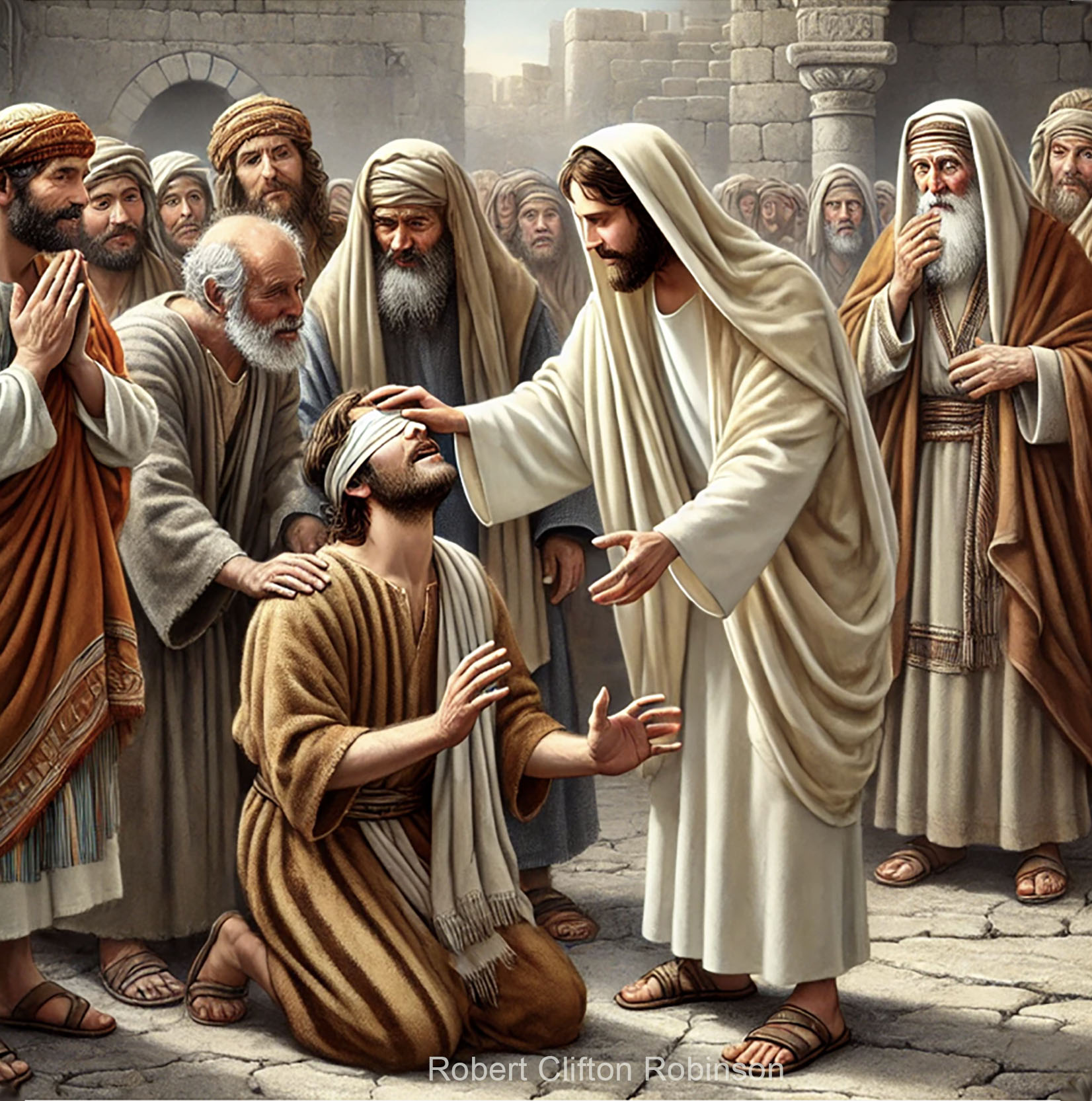
New Testament Eyewitnesses, Jesus Heals, Copyright, RCR
If we conduct a personal investigation concerning the Canonical Gospels of the New Testament, we quickly discern that we are reading testimony from men who were present when Jesus said and did the things recorded in these texts. These men state repeatedly that they saw and heard Jesus and there is no ambiguity in what they meant:
- Paul: 1 Corinthians 9:1: “Am I not an apostle? Haven’t I seen Jesus our Lord with my own eyes?
- Peter: 1 Peter 1:16: “We saw his majestic splendor with our own eyes.”
- John: 1 John 1:1:”We saw him with our own eyes and touched him with our own hands.”
- James, Paul, all the Apostles: 1 Corinthians 15:7: “Then Jesus was seen alive by James and later by all the apostles. Last of all, as though I had been born at the wrong time, I also saw him.”
- Mary Magdalene: John 20:18: “Mary Magdalene found the disciples and told them, “I have seen the Lord!”
- Peter: Acts 5:29-32: “But Peter and the apostles replied… We are witnesses of these things…”
- John: 1 John 1:2-3: “This one who is life itself was revealed to us, and we have seen him. And now we testify and proclaim to you that he is the one who is eternal life. He was with the Father, and then he was revealed to us. We proclaim to you what we ourselves have actually seen and heard so that you may have fellowship with us.
A historical comparison between events that we know are true based on eyewitness testimony and the eyewitness testimony of the men in the New Testament who claimed to have seen Jesus can be established based on key historical principles used in historiography:
- Multiple Attestation – Do independent sources confirm the event?
- Early Testimony – How close in time is the testimony to the events?
- Enemy Confirmation – Do opponents acknowledge the event?
- Eyewitness Accounts – Do we have claims from those who were present?
- Consistency – Are the reports internally consistent?
- Embarrassment – Do the reports contain details unlikely to be fabricated?
A Comparison of Historical Eyewitness Testimony
The following chart reveals key historical events, universally accepted based on eyewitness testimony, compared to the eyewitness testimony of the apostles and early Christians:

Comparison of NT Witnesses to Secular Witnesses, Copyright RCR
Why the New Testament Eyewitness Testimony Holds Historical Weight
Multiple Attestation
- The Resurrection is reported by Paul (1 Cor. 15:3-8), the four Gospels, and Acts.
- The mischievous superstition that Tacitus, Pliny, and Suetonius refer to was the firm belief by the followers of Jesus that He had risen from the dead.
- Roman authors describe Christianity as so dangerous to Roman society, that it was characterized as “insanity” that would spread to the entire Roman Empire. The Romans record that Christians would not deny the resurrection of Jesus, as “Superstitio.” Tacitus called their trust in the resurrection, exitabilis (detestable). Suetonius referred to the Christian stance of Jesus’ resurrection as Superstitio nova ac malefica (Mischievous Superstition). Pliny wrote to Emperor Trajan that the Christian superstitious belief in the resurrection was a contagio (disease).
- Independent sources: Josephus and Tacitus confirm Jesus’ existence and crucifixion.
- There are 136 secular, non-biblical citations about Jesus in the historical record.
The Number of Attestations
- The men who were with Jesus since the beginning of His ministry, record that “Jesus healed everyone brought to Him.” How many people who were sick, diseased, and dying, were brought to Jesus in the 3 1/2 years of His public ministry? Conservative estimates are in the tens of thousands.
Matthew 4:24-25 “News about Jesus spread as far as Syria, and people soon began bringing to him all who were sick. And whatever their sickness or disease, or if they were demon possessed or epileptic or paralyzed—he healed them all. Large crowds followed him wherever he went—people from Galilee, the Ten Towns, Jerusalem, from all over Judea, and from east of the Jordan River.
John 20:30-31 “The disciples saw Jesus do many other miraculous signs in addition to the ones recorded in this book. But these are written so that you may continue to believe that Jesus is the Messiah, the Son of God, and that by believing in him you will have life by the power of his name.”
John 21:25 “Jesus also did many other things. If they were all written down, I suppose the whole world could not contain the books that would be written.”
- Jesus performed 9 miracles that demonstrated His mastery over the physical laws of the universe—a power that has never been seen on earth from any human being.
- Turning water to wine: John 2:1-11
- The first catch of fish: Luke 5:4-10
- Calming a storm: Matthew 8:23-27, Mark 4:35-41, Luke 8:22-25.
- Feeding 5,000: Matthew 14:13-21, Mark 6:30-34, Luke 9:10-17, John 6:1-15.
- Walking on water: Matthew 14:22-23, Mark 6:45-52, John 6:16-24.
- Feeding 4,000: Matthew 15:29-39, Mark 8:1-10.
- A caught fish pays Temple tax: Matthew 17:24-27.
- Curse of the fig tree: Matthew 21:18-22, Mark 11:12-14, 20-26.
- Second catch of fish: John 2:1-11
- The New Testament Exhibition Of Jesus; Miracles: Evidence Of Truth And His Identity
- Did The Miracles Of Jesus Described In The New Testament Violate The Laws Of Physics?
Early Testimony
- Paul’s letters (Galatians, 1 Corinthians) were written within 20 years of the events.
- The Synoptic Gospels were written by 44 AD, because Paul carried these eyewitness testimonies about Jesus, with him to Asia, on his first missionary journey on 45 AD.
- It is impossible that Paul could have proved to the people in Asia that Jesus is the Messiah, without the eyewitness testimony of the men who saw and heard Jesus.
- The historical eyewitness testimonies of these men who had “been with Jesus since the beginning of His ministry’ (Luke 1), cite the hundreds of Old Testament Messianic Prophecies Jesus fulfilled.
Hostile Enemy Confirmation
- Jewish leaders accused the disciples of stealing the body (Matt. 28:11-15), implicitly admitting the tomb was empty.
- Tacitus (Annals 15.44) records that Jesus was executed under Pontius Pilate and that Christianity spread rapidly.
- There are 136 secular, non-biblical citations for Jesus in the historical record.
- The Romans and Jesus had no interest in preserving a historical record for Jesus, His crucifixion or resurrection—yet this is precisely what they did by their hostile, adversarial comments about Jesus in the records.
Eyewitness Testimony
- Paul (1 Cor. 9:1; 15:7-8) claimed to see the risen Jesus.
- Peter (Acts 2:32; 2 Peter 1:16) said, “We were eyewitnesses of His majesty.”
- John (1 John 1:1-3) states, “We saw Him with our own eyes and touched Him.”
- Mary Magdalene personally testified, “I have seen the Lord” (John 20:18).
- 500 witnesses, still alive when the New Testament was written, never deny Jesus rose from the dead: 1 Corinthians 15:6 saw the risen Christ.
- The Roman historical record describes ten Roman Emperors who executed millions of Christians because they refused to deny the resurrection of Jesus.
The Embarrassment Principle
- People who make mistakes and reveal their own inadequacies and weaknesses, do not include these mistakes in their historical testimony.
- In the record of the New Testament narratives, the text is filled with the failures and weaknesses of the men and women who followed Jesus. Only truthful written testimony would permit and include these embarrassing events.
- The writers of the New Testament who record Jesus’ life, death, and resurrection, do not include their names in their testimony. We learn in John 7:18, why this happened. These men were not seeking to make themselves known, they wanted the world to know about Jesus: John 7:18 “Those who speak for themselves want glory only for themselves, but a person who seeks to honor the one who sent him speaks truth, not lies.” This is why John didn’t include his name in his Gospel about Jesus. He had heard Jesus teach this text before, and John didn’t want to be misunderstood as promoting himself.
- Women were the first eyewitnesses of Jesus’ resurrection, despite their testimony being considered unreliable in Jewish courts. This could only happen if the written testimonies about Jesus were true.
- The apostles initially doubted Jesus’ resurrection (Matt. 28:17, Luke 24:11), an unlikely detail to fabricate. These men tell us about their doubts, failures, and weaknesses. This would never happen in a fabricated story.
Martyrdom of the Eyewitnesses
- One of the most compelling pieces of evidence from secular history that serves to validate the presence of Jesus on earth, dying on the cross and resurrecting from the dead, is the persecution of the early followers of Jesus by the Roman government.
- Christians of the first century had something in their possession that others in history who died for their beliefs did not have; a written record from eyewitnesses who stated they had seen Jesus crucified and then alive three days later.“I passed on to you what was most important and what had also been passed on to me. Christ died for our sins, just as the Scriptures said. He was buried, and he was raised from the dead on the third day, just as the Scriptures said. He was seen by Peter and then by the Twelve. After that, he was seen by more than 500 of his followers at one time, most of whom are still alive, though some have died. Then he was seen by James and later by all the apostles. Last of all, as though I had been born at the wrong time, I also saw him.” ~1 Corinthians 15:3-8
- It was because the early followers of Jesus had such a large body of eyewitness evidence from the men who had been with Jesus from the beginning, and had seen Him crucified, dead, buried and alive after three days, and walking with them for 40 days, these early believers refused to deny their trust in Jesus, and so, they were executed.
- Peter, Paul, James, and others died for their testimony.
- Unlike political revolutionaries, they had nothing to gain.
The New Testament Witnesses Are as Reliable—More Reliable—Than Other Ancient Historical Testimonies
The eyewitness testimony of the New Testament holds equal or greater historical credibility than many widely accepted historical accounts.
- Roman and Greek history depends on fewer sources, written much later.
- The apostles’ testimony is first-hand, early, and independently confirmed.
- Their willingness to die rather than recant supports their sincerity.
By historical standards, if we accept Caesar’s assassination, Socrates’ death, and Alexander’s campaigns, we have even greater reason to accept the apostolic testimony of Jesus’ resurrection as authentic.
Is The New Testament A Valid Historical Narrative?
The Following is A Comparison of the Historical Eyewitness Events of American History, with the Historical Eyewitness Events of the New Testament:
The following chart is a comparison of historical eyewitness events from American history and the eyewitness testimony of the New Testament regarding Jesus. These comparisons are based on historical reliability criteria, such as multiple attestation, early testimony, enemy confirmation, eyewitness accounts, consistency, and willingness to suffer for the truth.
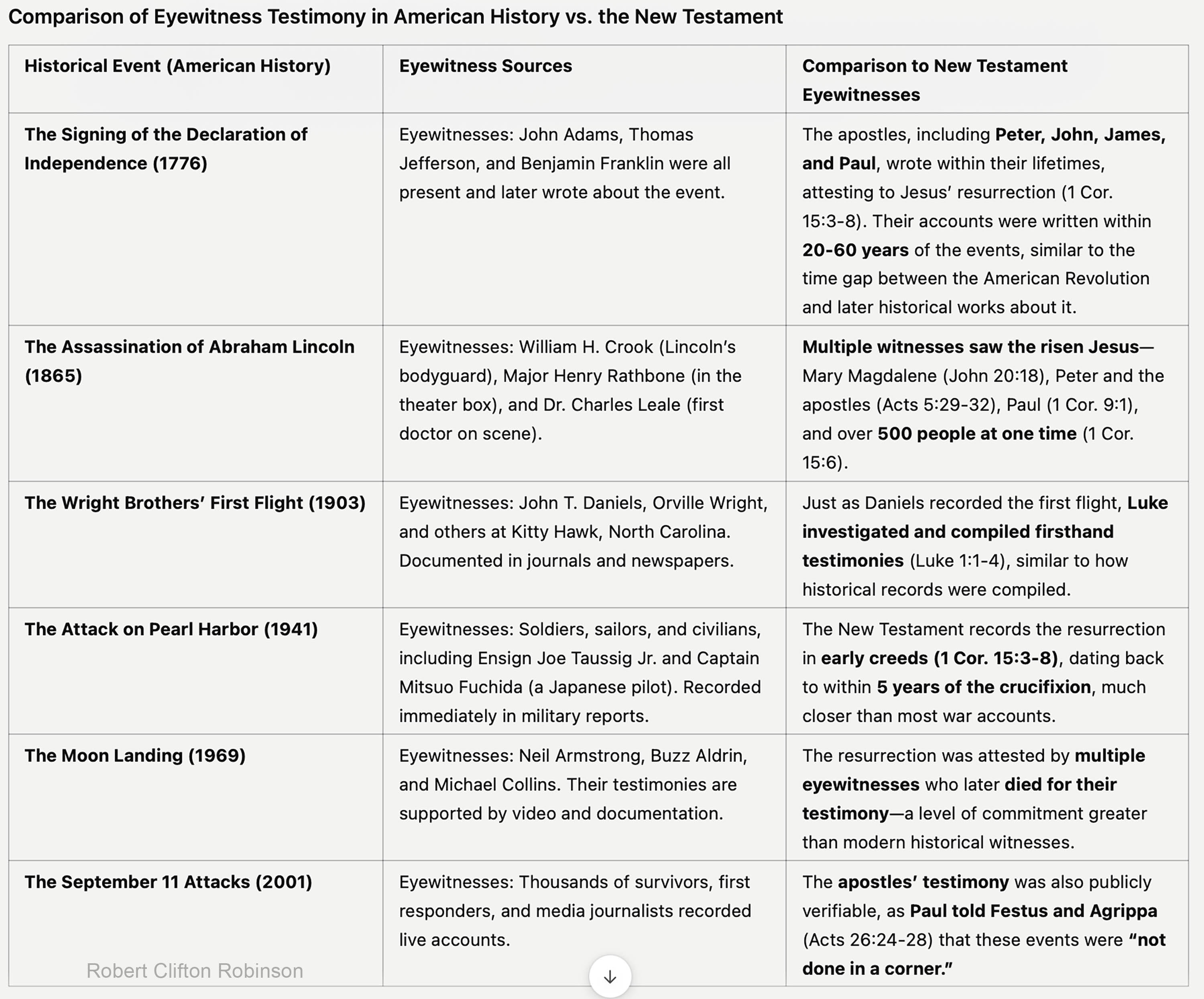
Comparison of NT Witnesses to American History Witnesses, Copyright RCR
Why the New Testament Eyewitnesses Hold Historical Weight
Multiple Attestation
- In American history, events like Lincoln’s assassination or 9/11 are verified by multiple sources.
- The life, death, and resurrection of Jesus is reported by multiple independent sources (Paul, Peter, John, and the Gospels). Also, secular, non-biblical sources.
Early Testimony
- The Declaration of Independence was recorded by its signers shortly after 1776.
- 1 Corinthians 15:3-8 is an early Christian creed written within 5 years of Jesus’ death, making it one of the earliest historical testimonies of an event in ancient history.
- The Synoptic Gospels were completed by 44 AD
Eyewitness Confirmation
- The Wright brothers’ flight had several witnesses, proving its reality.
- The apostles record that they saw Jesus risen, including 500 people at one time (1 Cor. 15:6).
- There are 203 eyewitness statements in the 260 chapters of the New Testament
- The events of American history are no more credible that the events described in the New Testament.
- Founder of Harvard Law School, Simon Greenleaf stated that the eyewitness testimony about Jesus in the New Testament, is credible historical evidence that would stand up in court of law.
Enemy Confirmation
- Pearl Harbor was confirmed by Japanese and American sources.
- The events of the Civil War were recorded by several eyewitnesses.
- Jesus’ empty tomb was acknowledged by Jewish leaders, who claimed the body was stolen (Matt. 28:11-15).
- Romans record both the crucifixion of Jesus and the belief that Christians were testifying that Jesus had been seen alive by many eyewitnesses.
- There are 396 historical citations for Jesus’ Crucifixion and Resurrection
Martyrdom and Willingness to Suffer
- The signers of the Declaration of Independence risked their lives for their claim of freedom.
- The apostles willingly died for their testimony, unlike American historical figures who fought for political causes.
- Over 5 million Christians were executed for refusing to deny the historical eyewitness testimony of those who had seen Jesus alive after His crucifixion.
The New Testament Eyewitnesses Meet or Exceed the Standards of American Historical Events
If we trust American eyewitness accounts—like the Moon Landing, 9/11, Pearl Harbor, or Lincoln’s assassination—then we have even greater reason to trust the eyewitnesses of the New Testament because:
- Their accounts were written within their lifetimes (not centuries later).
- They suffered and died for their testimony, proving sincerity.
- Their reports are independently corroborated by multiple sources.
- Enemy sources confirmed key facts, such as the empty tomb.
By historical methodology, the eyewitness testimony of the apostles regarding Jesus’ resurrection is as reliable—if not more reliable—than major events in American history.
See “New Testament Apologetics,” by Robert Clifton Robinson. This 650 page treatise documents the eyewitness, historical evidence that proves the New Testament was written by Men who had seen Jesus with their own eyes.

Available In Kindle eBook, Paperback, and Hardback Editions
Categories: Robert Clifton Robinson
 Robert Clifton Robinson
Please see, "Guidelines For Debate," at the right-side menu. Post your comment or argument here: