The Following Is From The Website of Bart Ehrman:
I provide in this essay the actual citations from Ehrman’s Website, and my impeachment of the false assertions, located between the two lines at the end of each false claim of contradiction.
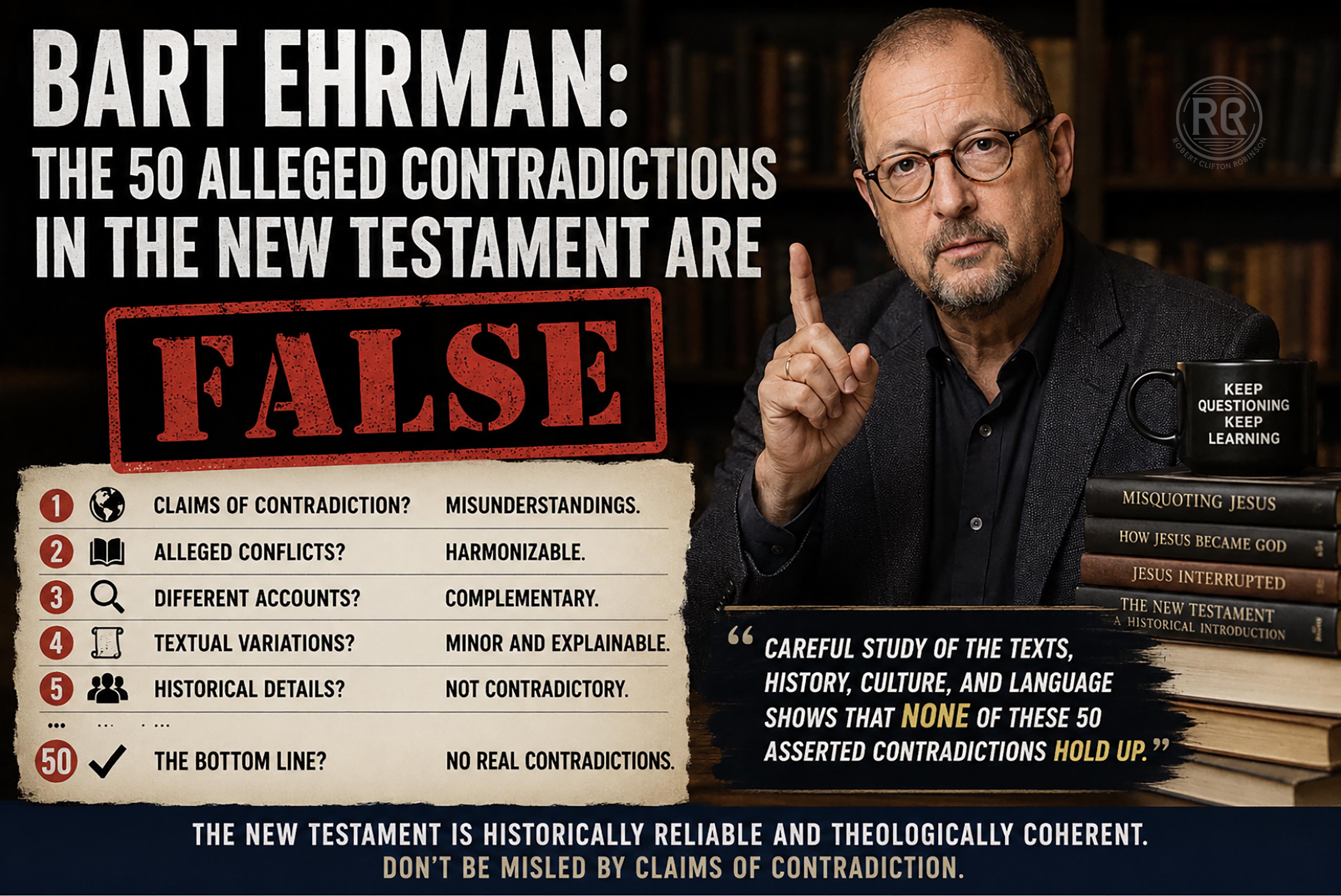
Biblical Contradictions: List of 50 Biblical Inconsistencies, at Bart Ehrman’s Website*
Bart Ehrman is known as a preeminent New Testament Scholar. His manner of examining the texts of the New Testament is from his view as an atheist, concluding that because God doesn’t exist, miracles are not possible, Jesus was not capable of these miracles, and is therefore not God.
When we examine Ehrman’s conclusions about the New Testament, he classifies these texts as non-historical, fabricated narratives. Ehrman rejects the eyewitness testimony because he does not believe miracles are possible, while demanding proof of God that would necessarily involve miracles.
This is classic circular reasoning that says Miracles cannot occur (assumed). Therefore, any testimony reporting miracles is unreliable. Therefore, there is no reliable evidence for God. Therefore, miracles cannot occur. The conclusion is embedded in the premise.
All of the following 50 alleged contradictions are easily impeached. As I went through these claimed contradictions, I was struck that someone known as a New Testament Scholar doesn’t know the actual texts of the Bible that are claimed as contradictions.

#1 – The Earth Does Not Last Forever
In Ecclesiastes 1:4, we read that “the earth remains forever,” a sentiment echoed in Psalm 104:5, which praises God for laying the foundations of the earth so firmly that “it should never be moved.”
However, this view contrasts sharply with certain passages in the New Testament that foresee the destruction of the current earth and the creation of a new one. For example, 2 Peter 3:13 describes the hope for “new heavens and a new earth, where righteousness dwells,” and Revelation 21:1 envisions “a new heaven and a new earth” after the first has passed away.
IMPEACHMENT: Earth “forever” — Ecclesiastes 1:4 and Psalm 104:5 use “forever” in the sense of enduring stability within the present created order, not an absolute denial that God may renew creation. 2 Peter 3 and Revelation 21 describe transformation/replacement by divine judgment, not a contradiction.
#2 – The Number of Animals Noah Took on the Ark
Another example that reminds us of the discrepancies in the Bible can be found in the story of Noah and the Ark. In Genesis 6:19-20, God commands Noah to take two of every kind of animal — one male and one female — onto the Ark to preserve their species. However, in Genesis 7:2-3, the instructions are more specific, stating that Noah should take seven pairs of clean animals (suitable for sacrifice) and one pair of unclean animals.
So, which is it? This discrepancy reflects differing traditions within the text, likely stemming from the merging of multiple sources behind the composition of Genesis. As Robert Alter explains in his Commentary:
As scholarship has often noted, two versions of the Flood story, the Priestly and the Yahwistic, are intertwined in a somewhat confusing fashion… Abraham ibn Ezra and other medieval exegetes rescue consistency by proposing that when God directed attention to the clean-unclean distinction, He had to add the difference in numbers because more animals needed to be sacrificed. (Noah, like his counterpart in the Mesopotamian Flood stories, does in fact offer a thanksgiving sacrifice after the waters recede.) But the tensions between the two versions, including how they record the time span of the Flood, persist, and there are some indications that the editor himself struggled to harmonize them.
IMPEACHMENT: Noah’s animals — Genesis 6 gives the general rule: two of every kind. Genesis 7 gives the added detail: extra clean animals for sacrifice and later food. A general statement followed by a more specific instruction is not a contradiction.
#3 – Two Creation Stories
In exploring other biblical contradictions, we are (for now) staying with the Book of Genesis, which begins with two distinct accounts of creation. In Genesis 1:1-2:3, it unfolds in a structured, ordered sequence over six days, culminating in the creation of humanity (male and female) together on the sixth day.
In Genesis 2:4-25, however, the narrative is more focused on human formation. Here, man (Adam) is created first from the dust of the ground, followed by vegetation, animals, and finally, a woman (Eve) as a helper. This portrayal is more intimate and anthropocentric, with God personally shaping Adam and breathing life into him.
IMPEACHMENT: Two creation stories — Genesis 1 gives the cosmic sequence; Genesis 2 narrows in on man, Eden, covenant responsibility, and woman. Genesis 2 does not retell every event chronologically; it develops the human-centered portion of day six.
#4 – Does God Forgive People?
In 2 Kings 24:4, we encounter a stark declaration: “The LORD was not willing to forgive,” specifically regarding the sins of King Manasseh, who led Judah into idolatry and shed innocent blood.
This statement stands in tension with the broader biblical theme of God’s mercy and willingness to forgive, as seen in passages like Psalms 103:3,10, which praise God for forgiving iniquities and not treating humanity as their sins deserve.
The contradiction deepens when we compare 2 Kings with 2 Chronicles. In the latter (2 Chronicles 33:19), we learn that Manasseh eventually repented, humbling himself before God, who then restored him.
However, repentance and restoration are entirely absent from the account in Kings, which portrays Manasseh’s sins as the ultimate reason for Judah’s destruction — a punishment that fell upon generations long after his reign.
IMPEACHMENT: Does God forgive? — 2 Kings 24:4 concerns national judgment on Judah after accumulated bloodguilt; 2 Chronicles 33 concerns Manasseh’s personal repentance. God may forgive an individual while still allowing national consequences.
#5 – How Many Items?
In the book of Ezra, we encounter a numerical inconsistency regarding the temple vessels that King Cyrus of Persia returned to the Jews for their use in rebuilding the temple in Jerusalem. Ezra 1:9-10 provides a detailed inventory:
This totals 2,469 items. Yet in Ezra 1:11, the text states that the total number of vessels returned was 5,400. This represents another example of the contradictions in the Bible, deriving from the difference between the listed items and the sum provided.
Attempts to harmonize this contradiction by suggesting that not all items were included in the detailed list seem unlikely. Verse 10 explicitly states, “and 1,000 other devices,” implying that all categories of vessels were accounted for.
IMPEACHMENT: Ezra’s temple vessels — Ezra 1:9–10 lists selected categories; Ezra 1:11 gives the full total. The phrase “other vessels” need not mean every remaining object is individually enumerated.
#6 – Levite Cities: 11 or 13?
Another contradiction arises in the accounts of the Levite cities allocated to the descendants of Aaron. In 1 Chronicles 6:42-45, 11 cities are listed, but the text states there should be 13 in total. These cities include Hebron, Libna, Jattir, Eschtemoa, Holon, Debir, Aschan, Beth Shemesh, Geba, Alemet, and Anatot. The discrepancy between the stated total and the actual list creates an inconsistency within the text.
The parallel account in Joshua 21:13-19 provides a different list of 13 cities, with variations and additions. Notably, this list includes Ajin, Jutta, Gibeon, and Almon, which are absent in Chronicles, while Aschan and Alemet do not appear in Joshua’s account.
IMPEACHMENT: Levite cities — Chronicles often abbreviates or preserves variant spellings; Joshua gives the fuller allotment. Missing names in a compressed genealogical list do not equal contradiction.
#7 – The Prophetess Huldah and Her Family: A Case of Differing Names
In 2 Kings 22:14, we read about Hilkiah the priest consulting the prophetess Huldah, who is described as the wife of Shallum, son of Tikvah, the son of Harhas. However, the parallel account in 2 Chronicles 34:22 provides slightly different details about Huldah’s family.
Here, her husband is named Shallum, but his lineage includes Tokhat and Hasra instead of Tikvah and Harhas. Even in the original Hebrew, these differences in names are clear and distinct.
IMPEACHMENT: Huldah’s family names — Tikvah/Tokhat and Harhas/Hasrah are likely variant spellings, textual transmission forms, or alternate family names. Ancient Hebrew names often appear in multiple forms.
#8 – The Passover Celebrations of Hezekiah and Josiah
A notable example of the contradictions in the Bible arises when comparing the accounts of Passover celebrations under the reigns of King Hezekiah and King Josiah.
In 2 Kings 23:21-23, it’s stated that during Josiah’s reign, the Passover was celebrated for the first time since the era of the judges, explicitly noting that no such observance occurred during the time of the kings of Israel and Judah.
However, in 2 Chronicles 30, we find an account of an earlier Passover celebrated under King Hezekiah. This celebration is described as extraordinarily large and marked by great joy, involving participants from both Judah and remnants of the northern kingdom of Israel.
IMPEACHMENT: Hezekiah and Josiah Passovers — 2 Kings 23 says no Passover like Josiah’s had been kept, not that no Passover of any kind had occurred. Chronicles itself says Hezekiah’s Passover was extraordinary, but Josiah’s was unique in another sense.
#9 – Who Was David’s Scribe? Three Different Answers
A fascinating example of a biblical mistake relates to the identity of the scribe who served during King David’s reign.
In 2 Samuel 8:17, the scribe is identified as Seraiah. Later, in 2 Samuel 20:25, the same position is ascribed to someone named Shevah. Meanwhile, 1 Chronicles 18:16 lists Shawsha as the scribe during David’s reign. The differences in names are evident even in the original Hebrew, which creates a clear inconsistency in the record of this key position.
This contradiction may be the result of scribal errors in the transmission of the texts, as the names are phonetically similar, suggesting possible confusion during copying.
IMPEACHMENT: David’s scribe — Seraiah, Shevah, and Shavsha are plausibly variant names/titles for the same official, or successive holders of the office. Royal administrations had more than one scribe.
#10 – The Mysterious Disappearance of Swords in Israel
A perplexing biblical contradiction emerges in the account of weaponry among the Israelites. In 1 Samuel 13:19-22, we are told that during Saul’s reign, there was not a single sword or spear among the Israelites, except for those belonging to Saul and his son Jonathan.
However, this claim is difficult to reconcile with other passages. In the period of the judges, only a generation or so earlier, swords appear to have been commonplace. Judges 8:10 describes Gideon defeating 120,000 enemy swordsmen, and Judges 20:2,15,17 detail a vast Israelite army equipped for battle, implying they were well-armed.
IMPEACHMENT: Israelite swords — 1 Samuel 13 describes a specific military crisis under Philistine oppression, not all Israelite history. Earlier periods with weapons do not prove weapons were available during Saul’s emergency.
#11 – Contradictions in the Story of Jacob and Esau: Method of Deception
The story of Jacob and Esau, as told in Genesis 27 and beyond, is a rich narrative full of theological and literary significance. However, as noted in Gabel’s Bible as Literature, it also exhibits several biblical contradictions and narrative inconsistencies, likely due to the blending of multiple sources.
One notable inconsistency lies in the methods Jacob uses to deceive his father, Isaac. The narrative presents two separate strategies: Jacob wears Esau’s clothes — which smell of the open country — and covers his arms with goatskins to mimic Esau’s hairy skin. While both methods are effective, the dual explanation seems redundant and suggests the merging of two versions of the story.
Each may have originally featured a single method of deception, but they were later combined into the unified account we have today.
IMPEACHMENT: Jacob’s deception — Clothes supplied smell; goatskins supply touch. Isaac was blind, suspicious, and used several senses. Multiple deceptive devices are exactly what the story requires.
#12 – Contradictions in the Bible: Jacob’s Departure from Home
Another contradiction emerges in Jacob’s departure from home after the deception. In one account, he flees to Harran to escape Esau’s wrath, acting on his mother Rebekah’s advice (Genesis 27:42-45).
In another, Jacob travels to Harran to find a wife, following his father Isaac’s command (Genesis 28:1-5). These differing motivations for Jacob’s journey point to distinct narrative strands, each with its theological emphasis — one focusing on familial conflict and another on divine providence in securing the lineage of the patriarchs.
As we, in our exploration of the contradictions in the Bible, slowly shift focus to the New Testament, I’m reminded again of Gail Evans’ assertion that each biblical contradiction “is not so much the hard and fast word of God, but a collection of scrolls, written by various people” who often had different views about the relationship between humans and what they consider to be the Supreme Being or God.
IMPEACHMENT: Jacob’s departure — Both motives are true: Rebekah urges Jacob to flee Esau, and Isaac sends him to obtain a proper wife. Human danger and covenant marriage are complementary causes.
#13 – What Did the Voice at Jesus’ Baptism Say?
The accounts of Jesus’ baptism in the Gospels of Matthew, Mark, and Luke reveal fascinating examples of discrepancy in the Bible regarding the words spoken by the divine voice from heaven. While all three narratives describe this pivotal event, the exact wording and audience of the voice differ, reflecting unique theological emphases and textual traditions.
In Matthew 3:17, the voice appears to address the gathered crowd, proclaiming: “This is my beloved Son, with whom I am well pleased.”
Bart Ehrman, in his book Jesus Interrupted (an excellent study of numerous contradictions in the Bible), notes: “The voice appears to be speaking to the people around Jesus, or possibly to John the Baptist, informing them who Jesus is.”
In Mark 1:11, however, the voice speaks directly to Jesus: “You are my beloved Son; with you I am well pleased.” Here, the statement is more intimate, suggesting a personal affirmation of Jesus’ identity and mission.
Luke 3:22 presents an even more intriguing variation. In some of the oldest manuscripts, the voice says: “You are my Son; today I have begotten you.” This wording echoes Psalm 2:7 and carries significant theological implications, suggesting a moment of divine appointment or recognition of Jesus’ sonship at his baptism.
IMPEACHMENT: Voice at Jesus’ baptism — Matthew reports the public significance; Mark/Luke report the direct address. A heavenly declaration can be both addressed to Jesus and heard as testimony by others. Multiple eyewitnesses often report different details of the same event. Doing so does not constitute contraditions; it forensically proves truthful testimony.
#14 – Conflicting Accounts of Paul’s Journeys
The life of the apostle Paul provides another example of biblical contradiction when comparing his travel narrative in Galatians with that in the Acts of the Apostles. In Galatians 1:17-2:9, Paul emphasizes that, after his conversion, he did not go to Jerusalem immediately.
Instead, he traveled to Arabia and then returned to Damascus. He states that he visited Jerusalem only three years later, staying for 15 days and meeting only Cephas (Peter) and James. He explicitly notes that he did not meet any other apostles at that time.
Afterward, he went to Syria and Cilicia, and 14 years later, he returned to Jerusalem for the apostolic council, possibly corresponding to the events of Acts 15.
In Acts 9, however, Paul’s movements after his conversion appear different. According to this account, Paul stayed in Damascus for many days, preaching the gospel before fleeing due to a plot against his life. He then traveled to Jerusalem, where he met Barnabas and was introduced to the apostles, with no mention of his journey to Arabia.
The text suggests he stayed in Jerusalem for a longer period, preaching openly before leaving for Caesarea and then Tarsus. Later, Barnabas brought him from Tarsus to Antioch, where Paul began his missionary work.
The two accounts differ significantly in timing, locations, and the people Paul met, creating challenges for harmonizing the narratives.
In his Commentary, therefore, Joseph Fitzmyer rightly points out that “Luke [Fitzmyer believes that the name of the author of Acts is Luke] says nothing about Paul’s journey to Arabia or his return from there to Damascus (see Gal I: 17). Nor does he indicate that the “considerable time” (9:23) was actually “three years” (Gal 1:18).”
IMPEACHMENT: Paul’s journeys — Acts abbreviates; Galatians supplies details. Acts omits details. This is an attribute of truthful testimony by multiple witnesses. “Many days” in Acts 9 can include the longer period Paul describes in Galatians 1.
#15 – The Genealogy of Jesus
One of the most well-known examples of the contradictions in the Bible lies in the differing genealogies of Jesus presented in Matthew 1:1-17 and Luke 3:23-38. Both Gospels trace Jesus’ lineage, but they do so in significantly different ways, with notable discrepancies in names.
The differences in the lists of names are striking. For example, Jesus’ grandfather in Matthew is Jacob, whereas it’s Heli in Luke (Matthew 1:16; Luke 3:23).
Similarly, the genealogies diverge dramatically in the generations following David. Matthew traces Jesus’ descent through Solomon, emphasizing the royal line, while Luke follows Nathan, another son of David, presenting a priestly or prophetic lineage.
Some have suggested that Matthew provides Joseph’s legal lineage, while Luke traces a biological or maternal line. However, Bart Ehrman, in Jesus Interrupted, notes: “It is an attractive solution, but it has a fatal flaw. Luke explicitly indicates that the family line is that of Joseph, not Mary (Luke 1:23; also Matthew 1:16).
IMPEACHMENT: Jesus’ genealogy —According to the Gospel of Matthew, through Joseph’s genealogy, Jesus came from Abraham and David. The Messiah must come from the seed of Abraham and be from the house of David. This genealogy in Matthew, showing that Jesus came through Joseph’s line, proves that Jesus has the Legal right to the throne of David.
Mary’s genealogy in the Gospel of Luke traces Jesus’ line all the way back to Adam, validating that He was qualified to be the Second Adam and Savior of all men. Mary’s genealogy proves that Jesus has the Physical right to be the Messiah.
These two genealogies are not contradictory; they are showing two different lines of descendants, necessary to prove Jesus is the Messiah.
#16 – Where Was Jesus the Day After His Baptism?
The Gospels present differing accounts of what happened to Jesus immediately after his baptism. In the Synoptic Gospels Jesus goes directly into the wilderness, where the Devil tempts him.
In contrast, the Gospel of John omits any mention of Jesus’ temptation in the wilderness. Instead, John describes a sequence of events in which John the Baptist, on the day after witnessing the Spirit descending on Jesus during his baptism, publicly identifies Jesus as the Lamb of God (John 1:29-34).
IMPEACHMENT: After baptism, John does not say that Jesus doesn’t go into the wilderness. He simply omits the temptation account and selects other testimony from John the Baptist.
#17 – The Death of Judas: Two Contradictory Accounts
This is one of my favorite contradictions in the Bible, as it vividly illustrates the complexities of the Gospel and Acts narratives. The accounts of Judas Iscariot’s death in Matthew 27:3-10 and Acts 1:18-19 differ both in the details of what happened and the description of his death.
In Matthew, Judas is said to have felt remorse after betraying Jesus, returned the 30 pieces of silver to the temple, and hanged himself in despair. The chief priests used the returned money to buy a potter’s field, which came to be known as the “Field of Blood.”
In Acts, however, Judas’ death is described quite differently. Here, Judas is said to have acquired a field with the payment he received for his betrayal, and his death occurs when he falls headlong (Greek: πρηνὴς γενόμενος), bursting open and spilling his intestines. The verb πρηνὴς indicates, without a doubt, a headfirst fall!
In his Commentary on Acts, Charles K. Barrett concludes:
It is evident that Matthew and Luke report different traditions, which have in common only the belief that Judas died an unhappy death and knowledge of the existence in Jerusalem of a field called Blood Field, which had at some earlier stage come to be associated with Judas (for it is most unlikely that Matthew and Luke should both, independently, have made the association).
IMPEACHMENT: Judas’ death — Matthew gives the manner: hanging. Acts gives the aftermath: his body fell and burst open. “Acquired a field” can mean his blood money procured it. It is interesting that a New Testament scholar is incapable of understanding this basic premise.
#18 – Was Jairus’ Daughter Already Dead?
This example of biblical contradiction was at the heart of an online debate between Bart D. Ehrman and Matthew Firth that you can check out here! What is this inconsistency all about?
In Mark 5:22-23 and Luke 8:41-42, Jairus approaches Jesus, pleading with him to heal his daughter, who is described as gravely ill but still alive. Jairus says: “My little daughter is dying” (Mark 5:23). However, while Jesus is on his way to Jairus’ house, a messenger arrives to report that the girl has died, leading to the dramatic miracle where Jesus raises her from the dead.
In Matthew 9:18, the story takes a different turn. Here, Jairus tells Jesus from the outset that his daughter has already died: “My daughter has just died. But come and put your hand on her, and she will live” (Matthew 9:18). It’s a small contradiction, but indeed a contradiction!
IMPEACHMENT: Jairus’ daughter — Mark/Luke give the fuller sequence; Matthew compresses the story. Ancient biographies often condensed dialogue without falsifying the event. This is a classic intentional assertion made by persons looking for a contradiction when none exists.
#19 – On What Day Did Jesus Die?
We know that Jesus died by crucifixion. However, on what day? In the Synoptic Gospels, Jesus is crucified on the day of Passover (Nisan 15), following the Last Supper, which is described as a Passover meal. This timeline situates Jesus’ death after the Passover lambs were sacrificed.
In contrast, John’s Gospel places Jesus’ crucifixion on the day before Passover (Nisan 14), at the same time the Passover lambs were being slaughtered in preparation for the festival (John 19:14).
IMPEACHMENT: Day Jesus died — The issue depends on Passover terminology, Galilean/Judean reckoning, and whether “Preparation” means Friday or preparation for the feast. John and the Synoptics can both place Jesus’ death on Friday of Passover week.
Available in Kindle eBook, Paperback, Audiobook. and Hardback Editions
#20 – The High Priest Abiathar in Mark 2:26
Another biblical mistake comes from Mark 2:26, where Jesus references an event from 1 Samuel 21:1-6. In Mark’s account, Jesus recalls how David, in need of food, entered the house of God and ate the consecrated bread, “in the days of Abiathar the high priest.”
The problem lies in that, according to 1 Samuel, the high priest at the time of this event was Ahimelech, Abiathar’s father. Abiathar became high priest later, following Ahimelech’s death. This discrepancy has prompted much scholarly debate.
However, most critical scholars, unburdened by the radical understanding of inerrancy, see it as a simple error or misattribution by the author of Mark.
IMPEACHMENT: Abiathar in Mark 2:26 — “In the days of Abiathar” can mean during the well-known Abiathar-era narrative, not that Abiathar personally handed David the bread. Abiathar became the more famous priestly figure connected with David.
#21 – Was the Curtain in the Temple Torn Before or After Jesus’ Death?
There is another contradiction in the Bible related to Jesus’ death. It centers on the timing of the tearing of the temple curtain. In Matthew 27:50-51, the moment is described as happening immediately after Jesus’ death: “And when Jesus had cried out again in a loud voice, he gave up his spirit. At that moment, the curtain of the temple was torn in two from top to bottom.”
However, in Luke’s account, a slight difference in the sequence arises. Luke 23:45 mentions the tearing of the curtain just before Jesus cries out: “Father, into your hands I commit my spirit.” This subtle shift in timing creates a discrepancy between Luke and the other Synoptic Gospels.
IMPEACHMENT: Temple curtain — Luke’s wording does not require a strict timestamp before Jesus’ death; he groups the darkness and temple sign together. Matthew marks the precise sequence more explicitly.
#22 – How Many Times Will the Rooster Crow Before Peter Denies Jesus?
A subtle and funny contradiction emerges in the accounts of Peter’s denial of Jesus and the role of the rooster’s crowing.
In Mark 14:30, Jesus predicts: “Truly I tell you, today – yes, tonight – before the rooster crows twice you yourself will disown me three times.” True to the prediction, Mark’s Gospel records the rooster crowing twice as Peter denies Jesus three times (Mark 14:68, 72).
In contrast, the other Gospels — Matthew (26:34), Luke (22:34), and John (13:38) — simplify the prediction, stating that Peter will deny Jesus three times before the rooster crows, with no mention of a second crowing.
Jesus’ birth stories in Matthew and Luke contain several examples of the contradictions in the Bible that scholars have noted since the work of Enlightenment thinkers in the 18th century. Let’s take a look!
IMPEACHMENT: Rooster crowing — Mark gives the more detailed “twice”; the others give the general “before the rooster crows.” One crowing prediction can be summarized without contradiction.
#23 – The Hometown of Mary and Joseph
In Matthew’s Gospel, the hometown of Mary and Joseph is implied to be Bethlehem. The narrative begins with Jesus’ birth in Bethlehem and continues with the family fleeing to Egypt to escape Herod’s massacre (Matthew 2:1-15). Only later, after returning from Egypt, do they settle in Nazareth, presented as a new location chosen to avoid Herod’s successor (Matthew 2:22-23).
Luke, however, explicitly states that Mary and Joseph were living in Nazareth before Jesus’ birth. The couple travels to Bethlehem for a census, as Joseph is said to be of the house of David (Luke 2:4-5). After Jesus is born in Bethlehem, the family returns directly to Nazareth, with no mention of Egypt or Herod’s massacre (Luke 2:39-40).
IMPEACHMENT: Mary and Joseph’s hometown — Matthew never says they originally lived in Bethlehem. He begins with Jesus’ birth there. Luke supplies the prior Nazareth residence.
#24 – Where Did the Family Go After Jesus’ Birth?
Another notable contradiction between Matthew and Luke concerns the family’s movements after Jesus was born. In Matthew, the Holy Family doesn’t return to Nazareth immediately. Instead, they flee to Egypt to escape King Herod’s order to kill all the male infants in Bethlehem.
In Luke’s Gospel, however, there is no mention of Herod’s massacre or a flight to Egypt. After Jesus is born, the family completes the required purification rites in Jerusalem (Luke 2:22-24) and then returns directly to their home in Nazareth.
IMPEACHMENT: After Jesus’ birth, Luke summarizes the return to Nazareth after purification; Matthew includes the Egypt episode. Luke does not say they returned immediately, the same day, or deny intervening events.
#25 – Who Visited Baby Jesus?
The visitors who come to see baby Jesus differ significantly between Matthew and Luke. In Matthew’s account, magi (wise men) from the East follow a star to Bethlehem, bringing gifts of gold, frankincense, and myrrh to honor the newborn “King of the Jews” (Matthew 2:1-12).
Luke, on the other hand, introduces humble shepherds who are visited by an angel announcing the birth of the Savior. The shepherds then go to Bethlehem to see Jesus, glorifying and praising God for what they had witnessed (Luke 2:8-20).
This difference but also other contradictory elements are analyzed in depth by Raymond E. Brown in his magnificent and enormous book The Birth of the Messiah. For those ready to immerse themselves in all the nuances and details of the birth narratives, it is a must-read.
IMPEACHMENT: Visitors to Jesus — Shepherds and magi came at different times. Luke describes the birth-night visit; Matthew describes a later visit to the “young child” in a house.
#26 – Who Is For Jesus and Who Is Against Him?
Another discrepancy that Bart Ehrman highlights in his book Jesus Interrupted involves two seemingly contradictory sayings of Jesus as recorded in Matthew and Mark. In Matthew 12:30, Jesus states, “Whoever is not with me is against me,” drawing a clear line between allegiance and opposition. Yet, in Mark 9:40, he appears to express the opposite sentiment: “Whoever is not against us is for us.” These sayings, while similar in structure, convey starkly different messages.
IMPEACHMENT: For or against Jesus — Matthew addresses hostile neutrality toward Jesus; Mark addresses unauthorized allies not opposing Him. Different situations, different principles.
#27 – The Council of Jerusalem
The description of the Jerusalem Council in Acts 15 differs in emphasis from Paul’s account in Galatians 2:1-10. In Galatians, Paul emphasizes his independence from the Jerusalem apostles, presenting the council as a private meeting where his mission to the Gentiles was endorsed.
The book of Acts, however, portrays the event as a public council where the apostles collectively and in harmony decide on guidelines for Gentile converts, such as abstaining from food sacrificed to idols.
IMPEACHMENT: Jerusalem Council — Galatians emphasizes Paul’s apostolic independence; Acts emphasizes public church resolution. Private consultation and public council can both occur.
#28 – Gamaliel’s Speech in Acts
Among the inconsistencies in the Bible, one stands out! In Acts 5:34-39, Gamaliel, a Pharisee, refers to Theudas and Judas the Galilean as examples of failed revolutionary leaders. However, this raises a historical issue, as Josephus, the Jewish historian, places Theudas after Judas the Galilean, suggesting that Luke (the author of Acts) may have confused the chronological order.
IMPEACHMENT: Gamaliel and Theudas — Josephus mentions one Theudas; this name was very popular at this time and not unique. Gamaliel may refer to an earlier rebel otherwise unknown to Josephus.
#29 – Paul’s Views on Women: Silence or Leadership?
One of the most interesting examples of the contradictions in the Bible emerges when comparing Paul’s seemingly supportive views on women’s roles in the church with a passage often attributed to him but suspected by scholars to be a later interpolation.
In 1 Corinthians 14:34-35, Paul is quoted as saying: “Women should remain silent in the churches. They are not allowed to speak, but must be in submission, as the Law says.” In Romans 16, however, Paul commends several women for their roles in the early Christian community. He praises Phoebe as a deacon (Romans 16:1), Junia as “outstanding among the apostles” (16:7), and others such as Priscilla, who worked alongside him in ministry.
Many scholars argue that may not be original to Paul’s letter. They note that the verses disrupt the flow of the surrounding text, where Paul discusses orderly worship, and that some manuscripts place the passage in different locations.
IMPEACHMENT: Women silent or serving — Paul permits women to pray and prophesy in 1 Corinthians 11, so 1 Corinthians 14 concerns disorderly speech/judging in assembly, not absolute silence in all ministry.
#30 – Stephen’s Account of Abraham’s Tomb in Acts: A Historical and Textual Contradiction
In Acts 7:15-16, Stephen, during his speech before the Sanhedrin, claims that Abraham purchased a burial place in Shechem from the sons of Hamor. This account introduces several significant problems when compared to the Old Testament narrative.
According to Genesis 23, Abraham purchased a family tomb in Machpelah near Mamre from Ephron the Hittite, where Sarah, Abraham, Isaac, Rebekah, Leah, and Jacob were all eventually buried.
On the other hand, Genesis 33:18-19 and Joshua 24:32 state that the burial site in Shechem was purchased by Jacob from the sons of Hamor and that it was Joseph, not Jacob, who was buried there.
IMPEACHMENT: Stephen and the tomb — Stephen compresses patriarchal burial traditions into a summary speech. Ancient speeches often combine related events without modern footnote precision.
#31 – Stephen’s Account of Abraham’s Tomb in Acts: A Historical and Textual Contradiction
Another possible biblical contradiction is related to the historical implausibility of Abraham interacting with the sons of Hamor.
According to Genesis 34, Hamor and his son Shechem lived during Jacob’s lifetime, a period long after Abraham’s death. This discrepancy makes it unlikely Abraham could have purchased land from them.
Additionally, the text of Genesis 23 does not indicate that Abraham owned other burial sites, and it seems illogical that Jacob would buy a tomb already owned by his grandfather.
IMPEACHMENT: Abraham and sons of Hamor — “From the sons of Hamor” can refer to the later clan/descendants associated with Shechem, not necessarily Hamor’s immediate sons living in Abraham’s day. This error on Ehrman’s website demonstrates his lack of knowledge in the scriptures and Hebrew culture.
#32 – Did the Arameans Stop Invading Israel?
In 2 Kings 6:23, we read that after a miraculous intervention where the prophet Elisha spares captured Aramean soldiers, the text concludes: “So the bands of Aram stopped raiding Israel’s territory.”
This statement suggests a cessation of hostilities between Aram (Syria) and Israel. However, in the very next verse (2 Kings 6:24), the narrative takes an opposite turn, as Ben-Hadad, king of Aram, gathers his entire army and lays siege to Samaria, the capital of Israel.
IMPEACHMENT: Aramean raids stopped — 2 Kings 6:23 says raiding bands stopped; 6:24 describes a later full military siege. Raids and national invasions are not the same.
#33 – Who Instigated the Census: God or Satan?
In our journey through differences and contradictions in the Bible, we are driven back to the time of King David and his census.
In 2 Samuel 24:1, it is the Lord who incites David to number Israel, reflecting a theological perspective in which God is sovereign over all events, even those leading to judgment. In contrast, 1 Chronicles 21:1 attributes the incitement to Satan which introduces a distinct shift in theological interpretation.
IMPEACHMENT: God or Satan incited David? — Samuel gives the ultimate sovereign cause; Chronicles gives the immediate evil agent. Biblical theology often distinguishes God’s permission/superintendence from Satan’s temptation. The critic doesn’t know that Chronicles shows us the view of events from God’s perspective.
#34 – Differing Numbers in the Census
The reported results of the census differ significantly between the two accounts. 2 Samuel 24:9 records 800,000 swordsmen in Israel and 500,000 men in Judah, while 1 Chronicles 21:5 lists 1,100,000 swordsmen in Israel and 470,000 in Judah.
IMPEACHMENT: Census numbers — Samuel and Chronicles may count different categories: standing army, total eligible fighting men, or include/exclude certain tribal groups. Ancient census totals often differ by counting method. If this biblical critic is a genuine scholar, he should know this. A PhD is not a document that guarantees a person is a biblical scholar.
#35 – The Death of Saul’s Sons vs. Deuteronomy’s Law
The execution of seven of Saul’s sons (2 Samuel 21:7-14) to atone for his actions contradicts Deuteronomy 24:16, which explicitly states that children shouldn’t be punished for the sins of their fathers. This lex talionis violation suggests a tension between the moral and legal principles outlined in the Torah and the actions described in the narrative.
IMPEACHMENT: Saul’s sons and Deuteronomy — 2 Samuel 21 concerns bloodguilt under covenant justice and the Gibeonite treaty violation, not ordinary civil punishment of innocent children for a father’s private sin. Again, a lack of biblical knowledge has caused this error by the critic.
#36 – The Number of Saul’s Sons
Another example of the contradiction in the Bible arises concerning the number of Saul’s sons. In 1 Samuel 31:2 and 1 Chronicles 10:5, Saul and all his sons are said to have died in battle, yet 2 Samuel 21:1-14 introduces seven additional sons whose deaths are required to atone for Saul’s sin.
IMPEACHMENT: Number of Saul’s sons — “All his sons” in 1 Samuel 31 means all sons present in that battle context, not every male descendant Saul ever had. The critic is not paying attention to context and scripture details.
#37 – Michal or Merab?
In 2 Samuel 21:8, the text states that five of the executed sons were Michal’s. However, this conflicts with 2 Samuel 6:23, which explicitly states that Michal, David’s wife, had no children.
Scholars argue this is likely a scribal error and that the text should read “Merab” (Michal’s sister) instead of Michal. This correction aligns with 1 Samuel 18:17, where Merab is mentioned as Saul’s daughter.
IMPEACHMENT: Michal or Merab — This is likely a copyist issue, and many translations note Merab. A transmissional variant is not a contradiction in the original event.
#38 – Did Saul See Samuel Again After His Rejection?
An apparent biblical contradiction is also seen in 1 Samuel 15:35. There, it’s explicitly stated that after Saul was rejected by God: “Samuel did not see Saul again until the day of his death.” The Hebrew word used (ra’a), clearly indicates physical sight or meeting.
However, in 1 Samuel 19:24, Saul encounters Samuel during an episode in which Saul is overcome by the Spirit of God and prophesies in Samuel’s presence at Naioth in Ramah.
IMPEACHMENT: Samuel did not see Saul again — 1 Samuel 15:35 means Samuel no longer visited Saul in royal fellowship or counsel. 1 Samuel 19 is an abnormal prophetic encounter, not restored relationship.
#39 – How Long Did Saul Reign?
An example of a time-based discrepancy in the Bible revolves around Saul’s reign as described in 1 Samuel 13:1. The verse famously omits Saul’s age and states that he reigned for only two years.
This short time frame contradicts Acts 13:21, where Paul declares that Saul ruled for 40 years. Additionally, if 1 Samuel 13:1 is taken as part of the narrative, verse 8 becomes problematic, as it suggests only seven days have passed, not two years.
IMPEACHMENT: Saul’s reign — 1 Samuel 13:1 is textually damaged in Hebrew. Acts 13:21 preserves the broader reign length. A damaged numeral is a textual transmission problem, not a theological contradiction.
#40 – How Many Men Were in the Ambush Against Ai?
In Joshua 8, a numerical error arises concerning the ambush Joshua planned against the city of Ai. In verse 3, Joshua selects 30,000 warriors for the ambush, clearly distinguishing this group from those engaged in the direct attack.
However, in verse 12, the text states that only 5,000 men were placed in ambush. The inconsistency between these two numbers is further complicated by verses 9 and 12, which indicate there was only one ambush force hidden west of the city.
IMPEACHMENT: Ai ambush — Joshua 8 can describe two detachments or the larger force and a smaller selected unit. The 30,000 and 5,000 need not be the same group.
#41 – What Livestock? The Plagues of Egypt
As we are getting close to the end of our journey through the contradictions in the Bible, one thing pops out! It seems that keeping track of livestock was as challenging for the ancient authors as it might have been for Pharaoh!
In Exodus 9:5, during the fifth plague, a pestilence is said to kill “all of the livestock of the Egyptians.”
Yet, just a few days later, in Exodus 9:21-22, the seventh plague of hail threatens to destroy “all the livestock in the fields.” The obvious question arises: what livestock? If the fifth plague wiped them all out, where did the animals for the seventh plague come from?
IMPEACHMENT: Egyptian livestock — Exodus 9:3 specifies livestock “in the field.” Some animals were sheltered, replaced, imported, or belonged to servants who heeded Moses’ warning before the hail.
#42 – Did God Reveal His Name Yahweh to the Patriarchs?
It seems that even God can contradict himself — or at least, that’s how it appears in the Bible! In Exodus 6:3, God tells Moses: “I appeared to Abraham, Isaac, and Jacob as God Almighty [El Shaddai], but by my name ‘The LORD’ [Yahweh], I did not make myself known to them.”
This statement suggests that Yahweh’s name was unknown to the patriarchs. But earlier in Genesis 15:7, God declares to Abraham: “I am The LORD [Yahweh], who brought you from Ur of the Chaldeans.” Additionally, the name Yahweh is used repeatedly throughout Genesis.
IMPEACHMENT: Yahweh known to patriarchs? — Exodus 6:3 means the patriarchs did not know Yahweh by the full covenantal experience of redemption now revealed through the Exodus, not that they never heard the name.
#43 – Where Did Aaron, the Brother of Moses, Die?
This is another possible example of a contradiction in the Bible! In Numbers 20:28 and Numbers 33:38, Aaron is said to have died and remained on the top of Mount Hor, a location emphasized as the site of his death and burial.
However, in Deuteronomy 10:6, Aaron is reported to have died and been buried at Moser (or Moseroth), a completely different location.
After a couple of Old Testament examples of the contradictions in the Bible and clear differences, let’s get back to the New Testament. After all, when it comes to the contradictions in the Bible, most people think of the Gospels and the story of Jesus’ life!
IMPEACHMENT: Aaron’s death site — Moser/Moseroth likely names the broader district or encampment region near Mount Hor. One passage names the mountain; another the travel station area.
#44 – Jesus’ Trial Before Pilate: Silent or Conversational?
The Gospel accounts of Jesus’ trial before Pilate reveal stark differences, particularly between Mark and John. In Mark 15:2-5, Jesus remains almost entirely silent during the interrogation, uttering only the cryptic phrase “You say so” when asked if he is the King of the Jews.
In contrast, John 18:33-38 presents a dramatically different scene where Jesus engages in an extended and profound dialogue with Pilate. Here, Jesus discusses the nature of his kingdom, truth, and authority, portraying him as a figure of wisdom and divine insight.
IMPEACHMENT: Jesus silent or conversational before Pilate — Mark says Jesus gave no further answer to the accusations, not that He never spoke at all. John records additional private dialogue.
#45 – Pilate’s Declaration of Innocence: Present in John, Absent in Mark
Another important difference and a possible biblical contradiction concerns Pilate’s assessment of Jesus’ innocence. In John 18:38, 19:4, and 19:6, Pilate declares three separate times: “I find no basis for a charge against him.”
In stark contrast, Mark’s Gospel (15:1-15) contains no such declarations of innocence. Instead, Pilate’s role is portrayed as passive; he quickly succumbs to the demands of the crowd and authorizes Jesus’ crucifixion without protest or hesitation.
Why is that? Scholars have noted that the Gospel accounts of Jesus’ trial and execution, when analyzed chronologically from Mark to John, become increasingly anti-Jewish. This progression likely reflects the evolving social dynamics and deteriorating relationship between Jews and Christians in the later part of the 1st century.
As Christopher Edwards, in his book Crucified: The Christian Invention of the Jewish Executioners of Jesus notes:
John’s gospel has mixed messages about who crucifies Jesus. On the one hand, John’s Jews testify that they are not allowed to put anyone to death, and after the crucifixion, the gospel recalls that the Roman soldiers carried out the execution. On the other hand, when John narrates the crucifixion, he clearly states that ‘the Jews [. . .] the chief priests [. . .] they crucified him’… The chronological examination of the relevant New Testament crucifixion texts displays the development of the accusation that Jewish actors killed Jesus from a parable in Mark to more explicit descriptions and declarations in Luke-Acts and John.
IMPEACHMENT: Pilate’s innocence declaration — Mark’s omission is not denial. In all testimonies about Jesus, there are details that one remembers, details omitted by another witness. This is forensic evidence of truthful testimony, not a contradiction. John supplies fuller legal dialogue; Mark emphasizes Pilate’s weakness before the crowd.
#46 – Did John the Baptist Recognize Jesus’ Identity?
Another example of the contradictions in the Bible emerges when comparing John the Baptist’s understanding of Jesus’ identity in John 1 with his actions in Matthew 11.
In John’s Gospel, John the Baptist unequivocally identifies Jesus as “the Lamb of God who takes away the sin of the world” (1:29) and as the one upon whom the Spirit descended, confirming him as the chosen one of God. This portrayal suggests that John fully recognized Jesus’ divine role and identity from the outset.
However, in Matthew’s Gospel, John later sends his disciples to ask Jesus, “Are you the one who is to come, or should we expect someone else?” (11:3). This question reflects uncertainty or doubt on John’s part, which contradicts the confident declaration found in John 1.
IMPEACHMENT: John the Baptist recognizes Jesus? — John’s later question from prison may reflect discouragement, a request for public confirmation for his disciples, or a different recollection about timing, not ignorance of Jesus’ identity.
#47 – Jesus’ Ministry: Apocalyptic Preacher or Divine Logos?
One striking difference and a possible contradiction between the Gospels lies in their portrayals of Jesus’ public ministry. In the Synoptic Gospels, Jesus is primarily depicted as a Jewish apocalyptic preacher proclaiming the imminent arrival of the Kingdom of God.
As Bart D. Ehrman explains in Jesus: Apocalyptic Prophet of the New Millennium:
In contrast, the Gospel of John presents a markedly different picture. Here, Jesus focuses less on the coming kingdom and more on his identity as the incarnate Logos (Word), the divine Son of God who came to reveal eternal truths and offer salvation through belief in him.
IMPEACHMENT: Apocalyptic preacher or Logos — These are complementary. The divine Logos can proclaim the kingdom; the kingdom preacher can also be the incarnate Son. John emphasizes identity; the Synoptics emphasize proclamation.
#48 – The Timing of Jesus’ Temple Cleansing: Early or Late?
In John (2:13-16), this dramatic event occurs early in Jesus’ ministry, shortly after his first miracle at the wedding in Cana. John uses this event to underscore Jesus’ divine authority and mission right from the start.
The Synoptic Gospels, however, place the temple cleansing near the end of Jesus’ ministry, during the final week of his life (Mark 11:15-17; Matthew 21:12-13; Luke 19:45-46). In these accounts, the cleansing is a catalyst for the events leading to Jesus’ arrest and crucifixion.
IMPEACHMENT: Temple cleansing — The simple answer is that Jesus cleansed the temple twice, once at the beginning of His ministry, once at the end of His ministry. It is also possible that John arranged the narrative thematically. Neither possibility requires contradiction.
#49 – Who Went to Jesus’ Tomb?
It only seems natural to end our journey through the contradictions in the Bible by looking at the central element of Christianity: Jesus’ death and resurrection. These examples have been discussed for decades, even centuries, and are best explained in Bart Ehrman’s insightful and already mentioned book Jesus Interrupted.
A well-known contradiction involves the identities of those who visited Jesus’ tomb on Easter morning. John 20:1 mentions Mary Magdalene alone, while Matthew 28:1 lists Mary Magdalene and “the other Mary.” Mark 16:1 adds a third woman, Salome, to the group. Luke 24:1 expands it further to include Mary Magdalene, Joanna, Mary the mother of James, and “other women.”
IMPEACHMENT: Women at the tomb — John names Mary Magdalene without saying she was alone. In fact, “we don’t know where they have laid him” in John 20:2 implies others were with her.
#50 – Where Did the Disciples Go After the Resurrection?
A final example concerns Jesus’ post-resurrection instructions to his disciples and their immediate actions. In Luke’s Gospel (24:49-53), Jesus explicitly tells his disciples to stay in Jerusalem until they are “clothed with power from on high,” referring to the coming of the Holy Spirit at Pentecost.
In contrast, Matthew 28:10, 16-20 records Jesus instructing his disciples to go to Galilee, where they meet him on a mountain and receive the Great Commission: “Go and make disciples of all nations.”
IMPEACHMENT: Jerusalem or Galilee after resurrection — The disciples remained in Jerusalem until Pentecost, but also met Jesus in Galilee during the forty days before the ascension. Matthew and Luke select different resurrection appearances.
See The Truth of Reliability for the New Testament with the Evidence that Proves the Narratives about Jesus are Accurate, Reliable, and Prove Jesus is the Eternal Living God:
- Written by Marko Marina, Ph.D.
Categories: Robert Clifton Robinson


I apologize. I could only read a few of these. I may come back in a few days and finish this article; but, the truth is my spirit would not let me continue and insisted on the following to be written.
Mr. Erhman is simply ONE MAN. That’s it. He is in the same boat as everyone else whether he knows it or not. It is fine that we polish each other as it takes steel to sharpen steel. But we must always remember that the enemies of God are also our enemies and the Lord Jesus Christ told us that we must pray for our enemies no matter how hard that seems.
We must also remember that it is the Word (The Messiah – Jesus Christ) that we must listen to; not a man bent on distorting the Word as his father satan the devil would have him do. Mr. Erhman can claim whatever he wishes to claim. The blind can continue following him. If we pray for them, and, hope that they see the light at some point then maybe they will.
Consider. Many things happened the moment the Christ died on the cross. Given all of that, Caiaphas (and Ananias) had to have known that they just killed the Son of God. Deep down they knew what they had done. There is no way in my opinion, given what was experienced shortly afterward, that these men could not have know what they had done. I will say the same thing about Judas. And yet these men continued on the road of death by following their father satan the devil. How could these men not know specifically when the scarlet wool tied to the scapegoat stopped turning white around 30AD. How could they have not known?
At the Rapture, Mr. Erhman, remaining in his current mindset, will not be taken. I hope for his sake that he does not repeat the mistake of Caiaphas and Ananias by not repenting and seeking forgivence. Mr. Erhman. On the day of the Rapture, you will know your mistake if God has allowed you to live to see it. After that, realize YOU ARE WRONG and REPENT and LIVE. We are all guilty. It is the Christ that removes it. If you have ears … please open them for you are worth it.
Thank you Brother Rob for all you do.
Tony
LikeLike