There are Impossible Barriers in Math and Science that Exist in Proving the Evolutionary Origin of Life
The Mathematical and Informational Challenge to the Origin of Life
The greatest challenge facing materialistic explanations for life is not the evolution of species, but the origin of life itself. Long before natural selection could preserve advantageous traits, before mutations could be inherited, and before populations could adapt to environmental pressures, a living organism capable of metabolism, information storage, replication, and reproduction had to exist. This problem, known as abiogenesis, remains one of the most difficult and unresolved questions in modern science.[1]
The distinction between abiogenesis and biological evolution is crucial. Evolutionary theory attempts to explain how living organisms diversify after life already exists. Abiogenesis attempts to explain how life arose from non-life in the first place. Mutation and natural selection cannot operate in the absence of a living system because both require self-replication, inheritance, and genetic continuity. Consequently, the first cell is not merely one problem among many in biology; it is the prerequisite for every evolutionary mechanism that follows.[2]
Charles Darwin lived during a period when scientists viewed the cell as a relatively simple structure. The interior of the cell was often described as little more than a blob of protoplasm enclosed within a membrane. Modern molecular biology has completely overturned that view. What was once thought to be simple is now recognized as one of the most sophisticated engineering systems known to science.[3]
Even the simplest free-living bacterial cells contain astonishing levels of complexity. A typical bacterial cell possesses a digital information storage system in DNA, a message transfer system in RNA, protein manufacturing facilities in ribosomes, molecular motors, membrane transport systems, ATP energy production pathways, error correction mechanisms, protein folding systems, transcription machinery, regulatory networks, and integrated metabolic pathways involving thousands of coordinated chemical reactions.[4]
The DNA molecule stores information using a four-character alphabet consisting of adenine, thymine, cytosine, and guanine. These nucleotide bases are arranged in precise sequences that determine the order of amino acids within proteins. Those proteins then assemble into molecular machines and cellular structures that sustain life. Molecular biologists routinely describe these processes using the language of information science, including terms such as code, translation, transcription, proofreading, editing, and messaging.[5]
The informational content of DNA is not merely metaphorical. Information theory demonstrates that information resides primarily in the arrangement of symbols rather than in the material substrate carrying those symbols.[6] The sentence, “The cat sat on the mat,” derives its meaning not from the chemistry of the ink on the page but from the arrangement of symbols according to a predetermined code. Similarly, the sequence of nucleotide bases in DNA derives its functional significance not from the chemistry of the nucleotides themselves but from their arrangement according to the genetic code.[7]
Neo-Darwinian theory proposes that mutations generate new information and that natural selection preserves advantageous changes. Critics of this explanation do not dispute the existence of mutation or selection. The question instead concerns creative capacity: can mutation and selection generate the enormous quantities of functionally specified information required to explain biological complexity?[8]
Gene duplication is frequently proposed as the primary mechanism by which evolution generates new information. According to this model, one copy of a duplicated gene continues performing its original function while the second copy accumulates mutations that eventually produce a new function. The mechanism itself undoubtedly occurs. The controversy concerns whether it possesses sufficient creative power to generate fundamentally new biological systems and molecular machinery.[9]
Proteins occupy extraordinarily small regions within an immense universe of possible amino acid combinations. A protein composed of 150 amino acids possesses twenty possibilities at each position, producing approximately 10^195 possible combinations. Critics argue that functional proteins represent only a tiny fraction of this sequence space, creating a formidable search problem for undirected processes.[10]
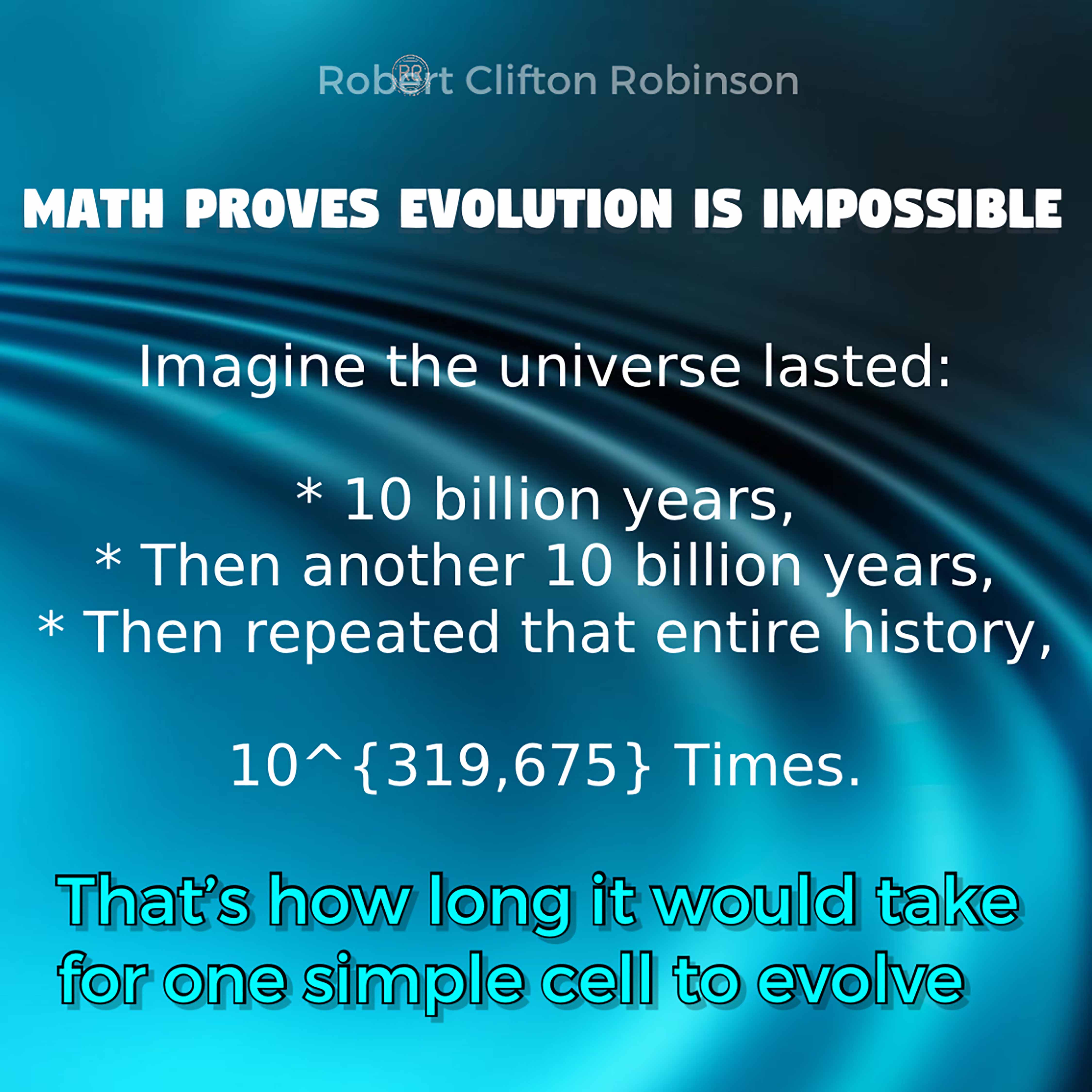
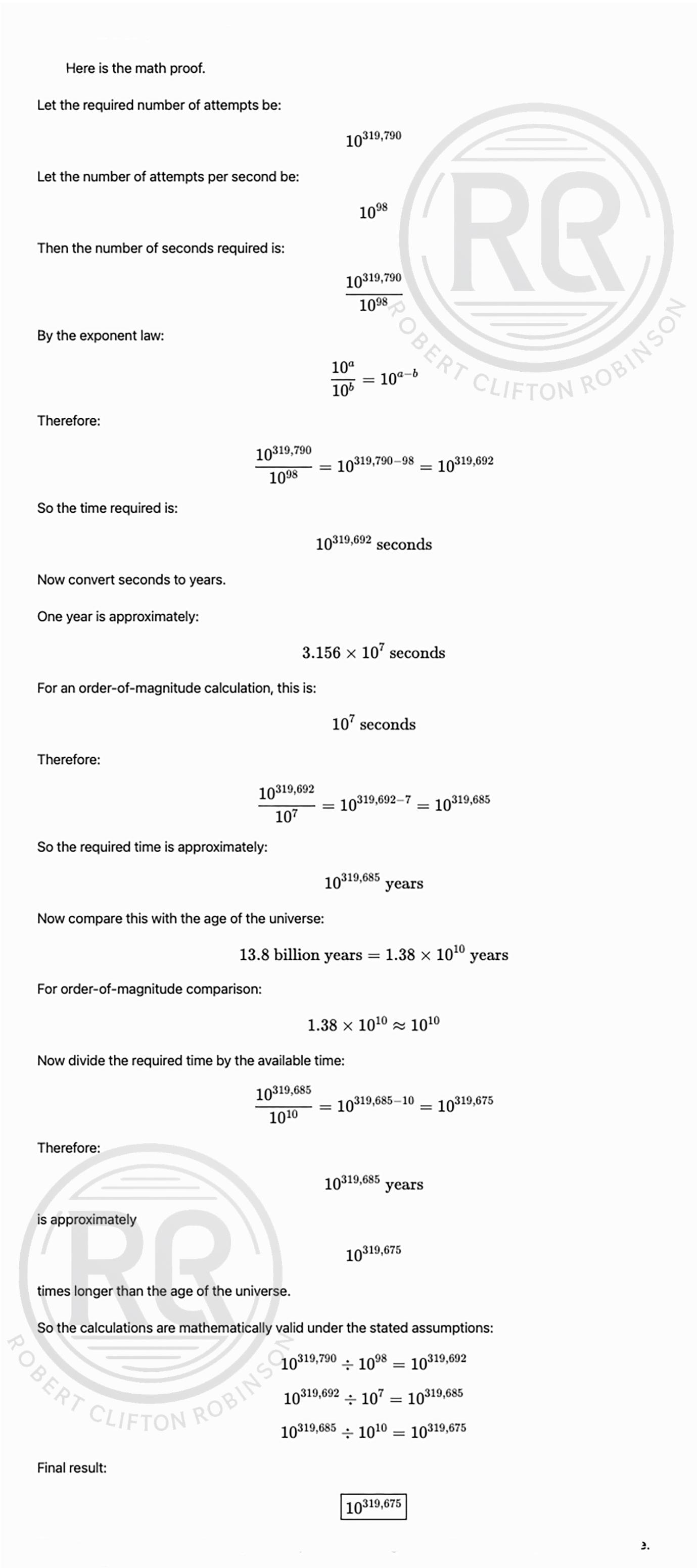
Some probability calculations proposed by intelligent design advocates attempt to illustrate this challenge by estimating the likelihood of obtaining the informational requirements of even a minimal cell through undirected processes. One such estimate produces a probability of approximately one successful event in 10^319,790 attempts. Assuming an extremely generous rate of 10^98 chemical trials per second throughout the observable universe would still require approximately 10^319,685 years for a single successful event to be expected statistically, exceeding the age of the universe by approximately 10^319,675 times.[11]
See The Math Proof Below
If the assumptions underlying these calculations are substantially correct, intelligent design proponents argue that the available probabilistic resources of the universe are insufficient to explain the origin of the first cell through undirected chemistry alone.[12] Since mutation and natural selection require a preexisting self-replicating organism, the origin of the first cell becomes the necessary gateway through which every evolutionary explanation must first pass.[13]
This conclusion has led several intelligent design scholars to argue that natural selection functions primarily as a filtering mechanism rather than a creative mechanism. Selection preserves advantageous variations that already exist but does not itself generate the informational innovations upon which it acts.[14]
The origin of biological information remains one of the central unresolved questions in origins science. Whether future discoveries ultimately provide a sufficient natural explanation or whether intelligence represents the better explanation for the informational architecture of life remains one of the defining scientific questions of modern biology.[15]
The Information Barrier and the Limits of Natural Selection
Perhaps the most important distinction in the modern origins debate is the distinction between chemistry and information. Chemistry can explain the attraction and repulsion of atoms, the formation of covalent bonds, the behavior of ions in solution, and the thermodynamic tendencies of molecules to move toward equilibrium. Chemistry can explain why sodium and chlorine combine to form salt, why water exhibits polarity, and why carbon is uniquely suited for complex molecular structures. What chemistry has never demonstrated, however, is the spontaneous generation of coded, functionally specified information.[23] The laws of chemistry can explain why nucleotides bond together under certain conditions, but chemistry alone does not explain why those nucleotides should assemble into a sequence that encodes a functioning ATP synthase, a DNA polymerase, or a ribosomal protein.[18] The difference is the difference between letters and language. Ink and paper can explain the physical existence of a book, but they do not explain the origin of Shakespeare’s plays. Silicon and electricity can explain the operation of a computer chip, but they do not explain the origin of the operating system running upon it. In every field of human experience, information is traced back to intelligence rather than to unguided physical processes.[22] This observation forms the central thesis of Stephen Meyer’s work in Signature in the Cell, where he argues that intelligence remains the only known cause capable of producing large quantities of functionally specified information.[18]
The argument becomes more powerful when one considers the informational density of even the simplest living systems. The genome of the bacterium Mycoplasma genitalium, often cited as one of the smallest known genomes capable of sustaining independent life, contains approximately 580,000 nucleotide base pairs and over 470 genes. Yet even this organism is now believed to be too complex to represent the minimum requirements for life. Attempts by synthetic biologists to determine the smallest possible genome capable of independent existence have repeatedly demonstrated that dozens of genes once thought unnecessary prove indispensable for survival under laboratory conditions. The more scientists reduce the cell, the more irreducible the system appears to become. The minimum cell is not becoming simpler with investigation; it is becoming more complex.[25]
The problem is not merely one of assembling molecules. Amino acids, sugars, lipids, and nucleotides have all been synthesized under laboratory conditions.[24] The challenge lies in arranging those building blocks into integrated systems capable of performing useful functions. A pile of transistors is not a computer. A warehouse full of gears and pistons is not an automobile. Likewise, a mixture of amino acids is not a cell. The organization itself requires explanation. James Tour, one of the world’s leading synthetic organic chemists, has repeatedly emphasized that origin-of-life discussions frequently leap from simple molecules to functioning systems while quietly ignoring the enormous engineering challenges that exist between those two points.[16] Tour argues that chemists understand very well how difficult it is to synthesize complex molecular systems, and for that reason he has criticized the confidence with which many popular presentations describe abiogenesis as though it were essentially solved.[17]
One of the most difficult problems concerns chirality. Amino acids exist in both left-handed and right-handed forms. Living organisms utilize almost exclusively left-handed amino acids, while nucleic acids utilize right-handed sugars. Natural chemistry produces both forms in roughly equal quantities. Yet a functioning protein constructed from randomly mixed chirality rapidly loses the ability to fold into stable functional structures. This means that before the first protein could function, nature would have needed not merely to produce amino acids, but to separate one handedness from the other with extraordinary precision. Despite decades of investigation, no universally accepted mechanism has been discovered that explains the origin of biological homochirality under realistic prebiotic conditions.[24]
Another challenge concerns polymerization. Amino acids do not naturally assemble themselves into proteins in aqueous environments because water favors the reverse reaction, hydrolysis, which breaks peptide bonds apart. The same difficulty exists for nucleotides attempting to form long chains of RNA or DNA. The popular image of a primordial ocean gradually assembling increasingly complex molecules encounters a severe thermodynamic obstacle because the ocean itself tends to destroy the very polymers required for life. Researchers have proposed clay surfaces, hydrothermal vents, evaporation pools, volcanic environments, and mineral catalysts as possible solutions, but no model has yet demonstrated a complete pathway from simple monomers to a self-replicating information-bearing cell.[24]
The RNA world hypothesis emerged as an attempt to overcome the famous chicken-and-egg problem of molecular biology. DNA requires proteins for replication and maintenance. Proteins require DNA for their instructions. Which came first? RNA appeared to offer a possible answer because certain RNA molecules possess both informational and catalytic properties. If an RNA molecule could store information while simultaneously catalyzing its own replication, the cycle might begin. The problem, however, is that RNA itself is chemically fragile, difficult to synthesize under realistic prebiotic conditions, and highly susceptible to degradation. Even origin-of-life researchers sympathetic to the RNA world acknowledge that the model leaves major unanswered questions regarding the origin of the ribose sugar, nucleotide assembly, sequence specificity, and replication fidelity.[24] Meyer devotes substantial portions of Signature in the Cell to examining these difficulties and concludes that RNA world models merely relocate the information problem rather than solving it.[18]
The issue of information returns with even greater force when evolutionary mechanisms are invoked to explain biological innovation. Mutation is frequently described as the engine of evolutionary creativity, but mutation itself possesses no foresight and no goal. It alters existing sequences without regard for future usefulness. The overwhelming majority of mutations are either neutral or harmful. Beneficial mutations unquestionably occur, but their existence alone does not answer the question of information generation. A mutation that disables a transport protein may allow bacteria to survive antibiotic exposure, but such a mutation represents a loss or modification of existing function rather than the invention of a new molecular machine. Critics of neo-Darwinism distinguish carefully between adaptation and innovation. Adaptation explains survival within an environment. Innovation seeks to explain the origin of entirely new structures, systems, and body plans.[20]
Click On Image To Look Inside
Gene duplication is often proposed as the solution to this difficulty. Duplicate a gene, preserve one copy, and allow the second copy to experiment with mutations. In principle, this seems plausible. In practice, the challenge remains formidable. A duplicated gene initially contains no new information whatsoever; it merely repeats what already exists. The new information must arise later through random modifications. The probability of arriving at a genuinely useful new protein sequence within the enormous space of possible amino acid arrangements remains one of the central mathematical problems confronting evolutionary theory. Douglas Axe’s work on protein sequence space argued that functional proteins occupy exceedingly rare islands within a vast ocean of nonfunctional possibilities. Whether his estimates prove exactly correct is less important than the principle they illustrate: functionality appears to represent an extraordinarily tiny target within an unimaginably large search space.[21]
This brings us to the probability calculations themselves. Suppose, for the sake of argument, that the probability of assembling the informational content of a minimal cell through undirected chemistry is one chance in 10^319,790. Critics often focus on the size of the number rather than on its implications. The implications are straightforward. Even granting the entire observable universe as a laboratory, every atom as a reaction site, and every moment since the Big Bang as available time, the resources of the cosmos remain insufficient to perform enough trials to expect success. Assuming an impossibly generous reaction rate of 10^98 attempts every second still leaves an expected waiting time of 10^319,692 seconds, or approximately 10^319,685 years. The observable universe is approximately 1.38 × 10^10 years old. The shortage of time approaches a factor of 10^319,675. This figure is not merely larger than the age of the universe. It is larger than the age of the universe by an amount that dwarfs every other large number commonly encountered in science.[22]
The Math Proof
At this point, evolutionary biologists frequently respond that evolution is not random because natural selection accumulates improvements over time. Intelligent design advocates generally agree with this statement but point out that it addresses a different problem. Natural selection can only preserve what already exists. It cannot select an advantage that has not yet appeared. Selection is fundamentally conservative rather than creative. It acts as a filter, preserving beneficial changes and eliminating harmful ones, but it does not explain the arrival of the information upon which it acts. An editor may improve a manuscript by removing errors, but no editor can create an encyclopedia merely by deleting typographical mistakes.[20]
The problem becomes especially acute when considering systems that require multiple coordinated components before any benefit appears. Michael Behe introduced the term “irreducible complexity” to describe systems in which all major parts appear necessary for function. His examples included the bacterial flagellum, the blood clotting cascade, and intracellular transport systems. His argument was not that evolution never occurs, but that some systems appear to require numerous simultaneous components before selection can operate. A partial outboard motor provides no propulsion. Half of a mousetrap catches no mice. Likewise, partial molecular machines may provide no selectable advantage until many interacting pieces are already in place. Behe argues that this creates a waiting-time problem that cumulative selection cannot easily overcome.[19]
The Cambrian explosion introduces a related difficulty. The fossil record reveals the relatively abrupt appearance of most major animal body plans within a geologically narrow window of time, approximately 530 million years ago. Evolutionary theory does not deny this event; rather, it seeks mechanisms capable of explaining it. Intelligent design advocates argue that the appearance of new body plans requires not merely new proteins but new developmental information, new regulatory networks, and new genetic architectures operating in coordinated fashion. The origin of this information, they argue, remains inadequately explained by mutation and selection alone.[18]
In the end, the debate returns to the origin of information itself. Information theory does not recognize a known natural law capable of transforming randomness into large quantities of specified complexity without guidance or selection operating upon preexisting information-bearing systems.[23] Biological evolution assumes such systems already exist. Abiogenesis seeks to explain how they appeared in the first place. The first problem in biology remains the first cell.[16]
This is why intelligent design proponents continue to emphasize that the central issue is not whether finches adapt, bacteria evolve resistance, or populations change over time. The issue is whether undirected chemistry can generate the digital information, integrated machinery, and coordinated complexity observed in living systems.[18] If the probability estimates advanced by critics of abiogenesis are even approximately correct, then the available probabilistic resources of the universe fall catastrophically short of what would be required.[22] Under that conclusion, natural selection never receives the opportunity to operate because the first living system never comes into existence through unguided means.[16]
The evolution of the first cell remains the great divide in origins science. Every material explanation for life’s history must first pass through that gateway.[16] If chemistry alone cannot open the gate, then the search for origins must consider causes capable of producing information-rich systems.[18] Intelligent design advocates argue that intelligence represents precisely this cause because intelligence is the only known source of functionally specified information observed in every other realm of experience.[18 Whether one ultimately accepts or rejects that conclusion, the informational challenge presented by the cell remains one of the deepest and most consequential questions in all of science.[25]
There is only one part of the three parts of Evolution that has been proven
The challenge becomes even more formidable when we consider that the first living system required not merely information, but information integrated into a hierarchy of interdependent systems that could not function independently of one another. DNA stores information, but DNA cannot replicate itself without polymerase enzymes. Polymerase enzymes are proteins, but proteins cannot be synthesized without ribosomes. Ribosomes themselves are extraordinarily complex molecular assemblies composed of proteins and ribosomal RNA. Ribosomal RNA is encoded by DNA, while DNA depends upon proteins and ribosomes for its own replication and maintenance. ATP synthase produces cellular energy, yet ATP synthase itself requires the informational machinery of the cell to assemble it. Membrane transport proteins regulate the import and export of essential materials, but those proteins likewise depend upon preexisting genetic information and translational systems. The entire cell appears less like a collection of independent parts and more like an integrated city whose power stations, communication systems, transportation infrastructure, and manufacturing facilities all depend upon one another simultaneously.
This interdependence creates what has often been called the systems problem of abiogenesis. It is not enough to explain DNA in isolation. One must explain DNA, RNA, proteins, membranes, metabolism, energy generation, molecular transport, and replication as components of a functioning whole. Remove any one of these systems and the cell ceases to operate. The origin of life requires not merely chemistry, but organized chemistry operating under informational control. No natural process is capable of organizing or fine-tuning anything.
Evidence For Fine-Tuning Of The Universe: 209 Physical Constants That Make Life On Earth Possible
Some researchers have attempted to address this challenge through metabolism-first models. These hypotheses propose that simple chemical cycles may have emerged prior to genetic information and gradually increased in complexity until informational molecules appeared. Others have proposed hydrothermal vent environments as natural reactors capable of concentrating chemicals and providing energy gradients that might drive molecular organization. Perhaps the best-known advocate of this approach is Nick Lane, who argues that proton gradients within alkaline hydrothermal vents may have provided an energy source analogous to the proton gradients used by living cells today.[26] Lane’s work has attracted considerable attention because it attempts to connect geochemistry with bioenergetics. Nevertheless, critics argue that even if such environments can generate favorable chemistry, they do not explain the origin of coded information or the emergence of translation systems capable of interpreting that information.[27]
The informational challenge becomes particularly evident when considering the genetic code itself. DNA does not merely contain chemicals arranged in a sequence. It contains instructions interpreted according to a symbolic convention known as the genetic code. Triplets of nucleotides correspond to amino acids in a translation table remarkably similar to symbolic encoding systems used in computer science. The sequence AUG specifies methionine and frequently serves as a start signal. Other codons signal termination. Transfer RNA molecules function as adaptors that convert nucleotide information into amino acid sequences. The existence of such a coding relationship raises profound questions because coding systems are not ordinarily explained by chemistry alone. The chemistry of ink does not explain the English language, and the chemistry of silicon does not explain programming languages. In both cases, symbols derive their meaning from conventions established by minds. Intelligent design theorists argue that the genetic code exhibits precisely this characteristic of symbolic representation.[28]
Hubert Yockey, one of the pioneers of applying information theory to molecular biology, repeatedly emphasized that information theory treats genetic information as a communication problem rather than merely a chemistry problem.[29] The sequence of nucleotides matters because the sequence determines function. Rearranging the same nucleotides in a different order can completely destroy biological activity while leaving the chemistry unchanged. For these reasons, function depends upon arrangement rather than composition. This distinction lies at the heart of the information argument.
Evolutionary mechanisms are frequently asserted to solve this problem through cumulative selection operating over vast spans of time. Yet cumulative selection presupposes the existence of a replicating population capable of passing information from one generation to the next. The information problem precedes the evolutionary solution. Natural selection may explain the differential survival of organisms after replication exists, but it does not explain the origin of the first replicator. This point was acknowledged by many evolutionary theorists long before the rise of intelligent design. The question of life’s origin remains logically distinct from the question of life’s diversification.
The waiting-time problem represents another area of concern raised by critics of neo-Darwinian theory. Single beneficial mutations may arise and spread through populations with relative ease. Difficulties emerge when multiple coordinated mutations are required before any advantage appears. Suppose that two, three, or four specific mutations must occur simultaneously before a new function becomes beneficial. The probability of obtaining such combinations declines rapidly as the number of required mutations increases. Michael Behe has argued that many molecular systems appear to require multiple coordinated changes before selection can act effectively upon them.[30]
The significance of this argument lies not merely in probability but in timing. Population sizes are finite. Mutation rates are finite. Generation times are finite. Consequently, biological systems possess only limited opportunities to search sequence space. If the waiting time for coordinated mutations exceeds the available evolutionary window, then the proposed pathway becomes implausible regardless of its theoretical possibility. Behe’s calculations concerning malaria parasites and chloroquine resistance sought to illustrate this principle by examining observed mutation rates in enormous populations under intense selection pressure.[31] Whether one accepts all of his conclusions or not, the underlying issue of population genetics and waiting times remains an important area of discussion.
The Cambrian explosion introduces this challenge on a larger scale. During this period, the fossil record reveals the relatively rapid appearance of numerous animal body plans possessing complex anatomical features, including eyes, nervous systems, circulatory systems, digestive systems, and skeletal structures. Intelligent design advocates argue that the origin of these body plans requires not merely additional genes but new developmental programs and regulatory information controlling embryological development.[32] The problem shifts from individual proteins to the orchestration of entire developmental networks.
Developmental biology has demonstrated that body plans depend heavily upon gene regulatory networks that determine when genes activate, where they activate, and how long they remain active during embryonic development. Small changes in these regulatory systems can produce dramatic effects, but critics argue that major innovations require the coordinated modification of extensive networks rather than isolated mutations. Stephen Meyer has argued that the Cambrian event represents an information explosion rather than merely a diversification event because it involves the appearance of new biological forms requiring large quantities of additional developmental information.[33]
The issue of probabilistic resources extends beyond abiogenesis and into macroevolutionary transitions. If the informational demands of major innovations exceed the search capacity of mutation and selection operating within realistic population sizes and timescales, then additional explanatory mechanisms become necessary. Intelligent design theorists argue that intelligence constitutes the best candidate because intelligence remains the only known cause capable of generating large quantities of specified information in every other domain of experience.
William Dembski formalized this argument through the concept of specified complexity.[34] According to Dembski, events that are simultaneously highly improbable and conform to an independently recognizable pattern warrant an inference to design rather than chance. A sequence of random letters scattered across a page does not imply intelligence. A meaningful paragraph from Shakespeare does. Likewise, a random arrangement of nucleotides differs fundamentally from a sequence encoding ATP synthase or DNA polymerase. The distinction lies in specification and function.
Critics of intelligent design respond that biological systems differ from human artifacts because living organisms reproduce, mutate, and undergo selection, whereas books and machines do not. Intelligent design proponents answer that this objection addresses the diversification of life rather than the origin of information itself. The question remains whether undirected processes can generate the original information-rich systems upon which selection later acts.
James Tour has often expressed frustration that public discussions of abiogenesis frequently underestimate the enormous gap separating simple organic chemistry from living systems.[35] Producing amino acids is not equivalent to producing proteins. Producing proteins is not equivalent to producing metabolic networks. Producing metabolic networks is not equivalent to producing self-replicating cells. Every level introduces additional requirements for organization, integration, and informational control.
The result is that the first cell remains one of the most profound mysteries in science. Every proposed naturalistic explanation must explain not merely molecules, but molecular organization; not merely chemistry, but coded information; not merely complexity, but functional complexity integrated into a self-sustaining system. The farther science penetrates into the molecular architecture of life, the more remarkable that architecture appears to become.
If the probability calculations advanced by intelligent design are substantially correct, then the origin of the first cell lies beyond the probabilistic resources of the observable universe. If that conclusion is valid, then Darwinian evolution never receives the opportunity to begin because the self-replicating organism required for mutation and selection never arises through unguided means. Under this framework, intelligence becomes not a theological placeholder for ignorance but an inference drawn from the informational properties of life itself.
Whether future discoveries will alter that conclusion remains to be seen. What cannot be denied is that the origin of biological information, the emergence of molecular machinery, and the appearance of the first cell continue to stand among the deepest and most consequential questions in all of science.
- Did All Species Evolve From One Common Ancestor? The Facts Of Science That Impeach Darwinian Evolution
- The Biblical Definition Of Kinds In Comparison With The Evolutionary Definition Of Species
- Falsification, Eyewitness Testimony, and the Reliability of the New Testament
- 1,000 Scientists Who Say Evolution Is Wrong
The problem of homochirality represents one of the least appreciated but most formidable obstacles confronting origin-of-life research. Nearly all biological systems employ left-handed amino acids and right-handed sugars. Yet ordinary chemistry produces both forms in approximately equal proportions. This mixture, known as a racemic mixture, presents a severe difficulty because proteins constructed from mixed chirality fail to fold properly and generally lose biological function. DNA and RNA face similar challenges because their structural integrity depends upon sugars of a single orientation. Thus, before life could begin, nature would have needed not only to produce amino acids and sugars but also to separate and preserve the correct handedness with extraordinary precision. Although numerous hypotheses involving polarized light, mineral surfaces, crystallization processes, and extraterrestrial delivery have been proposed, no universally accepted mechanism has emerged that explains the overwhelming preference for biological homochirality under realistic prebiotic conditions.[36]
The famous Miller-Urey experiment of 1953 is frequently cited as evidence that life can arise naturally from chemistry. In the experiment, electrical discharges passed through a reducing atmosphere containing methane, ammonia, hydrogen, and water vapor produced several amino acids and organic compounds. The experiment represented an important achievement in prebiotic chemistry because it demonstrated that some organic molecules could form under laboratory conditions. However, critics point out that the experiment did not produce proteins, DNA, RNA, membranes, metabolic systems, or cells. More importantly, subsequent geological evidence suggested that the early Earth’s atmosphere was likely far less reducing than the atmosphere employed in the experiment, reducing the relevance of the original conditions.[37] The experiment demonstrated the formation of some building blocks of life, but not the construction of life itself.
This distinction between building blocks and functional systems cannot be overstated. A pile of bricks does not explain a cathedral. Steel beams do not explain a skyscraper. Likewise, amino acids do not explain a ribosome. The challenge facing origin-of-life research is not the production of organic molecules but their arrangement into systems exhibiting function, coordination, and informational specificity.
The RNA world hypothesis was developed largely to solve the interdependence problem between DNA and proteins. Because some RNA molecules can store information and catalyze chemical reactions, researchers proposed that an earlier RNA-based biology may have preceded modern life. In principle, such a molecule could act both as genetic material and as an enzyme, thereby simplifying the problem of life’s origin. Yet RNA world models face their own formidable challenges. Ribose sugars are difficult to produce under realistic prebiotic conditions. Nucleotides are chemically complex molecules requiring multiple coordinated synthesis steps. RNA is chemically unstable and rapidly degrades in aqueous environments. Most importantly, no self-replicating RNA system approaching the complexity required for cellular life has ever been demonstrated.[38]
Even leading proponents of RNA world models acknowledge these difficulties. Leslie Orgel, one of the pioneers of origin-of-life chemistry, famously remarked that discussions of the origin of life often reveal more about the optimism of researchers than about the chemistry itself.[39] The problem is not merely producing RNA molecules but producing RNA molecules capable of accurate replication, information storage, and functional catalysis simultaneously.
The issue of information becomes even more striking when viewed through the lens of information theory. Claude Shannon’s mathematical treatment of communication demonstrated that information is fundamentally related to the arrangement of symbols rather than the medium that carries them.[40] A message encoded in radio waves remains the same message if transmitted by fiber optics or printed on paper. Similarly, the information contained in DNA is independent of the chemistry of nucleotides themselves. Rearranging the same nucleotides in a different sequence can destroy biological function entirely while leaving the chemistry unchanged.
This observation led information theorists such as Hubert Yockey to conclude that genetics should be understood as an information science as much as a branch of chemistry.[41] The sequence matters more than the substance. In biological systems, function arises not merely from matter but from matter organized according to informational rules.
Critics of intelligent design frequently argue that biological information differs fundamentally from human language because living organisms reproduce and evolve while books and computer programs do not. Intelligent design proponents respond that this objection addresses the transmission of information rather than its origin. Reproduction can copy information. A mutation can modify information. Selection can preserve information. None of these mechanisms directly explains the origin of the information itself.
Universal Common Ancestry, a foundation of Evolution, cannot be proven: The hypothesis that all living organisms on Earth descended from a single common ancestor, often referred to as the “Last Universal Common Ancestor” (LUCA).
Gene duplication illustrates this point clearly. Evolutionary theory often proposes that duplicated genes provide raw material for innovation because one copy preserves the original function while the other accumulates mutations. Critics respond that duplication initially produces only redundancy rather than novelty. A duplicated chapter in a textbook does not create a new chapter. A duplicated software file does not create a new application. The informational problem shifts from duplication itself to the origin of a new function within the duplicate sequence.
Douglas Axe’s work on protein sequence space sought to quantify this challenge. His experiments suggested that functional proteins occupy extraordinarily rare positions within the enormous universe of possible amino acid combinations.[42] Even if later research modifies the exact probabilities involved, the principle remains significant: functionality appears to represent a tiny island within an immense ocean of nonfunctional possibilities. Random exploration of such spaces becomes increasingly difficult as sequence length increases.
This is where probability calculations become central to the intelligent design critique. If a functional sequence requires highly specific arrangements among vast numbers of possibilities, then the available search resources become critically important. The argument is not that improbable events never occur. Every individual hand of cards dealt in a casino is extraordinarily improbable. The issue is specified as improbability. A random sequence of letters is unlikely, but a complete Shakespearean sonnet appearing by chance is both improbable and specified. The presence of specification changes the inference.
William Dembski formalized this reasoning through the concept of specified complexity.[43] Events that are highly improbable and conform to an independently recognizable pattern are routinely attributed to intelligence rather than chance. Archaeologists distinguish inscriptions from erosion. Cryptographers distinguish coded messages from noise. Intelligence is inferred not merely from complexity but from complexity organized toward function.
Natural selection is often presented as the answer to these probability objections because selection accumulates small improvements over time. Yet selection itself does not generate variation. It merely preserves advantageous variations that already exist. Selection acts as a filter rather than a source. An editor can improve a manuscript by removing typographical errors, but no editor creates a novel merely by deleting mistakes. Likewise, natural selection may preserve useful mutations without explaining the origin of the information upon which it acts.
The distinction between microevolution and macroevolution often emerges at this point in the discussion. Changes in beak size among finches, shifts in bacterial populations, and adaptation to environmental pressures are well-documented observations. Intelligent design advocates generally accept these phenomena as examples of variation within existing informational frameworks. The controversy concerns whether the same mechanisms can account for entirely new body plans, organs, molecular machines, and developmental programs.
The Cambrian explosion remains particularly significant because it appears to involve the relatively abrupt appearance of numerous animal body plans in geological terms. Eyes, nervous systems, digestive systems, circulatory systems, and skeletal structures emerge in comparatively narrow windows of time. Stephen Meyer argues that these innovations required not merely additional genes but large quantities of developmental information controlling embryological processes and body architecture.[44] The origin of this information remains, in his view, insufficiently explained by mutation and selection alone.
James Tour has repeatedly emphasized that the public often receives the impression that origin-of-life research is approaching a solution, whereas the actual scientific literature reveals numerous unresolved challenges.[45] The gulf between simple organic chemistry and autonomous cellular life remains immense. Producing amino acids is not equivalent to producing proteins. Producing proteins is not equivalent to producing metabolic pathways. Producing pathways is not equivalent to producing information-bearing self-replicating systems.
For intelligent design proponents, the conclusion follows naturally from these observations. If life depends fundamentally upon information, if information universally arises from intelligence in every other observed context, and if the probabilistic resources of the universe prove insufficient to generate the first information-rich cell through unguided processes, then intelligence constitutes the best available explanation for biological origins.
Whether future discoveries will overturn this conclusion remains unknown. Science remains an ongoing enterprise of investigation and discovery. Yet the first cell continues to stand as one of the deepest mysteries in human knowledge. Every explanation of life’s history must ultimately pass through that gateway. Until a convincing explanation exists for the origin of biological information, the question of life’s beginnings will remain open, and the inference to intelligent causation will continue to occupy an important place within the origins debate.
See: “A Universe That Proves God: The True Source of the Cosmos,” by Robert Clifton Robinson, as Amazon in Kindle, Print, and Audiobook formats
Click On Image To Look Inside
Sources and Citations
- James Tour, “Animadversions of a Synthetic Chemist,” Inference: International Review of Science, Vol. 4, No. 2 (2018).
- Stephen C. Meyer, Signature in the Cell: DNA and the Evidence for Intelligent Design (New York: HarperOne, 2009).
- Michael J. Behe, Darwin’s Black Box: The Biochemical Challenge to Evolution (New York: Free Press, 1996).
- Michael J. Behe, The Edge of Evolution (New York: Free Press, 2007).
- Douglas Axe, Undeniable: How Biology Confirms Our Intuition That Life Is Designed (New York: HarperOne, 2016).
- William A. Dembski, The Design Inference (Cambridge: Cambridge University Press, 1998).
- Hubert P. Yockey, Information Theory and Molecular Biology (Cambridge: Cambridge University Press, 1992).
- Leslie Orgel, “The Origin of Life on Earth,” Scientific American 271, no. 4 (1994): 76–83.
- Jack Szostak, David Bartel, and P. Luigi Luisi, “Synthesizing Life,” Nature 409 (2001): 387–390.
- Nick Lane, The Vital Question: Energy, Evolution, and the Origins of Complex Life (New York: W.W. Norton, 2015).
- Claude Shannon, “A Mathematical Theory of Communication,” Bell System Technical Journal 27 (1948): 379–423.
F - rancis Crick, “On Protein Synthesis,” Symposia of the Society for Experimental Biology 12 (1958): 138–163.
- Carl Woese, The Genetic Code (New York: Harper & Row, 1967).
- Robert Hazen, Genesis: The Scientific Quest for Life’s Origin (Washington, D.C.: Joseph Henry Press, 2005).
- Paul Davies, The Fifth Miracle: The Search for the Origin and Meaning of Life (New York: Simon & Schuster, 1999).
- James M. Tour, “An Open Letter to My Colleagues,” Inference: International Review of Science (2018).
- James M. Tour, “Animadversions of a Synthetic Chemist,” Inference: International Review of Science (2016).
- Stephen C. Meyer, Signature in the Cell: DNA and the Evidence for Intelligent Design (HarperOne, 2009).
- Michael J. Behe, Darwin’s Black Box: The Biochemical Challenge to Evolution (Free Press, 1996).
- Michael J. Behe, The Edge of Evolution (Free Press, 2007).
- Douglas D. Axe, Undeniable: How Biology Confirms Our Intuition That Life Is Designed (HarperOne, 2016).
- William A. Dembski, The Design Inference (Cambridge University Press, 1998).
- Hubert P. Yockey, Information Theory and Molecular Biology (Cambridge University Press, 1992).
- Leslie E. Orgel, “The Origin of Life on Earth,” Scientific American 271, no. 4 (1994): 76–83.
- Paul Davies, The Fifth Miracle: The Search for the Origin and Meaning of Life (Simon & Schuster, 1999).
- Nick Lane and William Martin, “The Origin of Membrane Bioenergetics,” Cell 151, no. 7 (2012): 1406–1416.
- Nick Lane, The Vital Question: Energy, Evolution, and the Origins of Complex Life (New York: W.W. Norton, 2015).
- Francis Crick, “The Origin of the Genetic Code,” Journal of Molecular Biology 38 (1968): 367–379.
- Hubert P. Yockey, Information Theory and Molecular Biology (Cambridge University Press, 1992).
- Michael J. Behe, The Edge of Evolution (New York: Free Press, 2007).
- Michael J. Behe and David W. Snoke, “Simulating Evolution by Gene Duplication of Protein Features That Require Multiple Amino Acid Residues,” Protein Science 13 (2004): 2651–2664.
- Douglas H. Erwin and James W. Valentine, The Cambrian Explosion: The Construction of Animal Biodiversity (Roberts and Company, 2013).
- Stephen C. Meyer, Darwin’s Doubt: The Explosive Origin of Animal Life and the Case for Intelligent Design (HarperOne, 2013).
- William A. Dembski, The Design Inference (Cambridge University Press, 1998).
- James M. Tour, “Animadversions of a Synthetic Chemist,” Inference: International Review of Science 4, no. 2 (2018).
- Jeffrey L. Bada, “How Life Began on Earth: A Status Report,” Earth and Planetary Science Letters 226 (2004): 1–15.
- Stanley L. Miller, “A Production of Amino Acids Under Possible Primitive Earth Conditions,” Science 117 (1953): 528–529.
- Gerald F. Joyce, “The Antiquity of RNA-Based Evolution,” Nature 418 (2002): 214–221.
- Leslie E. Orgel, “Prebiotic Chemistry and the Origin of the RNA World,” Critical Reviews in Biochemistry and Molecular Biology 39 (2004): 99–123.
- Claude E. Shannon, “A Mathematical Theory of Communication,” Bell System Technical Journal 27 (1948): 379–423.
- Hubert P. Yockey, Information Theory and Molecular Biology (Cambridge University Press, 1992).
- Douglas D. Axe, “Estimating the Prevalence of Protein Sequences Adopting Functional Enzyme Folds,” Journal of Molecular Biology 341 (2004): 1295–1315.
- William A. Dembski, No Free Lunch: Why Specified Complexity Cannot Be Purchased Without Intelligence (Rowman & Littlefield, 2002).
- Stephen C. Meyer, Darwin’s Doubt: The Explosive Origin of Animal Life and the Case for Intelligent Design (HarperOne, 2013).
- James M. Tour, “An Open Letter to My Colleagues Regarding Evolution,” Inference: International Review of Science (2016).
Categories: Robert Clifton Robinson


Consider. https://www.cnn.com/2026/07/01/science/synthetic-cell-research
LikeLike
For anyone reading this article, you must acquire the book recommended. I own and have read it and it completely proves to me beyond a reasonable doubt that life came from an intelligent source.
Call me biased and maybe I am but as a computer scientist I know that physics states that it is impossible for something to come from absolute nothing. It is stated as such because we have no known reproducible outcomes of such a thing occurring outside the thought that this is how the universe came into existence.
So I will always ask. What existed one trillion trillion years before the Big Bang? The answer is usually this: We do not know but that doesn’t prove God. So be it. I am not asking anyone to prove God. What I am asking for is a reasonable explanation, outside of arrogant ego, as to how we arrived. Thats it. Nothing more.
Now. Since I cannot believe that something comes from nothing simply because it is outside of my experience and ability to reason, as it should be for anyone else, I have only two other choices: 1) the universe has always been as it is now; or, 2) it was created.
Physicist have stated that if the universe were eternal the fuel for stars would have long been used up and since I can look outside my window and see a star shining down on me I have to assume that possibility is unreal as well. So I am only left with the final option: it was created.
This is how I reason this out being a laymen in cosmology. Call me uneducated if you wish but at least try to explain simplistically with solid proof, which is what the Atheist would demand for God, that the house next door just magically came up out of the ground because a common ancestor, the cell, had been working on it for about 10 billion years. Please give it a go. Make me understand without the insult.
Now. I believe life comes from life. This means I have to accept that life is eternal. Meaning. It always has been – no beginning and no end. This is what I reasonably believe. So that means there must be a life giver. I call that Lifer Giver – God. But which one?
The God of Abraham, Issac and Jacob is the only God claiming to have created the Heavens and the Earth in such a way that scientist have said is reasonable. So I start there. So why Jesus? Why do I follow Him? The answer is very simple. Since I believe life comes from a Giver and Jesus states very clearly that He is the way, the truth, and the LIFE I choose him. This is my right as a human being and I am unconcerned how anyone else feels about that.
John 3:16 does not state that I must prove God beyond any insane doubt; it just simply states that I must believe. And I do, and, what is written above is my reason for that belief. What is written below is how I got there (mostly).
These books from Brother Rob have help me to this conclusion:
These books are the core to the Holy Bible for me. I recommend them all. Thank you again Brother Rob for having the courage to share with us in print that which the Holy Spirit has given you.
Prayers and blessings to all who read this.
The Beginning is Near!
LikeLike