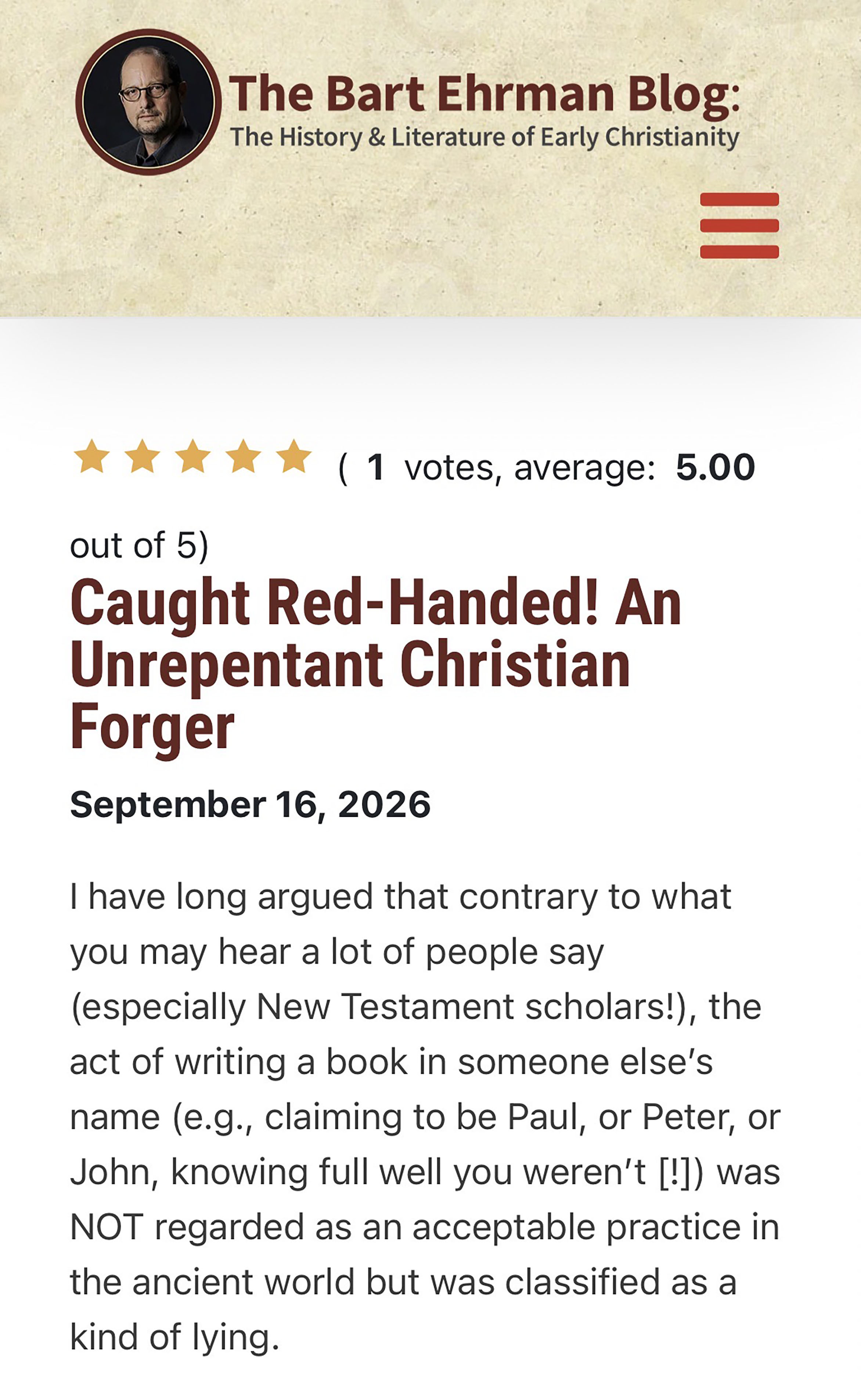
When you are a recognized New Testament scholar, and you insinuate that the extant Manuscript evidence for the New Testament is the work of forgery, how could anyone know whether this claim is true or false? We must examine what Bart Ehrman is actually saying. Ehrman writes in an essay on his website:
“I have long argued that contrary to what you may hear a lot of people say (especially New Testament scholars!), the act of writing a book in someone else’s name (e.g., claiming to be Paul, or Peter, or John, knowing full well you weren’t [!]) was NOT regarded as an acceptable practice in the ancient world but was classified as a kind of lying.”
Ehrman claims that some of the New Testament letters are Christian Forgeries. He makes this assumption because there are letters outside the New Testament that are known forgeries; therefore, Ehrman asserts, some of the Pastoral Letters are also forgeries. The problem for the average reader is that they don’t know that this is merely the opinion of Bart Ehrman, not an established fact of the New Testament letters.
 No New Testament manuscript has been demonstrated to be a forgery in the way an ancient document can sometimes be positively exposed as forged—for example, by identifying the actual forger, finding an anachronistic physical feature, discovering documentary evidence of fabrication, or finding an ancient confession of authorship. What exists for several New Testament books is a scholarly argument for pseudonymous authorship, based principally on literary, linguistic, historical, and theological considerations. Those arguments are disputed.
Ehrman himself effectively acknowledges the distinction when he says that “different scholars will have different opinions” about which New Testament books are pseudepigraphical. He then gives his own classification, calling 10–13 New Testament books “forged,” while acknowledging that other scholars reach different conclusions.
That distinction matters enormously.
Disputed authorship” is not “proven forgery
To establish forgery in Ehrman’s technical sense requires more than showing that a book’s authorship has been questioned. Ehrman defines a forgery as a document in which an author claims to be another person while knowing that he is not that person.
That definition presents at least three propositions:
(1) The document claims a particular person’s authorship.
(2) That person did not actually author it.
(3) The actual writer knowingly made the false attribution.
For several New Testament books, scholars debate proposition (2). Proposition (3) adds the further question of intentional deception.
Take 2 Peter, probably the clearest example. It explicitly presents itself as coming from “Simon Peter, a servant and apostle of Jesus Christ” (2 Peter 1:1)
The writer also claims to have witnessed the Transfiguration:
“For we did not follow cunningly devised fables when we made known to you the power and coming of our Lord Jesus Christ, but we were eyewitnesses of his majesty.” (2 Peter 1:16)
If Peter wrote it, these statements are straightforward autobiographical testimony.
If Peter did not write it, then the author has constructed an extraordinarily specific Petrine identity. Under Ehrman’s own definition, that would indeed constitute forgery. But the conclusion that Peter did not write it is the disputed premise.
Ehrman writes: “1 Peter illustrates the distinction nicely: it says that “most scholars favour pseudonymity,” while immediately acknowledging that arguments continue to be made for Petrine authorship and a date in the 60s.
“Most scholars think X” and “X has been historically demonstrated” are not equivalent statements.
The Pastoral Epistles provide another good example. The same issue occurs with 1 Timothy, 2 Timothy, and Titus.
Arguments against Pauline authorship typically appeal to vocabulary and style, church organization, theology, and difficulties fitting the letters into reconstructions of Paul’s chronology. This is a matter of opinion, not a fact established by evidence that Paul or any other writer is not the true source. When we consider that the premise of those who are saying these letters are forgeries is that of an atheist who doesn’t believe the New Testament is a true account of Jesus, this places great light upon the motives for claiming forged texts.
In fact, if a critic will claim that any letters in the New Testament are forgeries, they must prove this by more than conjecture and speculation.
But these opinions by Ehrman and other Critical Scholars are not inferential arguments. They aren’t equivalent to discovering an ancient document saying: “I composed these letters after Paul’s death and placed Paul’s name upon them.”
No documents in the historical record ever say this!
In fact, the modern critical challenge to the Pastorals has its own identifiable history. Cambridge’s New Testament Studies notes that criticism of their authenticity developed in the late eighteenth and early nineteenth centuries and discusses how the arguments evolved.
That doesn’t make those arguments wrong. But it does mean we should describe their epistemological status accurately: They are historical-critical conclusions based upon interpretations of internal evidence, not forensic demonstrations of forgery.
And some of the language of critics like Ehrman becomes misleading. Consider the difference between these two statements:
“Many contemporary scholars consider 1 Timothy pseudonymous.”
and
“1 Timothy is a forgery.”
The first accurately reports the state of a scholarly dispute. The second presents the conclusion of one side of that dispute as an established historical fact.
Ehrman clearly takes the latter position. His own materials describe disputed Pauline letters as “probably pseudonymous,” while elsewhere he categorizes particular books outright as “forged writings.” This reveals his deceptive intention to undermine the texts of the New Testament simply because he is a recognized scholar.
The early church knew perfectly well that pseudonymous Christian writings existed.
And it rejected many of them. The early Christian church also knew as fact that the letters included in the New Testament that match our current texts were NOT pseudonymous Christian writings.
Early Christians were not operating according to a rule that said it doesn’t matter whether Peter actually wrote something bearing Peter’s name. On the contrary, authenticity mattered.
Recent scholarship on Eusebius emphasizes precisely this point. Questions about apostolic authorship affected whether books were regarded as authoritative. Some writings were antilegomena, disputed, while others were regarded as notha, spurious. Significantly, the scholarship itself distinguishes suspected pseudonymity from established pseudonymity.
That distinction is remarkably relevant to the discussion in this essay. Early Christians knew about writings falsely attributed to apostles. They rejected works such as the Gospel of Peter, Acts of Peter, and other pseudonymous writings.
Ehrman’s position demonstrates that this isn’t simply a discovery of “forgery.” Ehrman classifies the New Testament approximately as follows:
He accepts seven Pauline letters as genuinely Pauline—Romans, 1–2 Corinthians, Galatians, Philippians, 1 Thessalonians and Philemon—but considers six others falsely Pauline. He additionally considers James, 1–2 Peter, Jude and others pseudonymous or otherwise falsely represented.
But notice what produced those conclusions:
- We don’t possess manuscripts signed by the supposed actual authors.
- We haven’t discovered the workshop where the documents were forged.
- We don’t possess correspondence between the alleged forgers discussing their deception.
- We don’t have confessions from the purported pseudonymous authors.
Instead, scholars compare vocabulary, syntax, theological emphases, historical circumstances, literary relationships, educational assumptions, and other internal and external evidence and infer authorship. Those methods are legitimate historical tools. But the resulting conclusions retain the character of historical arguments and can be challenged by contrary evidence.
And this makes Ehrman’s September 16 statement particularly interesting. The statement in this screenshot may actually create a tension within Ehrman’s larger argument. He argues:
Premise 1: Writing in someone else’s name while pretending to be that person was considered deceptive.
There is substantial historical evidence supporting that proposition, but none towards the Canonical New Testament documents.
He then argues:
Premise 2: Several New Testament authors did exactly that.
That is a completely different historical proposition and must be independently demonstrated. Ehrman’s evidence for Premise 1 cannot establish Premise 2. In fact, accepting Premise 1 eliminates one commonly proposed explanation for pseudonymity: that everyone understood the convention and nobody was being deceived.
If 2 Thessalonians wasn’t written by Paul, for example, then 2 Thessalonians 3:17 becomes especially problematic: “The greeting of me, Paul, with my own hand, which is the sign in every letter: this is how I write.”
Under genuine Pauline authorship, that is an authentication device.
Under the forgery hypothesis, it becomes part of the deception. The unknown writer isn’t merely continuing Pauline tradition; he is presenting an authentication statement intended to persuade his readers that Paul himself stands behind the letter. And just a chapter earlier, the writer warns about a:
“letter as from us” (2 Thessalonians 2:2)
Under Ehrman’s reconstruction, a forger effectively warns his readers about forged Pauline correspondence while forging Paul’s own authentication of his letter.
That isn’t logically impossible. A clever forger could certainly do precisely that. But it means the claim requires evidence rather than assumption.
There is strong evidence that early Christians recognized and condemned falsely attributed apostolic writings. There is also genuine scholarly disagreement about the authorship of several canonical New Testament books. But those two facts do not establish that any canonical New Testament book actually is a forgery.
Calling these books “disputed” accurately describes the historical situation. Calling them “forgeries” states a conclusion that first requires proving that their explicit or implicit authorship claims are false.
And that distinction is especially important because Ehrman’s own definition requires knowing deception. It isn’t sufficient to demonstrate stylistic differences, unusual vocabulary, theological development, secretarial participation, or uncertainty regarding authorship. We must first establish that the named author did not author the document and then justify the conclusion that another person deliberately impersonated him.
Some modern scholars argue that several New Testament writings are pseudonymous, while other scholars defend their traditional or stated authorship.
No surviving canonical New Testament document comes with independent evidence identifying a different author and demonstrating intentional fraudulent attribution.
The entire case for forgery is an inference from disputed historical and literary evidence. That is a materially different claim from saying scholars have proved that Paul didn’t write 2 Thessalonians or the Pastorals, or that Peter didn’t write 1 or 2 Peter.
Ehrman’s evidence that ancient Christians condemned forgery actually raises the stakes of his argument; it does not supply the missing proof that canonical books were forged.
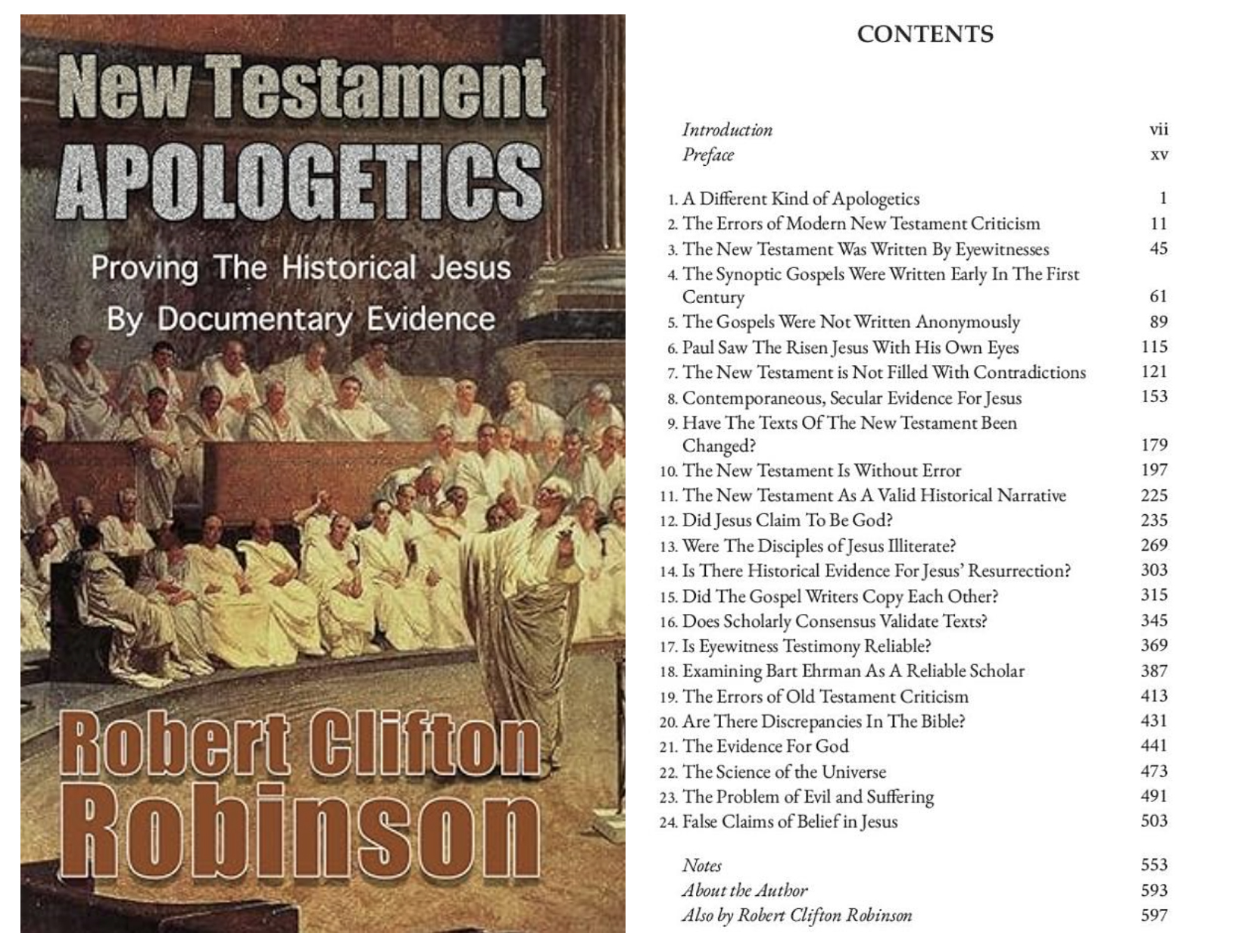
SEE MY IN-DEPTH NEW TESTAMENT APOLOGETIC THAT FULLY VALIDATES THE TEXTS OF THE NEW TESTAMENT BY EVIDENCE
Categories: Robert Clifton Robinson


Lets not forget Matthew 24:24 where Jesus states in effect that the deception in the last days will be so great that even the elect risk being deceived by it. What better way for Satan to kill than to flip the truth of the Gospel and represent it as a forgery thus calling it a lie? Think about that.
But Jesus also told us to pray for such people.
Thank you brother Rob for exposing the truth of this man. Forgive Bart Ehrman Father for he knows not what he does!
LikeLiked by 1 person