Most people read the New Testament through Gentile eyes. They read the texts as someone who is not familiar with how first-century Jews thought when Jesus arrived. Modern readers don’t understand that Jesus couldn’t simply stand in the Temple and say: “I am Yahweh-God.”
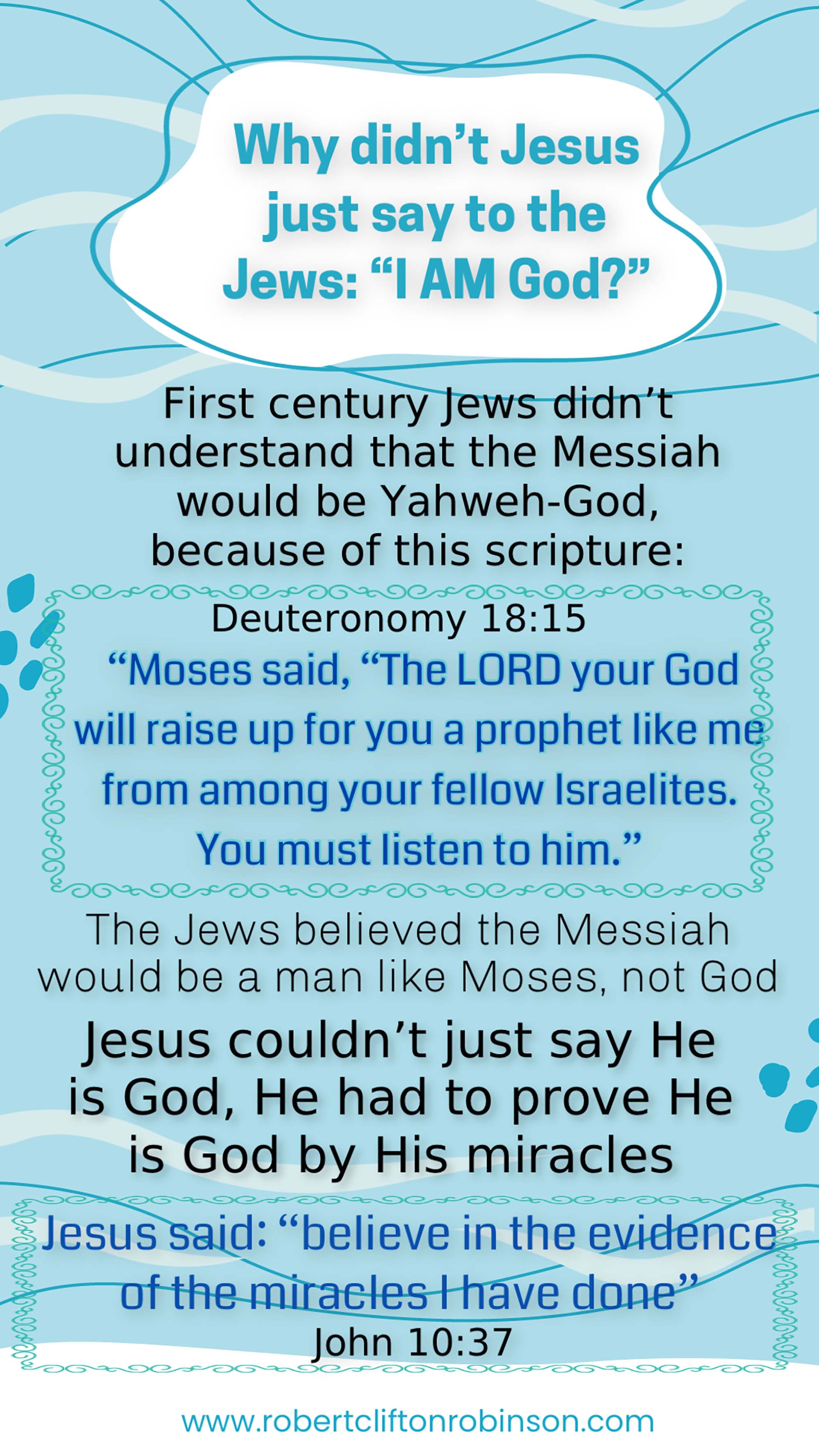 Jesus was a Jew, and because He was a Jew talking to Jews, He had to use language they would understand. The meaning of words used early in the first century and the subtleties of these texts are lost today to modern readers of the Bible. Because these misunderstood texts still exist today in our Bible just as they did 2,000 years ago, we can also fail to understand what Jesus was saying in reference to His identity.
The Jews were anticipating their Messiah at any moment when Jesus arrived, but they were not expecting the kind of Messiah that Jesus was. These Jews were under Roman occupation and had lost their sovereignty and nation. This caused great expectation for a conquering Messiah who would overthrow the Romans and return their nation to its former glory.
First, because of what Moses said in Deuteronomy 18:15, all Jews believed that the Messiah would be a man like Moses, not God:
“Moses continued, “The LORD your God will raise up for you a prophet like me from among your fellow Israelites. You must listen to him.”
Since Moses was just a man, no Jews in the first century imagined that the Messiah would be God. This is the primary reason that Jesus didn’t announce He is Yahweh-God when He arrived.
There was a secondary reason that Jesus didn’t proclaim His true identity when He came to earth. Jesus stated this reason often at the beginning of His public ministry: “My time has not yet come…” Jesus was following a precise and detailed timeline predicted by the 400 Messianic Prophecies of the Old Testament. He had just three and a half years to fulfill all 400 of these Messianic Prophecies, or He could not be the Messiah. But if the people started to call Him Messiah too soon, it would jeopardize the timeline that God had planned. For this reason, Jesus was careful, at the beginning, to not call too much attention to Himself, too fast. Jesus had to fulfill many Messianic Prophecies first before being recognized as the Messiah, arrested, and condemned to death on the cross.
During Jesus’ first miracle at the wedding of Cana, He explained this to His mother, Mary:
John 2:3-4: “The wine supply ran out during the festivities, so Jesus’ mother told him, “They have no more wine.” “Dear woman, that’s not our problem,” Jesus replied. “My time has not yet come.”
The following is a chart that lists 25 of the similarities between Jesus and Moses that fulfill the prophecy of Deuteronomy 18:15.
| # | Similarity | Moses | Jesus |
|---|---|---|---|
| 1 | Their lives were threatened in infancy by a ruler’s order to kill children. | Exodus 1:22–2:10 | Matthew 2:13–16 |
| 2 | They were protected from that threat. | Exodus 2:2–10 | Matthew 2:13–15 |
| 3 | Egypt played a significant role in their childhood. | Exodus 2:10 | Matthew 2:14–15 |
| 4 | They left Egypt. | Exodus 12:31–42 | Matthew 2:19–21 |
| 5 | They were called to deliver God’s people—Moses from slavery, Jesus from slavery to sin. | Exodus 3:7–10 | Matthew 1:21 |
| 6 | They experienced rejection from their own people. | Exodus 2:14; Acts 7:35 | John 1:11 |
| 7 | They functioned as prophets. | Deuteronomy 34:10 | Luke 24:19; Acts 3:22 |
| 8 | They mediated between God and people. | Deuteronomy 5:5 | 1 Timothy 2:5 |
| 9 | Their ministries were associated with covenants. | Exodus 24:3–8 | Luke 22:20; Hebrews 8:6 |
| 10 | Blood accompanied the establishment of those covenants. | Exodus 24:8 | Matthew 26:28 |
| 11 | They performed signs and wonders. | Exodus 4:1–9; Deuteronomy 34:11–12 | Acts 2:22 |
| 12 | They fasted for forty days and nights. | Exodus 34:28 | Matthew 4:2 |
| 13 | Wilderness experiences were important in their lives. | Exodus 3:1; Acts 7:30 | Luke 4:1–2 |
| 14 | They taught God’s commands in a mountain setting. | Exodus 19–20 | Matthew 5–7 |
| 15 | Their faces shone in encounters revealing divine glory. | Exodus 34:29–35 | Matthew 17:1–2 |
| 16 | Clouds and God’s voice accompanied mountain revelations. | Exodus 24:15–18 | Matthew 17:5 |
| 17 | They had an exceptional relationship with God. | Numbers 12:6–8 | John 1:18; Matthew 11:27 |
| 18 | They faithfully carried out their God-given work. | Numbers 12:7 | Hebrews 3:1–6 |
| 19 | They interceded for others. | Exodus 32:11–14 | John 17; Hebrews 7:25 |
| 20 | They prayed for people who opposed or mistreated them. | Numbers 12:1–13 | Luke 23:34 |
| 21 | Miraculous provision of bread accompanied their leadership. | Exodus 16:4–15 | John 6:5–14 |
| 22 | Miracles involving the sea accompanied their ministries. | Exodus 14:21–22 | Mark 4:35–41; Matthew 14:25 |
| 23 | They appointed others to share their work. | Numbers 11:16–17, 24–25 | Luke 9:1–2; 10:1 |
| 24 | They used shepherd imagery for the needs of God’s people. | Numbers 27:15–17 | Matthew 9:36; John 10:11 |
| 25 | They blessed their people near the end of their earthly lives. | Deuteronomy 33:1 | Luke 24:50–51 |
There are several instances in the New Testament where Jews in the first century had a fundamental misunderstanding of Scripture in applying these to Jesus:
The People Were Confused About Where The Messiah Would Originate From
John 7:40-42: When the crowds heard him say this, some of them declared, “Surely this man is the Prophet we’ve been expecting.” Others said, “He is the Messiah.” Still others said, “But he can’t be! Will the Messiah come from Galilee? For the Scriptures clearly state that the Messiah will be born of the royal line of David, in Bethlehem, the village where King David was born.”
Some people thought Jesus was from Galilee because He lived in this area when he began His public ministry.
Others understood from the prophecy of Micah 5:2 that the Messiah would be born in Bethlehem.
“But you, Bethlehem Ephrathah, though you are little among the thousands of Judah, yet out of you shall come forth to Me the One to be Ruler in Israel, whose goings forth are from of old, from everlasting.”
The idea that “no prophet ever came from Galilee, is also incorrect. Micah, Elijah, and Jonah all came from Galilee.
The point is that the people also thought that the Messiah would be merely a man, not God, even though Moses never said this.
Jesus Confounded The Leaders Of Israel
When Jesus spoke to the Leaders of Israel, He used language from the scriptures that they already knew to convince them that He was the object of all that the prophets had written.
When the Pharisees gathered before Jesus to question Him, it was with the intent of publicly discrediting Him before all those who were listening. Instead, these men were themselves confounded. The text that the Pharisees used to trap Jesus was a well-known verse from Psalm 110:1a.
In this portion of scripture, the LORD God is saying to the Messiah, “Sit at my right hand till I make your enemies my footstool.” The Pharisees believed that they already knew the answer to this question when they asked Jesus: “What do you think about the Christ (Messiah) Whose Son is He?” The Pharisees believed that the Messiah was the Son of David.
The LORD said to my Lord, “Sit at My right hand, Till I make Your enemies Your footstool.” ~Psalms 110:1a
Matthew Records This Event In His Gospel
While the Pharisees were gathered together, Jesus asked them, saying, “What do you think about the Christ? Whose Son is He?”
They said to Him, “The Son of David.” He said to them, “How then does David in the Spirit call Him ‘Lord,’ saying: ‘The LORD said to my Lord, “Sit at My right hand, Till I make Your enemies Your footstool” ’? If David then calls Him ‘Lord,’ how is He his Son?” ~Matthew 22:41-45
Jesus asked the Pharisees, “If the Messiah is David’s son, then why did David also call Him ‘ Lord ‘?” In other words, how could the Messiah be both a human being (David’s son) and also Lord (God’s Son)?
These men knew and understood that this verse of scripture that Jesus referred to was about the Messiah. Only the Messiah could sit at the right hand of God. Jesus believed these verses from Psalm 110:1 were inspired by God and were true—as did these leaders of Israel. Jesus asked these teachers of the law how the Messiah could be both God and a human being.
“If the Messiah is David’s son, how can He also be David’s Lord?”
This is precisely what this prophecy from Psalm 110:1a is predicting.
The Pharisees didn’t have an answer. They were bewildered, but not Jesus. The obvious answer to this question is that the Messiah will be both David’s Lord (God) and His Son (a future human descendant), a fact that Jesus made repeatedly concerning Himself.
The reality that Jesus is both David’s son and his Lord is confirmed by Jesus’ question which He asks of the Pharisees. For those who say that Jesus never claimed to be God, this is one of many places where He clearly asserts that He is God.
When Jesus asks this question of the religious leadership of Israel, no one was able to answer Him. This is because it was generally accepted by the Jews that Psalm 110:1 was speaking of the Messiah who will also be God. If, by David’s words, the Messiah is both a son and Lord, He must also be God and man.
The idea that God could be dwelling within the person of Jesus Christ was a reality that was totally unacceptable to the leaders of Israel. Yet, this is precisely what David was predicting when he penned Psalms 110:1.
Here before the Pharisees, Jesus meticulously demonstrates from the Old Testament that His identity as God and Messiah is precisely what David predicted: A man who is both Messiah and God.
During Jesus’ Trial Just Before He Was Crucified, He Claimed To Be Yahweh-God
Mark 14:60-64: “And the high priest stood up in the midst and asked Jesus, saying, “Do You answer nothing? What is it these men testify against You?” But He kept silent and answered nothing.
Again the high priest asked Him, saying to Him, “Are You the Christ, the Son of the Blessed?” Jesus said, “I am. And you will see the Son of Man sitting at the right hand of God, and coming with the clouds of heaven.” Then the high priest tore his clothes and said, “What further need do we have of witnesses? You have heard the blasphemy! What do you think?” And they all condemned Him to be deserving of death.
Jesus combines Daniel 7:13’s coming with the clouds with Psalm 110:1’s sitting at God’s right hand.
Daniel describes the Messiah as “the Ancient of Days” (Yahweh-God); the right-hand language comes from the psalm. In Mark, Jesus brings both passages together, and the high priest responds by charging him with blasphemy. Mark 14:61–64; Daniel 7:13–14; Psalm 110:1
These Old and New Testament texts prove that Jesus was claiming more than just a man: he identified himself as Yahweh, the Messiah, the ruler who receives everlasting dominion and sits at God’s throne and with all authority.
Mark adds the accusation of blasphemy by the leaders of Israel when Jesus said He is Yahweh-Messiah, described by Daniel 7:13 and Psalm 110:1, both written for Yahweh-God-Messiah.
Jesus Claimed To Be God: 104 Times In The New Testament
- Jesus, in the New Testament texts, applied a name to Himself that is only used for Yahweh, “I AM” (John 4:26; 6:20; 8:24,28,58; 18:5,6).
- When the Pharisees asked Jesus if He is God, He said “Yes” (Mark 14:61-62).
- It was because Jesus had clearly claimed to be God that the Pharisees took up stones to kill Him. They believed that Jesus was a mere man, but He was claiming to be God (John 10:31-33).
- Jesus claimed to be the Adonai of the Old Testament (Matthew 22:42-45; see Genesis 15:2).
- Jesus claimed an identity with the Father that no human has; equality with God (Matthew 28:19; Mark 14:62; John 5:18; John 10:30. The Jews understood that Jesus was claiming to be God by calling God His Father (John 10:31-33; 14:8-9; 17:5).
- Jesus claimed to be God by exercising the chief prerogative of God-the forgiveness of sins (Mark 2:5-7; Luke 7:48-50).
- Jesus claimed to be God by asserting Omnipresence (Matthew. 18:20; John. 3:13); Omniscience (Jn. 11:11-14, when Jesus was fifty miles away; Mark. 11:6-8); Omnipotence (Matthew 28:18; Luke 7:14; John 5:21-23; 6:19); mastery over nature, and creative power (Luke 9:16-17; John 2:9; 10:28).
- Jesus claimed to be God by receiving and approving of human worship of Himself (Matthew 14:33; 28:9; John 20:28-29).
- Jesus claimed to be God by referring to Himself as “The Son of Man,” 77 times; a term used by Daniel 7:13 to describe the Messiah. This is translated from the Aramaic term: kebar enas, and it identifies the appearance of the Son of Man, according to Daniel, as God in human flesh.
- Jesus claimed to be God by calling Himself “The Son of God,” a term that was well understood by the people of that time, as defining the Messiah as Adonai–Yahweh, come to earth as a man (Matthew 26:63, Matthew 16:15-16). In John 5:18, “So the Jewish leaders tried all the harder to find a way to kill Jesus. For he not only broke the Sabbath, but he also called God his Father, thereby making himself equal with God.”The Old Testament predicted that the Messiah would be the Son of God (2 Samuel 7:14, Psalms 2:7, Psalms 110:1). In 1 John 5:20, this becomes clear as the Koine-Greek, the ἐν τῷ ἀληθινῷ (living and true God), does not refer to a different person than the τὸν ἀληθινόν, specifically, “the real God.” The article with the dative reads like an article of previous reference. “He” is Jesus, “the only True God.” The Koine-Greek texts prove that the term “Son of God” defines Jesus as the “only True God.”
- Jesus claimed to be God by His miracles of healing (John 5:36), predicted by Isaiah 35 as works of God in the person of the Messiah (Isaiah 35:4-6). “For your God is coming to save you. And when he comes, he will open the eyes of the blind and unplug the ears of the deaf. The lame will leap like a deer, and those who cannot speak will sing for joy!”
- Ezekiel the prophet recorded the words of Yahweh that He will open the graves of all who have died, and conduct judgment. Jesus cites this scripture in stating that He is Yahweh-God, who will open every grave and judge the world: Ezekiel 37:13 “Then you shall know that I am the LORD (Yahweh), when I have opened your graves…”John 5:28 “The time is coming when all the dead in their graves will hear the voice of God’s Son, and they will rise again.”Jesus is Yahweh-God!
So, when critics say that Jesus never claimed to be God, this is an error made because they “don’t know the Scriptures.” Jesus claimed to be Yahweh-God 104 times in the New Testament, without saying directly, “I AM God.”
The reason He did not say He is God directly was due to the understanding of the Jews in the first century. Rather than alienate these men, Jesus used their own scriptures to demonstrate that the Law and the Prophets predicted the Messiah would be Yahweh.
The Old Testament Prophecies That State The Messiah will be the Son of God
There are seven Old Testament prophecies that either state or allude to the fact that the Messiah will be the “Son of God”. The seventh, although not referring directly to the “Son, is generally understood to be a Messianic prophecy, describing the coming of God’s Son and those who are waiting for Him.
- Prophecy 50: 2 Samuel 7:14 “I will be his Father, and he shall be My son.”
- Prophecy 57: 1 Chronicles 17:13 “I will be his Father, and he shall be My son…”
- Prophecy 63: Psalms 2:7 “I will declare the decree: The LORD has said to Me, ‘You are My Son; today I have begotten You.”
- Prophecy 128: Psalms 89:26 “He shall cry to Me, ‘You are my Father, My God, and the rock of my salvation.”
- Prophecy 156: Proverbs 30:4 Who has ascended into heaven, or descended? Who has gathered the wind in His fists? Who has bound the waters in a garment? Who has established all the ends of the earth? What is His name, and what is His Son’s name, if you know?
- Prophecy 171: Isaiah 9:6c For unto us a Child is born, unto us a Son is given; And the government will be upon His shoulder. And His name will be called Wonderful, Counselor, Mighty God
- Prophecy 195: Isaiah 33:2 O LORD, be gracious to us; We have waited for You.
With this great witness to the Messiah being the “Son of God, why then do so many Jews today find it impossible to believe that Jesus is the Messiah, because He claimed to be the “Son of God”?
Clearly, it was the intention of the Old Testament scriptures to inform us that the Messiah would be God’s Son. When Jesus referred to Himself as “The Son of God, He was firmly stating that He was the one to whom the Old Testament prophecies of the Bible were pointing. Which Son was Isaiah referring to in chapter 9:6-7, if not God’s Son? In the context of this verse, Isaiah writes that this “Son” is the “Mighty God”.
Translators of the early Koine Greek texts of the New Testament understood that Jesus was Yahweh/God of the Old Testament
The early translators of the New Testament from Koine Greek into English understood that the word “Lord” (κύριος, kurios) in the New Testament was often used to refer to Yahweh (יהוה, YHWH) in the Old Testament.
Understanding “Kurios” in the New Testament
In the Koine Greek Septuagint (LXX) translation of the Hebrew Scriptures (Tanakh), the divine name YHWH (יהוה) was consistently translated as κύριος (kurios), meaning “Lord.” This established a precedent for using “kurios” as a direct substitute for God’s covenant name.
The New Testament writers, being Jewish and well-versed in the Septuagint, carried this practice into their writings. When quoting Old Testament passages that referred to Yahweh, they used kurios in place of the Hebrew name for God. This is evident in many quotations where an Old Testament verse referring to YHWH is applied to Jesus Christ in the New Testament, equating Him with Yahweh.
Examples of “Kurios” as Yahweh in the New Testament
- Joel 2:32 → Romans 10:13
- Hebrew (Masoretic Text):“Whoever calls on the name of Yahweh (יהוה) shall be saved.”
- Septuagint (LXX): “Whoever calls on the name of kurios (κύριος) shall be saved.”
- Romans 10:13: ”For whoever calls on the name of the Lord (κύριος) will be saved.”
Application: Paul clearly applies this verse about Yahweh to Jesus, equating Him with the Lord (YHWH) of the Old Testament.
Isaiah 40:3 → Matthew 3:3
- Isaiah 40:3 (MT): “Prepare the way of Yahweh (יהוה); make straight in the desert a highway for our God.”
- Matthew 3:3: “Prepare the way of the Lord (κύριος), make His paths straight.”
Application: The verse about Yahweh is applied to Jesus, confirming that kurios in the NT refers to Yahweh.
Psalm 102:25-27 → Hebrews 1:10-12
- Psalm 102:25-27 (MT): “Of old You laid the foundation of the earth, and the heavens are the work of Your hands… but You are the same, and Your years will have no end.”
- Hebrews 1:10-12: “You, Lord (κύριος), in the beginning laid the foundation of the earth…”
Application: The writer of Hebrews directly attributes Yahweh’s creative power to Jesus.
Did The Koine-Greek English Translators Recognize These Facts?
Yes, the early English translators (Tyndale, Geneva Bible, KJV, etc.) were aware of this exegetical connection. However, due to the limitations of English, they followed the tradition of using “LORD” (all caps) for YHWH in the Old Testament but “Lord” (capitalized) for kurios in the New Testament.
For the average reader, this sometimes obscured the fact that when the New Testament uses kurios, it is often referring to Yahweh Himself, particularly in texts where Jesus is identified with Yahweh.
Why is this not obvious to people who read the New Testament today? Again, the translators understood that kurios in the New Testament often refers to Yahweh (יהוה)from the Old Testament. But due to the lack of capitalization or differentiation in English, this fact is often less explicit to modern readers. The theological reality remains that the NT writers, through the use of kurios, equated Jesus with YHWH, confirming His divine identity.
The importance of this fact of Jesus’ true identity is seen in the text of Genesis 19:24, where the LORD (Yahweh), destroys Sodom and Gomorrah for their sin of Sodomy among the men of these two cities. The fact that many people who read the New Testament have stated that “Jesus never said anything about homosexuality, or condemned its practice ” shows they are not aware that Jesus is Yahweh from the Old Testament.
In Genesis 19:24, it was Jesus as Yahweh who went to Sodom and Gomorrah and destroyed all the men of these two cities because they refused to repent of their same-sex sin.
“Then the LORD (Yahweh-Jesus) rained down fire and burning sulfur from the sky on Sodom and Gomorrah. He utterly destroyed them all.”
Jesus did not begin His existence at Bethlehem in the New Testament. John 1, Colossians 1, Hebrews 1, and Jesus Himself said that He is the Eternal God who has always existed.
There are 6,800 references to Jesus as Lord in the original Koine Greek texts of the New Testament. The translators of the Greek texts into English understood that the same Lord Jesus of the New Testament is the same Lord Yahweh in the Old Testament.
Jude and Peter confirm that it was Jesus who destroyed the men of Sodom and Gomorrah because they would not repent of their Sodomy.
Jude states in 1:5-7 that Jesus, as Yahweh, led the Israelites out of Egypt, then later destroyed them in the desert because they complained and rebelled against Him:
“So I want to remind you, though you already know these things, that Jesus first rescued the nation of Israel from Egypt, but later he destroyed those who did not remain faithful.”
Jude also states that Jesus, as Yahweh in the Old Testament, also destroyed the men of Sodom and Gomorrah because they refused to repent of their homosexuality, describing these acts as “sexual perversion and immorality,” serving as a warning to everyone that God will not tolerate same-sex sin:
” …And don’t forget Sodom and Gomorrah and their neighboring towns, which were filled with immorality and every kind of sexual perversion. Those cities were destroyed by fire and serve as a warning of the eternal fire of God’s judgment.”
2 Peter chapter 2 also confirms that the men of Sodom and Gomorrah were destroyed by Jesus because of their “shameful immorality, wickedness, and that their judgment is an example to us of what God will do in judgment to everyone who refuses to repent of same-sex sin:
“Later, God condemned the cities of Sodom and Gomorrah and turned them into heaps of ashes. He made them an example of what will happen to ungodly people. 7 But God also rescued Lot out of Sodom because he was a righteous man who was sick of the shameful immorality of the wicked people around him. Yes, Lot was a righteous man who was tormented in his soul by the wickedness he saw and heard day after day.”
The Messiah Is Yahweh
It is with these things in mind that we study the 400 Prophecies of the Messiah—knowing that He will be Yahweh from the Old Testament, when He arrives.
Long before Jesus was born in Bethlehem, grew into a man, suffered and died for all sins, the Old Testament scriptures recorded that He would be the Eternal Living God, living in the body of a man.
See All 400 of the Messianic Prophecies in One Kindle eBook, or Seven Print Editions
Categories: Robert Clifton Robinson


But if the first-century Jews expected a political savior (Luke 24:21, Acts 1:6), who would not be killed (Peter’s rebuke in Matthew 16:21–23), and yet Jesus explicitly told Romans and Jews that his kingdom was not of this world (John 18:36, Luke 17:20-21), we can possibly be reasonable to disagree with you, and say Jesus’ willingness to directly contradict first-century Jewish expectations about the Messiah argues that he would also be willing to directly contradict first-century Jewish expectations about the Messiah’s nature. That is, we can possibly be reasonable to reject your theory for why he refrained from directly claiming to be Deity, and favor some other theory that might explain this phenomena.
LikeLike
There is a pattern in your observations of biblical text, and your responses.
Seldom do human agents understand God and the way He works in our broken world.
It matters not what the Jews expected or how they reacted to Jesus.
All the prophets wrote about Jesus, and predicted He would be rejected because they didn’t understand who He was or why He came.
In three of the Gospels (Synoptics), Jesus is recorded as returning to His hometown of Nazareth and going to the synagogue where He was invited to read from the scroll of Isaiah the prophet.
As the attendant handed Jesus the scroll of Isaiah, Jesus opened it to Isaiah 61. This is interesting for us because, at the time Jesus took the scroll and opened it, the text He will be reading is at the end of the scroll of Isaiah.
Luke 4:16-20: “So Jesus came to Nazareth, where He had been brought up. And as His custom was, He went into the synagogue on the Sabbath day and stood up to read. And He was handed the book of the prophet Isaiah. And when He had opened the book, He found the place where it was written:
“The Spirit of the LORD is upon Me,…” Let’s examine the original text recorded by Isaiah and see what he wrote:
The Old Testament Prophecy:
Isaiah 61:1-62: “The Spirit of the Lord GOD is upon Me, Because the LORD has anointed Me To preach good tidings to the poor; He has sent Me to heal the brokenhearted, To proclaim liberty to the captives, And the opening of the prison to those who are bound; To proclaim the acceptable year of the LORD, And the day of vengeance of our God…”
Compare Isaiah’s words to those spoken by Jesus when He came to the synagogue at Nazareth and quoted from this verse found in Isaiah 61:
Luke 4:16-20: “So Jesus came to Nazareth, where He had been brought up. And as His custom was, He went into the synagogue on the Sabbath day, and stood up to read. And He was handed the book of the prophet Isaiah. And when He had opened the book, He found the place where it was written: “The Spirit of the LORD is upon Me, Because He has anointed Me To preach the gospel to the poor; He has sent Me to heal the brokenhearted, To proclaim liberty to the captives And recovery of sight to the blind, To set at liberty those who are oppressed; To proclaim the acceptable year of the LORD.”
Then He closed the book, and gave it back to the attendant and sat down. And the eyes of all who were in the synagogue were fixed on Him.”
Notice that Jesus omitted the text: And the day of vengeance of our God… Why? At Jesus’ first arrival on earth, He was coming as the suffering servant of God—the Lamb who would lay down His life for the sins of the world.
At Jesus’ second appearance on earth, at the end of the seven-year Tribulation, He is coming as King of kings and Lord of lords.
When Jesus finished reading the words of Isaiah Chapter 61, He rolled up the scroll and handed it back to the attendant. As He sat down, the eyes of all those in the synagogue were transfixed on Jesus. Then He said these words: Today this Scripture is fulfilled in your hearing (Luke 4:21).
Those who had heard Jesus speak in the synagogue were utterly astonished. The words of these prophecies, from Isaiah Chapter 61, could only be fulfilled by the coming of the Messiah.
By stating that this prophecy had been fulfilled as Jesus spoke, He was claiming to be the Messiah. Jesus said that He would fulfill the first part of Isaiah 61—the acceptable year of the Lord—during His first arrival, and then the day of vengeance of our God at His return.
Jesus revealed something to us that was hidden in verse 12 of Isaiah 61:
There were two parts to the fulfillment of this prophecy. Isaiah 61:2:
(Part 1) To proclaim the acceptable year of the LORD, (Part 2) And the day of vengeance of our God…
Part one: to fulfill the acceptable year of the Lord—the time when God would pardon the sins of anyone who came to Jesus and believed in Him as their Savior.
Part two: would be fulfilled at the end of the seven-year Tribulation (the time of vengeance), when Jesus would return to earth with His church (Revelation 19) and rule over the whole earth for one thousand years as absolute King and Lord.
This example from Isaiah 61, which is partially fulfilled in Luke Chapter 4, demonstrates that there can be an earlier fulfillment as well as a later fulfillment of the same prophecy.
In these examples, we can observe how an obscure verse from the Old Testament may not, at first glance, appear to be a relevant prophecy of the Messiah until we discover the fulfillment of a related prophecy in the New Testament.
These two principles of biblical exegesis; repetition of principles, and earlier and later fulfillments of important prophecies, will become very important to your education as we study Apologetics together.
When Jesus arrived the Jews did not understand that the Prophets had predicted two arrivals for Messiah.
Yes, He will come to overthrow the present human government and establish His kingdom on earth, but not the first time He arrived.
Jesus came first to take the sins of the world to the cross and pay the penalty we owe for our sins.
Jesus accomplished this. Then He rose from the dead, as the prophets predicted.
The time since He paid for all sins, to the present day, is the period when God is offering forgiveness of all sins to all people.
When this time of grace and mercy ends, Jesus will return.
So, it doesn’t matter what the Jews of the first century thought or expected. It doesn’t matter what you think.
It is the scripture that God will fulfill in His time and His way.
You seek to understand the Bible by your own human wisdom, but like the Jews, you and they, failed to realize what Jesus was doing.
The Jews should have known these things when Jesus arrived, but they substituted their own thoughts and expectations for what God had said.
Your comment makes the same mistake.
Instead of learning what the scriptures say, you question, scoff, and doubt them.
Under this method you will never understand God or the Bible.
LikeLike
I think you’ve lost sight of what’s going on. I’m only arguing that I can be reasonable to view Jesus as unconcerned about what the Jews expected, therefore, he was likely unconcerned about the Jewish belief that the Messiah would be something other than God-incarnate.
Nothing you responded with indicates I am unreasonable to disagree with your theory on why Jesus refrained from directly claiming to be God.
The flaw in your approach is that your fundamentalist motivation makes you want to write 90,000 pages of “rebuttal” every time you encounter somebody who disagrees with you on a single point. Probably because you think this constitutes “planting seeds”, and so the more verbiage posted, the more seeds planted.
This does little more than kick up several other side-issues that are arguably less relevant than or ancillary to the original post. This then causes the subsequent discussion to become frayed.
The advantage you apparently seek to gain with this approach is transparent: if your opponent makes any bit of valid refutation, it will likely be overlooked or misconstrued in the ocean of extra argumentation that you always always always try to overwhelm your opponent with.
Now you know why other Trinitarian fundamentalists who disagree with you on any biblical subject like Calvinism or Lordship Salvation, are 99% of the time impossible to dissuade: they too think that their ceaseless volumes of commentary constitute “planting a seed”. They see the prospect of changing their mind on doctrine in no less Satanic terms than you do.
Well? Do you share the same traits as those other Trinitarian fundamentalists who would rather burn to death than admit they got something wrong?
You have provided a theory on why Jesus didn’t directly claim “I am God”. The basis of your theory is this:
I simply argued that because Jesus was happy to contradict Jewish expectations on other subjects, I am reasonable to consider your theory unlikely, and go looking for another theory to explain why Jesus didn’t directly claim to be God.
You haven’t shown that my take is “unreasonable”, you’ve simply added further unnecessary issues to your original contention.
I’m not going to address your commentary on Jesus’ quoting of Isaiah 61 because it is part and parcel of your tendency to drown everything you disagree with in a sea of unnecessary verbiage. What you should have done was directly refute my contention that Jesus was happy to contradict Jewish expectation and belief in other areas. If Jesus had always been a softie, you might have a point. But the Jesus you serve seemed to get a fun thrill out of contradicting established Jewry. If he was God manifest in the flesh, we would be reasonable to assume he’d have been equally as direct about that as he was about the Pharisee’s legal errors.
LikeLike
There is a reality that happens in the lives of some people where they reach a point of rejecting God’s attempts at reaching them, where it is impossible for these individuals to be saved.
The primary symptom that indicates this has happened is when a person does what you are doing: refusing Scripture and the God who wrote these texts to try to reach you.
In Matthew chapter 13, the disciples of Jesus came to Him and asked why He only taught the great crowds of people through Parables.
Matthew 13:10-16 Jesus’ disciples came and asked him, “Why do you use parables when you talk to the people?”
11 He replied, “You are permitted to understand the secrets of the Kingdom of Heaven, but others are not. 12 To those who listen to my teaching, more understanding will be given, and they will have an abundance of knowledge. But for those who are not listening, even what little understanding they have will be taken away from them. 13 That is why I use these parables,
For they look, but they don’t really see.
They hear, but they don’t really listen or understand.
14 This fulfills the prophecy of Isaiah that says,
‘When you hear what I say,
you will not understand.
When you see what I do,
you will not comprehend.
15 For the hearts of these people are hardened,
and their ears cannot hear,
and they have closed their eyes—
so their eyes cannot see,
and their ears cannot hear,
and their hearts cannot understand,
and they cannot turn to me
and let me heal them.’
16 “But blessed are your eyes, because they see; and your ears, because they hear.
I am afraid that your continual rejection of what God has said has placed you into this category where you are not permitted to understand because you have refused to see and listen:
“You are permitted to understand the secrets of the Kingdom of Heaven, but others are not. 12 To those who listen to my teaching, more understanding will be given, and they will have an abundance of knowledge. But for those who are not listening, even what little understanding they have will be taken away from them.”
In this state, it will do you no good for me to try and teach you, or reason with you concerning what God has said. You have displayed persistent resistance and unwillingness to see or hear. You have gone so far now as to mock me when I cite what God has said.
As Paul said to those in the New Testament who would not listen or heed what God said:
“It was necessary that I teach the Word of God to you. But since you have rejected it and judged yourself unworthy of eternal life, I will offer it to others.”
I am truly sorry that you have placed yourself in this hopeless situation, but then again, it doesn’t seem that you care.
I hope that there might still be a chance for your repentance and that the Spirit of God might be able to reach you. As for me, I will spend my time on those who want to know, learn, and discover the immense treasure that is in Christ Jesus.
LikeLike