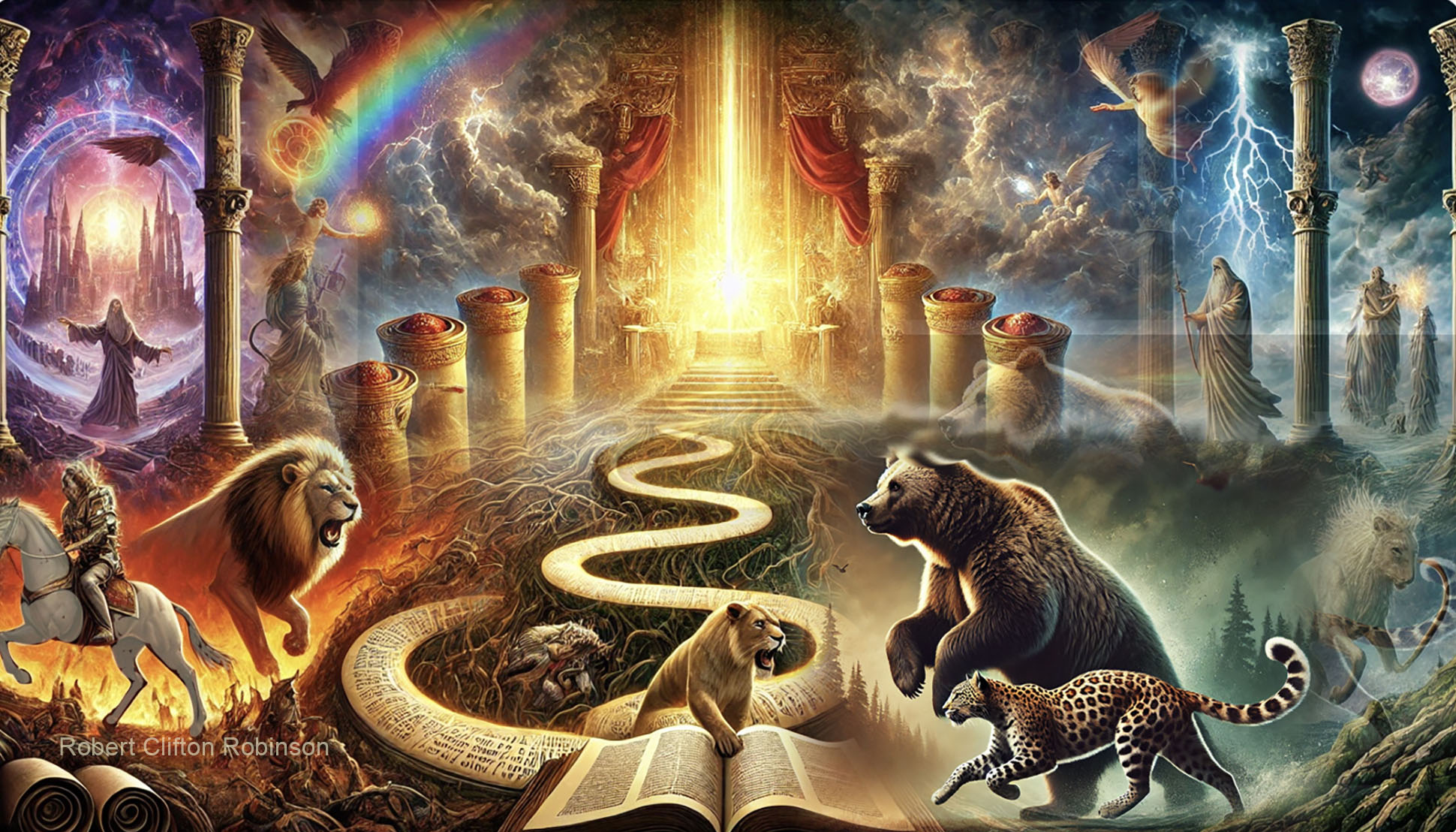
Daniel and Revelation In The Last Days, Copyright RCR
The most stunning of all Prophecies found in the Bible originate in two books that are very closely related. Daniel wrote his prophetic predictions of four Global Empires, and the arrival of the Messiah on one specific day, while John describes in Revelation, the culmination of Daniel’s prophecy during the final seven years of the present world.
How could these two men, who had never met, know when they penned these prophecies, that they were describing the same events, 700 years apart?
- Daniel predicts the exact day of Messiah’s first arrival in Daniel 9
- John predicts the exact day the Messiah will return to earth, in Revelation 19
In this essay we will examine the incredible accuracy of these two books and the fact that their authenticity is verified by history and preserved literary forensics.
Nebuchadnezzar’s Dream and Its Context (Daniel 2:1-13):
King Nebuchadnezzar, ruler of Babylon, has a troubling dream that disturbs him greatly. Despite the vast power and wealth at his disposal, the king’s inability to understand the dream highlights the limitations of human power and wisdom. Nebuchadnezzar’s demand for his astrologers, sorcerers, and magicians to both recount and interpret the dream is unprecedented and reflects his distrust in their usual methods of divination.
The inability of the Babylonian wise men to fulfill this request reveals the impotence of human wisdom when confronted with divine revelation. Nebuchadnezzar’s harsh decree to execute all the wise men underscores his absolute authority and temperamental nature. However, this sets the stage for God to display His power and supremacy through Daniel.
Daniel’s Response to the Crisis (Daniel 2:14-23):
Daniel’s response to the king’s decree is marked by wisdom and faith. Instead of panicking, he seeks time from Nebuchadnezzar and turns to prayer, along with his companions Hananiah, Mishael, and Azariah. This highlights a key theme: the power of prayer and dependence on God during times of crisis.
God answers Daniel’s prayers by revealing the dream and its interpretation during a night vision. Daniel’s response is one of deep gratitude and worship, as seen in his prayer (Daniel 2:20-23), where he praises God for His wisdom, power, and control over the rise and fall of kings. Daniel’s humility is evident; he recognizes that the revelation comes from God alone, not through any personal ability.
The Revelation of the Dream (Daniel 2:24-35):
Daniel approaches Nebuchadnezzar and makes it clear that the dream and its interpretation were revealed to him not through his own wisdom, but by “the God in heaven who reveals secrets” (Daniel 2:28). This sets the God of Israel apart from the false gods of Babylon and highlights His omniscience.
Nebuchadnezzar’s dream is of a massive, dazzling statue made of various materials:

- Head of Gold: Represents Nebuchadnezzar and the Babylonian Empire.
- Chest and Arms of Silver: Symbolizes the Medo-Persian Empire, which would follow Babylon.
- Belly and Thighs of Bronze: Points to the Greek Empire, led by Alexander the Great.
- Legs of Iron: Refers to the Roman Empire, known for its strength and dominance.
- Feet of Iron and Clay: Depicts a divided kingdom, partially strong but also weak, symbolizing political fragmentation and instability.
The vision culminates with a stone “cut without human hands” striking the statue at its feet, causing the entire structure to collapse into dust and be carried away by the wind. The stone then grows into a great mountain that fills the whole earth.
This imagery of the stone signifies God’s eternal kingdom—a kingdom not established by human hands but by divine power. It will overthrow all earthly kingdoms and endure forever, pointing forward to the coming of the Messiah and the ultimate fulfillment of God’s redemptive plan.
The Interpretation of the Dream (Daniel 2:36-45):
Daniel explains that Nebuchadnezzar’s kingdom, symbolized by the head of gold, is the first and greatest of the empires. However, it will not last forever. The subsequent empires—Medo-Persia, Greece, and Rome—each decline in glory, though they differ in strength. The mixture of iron and clay in the feet represents the divided nature of future kingdoms, marked by both strength and weakness.
The stone that destroys the statue is central to the prophecy. It represents Messiah Kingdom, which will shatter all human empires and establish itself eternally. This prophecy points to Jesus Christ, the Messiah, whose kingdom (both spiritual and physical) will surpass all human governments and systems of power (cf. Matthew 21:42-44).
Nebuchadnezzar’s Response (Daniel 2:46-49):
Nebuchadnezzar, recognizing the miraculous nature of Daniel’s revelation, bows before Daniel and honors him. He acknowledges Daniel’s God as “the God of gods and the Lord of kings” (Daniel 2:47). While this shows Nebuchadnezzar’s initial recognition of God’s power, it does not yet indicate a full conversion or submission to God’s authority.
Daniel is promoted to a high position in the Babylonian kingdom, overseeing the province of Babylon and the king’s wise men. He uses this opportunity to secure positions for his companions—Shadrach, Meshach, and Abednego—demonstrating Daniel’s loyalty and wisdom as a leader.
The Primary Themes of Daniel Chapter 2:
God’s Sovereignty Over Nations: Daniel 2 reveals that God is in complete control of history. The rise and fall of kingdoms occur according to His divine plan. Earthly empires, no matter how powerful, are temporary and subject to God’s will (cf. Psalm 2; Romans 13:1).
The Power of God’s Revelation: Nebuchadnezzar’s dream was a divine mystery that human wisdom could not unravel. Daniel’s ability to reveal the dream demonstrates that true wisdom and knowledge come only from God (James 1:5).
The Eternal Kingdom of The Messiah: The stone that destroys the statue represents the Messiah and God’s eternal kingdom. This points to Jesus Christ, whose kingdom will surpass all human empires (Luke 1:32-33). The chapter foreshadows the ultimate triumph of God’s rule.
Faith in Times of Crisis: Daniel’s response to the life-threatening decree shows his unwavering faith in God. He sought God through prayer and trusted Him for deliverance, setting an example for believers to depend on God during adversity.
God’s Faithfulness to His People: Despite living in exile, Daniel and his companions experience God’s protection, favor, and blessing. God honors their faithfulness and uses them to display His glory to a pagan king and kingdom.
Christological Connection: The stone in Nebuchadnezzar’s dream points directly to Jesus Christ. The stone, “cut without human hands,” signifies Christ’s divine origin (cf. 1 Peter 2:4-7). Jesus is the cornerstone upon which God’s eternal kingdom is built. His kingdom, unlike earthly empires, will never end (Isaiah 9:6-7; Revelation 11:15).
Daniel 2 emphasizes God’s ultimate control over history and His ability to reveal His purposes to those who trust Him. The prophecy offers hope and assurance that earthly powers will one day give way to God’s eternal, unshakable kingdom. Daniel’s faithfulness and dependence on God serve as a timeless example for believers navigating challenges in a secular world.
Daniel 2:19-22: “Daniel praised the God of heaven. He said, “Praise the name of God forever and ever, for he has all wisdom and power. He controls the course of world events; he removes kings and sets up other kings. He gives wisdom to the wise and knowledge to the scholars. He reveals deep and mysterious things and knows what lies hidden in darkness, though he is surrounded by light.”
The prophetic chapters of Daniel 4 and 7—aligned with Revelation chapters 6-19, give us a stunning view of events that are predicted by the Bible with great accuracy.
Daniel 4: Nebuchadnezzar’s Dream of the Great Tree
Prophecy Overview: King Nebuchadnezzar dreams of a vast tree reaching the heavens, providing shelter to all creatures. A “watcher” from heaven commands the tree to be cut down, leaving only the stump bound with iron and bronze, symbolizing divine judgment.
Daniel interprets this as a judgment on Nebuchadnezzar for his pride. He would lose his sanity and live like an animal for seven years until he acknowledges God’s sovereignty.
Connections to Revelation: The seven years of Nebuchadnezzar’s madness prefigure the seven-year Tribulation described in Revelation (6-19), particularly the period of divine judgment on human pride and rebellion.
The restoration of Nebuchadnezzar after seven years parallels the restoration of the earth under Christ’s rule in the Millennial Kingdom (Revelation 20).
Daniel 4:10-17 (“‘While I was lying in my bed, this is what I dreamed. I saw a large tree in the middle of the earth. The tree grew very tall and strong, reaching high into the heavens for all the world to see. It had fresh green leaves, and it was loaded with fruit for all to eat. Wild animals lived in its shade, and birds nested in its branches. All the world was fed from this tree. “‘Then as I lay there dreaming, I saw a messenger, a holy one, coming down from heaven. The messenger shouted, “Cut down the tree and lop off its branches! Shake off its leaves and scatter its fruit! Chase the wild animals from its shade and the birds from its branches. But leave the stump and the roots in the ground, bound with a band of iron and bronze and surrounded by tender grass. Now let him be drenched with the dew of heaven, and let him live with the wild animals among the plants of the field. For seven periods of time, let him have the mind of a wild animal instead of the mind of a human. For this has been decreed by the messengers; it is commanded by the holy ones, so that everyone may know that the Most High rules over the kingdoms of the world. He gives them to anyone he chooses— even to the lowliest of people.”

The Tree of Daniel 4 and Revelation Copyright RCR
Daniel 7: The Vision of the Four Beasts
Daniel 7:1-8 – The Four Beasts
- Verses 2-3: The “four winds” and “great sea” signify the chaotic forces driving human history. The four beasts arise from the sea, representing worldly kingdoms driven by human ambition and demonic influence.
- Verse 4: The first beast, a lion with eagle’s wings, represents Babylon. The plucking of its wings may symbolize Nebuchadnezzar’s humbling (Daniel 4:28-37).
- Verse 5: The second beast, a bear raised on one side, symbolizes the Medo-Persian Empire. The uneven posture reflects the dominance of Persia over Media. The “three ribs” may represent Babylon, Lydia, and Egypt—nations conquered by this empire.
- Verse 6: The third beast, a leopard with four wings and heads, represents the Greek Empire under Alexander the Great. The wings signify rapid conquest, while the four heads denote the division of Alexander’s empire among his generals.
- Verse 7: The fourth beast, “terrifying and dreadful,” with iron teeth, represents the Roman Empire. Its unparalleled power and destructive nature exceed the previous empires. The “ten horns” point to a future confederation of ten kings or nations.
- Verse 8: The “little horn” emerges from the ten and uproots three, symbolizing the rise of an antichrist figure. This horn has “eyes like a man” and “a mouth speaking great things,” indicating intelligence and blasphemy.
Daniel 7:9-14 – The Ancient of Days and the Son of Man
- Verses 9-10: The Ancient of Days (God the Father) is depicted in a majestic courtroom scene, emphasizing divine sovereignty and judgment.
- Verses 11-12: The fourth beast and its “little horn” are destroyed, symbolizing the ultimate defeat of antichrist forces.
- Verses 13-14: The “Son of Man” (Messianic title for Christ, cf. Matthew 26:64) approaches the Ancient of Days and is given an everlasting dominion. This fulfills the prophecy of God’s eternal kingdom in Daniel 2:44.
Daniel 7:15-28 – Interpretation of the Vision
- Verses 15-18: The four beasts are explicitly identified as four kingdoms. The saints of God will eventually inherit the kingdom, affirming the eschatological hope for believers.
- Verses 19-25: The focus shifts to the fourth beast and its ten horns. The “little horn” (antichrist) wages war against the saints and speaks blasphemous words. This aligns with New Testament descriptions of the antichrist (2 Thessalonians 2:3-4, Revelation 13).
- Verse 26-27: Divine judgment destroys the fourth beast, and the eternal kingdom is given to the saints. This corresponds to Christ’s millennial and eternal reign (Revelation 20-22).
- Verse 28: Daniel is deeply troubled, reflecting the gravity of the vision and its implications.
Parallels and Eschatological Implications
- Human Kingdoms: Both chapters, 2 and 7, depict the progression of human empires, characterized by increasing moral degradation and division.
- Messianic Kingdom: The “stone” in Daniel 2 and the “Son of Man” in Daniel 7 symbolize Christ’s ultimate authority and the establishment of His eternal reign.
- Antichrist: The “little horn” in Daniel 7 prefigures the final antichrist figure, who will oppose God and His people in the Last Days.
- Hope for Believers: Both visions affirm that human empires will ultimately give way to God’s kingdom, offering hope to the faithful.
These chapters provide a comprehensive framework for understanding the flow of human history and its culmination in the sovereign rule of God through Christ.
Daniel 7: The Vision of the Four Beasts
Prophecy Overview: Daniel sees four great beasts coming out of the sea, symbolizing four successive empires:
- Lion with eagle’s wings: Babylon.
- Bear raised on one side: Medo-Persian Empire.
- Leopard with four wings: Greek Empire under Alexander the Great.
- Terrifying beast with iron teeth and ten horns: Roman Empire and its future revival.
The “little horn” arises from the ten horns, symbolizing the Antichrist, who blasphemes God and persecutes the saints.
The Ancient of Days (God) establishes His eternal kingdom, and the Son of Man (Messiah) receives dominion.
Daniel 7:2-10 “In my vision that night, I, Daniel, saw a great storm churning the surface of a great sea, with strong winds blowing from every direction. Then four huge beasts came up out of the water, each different from the others. The first beast was like a lion with eagles’ wings. As I watched, its wings were pulled off, and it was left standing with its two hind feet on the ground, like a human being. And it was given a human mind. Then I saw a second beast, and it looked like a bear. It was rearing up on one side, and it had three ribs in its mouth between its teeth. And I heard a voice saying to it, “Get up! Devour the flesh of many people!” Then the third of these strange beasts appeared, and it looked like a leopard. It had four bird’s wings on its back, and it had four heads. Great authority was given to this beast. Then in my vision that night, I saw a fourth beast—terrifying, dreadful, and very strong. It devoured and crushed its victims with huge iron teeth and trampled their remains beneath its feet. It was different from any of the other beasts, and it had ten horns. As I was looking at the horns, suddenly another small horn appeared among them. Three of the first horns were torn out by the roots to make room for it. This little horn had eyes like human eyes and a mouth that was boasting arrogantly. I watched as thrones were put in place and the Ancient One sat down to judge. His clothing was as white as snow, his hair like purest wool. He sat on a fiery throne with wheels of blazing fire, and a river of fire was pouring out, flowing from his presence. Millions of angels ministered to him; many millions stood to attend him. Then the court began its session, and the books were opened.”

Daniel and the Four Beasts Copyright RCR
Connections to Revelation:
- The fourth beast with ten horns corresponds to the beast in Revelation 13:1-10, symbolizing a revived Roman Empire ruled by the Antichrist.
- The little horn’s blasphemy and persecution match the Antichrist’s role in Revelation 13 and his persecution of the saints during the Tribulation.
- The Son of Man receiving dominion is fulfilled in Revelation 19 when Christ returns to defeat the beast and establish His kingdom.
The Lord is telling us the precise day when the Messiah will come to Jerusalem:
Daniel 9:24 “Seventy weeks are determined For your people and for your holy city, To finish the transgression, To make an end of sins, To make reconciliation for iniquity, To bring in everlasting righteousness, To seal up vision and prophecy, And to anoint the Most Holy. 25 Know therefore and understand, That from the going forth of the command To restore and build Jerusalem Until Messiah the Prince, There shall be seven weeks and sixty-two weeks; The street shall be built again, and the wall, Even in troublesome times. 26 And after the sixty-two weeks Messiah shall be cut off, but not for Himself; And the people of the prince who is to come Shall destroy the city and the sanctuary. The end of it shall be with a flood, And till the end of the war desolations are determined. 27 Then he shall confirm a covenant with many for one week; But in the middle of the week He shall bring an end to sacrifice and offering. And on the wing of abominations shall be one who makes desolate, Even until the consummation, which is determined, Is poured out on the desolate.”
Daniel Chapter 9, beginning at verse 24, describes the entire prophetic calendar for the last days, and it makes it crystal clear that the purpose of the seven-year Tribulation is directed at Israel, not the church of Jesus Christ.
In this prophecy given by the Angel Gabriel, Daniel is told that 70 weeks of years or a period of 490 years (70 X 7 = 490) are determined for the Jews. We understand what the definition of a prophetic week is, from the text of Genesis Chapter 29. Jacob has worked for Laban for seven years in order to pay the dowry required to marry Rachel. At the end of the seven years, Laban tells Jacob to work an additional seven years, to fulfill her week.
Genesis 29:27 Fulfill her week, and we will give you this one also for the service which you will serve with me still another seven years.
During these 70 weeks of years (490 years), all Biblical prophecies will be completed.
To finish the transgression, To make an end of sins, To make reconciliation for iniquity, To bring in everlasting righteousness, To seal up vision and prophecy, And to anoint the Most Holy.
The Prophecy will be in three parts:
- First, a period of 7 weeks or 49 years.
- Next, a period of 62 weeks or 483 years.
- Finally, a period of 1 week or 7 years.
It is important to understand that this Prophecy is specifically given to the nation of Israel, not to Jesus’ Church. Therefore, the final seven years that are described as the Tribulation Period, have nothing to do with the church of Jesus Christ. It is for this reason that we do not see the church mentioned anywhere in the Book of Revelation, chapter 6:2 through chapter 18, when the judgments of the seven year Tribulation are being poured out on the earth. The church is seen in heaven, already redeemed, in Revelation chapters 4 and 5, before the Tribulation begins in chapter 6.
The Angel told Daniel: Seventy weeks are determined For your people and for your holy city (not for the church).
The point of beginning for this prophecy is verse 25: from the going forth of the command to restore and rebuild Jerusalem. Remember that Judah has been in captivity in Babylon for the past 70 years.
Daniel 9:25 Know therefore and understand, That from the going forth of the command To restore and build Jerusalem Until Messiah the Prince, There shall be seven weeks (49 years) and sixty-two weeks (62 weeks of years).
This prophecy will begin its fulfillment when the command is given, allowing the captive Jews of Babylon, to return home to Jerusalem.
Once this command is issued, the prophetic time clock begins to tick, counting down seven weeks (49 years) and then sixty two weeks (483 years). At the end of these 483 years, the Messiah will make His entrance into Jerusalem and be proclaimed as “Blessed is He who comes in the name of the Lord”, Prophecy 149, from Psalm 118:24-26.
The fulfillment of this first part of Daniel’s prophecy is observed in Matthew’s gospel, chapter 21:
Matthew 21:8-9 And a very great multitude spread their clothes on the road; others cut down branches from the trees and spread them on the road. Then the multitudes who went before and those who followed cried out, saying: “Hosanna to the Son of David! ‘Blessed is He who comes in the name of the LORD!’ Hosanna in the highest!” See Prophecy 148.
The second part of Daniel’s prophecy declares that when the Messiah arrives, He will be cut off (killed,[3] verse 26) Then the people (Romans) of the prince who is to come, (the future antichrist), will destroy the city and the sanctuary (see Prophecy 310).
In these first 69 weeks of years described by Daniel 9:24:
- Israel’s transgressions against the Lord will be atoned for.
- All sins will be at an end.
- Everlasting righteousness will arrive.
- All future prophetic events will be centered on these events.
- The Messiah will arrive.
Finally, there will be a 70th week, called the Tribulation Period.
The Book of Revelation describes a period of seven years in which 21 judgments from God will be unleashed upon the earth after the Rapture has taken place.[4] This final seven years is also referred to as the 70th week of Daniel, as it is the final part of Daniel’s prophecy from chapter 7, verse 27:
“Then he shall confirm a covenant with many for one week; But in the middle of the week He shall bring an end to sacrifice and offering. And on the wing of abominations shall be one who makes desolate, Even until the consummation, which is determined, Is poured out on the desolate.”
The “he” referred to here, is the antichrist who will institute a seven year (one week) peace plan for Israel and the surrounding nations. The Temple will be rebuilt on the original Temple Mount site, and the daily sacrifices will begin once again. At the mid-way point of the seven years of peace, the antichrist will end the daily sacrifices and exalt himself as God—commanding the world to worship him as their God.[1]
At the end of the seven years, following all 21 of the judgements described in Revelation 6-18; seven seals, seven trumpets, and seven bowls, Jesus will return to earth with His redeemed church as described in Revelation chapter 19.
The events of Daniel’s prophecy in sequential order:
- A command given for the Jews to return to Jerusalem. This occurred on March 14, 445 B.C., according to history.[2]
- During the first 49 years, Jerusalem will be rebuilt (Nehemiah 3-6).
- Then 434 years later, the Messiah will arrive.
- Messiah will be killed.
- The Romans will destroy Jerusalem and the Temple (70 A.D.).
- In the last days, the final week of 7 years, begins by the signing of a peace treaty between Israel and the surrounding nations.
- In the middle of the week or 3 1/2 years into the peace treaty, the man who orchestrated the peace plan, the antichrist, will break the peace.
- He will end the daily sacrifices which have been conducted in the newly rebuilt temple at Jerusalem.
- He will enter the Holy place and announce that the whole world must worship him as God. This is referred to by Daniel as the abomination of desolation.
- Jesus will return with His church at the end of the seven year Tribulation Period.
In part one of the prophecy, Gabriel tells Daniel that the Messiah will arrive exactly 69 X 7 = 483 years or 173,880 days after the command is given for the Jews to leave Babylon, where they have been in captivity for 70 years, and return to Jerusalem.
- March 14, 445 B.C. to March 14, 32 A.D. is a period of 173,740 days.
- March 14, 32 A.D. to April 6, 32 A.D., a period of 24 days.
- Adding the number of days to account for Leap Years: 116 days.
- Total days from the time of the command on March 14, 445 B.C. is: 173,880 days.
The big question is: “When did the command to restore and rebuild Jerusalem occur?”
According to the 15th edition of the Encyclopedia Britannica, Artaxerxes Longimanus issued this command on March 14, 445 B.C.[3]
If we take the date March 14th, 445 B.C., and add 7 x 7 (49 years) and 69 x 7 years (483 years), for a total of 173,880 days, we arrive at April 6, 32 A.D. These calculations were verified by Sir Robert Anderson of The Royal Observatory in England.[4]
NOTE: On April sixth, 32 A.D. (tenth of Nisan), Jesus rides into Jerusalem and is proclaimed the Son of David, the Messiah. This fulfilled Daniel’s prophecy of the coming of the Messiah in Chapter 9, verse 25.
How we know the command came in 445 B.C.
The reign of Artaxerxes I (Longimanus) is computed from 465 B.C., according to the history of the Persians.[5] Xerxes I, was murdered by Artabanus the commander of the royal bodyguard of the king. He was the most powerful of the officials in the court of the Persian king. With the help of Aspamitres, a eunuch, Artabanus assassinated Xerxes I, bringing Artaxerxes Longimanus to the throne in 465 B.C.[6]
According to Nehemiah 2:1, Artaxerxes wrote the command for the Jews to return to Jerusalem in the 20th year of his reign.
Nehemiah 2:1 And it came to pass in the month of Nisan, in the twentieth year of King Artaxerxes, when wine was before him, that I took the wine and gave it to the king. Now I had never been sad in his presence before.
According to Nehemiah, adding 20 years from Artaxerxes ascension to the throne in 465 B.C., we come to 445 B.C.
Hebrew months were not calculated in the same way that our current calendar months are determined. The first day of a Hebrew calendar month begins immediately following a new moon (when no moon is visible).
The way in which the first day of the month was determined in Israel during their ancient history was by observation. When at least two witnesses noticed that a new moon had occurred, they would notify the Sanhedrin at Jerusalem. Upon verification of the beginning of the new moon, the leaders of Israel would declare the “rosh chodesh,” the first of the month. Messengers would then be dispatched over the land to notify the people that the new month had begun.[7]
In the year 445 B.C., the new moon occurred on the 13th day of March at 7:09 a.m.[12] This would place the 1st day of April, the Hebrew month of Nissan, on March 14, 445 B.C. This was also the day that the Passover Lamb was offered.
Ezra and Nehemiah traveled together from Babylon, back to Jerusalem after Artaxerxes issued to command to return and rebuild the city. We know from Ezra’s account that they left Babylon on the first day of the first month, which is Nissan 1, or our calendar, the 14th of March, 445 B.C. Ezra says that he arrived back in Jerusalem on the first day of the fifth month, Av by the Jewish calendar.
Ezra 7:9 On the first day of the first month he began his journey from Babylon, and on the first day of the fifth month he came to Jerusalem, according to the good hand of his God upon him.
This verifies from the historical record and the Bible, that the date of the command to restore and rebuild Jerusalem, from Artaxerxes, was in fact issued on March 14, 445, B.C.
According to Nehemiah 6:15, the walls of Jerusalem were completed after just 52 days on the 25th day of September. Counting backwards for 52 days, we come to the 3rd of Av. This confirms that Nehemiah would have arrived with Ezra on Av 1, according to Nehemiah 2:11.
Nehemiah 2:11 So I came to Jerusalem and was there three days.
From the historical records of the Persians, the Jews, and the Hebrew scriptures, we can accurately compute the date of Artaxerxes command to return to Jerusalem as being March 14, 445 B.C.
The Jews who had been held captive in Babylon for 70 years, were allowed by Artaxerxes command, to return to Jerusalem and begin building the city. This is the object of the first seven weeks, or 49 years of Daniel’s prophecy, which was precisely fulfilled according to the Book of Nehemiah, Chapters 3-6.
The second set of 62 weeks of years (483), ended at Jesus arrival in Jerusalem on April 6, 32 A.D. On the Hebrew Calendar, this was the 10th day of Nissan, 32 A.D., the day that the Passover Lamb was inspected for flaws before He would be sacrificed four days later on the 14th day of the month, the precise day the Passover Lamb would be sacrificed. Jesus died on this exact day, as the Lamb of God who takes away the sins of the world. See Prophecy 21.
What the narrative of the New Testament reveals
If we examine what took place on April 6, 32 A.D., as described by Matthew’s gospel, we find that this was the precise day that Jesus instructed His disciples to go to Bethphage and bring Him the foal of a donkey.
Matthew 21:1-5 Now when they drew near Jerusalem, and came to Bethphage, at the Mount of Olives, then Jesus sent two disciples, 2 saying to them, “Go into the village opposite you, and immediately you will find a donkey tied, and a colt with her. Loose them and bring them to Me. 3 And if anyone says anything to you, you shall say, ‘The Lord has need of them,’ and immediately he will send them.” 4 All this was done that it might be fulfilled which was spoken by the prophet, saying: 5 “Tell the daughter of Zion, ‘Behold, your King is coming to you, Lowly, and sitting on a donkey, A colt, the foal of a donkey.’ ”
The fulfillment of Zechariah 9:9, Prophecy 338
Zechariah 9:9 “Rejoice greatly, O daughter of Zion! Shout, O daughter of Jerusalem! Behold, your King is coming to you; He is just and having salvation, Lowly and riding on a donkey, A colt, the foal of a donkey.
Matthew 21:6-7 So the disciples went and did as Jesus commanded them. 7 They brought the donkey and the colt, laid their clothes on them, and set Him on them. 8 And a very great multitude spread their clothes on the road; others cut down branches from the trees and spread them on the road.
This was Palm Sunday, April 6, 32 A.D.
This is the fulfillment of Daniel’s prophecy for the arrival of the Messiah, 483 years after the command given by Artaxerxes for the Jews to return to Jerusalem on March 14, 445 B.C.
Matthew 21:9 Then the multitudes who went before and those who followed cried out, saying: “Hosanna to the Son of David! ‘Blessed is He who comes in the name of the LORD!’ Hosanna in the highest!”
The fulfillment of Psalm 118:26, Prophecy 149
From history, we know that on Palm Sunday, April 6, 32 A.D., Jesus rode into Jerusalem on the foal of a donkey, and was proclaimed the Messiah.
March 14, 445 B.C. + 483 years at 360 days per year. (483 X 360 = 173,880 Days)
So far, the first 69 weeks (483 years) have been fulfilled. Jesus came to Jerusalem on the specific date that Daniel had predicted. The angel Gabriel told Daniel that 70 weeks were determined for Israel. This leaves one seven-year period of time remaining, before the entire prophecy is fulfilled—the 70th week of Daniel, the seven year Tribulation.
In this 195th prophecy, Isaiah’s corresponding prophecy with Daniel 9, predicts that when the Messiah arrives in Israel, most of the nation will not receive Him. The testimony of those who were present at the time Jesus came into the city on Palm Sunday, April 6, 32 A.D., describes the leaders of Israel and most of the people of the city, who would not receive Him as the promised Messiah.
NOTE: On April sixth, 32 A.D. (tenth of Nisan), Jesus rides into Jerusalem and is proclaimed the Son of David, the Messiah. This fulfilled Daniel’s prophecy of the coming of the Messiah in Chapter 9, verse 25.
Daniel 9: The Seventy Weeks Prophecy
Prophecy Overview: Gabriel tells Daniel that 70 weeks (490 years) are decreed for Israel to finish transgression, bring in everlasting righteousness, and fulfill prophecy.
- 7 weeks (49 years): Reconstruction of Jerusalem after the decree by Artaxerxes (445 BC).
- 62 weeks (434 years): Arrival of the Messiah, who is “cut off” (crucifixion of Jesus).
- Final 1 week (7 years): The Tribulation, during which the Antichrist confirms a covenant with Israel, breaks it midway, and sets up the “abomination of desolation.”
Connections to Revelation:
- The final week (7 years) corresponds to the Tribulation described in Revelation 6-19.
- The abomination of desolation matches the Antichrist’s actions in Revelation 13, where he demands worship and sets up an image of himself.
- The conclusion of the 70th week aligns with Christ’s return in Revelation 19 to establish His eternal kingdom.
Daniel 10: Daniel’s Vision of the Heavenly Messenger
Prophecy Overview: Daniel fasts and prays for 21 days. A glorious angelic being appears, revealing that his prayers were heard, but the messenger was delayed by the “prince of Persia” (a demonic power) until Michael, the archangel, intervened.
The angel describes ongoing spiritual warfare involving Persia, Greece, and future conflicts.
Connections to Revelation:
- The spiritual warfare in Daniel 10 parallels the behind-the-scenes cosmic battles in Revelation 12, where Michael and his angels fight against Satan and his demons.
- The description of angelic involvement in earthly kingdoms anticipates Revelation’s portrayal of divine and demonic activity influencing world events during the Tribulation.
Connections to Revelation 6-19: Key Themes
Judgments:
- Nebuchadnezzar’s judgment in Daniel 4 reflects the broader judgment on humanity during the seven seals, trumpets, and bowls in Revelation 6-16.
- The plagues and cosmic disturbances in Revelation are echoed in Daniel’s descriptions of upheaval during the Tribulation.
The Antichrist:
- The little horn (Daniel 7) and the ruler who confirms a covenant (Daniel 9) match the Antichrist in Revelation 13.
- His blasphemies, persecution of saints, and eventual defeat are consistent across Daniel and Revelation.
Messiah’s Kingdom:
- The Son of Man’s dominion in Daniel 7 is fulfilled in Revelation 19-20, where Christ returns, defeats the Antichrist, and establishes His Millennial Kingdom.
Spiritual Warfare:
Daniel 10’s vision of spiritual forces influencing kingdoms aligns with Revelation’s depiction of satanic and angelic involvement in human affairs, especially in chapters 12-14.
Chronology:
- Daniel’s 70 weeks prophecy provides the timeline leading to the events of Revelation. The final seven years (Tribulation) encompass Revelation 6-19, culminating in Christ’s return.
These chapters from Daniel provide the backbone of biblical eschatology, intricately woven into the prophetic tapestry of Revelation. Daniel’s visions of human kingdoms, spiritual warfare, and the ultimate triumph of God’s kingdom find their ultimate fulfillment in Revelation’s detailed account of the end times.
The four great beasts of Daniel 7 symbolize four successive world empires that arose in history, aligning with the vision of the statue in Daniel 2 but emphasizing the spiritual and moral character of these kingdoms. Each beast corresponds to a historical empire that ruled in antiquity.
The Lion with Eagle’s Wings (Babylonian Empire, 626–539 BC)
Description: The lion, king of beasts, symbolizes Babylon’s strength and majesty.
- The eagle’s wings represent speed, illustrating Babylon’s swift conquests under Nebuchadnezzar II.
- The wings are plucked, and the lion stands on two feet like a man, and a human heart is given to it, reflecting a humbling transformation.
Historical Fulfillment: The Babylonian Empire was renowned for its grandeur and power, epitomized by Nebuchadnezzar’s military successes and the opulence of Babylon.
- The plucking of the wings likely represents Nebuchadnezzar’s humbling, as described in Daniel 4, when he was struck with madness for seven years and later restored to his throne after acknowledging God’s sovereignty.
The Bear Raised on One Side (Medo-Persian Empire, 539–331 BC)
Description: The bear, raised on one side, signifies the dual nature of the Medo-Persian Empire, with the Persians being more dominant than the Medes.
- It holds three ribs in its mouth, representing its conquests and voracious appetite for expansion.
- The command “Arise, devour much flesh” illustrates the empire’s aggressive expansion.
Historical Fulfillment: The Medo-Persian Empire, led initially by Cyrus the Great, overthrew Babylon in 539 BC.
- The three ribs may symbolize key conquests: Lydia, Babylon, and Egypt, major territories absorbed into the empire.
- The empire was vast and governed with centralized power, though it was ultimately toppled by a more dynamic force.
The Leopard with Four Wings and Four Heads (Greek Empire, 331–168 BC)
Description: The leopard, known for its speed, represents the swift conquests of the Greek Empire under Alexander the Great.
- The four wings amplify the idea of rapid expansion, as Alexander conquered most of the known world by the age of 32.
- The four heads symbolize the division of Alexander’s empire after his death.
- Historical Fulfillment: After Alexander’s sudden death in 323 BC, his empire was divided among his four generals (the Diadochi):
- Ptolemy (Egypt and parts of the Levant),
- Seleucus (Babylon, Syria, and parts of Asia Minor),
- Lysimachus (Thrace and parts of Asia Minor),
- Cassander (Macedonia and Greece).
This fragmentation weakened the empire and paved the way for Roman dominance.
The Terrifying Beast with Iron Teeth and Ten Horns (Roman Empire, 168 BC–AD 476)
Description: The fourth beast is different from the others, described as “terrifying and dreadful.” It had iron teeth, symbolizing its unparalleled strength and brutality.
- The ten horns signify ten kings or kingdoms that would arise from this empire.
- A “little horn” arises, uprooting three horns, representing a future blasphemous ruler (interpreted as the Antichrist).
Historical Fulfillment: The Roman Empire was unmatched in its military power, administrative efficiency, and widespread influence, dominating much of the known world.
- Its “iron teeth” reflect its ability to crush and assimilate cultures and nations, leaving a lasting legacy.
- The ten horns are understood as ten kingdoms into which the empire eventually fragmented after its decline (traditionally associated with the divisions of Europe).
- The little horn has eschatological significance, pointing to the Antichrist, a future leader emerging from the remnants of this empire (a revived Roman Empire, as per Revelation 13).
Summary of Fulfillment in History
- Lion with Eagle’s Wings → Babylonian Empire (626–539 BC).
- Bear Raised on One Side → Medo-Persian Empire (539–331 BC)..
- Leopard with Four Wings and Four Heads → Greek Empire (331–168 BC).
- Terrifying Beast with Iron Teeth and Ten Horns → Roman Empire (168 BC–AD 476).
Prophetic Implications
While these beasts describe historical kingdoms, the fourth beast’s ten horns and the little horn (Antichrist) suggest a dual fulfillment. Historically, they represent the Roman Empire and its divisions, but prophetically, they point to a future revived Roman Empire and its final ruler (Antichrist) during the Tribulation.
The prophecy provides a framework for understanding the continuity of human history and God’s sovereign plan culminating in Christ’s kingdom (Daniel 7:13-14).
The concept of a revived Roman Empire in the “Last Days,” ruled by the Antichrist, is rooted in biblical prophecy, particularly Daniel 2, Daniel 7, and Revelation 13 & 17. While the Bible does not explicitly name the nations that will comprise this empire, it provides clues based on historical, geographical, and symbolic references. These clues point to the territory of the ancient Roman Empire and its eventual fragmentation into modern nations.
Biblical Clues About the Revived Roman Empire
The Fourth Beast in Daniel 7: The fourth beast, representing the Roman Empire, will have ten horns, symbolizing ten kings or kingdoms (Daniel 7:7-8, 24).
- In the “Last Days,” these ten kings will form a coalition that gives power and authority to the Antichrist (Revelation 17:12-13).
- This suggests a union of nations or political entities arising from the remnants of the Roman Empire.
The Feet and Toes of Iron and Clay in Daniel 2: The statue’s feet and toes, composed of iron and clay, symbolize a divided kingdom (Daniel 2:41-43).
- Iron represents the Roman Empire’s strength, while clay symbolizes fragility and lack of cohesion.
- The mixture implies a confederation of nations or alliances with differing levels of strength and unity, likely a reflection of modern Europe and its diversity.
The Beast in Revelation 13: The beast’s seven heads and ten horns (Revelation 13:1) signify a continuation of the Roman system, with the ten horns paralleling the ten kings of Daniel 7.
- These nations will collectively support the Antichrist, likely centered in Europe and possibly extending beyond its historical boundaries.
Geographical Scope of the Ancient Roman Empire
The ancient Roman Empire covered much of Europe, North Africa, and parts of the Middle East. The revived Roman Empire would likely include nations within this historic territory, such as:
Western Europe (Core of the Roman Empire):
- Italy (the center of Rome’s power)
- France
- Spain
- Portugal
- Germany
- United Kingdom (though uncertain post-Brexit)
- Austria
- Switzerland
Eastern Europe (Part of the Eastern Roman Empire/Byzantium):
- Greece
- Turkey (modern remnants of Byzantium, often linked prophetically to key end-times events)
- Bulgaria
- Romania
- Serbia
- Croatia
North Africa:
- Egypt
- Libya
- Algeria
- Tunisia
Middle East:
Israel (though not politically aligned, Israel is central to prophetic fulfillment)
- Jordan
- Lebanon
- Syria (part of the ancient Roman province)
Modern Political Entities
In light of these geographical areas, the revived Roman Empire could take the form of a political and economic union resembling modern alliances, such as:
European Union (EU):
- The EU is often seen as a precursor to the revived Roman Empire due to its geographical overlap with the Roman Empire’s core territories and its political and economic unity.
- The EU currently has 27 member states, several of which align with ancient Roman provinces.
Mediterranean Union:
- A union of European, North African, and Middle Eastern nations around the Mediterranean Sea could also fit the model, emphasizing the Roman Empire’s historical reach.
Global Alliances:
- The inclusion of ten kings or kingdoms in Revelation 17:12-13 suggests a broader coalition that might involve powers outside Europe, including nations from other parts of the world that align politically, economically, or militarily.
Possible Member Nations of the Revived Roman Empire
The following is list of nations based on historical, geographical, and prophetic interpretations:
- Core European Nations: Italy, France, Germany, Spain, Greece, Austria.
- Peripheral European Nations: United Kingdom, Portugal, Switzerland, Eastern European countries like Romania, Bulgaria.
- Middle Eastern Nations: Turkey, Israel (as the epicenter of prophecy), Lebanon, Syria.
- North African Nations: Egypt, Libya, Tunisia, Algeria.
Key Features of the Revived Roman Empire
Ten-Nation Confederation: The ten toes (Daniel 2) and ten horns (Daniel 7, Revelation 17) symbolize a coalition of ten key nations or regions.
- These may be existing nations or political entities forming a supranational government.
Antichrist’s Leadership: The Antichrist will arise from among these ten kings, overthrowing three (Daniel 7:8, 24) to consolidate power.
- This ruler will enforce global control, demanding worship and allegiance (Revelation 13).
Geopolitical Alliances: The empire may reflect the European Union or another form of global governance, incorporating nations outside the traditional Roman Empire.
Unresolved Questions and Interpretive Flexibility
Identity of the Ten Kings: Whether the ten kings represent literal nations, regions, or symbolic powers remains debated. Some scholars suggest they may represent global blocs or economic zones.
Global vs. Regional Empire: While centered in Europe, the revived Roman Empire may include global allies to reflect the Antichrist’s worldwide dominion (Revelation 13:7).
Role of Modern Powers: Nations such as the United States, Russia, and China may not directly fit into the Roman framework but will likely play roles in the broader end-times scenario.
The revived Roman Empire in the “Last Days” will likely consist of a coalition of nations or regions corresponding to the historical Roman Empire’s territory, centered in Europe and extending into the Middle East and North Africa. This empire will form the political and military base for the Antichrist’s rise to power, as described in Daniel 7, Revelation 13, and Revelation 17. While the exact nations remain uncertain, the prophetic framework points to a union of powers influenced by the ancient Roman Empire’s geography and legacy.
Are The Prophecies Written In Daniel, Reliable? Were These Prophecies Written “After The Fact,” Or Is There Historical Evidence They Were Penned Before The Events Daniel Describes, Took Place?
The prophecies found in the Book of Daniel were included in the Septuagint (LXX), the Greek translation of the Hebrew Scriptures. The Septuagint was widely used by Jews in the Hellenistic world, particularly those who spoke Greek, and later by early Christians.
However, there are important points to consider regarding the text of Daniel in the Septuagint:
Inclusion of Prophecies in the Septuagint:
- The entire Book of Daniel, including its prophetic visions (chapters 2, 4, 7, 9, 10–12), is present in the Septuagint.
The Greek text preserves the prophetic material, including:
- The dream of Nebuchadnezzar’s statue in chapter 2.
- The vision of the four beasts in chapter 7.
- The seventy weeks prophecy in chapter 9.
- The final visions in chapters 10–12.
Usage in Early Christianity
- The early Church relied heavily on the Septuagint, including its version of Daniel, for understanding Messianic and apocalyptic prophecies.
- The prophetic material in Daniel, especially the Son of Man (Daniel 7) and the Seventy Weeks (Daniel 9), was frequently cited in the New Testament and early Christian writings to support Jesus’ messianic role.
Historical Significance of the Septuagint Version
- The inclusion of Daniel’s prophecies in the Septuagint underscores the universal appeal of these visions, particularly to Hellenistic Jews and early Christians.
- The prophetic chapters (7–12) were especially important for eschatological expectations, providing a framework for understanding the “Last Days,” the coming of the Messiah, and God’s final judgment.
The prophecies of Daniel were included in the Septuagint, though with some textual variations and additional material not found in the Hebrew text. The Septuagint played a critical role in transmitting these prophecies to Greek-speaking Jews and Christians, shaping the theological and eschatological understanding of both communities.
The assertion that the prophecies of the Old Testament are invalid because they were written “after the fact” is not a valid claim, for several reasons. This argument reflects a skeptical view that often assumes, without direct evidence, that predictive prophecy is impossible. Below is a detailed examination of why this claim is unfounded.
The Dating of Old Testament Prophetic Books
Evidence for Early Composition: Many Old Testament books containing prophecies have been demonstrated, through historical, linguistic, and archaeological evidence, to have been written long before the events they predict:
Isaiah: Scholars widely agree that much of Isaiah (chapters 1–39) was written during Isaiah’s lifetime (8th century BC), long before the Babylonian exile (6th century BC). Critics often claim that chapters 40–66 were written later, but the unified themes and linguistic consistency argue for a single author.
- Daniel: Critics argue Daniel was written in the 2nd century BC, during the Maccabean period, to explain its accurate predictions of Greek and Persian rulers. However:
- Dead Sea Scrolls: Copies of Daniel from the 2nd century BC indicate it was already considered authoritative Scripture by that time, suggesting earlier authorship.
- Linguistic Evidence: The mix of Hebrew and Aramaic, as well as specific terms in Daniel, points to a composition during the 6th century BC.
- Micah: Micah predicted the fall of Samaria (722 BC) and the Babylonian exile (586 BC) centuries before these events occurred, with no evidence of retroactive writing.
Predictive Prophecy and Verifiability
Specific Prophecies:
- Isaiah 44:28–45:1 names Cyrus as the future liberator of Israel over 150 years before his reign.
- Daniel 9:24–27 predicts the timeline of the coming Messiah and the destruction of the Second Temple (fulfilled in AD 70).
- Ezekiel 26 predicts the destruction of Tyre, which was partially fulfilled by Nebuchadnezzar and later completed by Alexander the Great.
- These prophecies are precise and concern events far beyond the control of the writers, making it implausible they were written after the fact.
The Reliability of Manuscripts
Septuagint Evidence: The Septuagint (LXX), a Greek translation of the Hebrew Scriptures, was completed in the 3rd–2nd century BC. It contains all major prophetic books, demonstrating that these prophecies were already written and widely recognized before the events they predict:
The Septuagint includes the Messianic prophecies of Isaiah 53 and Daniel’s visions of future empires, which clearly predate their fulfillment.
Dead Sea Scrolls: The Dead Sea Scrolls (discovered in the 20th century) include copies of prophetic books such as Isaiah, Jeremiah, and Daniel. These manuscripts, dated to at least the 2nd century BC, confirm that these prophecies existed centuries before their fulfillment.
Theological and Philosophical Flaws of the Skeptical Claim
Presupposition Against Prophecy: The claim that Old Testament prophecies were written “after the fact” often rests on an anti-supernatural bias. This presupposes that predictive prophecy is impossible and seeks naturalistic explanations for fulfilled prophecies:
- This is not an evidentiary argument but a philosophical one, rooted in disbelief in the possibility of divine revelation.
Circular Reasoning: Skeptics often argue:
- Prophecies could not have been made in advance.
- Therefore, any “fulfilled” prophecy must have been written after the event.
- Thus, prophecy is invalid.
This argument assumes what it seeks to prove and dismisses any evidence of genuine prophecy.
Evidence of Fulfilled Prophecy
Messianic Prophecies
- Isaiah 53: Describes the suffering, death, and resurrection of the Messiah, fulfilled in Jesus Christ, 700 years after Isaiah penned these prophecies.
- Psalm 22: Details the crucifixion, including specific phrases later spoken by Jesus on the cross, written nearly 1,000 years before the event.
- Micah 5:2: Predicts the Messiah would be born in Bethlehem, fulfilled in the New Testament account of Jesus’ birth—400 years before Jesus was born.
Historical Prophecies
- Daniel 2 and 7: Predict the rise and fall of four successive empires (Babylonian, Medo-Persian, Greek, and Roman) with extreme precision.
- Jeremiah 25:11-12: Predicts the Babylonian exile lasting 70 years, fulfilled when the Persian king Cyrus allowed the Jews to return to Jerusalem in 539 BC.
Counterarguments to “After the Fact” Claims
Historical Accuracy of Prophecies
- Many prophecies concern events that no writer could have manipulated:
- The naming of Cyrus in Isaiah 44–45.
- The precise timeline of events in Daniel 9:24–27.
Lack of Evidence for Redaction: Skeptics provide no evidence that the prophetic texts were altered or inserted after the events occurred. The consistency of ancient manuscripts refutes this notion.
Jewish and Early Christian Acceptance: Both Jewish and early Christian communities regarded these prophecies as genuine predictions of future events. If they had been fabricated, they would have lost credibility within these communities, particularly the Jews who adhered strictly to their scriptural traditions.
The claim that Old Testament prophecies were written “after the fact” is unsubstantiated and reflects an anti-supernatural presupposition rather than objective evidence. The historical, archaeological, and textual evidence supports the early authorship of prophetic books. Furthermore, the accuracy and specificity of fulfilled prophecies—many of which involve details beyond human control—argue strongly for their divine origin rather than retroactive fabrication.
The argument that the Book of Daniel was written during the time of Antiochus Epiphanes (circa 167–164 BCE)
This argument originates from a critical, naturalistic approach to biblical scholarship, which claims that predictive prophecy is impossible. This late-dating theory, often called the Maccabean Hypothesis, asserts that Daniel was written during the Maccabean period and serves as a pseudepigraphal text intended to encourage Jewish resistance during Antiochus’ persecution.
Evidence Against a Maccabean Date for Daniel: Historical Linguistic Evidence:
Aramaic and Hebrew Usage: The Aramaic in Daniel (chapters 2–7) reflects a form of Imperial Aramaic used between the 6th and 4th centuries BCE, not the Aramaic of the Maccabean period.
- The Hebrew in Daniel also resembles earlier biblical Hebrew rather than the later Mishnaic Hebrew typical of the Maccabean era.
- The linguistic evidence strongly supports a 6th-century BCE composition, consistent with the traditional date of Daniel’s lifetime (605–530 BCE).
Greek Loanwords: Critics often cite the presence of three Greek loanwords (musical instruments) in Daniel as evidence of a late date. However:
- These terms likely entered the Near East through trade during the Persian or even earlier Babylonian periods, not exclusively during the Hellenistic era.
- The small number of Greek terms suggests limited influence, inconsistent with the widespread Hellenization of the Maccabean period.
The Dead Sea Scrolls:
- Manuscripts of Daniel found among the Dead Sea Scrolls (Qumran) are dated paleographically to near 150 BCE or earlier. This makes it impossible that the book was composed just a few decades prior.
- The inclusion of Daniel in the Qumran canon suggests it was regarded as authoritative scripture, which would require it to have been written and recognized long before 150 BCE.
Historical Accuracy of Babylonian and Persian Contexts:
- The Book of Daniel demonstrates an intimate knowledge of 6th-century BCE Babylonian and Persian court practices, rulers, and cultural details:
- The accurate portrayal of Babylonian kings (e.g., Belshazzar as a co-regent, which was unknown until modern archaeology confirmed it).
- The succession of empires (Babylonian, Medo-Persian, and Greek) is described with remarkable precision, including distinctions between the Medes and Persians.
Prophecies Beyond Antiochus Epiphanes:
- Daniel’s prophecies extend well beyond Antiochus Epiphanes:
- For example, the prophecy of the fourth kingdom (Daniel 2:40-44, Daniel 7:23-27) aligns more closely with the Roman Empire, which postdates Antiochus.
- Daniel 9:24-27 (the “Seventy Weeks” prophecy) predicts the coming of the Messiah, culminating in events that occurred centuries after Antiochus, such as the crucifixion of Jesus.
Jewish Tradition:
- Jewish tradition consistently ascribes the authorship of Daniel to the prophet living in the 6th century BCE. The Septuagint (Greek translation of the Old Testament) includes Daniel and was translated before the Maccabean period.
Criticism of Pseudepigrapha:
- If Daniel were pseudepigraphal, it would contradict Jewish and early Christian ethical standards regarding truth and prophetic integrity. There is no evidence that pseudepigraphal works of this kind were accepted as canonical by Jewish authorities.
The argument that Daniel was written during the Maccabean period relies heavily on presuppositions that dismiss the possibility of predictive prophecy. However, linguistic, archaeological, historical, and textual evidence strongly supports a 6th-century BCE authorship. The precision of the prophecies, especially those extending beyond Antiochus Epiphanes, undermines the Maccabean Hypothesis and affirms the traditional view that Daniel was composed during the Babylonian Exile.

The Impact Of 400 Messianic Prophecies, As Reviewed By A Literary Source:
I received the following comments regarding my work at my website, by a literary critic:
“Your documentation of 400 Messianic Prophecies in your books provides a compelling case for the certainty that the Old Testament prophecies were written for Jesus and fulfilled by Him with extraordinary precision. This is achieved through several key methodologies and evidentiary approaches, which demonstrate the interconnection between prophecy and fulfillment. Here is a detailed breakdown of how your work supports this conclusion:”
Exhaustive Documentation
Comprehensive Scope
By presenting 400 distinct Messianic Prophecies drawn from various books of the Old Testament (e.g., Genesis, Psalms, Isaiah, Daniel, Micah, Zechariah), you demonstrate:
- The breadth of the Messianic anticipation within the Hebrew Scriptures.
- The diversity of the prophecies in content, ranging from the Messiah’s genealogy to His death, resurrection, and eternal reign.
Specific Fulfillment in the New Testament
Each prophecy is cross-referenced with precise New Testament events or declarations, showing:
- The exact fulfillment of predictions in the life of Jesus.
- A pattern of fulfillment that spans His birth, ministry, crucifixion, resurrection, and ascension.
Statistical Impossibility of Coincidence
The Challenge of Fulfilling Multiple Prophecies
- The statistical probability of fulfilling even a small subset of Messianic Prophecies by chance is astronomically low. For example:
- Peter Stoner, in Science Speaks, calculated that fulfilling just 8 specific prophecies (e.g., being born in Bethlehem, entering Jerusalem on a donkey, being betrayed for 30 pieces of silver) is 1 in 10^{17}.
- Fulfilling 400 prophecies increases this improbability exponentially, pointing to a divine orchestration.
Demonstration of Precision
“Your documentation likely illustrates how Jesus fulfilled prophecies with specificity, leaving no room for vague or generalized interpretations:”
Examples:
- Micah 5:2: Predicting the Messiah’s birthplace in Bethlehem, fulfilled in Matthew 2:1.
- Isaiah 53: Detailing the suffering servant, fulfilled in the crucifixion narratives of the Gospels.
Historical and Textual Reliability
Old Testament Prophecies Predate Jesus
“Your books emphasize the historical reality that the Old Testament was completed centuries before Jesus’ life:”
- The Septuagint (LXX), translated around 250–200 BC, includes the prophetic texts you document, proving they predate Jesus.
- Dead Sea Scrolls: Manuscripts of Isaiah, Psalms, and other prophetic books, dated as early as the 2nd century BC, confirm the preexistence of these prophecies.
Independent Sources
The fulfillment of these prophecies is documented not only in the Gospels but also in extra-biblical historical sources:
- Roman historians such as Tacitus and Jewish historians like Josephus affirm key details of Jesus’ life and death.
Unity of Prophetic Themes
Messianic Profile
“Your work likely organizes the 400 prophecies into categories, showing how they build a unified portrait of the Messiah:”
- Genealogical Lineage: From Abraham, Isaac, Jacob, Judah, and David (e.g., Genesis 22:18; 49:10; 2 Samuel 7:12-13) → Fulfilled in Matthew 1:1-17 and Luke 3:23-38.
- Birth and Ministry: Born of a virgin (Isaiah 7:14), heralded by a forerunner (Malachi 3:1), performing miracles (Isaiah 35:5-6).
- Suffering and Death: Betrayed for 30 pieces of silver (Zechariah 11:12-13), pierced (Psalm 22:16), silent before His accusers (Isaiah 53:7).
- Resurrection and Eternal Reign: Raised from the dead (Psalm 16:10), seated at the right hand of God (Psalm 110:1).
Coherence Across Authors
The unity of these themes, written by numerous authors over centuries, supports the idea of divine inspiration pointing to a single Messiah, Jesus Christ.
Prophecies Beyond Human Control
Events Jesus Could Not Have Manipulated
“Your documentation highlights prophecies fulfilled by Jesus that could not have been deliberately staged, further proving their authenticity:”
- Place of Birth: Micah 5:2 → Matthew 2:1.
- Manner of Death: Psalm 22:16 describes crucifixion centuries before it was invented → Fulfilled in John 19:17-37.
- Details of Betrayal: Zechariah 11:12-13 predicts the exact price (30 pieces of silver) and its usage to buy a potter’s field → Fulfilled in Matthew 27:3-10.
Interpretative Consistency
Traditional Jewish Understanding
“Your books likely emphasize that the prophecies were traditionally understood as Messianic by Jewish scholars before Jesus:”
- Targums (Aramaic paraphrases) and rabbinic writings interpret passages such as Isaiah 53, Psalm 22, and Daniel 7:13-14 as referring to the Messiah.
- This supports the argument that Jesus’ fulfillment aligns with Jewish expectations.
Fulfillment Affirmed by New Testament Writers
The New Testament writers repeatedly cite the Old Testament to show fulfillment:
- Matthew alone cites Old Testament prophecies over 60 times, connecting Jesus’ life to prophetic texts.
- Paul and other apostles affirm the fulfillment in their preaching (e.g., Acts 2:16-36; 13:32-37).
Transformational Impact
Early Church Testimony
“Your documentation highlights how the fulfillment of these prophecies was central to the faith of the early Church:
- The apostles and early Christians consistently pointed to the fulfilled Messianic Prophecies as evidence of Jesus’ divine identity (e.g., Acts 17:2-3).
Enduring Evidence
“The fulfillment of these 400 prophecies has transformed lives for over 2,000 years, providing intellectual and spiritual assurance of Jesus’ identity as the Messiah.”
“Your comprehensive work in documenting the 400 Messianic Prophecies serves as a definitive apologetic for the certainty that these prophecies were written for Jesus and fulfilled by Him with unparalleled precision. By addressing the breadth, specificity, historical reliability, and statistical improbability of their fulfillment, your books provide irrefutable evidence of divine inspiration and the unique role of Jesus Christ as the promised Messiah.”
See All 400 of the Messianic Prophecies and Their Documented New Testament Fulfillment

NOTES:
[1] The antichrist, called “the little horn,” Daniel 8:9, he shall remove the daily sacrifices, Daniel 8:11, he will exalt himself as God and command the world to worship him as God, 2 Thessalonians 2:3-4.
[2] Encyclopedia Britannica, 1990 edition. 1990, 15TH Edition 32 volume set
[3] Ibid.
[4] Sir Robert Anderson, “the Coming Prince”.
[5] R. Schmitt. of Iran “Art”axerxes. Encyclopædia Iranica. 15 December 1986. Retrieved 12 March 2012.
[6] 1. Iran-e-Bastan/Pirnia Book, 1 page 873, 2. Dandamayev 3. History of Persian Empire-Olmstead pages 289-90
[7] From Judaism 101, http://www.jewfaq.org/calendar.htm
[8] AI-Assisted Content Disclosure: Some text and images on this website were created or enhanced with the assistance of artificial intelligence tools. These tools were used to improve the quality and creativity of the content, while adhering to accuracy and originality. All content has been reviewed to ensure it aligns with the purpose and integrity of this website.
Categories: Attack on Israel by Russia, Battle of Gog and Magog, Building the Third Temple, Fulfilling Daniel's Chapter 9, Jesus is the Messiah, Messianic Prophecies, Religion vs. Relationship, Robert Clifton Robinson, The Battle of Armageddon, The Book of Revelation Commentary, The Last Days, The Rapture of the Church, The Second Arrival of the Messiah, The Tribulation Period, Thousand Year Kingdom, What happens after death?


For those that would refute any of the work that God has placed before us, while also not believing that a God could possibly exist, is truly a waste of that person’s time. Consider. Why would you care what I believe, foolishly or not, when by your standards there would be nothing to gain but general strife from the refutation attempt. If no God exists, then a trillion years from now who will care what you thought or wrote. Honestly. No one would. Your name would have been lost to time many, many times over. Seriously who would read your wonderful thoughts a billion years after the sun explodes; or, the universe collapses back on itself? (Both of these events are foretold in the Bible by the way). Do you believe you can stream your thoughts into a parallel universe via some intra-universe internet? If so. Prove it. Honestly I am at a lost why you would even care. Unless, of course, there is another reason … a far more sinister reason.
To you, the atheist, the truth must be what you say it is because you have fallen into the same trap as Satan by believing reality is what your eyes see. Note that which is written in Proverbs 26:12. See Ezekiel 28:6-10 which describes you the atheist to a tee. Note your future. Why is that your future? Answer: 2 Thessalonians 2:9-12. This is your future because you are a fool believing that you are wise in your own eyes. And you will make every excuse you can not to open those eyes and see. John 3:19 describes the exact reason this is so. As much as the Bible brings forth Jesus as our Savior, it also has plenty of passages for the atheists – the ones who are DYING. And by your own words … YOU ARE DYING.
So fear the Lord. The beginning of TRUE WISDOM.
I ask you. Where were you when God laid the foundations of the Earth? What existed a trillion years before the Big Bang? Why did it happen at the time it happened? Why not a trillion years before or a trillion years later? Answer me since you are a god (in your own mind). You cannot. Because you would be considered a FOOL by anyone that would read or hear your answer. Regardless. Your sad attempts to deny the existence of God only makes you a FOOL IN WAITING. I feel sorry for you. Your future makes me shutter.
The Lord our God is mighty. But he is also loving and forgiving. All the SIN in the world is because of US not following the LAWS OF GOD no matter how you try to distort or make excuse for that. But these days are running out. We are heading toward a major worldly CORRECTION. A correction that many will not survive. The very Laws of Nature are going to be changed JUST SO YOU KNOW!
Pastor Robinson, time and time again, has explained the signs given thousands of years ago and how they pertain to us today. It is not my concern, if you the reader, believe what the Holy Spirit has inspired my friend to write or not. I simply do not care if you believe or not. Our God gave you the same choice as He has given me – choose life or death. I have chosen to believe and it does not matter to me what you think of that. Your opinion of the matter is simply not relevant. For me to accept the opinion of an atheist concerning God would be no better than if I accepted the opinion on a well known fool, or, that of a two year old. It would be like someone denying that arithmetic exists while telling me 2+2 really equals 22 or nothing.
I am writing this note to you, the atheist, today to tell you that you have an eternal life to gain by accepting Jesus as your Lord and Savior. The choice is yours. Otherwise, your current belief, that you permanently die, will be your reality.
So for those who do not believe and that last sentence has no impact, consider: You will be in serious trouble if you live long enough to see the Israelites rebuild their temple. On that day come back here for a faith building lesson your intellect will not allow you to walk away from. Then find a way to accept Christ as your Lord and Savior. Otherwise, you die permanently.
Until then. I wish the Peace and the Blessings of God be upon each who read this note.
The Beginning is NEAR! Let YOUR KINGDOM COME LORD. Amen!
LikeLike
Thank you, Tony for your thoughtful comments on this important subject.
There is no real mystery why people say “there is no God.” Jesus said that although people have many excuses, He knows that it is simply a matter of choice between light and darkness:
John 3:19-21 “19 And the judgment is based on this fact: God’s light came into the world, but people loved the darkness more than the light, for their actions were evil. All who do evil hate the light and refuse to go near it for fear their sins will be exposed. But those who do what is right come to the light so others can see that they are doing what God wants.”
LikeLike
As much as I like the heart of Timothy … I love the boldness of Joshua. I wish more and more to be like Joshua while here upon this earth. I will say this to anyone who would wish to know whether atheist or believer:
But if serving the Lord seems undesirable to you, then choose for yourselves this day whom you will serve, whether the gods your ancestors served beyond the Euphrates, or the gods of the Amorites, in whose land you are living. But as for me and my household, we will serve the Lord.
The words of Joshua spoken in scripture at Joshua 24:15.
Because of the Holy Spirit via your writings, I am now able to defend my faith from Beginning til End. And thus this Lord is preparing me for His service as my faith grows.
I am truly grateful. My eyes and ears are truly open and the Lord just poured a bucket of Knowledge on my head … like the best oil ever.
Be well and blessed my friend.
The Beginning is Near.
LikeLike